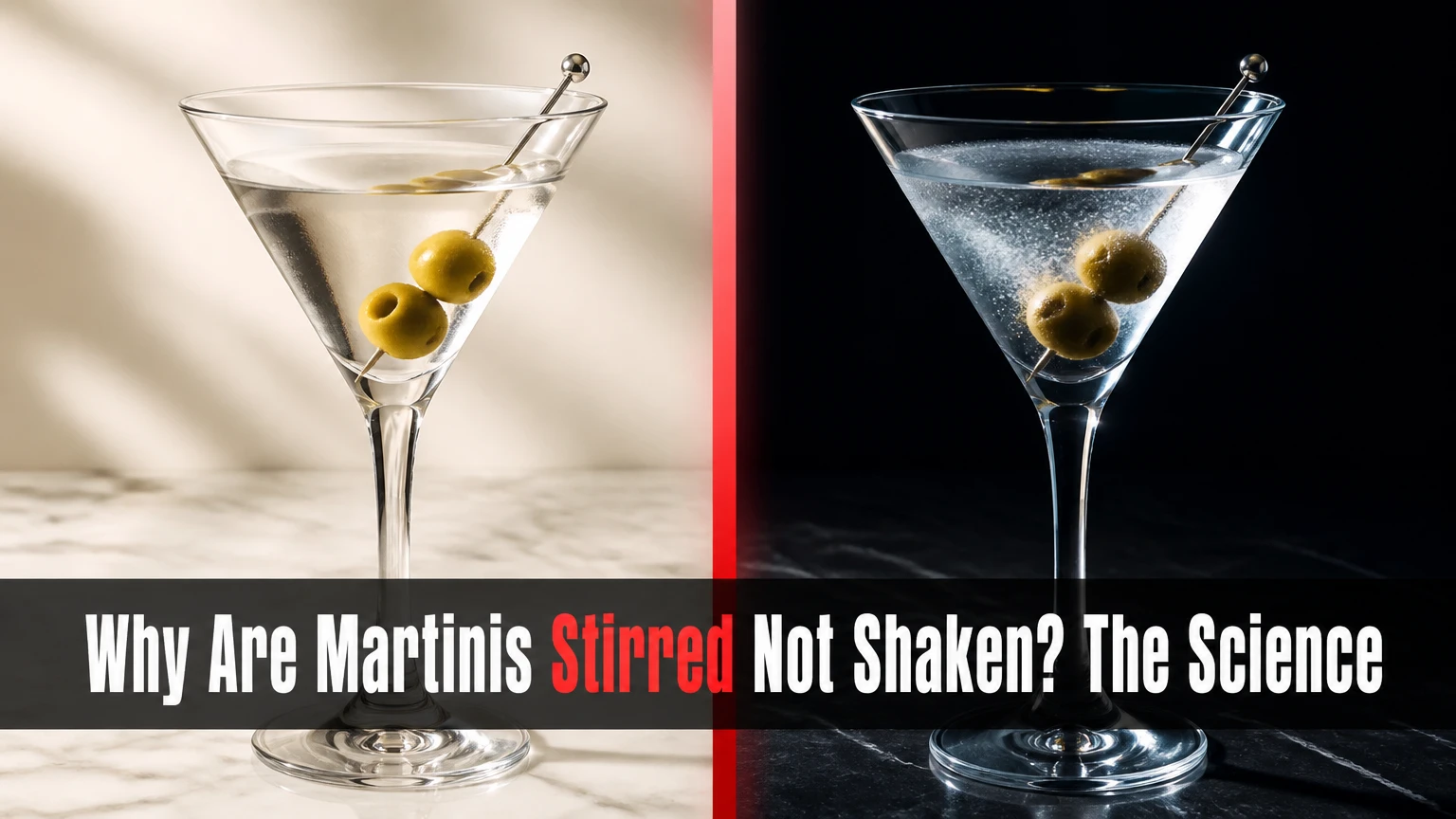
Martinis are stirred rather than shaken because a classic martini contains clear, spirit-based ingredients whose intended result is cold, diluted, clear, and silky. Stirring controls ice melt and mixing while preserving a dense texture, whereas shaking adds air, fractures ice, and can make the drink cloudy. Shaking remains a valid stylistic choice, especially for James Bond-style service.
Key Facts at a Glance
- A classic gin or vodka martini is usually stirred for clarity, controlled dilution, and a smooth texture.
- A typical stirred martini takes 25-45 seconds to chill and dilute, depending on ice, vessel, and stirring speed.
- Shaking does not literally “bruise” gin, but it can add aeration and fine ice particles.
- A practical martini dilution target is often about 15%-25% added water by finished drink weight.
- Dry vermouth is refrigerated after opening because oxidation changes its aroma and flavor.
- James Bond’s “shaken, not stirred” order describes a preference and a fictional character, not a universal bartending rule.
Why Are Martinis Stirred Not Shaken?
A martini is stirred because its recipe is normally made from transparent alcoholic ingredients, such as gin or vodka, dry vermouth, and sometimes bitters. Stirring chills those ingredients with relatively little turbulence, producing a bright drink with a rounded mouthfeel. Shaking is more appropriate when a cocktail must combine juice, syrup, cream, egg white, or another ingredient that needs vigorous emulsification.
The distinction is about the finished drink, not a rule that shaking makes a cocktail bad. A shaken martini can be colder immediately and may taste softer because aeration and extra dilution reduce the perception of alcohol. The trade-off is a less polished appearance, a lighter texture, and less predictable dilution.
The classic distinction appears in professional cocktail practice because clear spirit-forward drinks benefit from gentle integration. The International Bartenders Association lists the Dry Martini among stirred cocktails in its official cocktail collection, although recipes and service conventions vary between bars.
What Does Stirring Change in a Martini?
Stirring changes four measurable properties of a martini: temperature, water content, oxygen distribution, and suspended particles. The bar spoon transfers motion through the liquid and ice, allowing the bartender to reach a cold serving temperature without the violent collision produced inside a shaker.
Ice does two jobs. It removes heat as some of the ice melts, and the melted water lowers the cocktail’s alcohol concentration. A martini that is cold but undiluted can taste hot and aggressive, while a martini with excessive meltwater tastes thin. Stirring gives the bartender more control over that balance.
Stirring also keeps most ice fragments in the mixing glass. The result is usually clearer because fewer microscopic shards and bubbles pass through the strainer. Clarity is a presentation and texture preference, not proof that the ingredients are superior.
Does Shaking Really Bruise Gin?
Shaking does not physically “bruise” gin in the literal sense. Gin has no living structure that can be damaged by agitation, and the phrase has no accepted scientific meaning in cocktail chemistry. Shaking can, however, change how the drink presents by introducing air, breaking ice, and increasing turbulence.
The effect depends on the recipe and equipment. Large, dense ice in a well-sealed shaker creates a different result from small freezer cubes in a thin tin. A 10-second shake can produce a very cold cocktail, but the final dilution may vary substantially with ice temperature, shaker design, and the force of agitation.
The phrase became famous through James Bond. In Ian Fleming’s 1953 novel Casino Royale, Bond orders a Vesper martini “shaken, not stirred.” Fleming’s wording established a character detail that later became a cultural shorthand for sophistication and personal preference. It did not overturn the classical preparation convention.
Why Does a Shaken Martini Look Cloudy?
A shaken martini can look cloudy because agitation creates fine ice fragments and disperses microscopic air bubbles through the liquid. Some cloudiness fades as the drink rests, but small particles may remain suspended or collect on the surface after straining.
A stirred martini can also become cloudy if the ice is chipped, the vermouth contains sediment, or the drink is overworked. Conversely, a carefully shaken drink can appear relatively bright when the ice is hard and the cocktail is double-strained. The visual difference is common, not absolute.
Does Clarity Mean Better Flavor?
Clarity usually signals that a martini was stirred and strained cleanly, but it does not automatically mean better flavor. A drink can be crystal clear and poorly balanced if it contains stale vermouth or too little dilution. A slightly cloudy martini can be delicious when the drinker prefers a colder, more aerated style.
How Cold and Diluted Should a Martini Be?
A stirred martini is commonly served between approximately -2°C and -4°C, or 24°F and 28°F, although exact temperature depends on alcohol content, glassware, ice, and measurement method. A practical dilution range is about 15%-25% added water, with many bartenders targeting roughly 20% for a standard gin martini.
Those figures are working ranges rather than universal specifications. Measuring a small cocktail accurately at below-freezing temperatures is difficult because the drink warms during straining, the glass affects the reading, and alcohol changes the freezing behavior of the liquid.
| Martini variable | Typical working range | Main consequence |
|---|---|---|
| Stirring time | 25-45 seconds | Cold drink with controlled melt |
| Added water | 15%-25% of finished volume | Softer alcohol and integrated flavor |
| Gin-to-vermouth ratio | 2:1 to 5:1 | From aromatic and wine-led to dry and spirit-led |
| Finished serving temperature | -2°C to -4°C | Firm, cold palate impression |
| Glass pre-chill | 10-20 minutes in freezer | Slower warming during service |
Stirring time alone does not guarantee a particular dilution percentage. Ice size, ice age, mixing-glass shape, drink volume, and ambient temperature all matter. A bartender who changes from large commercial cubes to small household cubes should expect the same 40 seconds to produce a different drink.
How Do Stirring and Shaking Compare?
Stirring is the better default for a classic clear martini because it offers a cleaner appearance and more predictable texture. Shaking is faster and can produce a colder initial pour, but it creates more turbulence and can increase both aeration and ice fragmentation.
| Attribute | Stirred martini | Shaken martini |
|---|---|---|
| Typical preparation time | 25-45 seconds | 8-15 seconds |
| Visual result | Clear to brilliantly transparent | Slightly cloudy to visibly hazy |
| Texture | Dense, silky, rounded | Lighter, more aerated, sharper |
| Ice behavior | Mostly intact cubes | Fractured cubes and fine shards |
| Best use | Gin, vodka, vermouth, bitters | Preference-driven or nonstandard recipes |
| Main risk | Under-dilution if rushed | Uneven dilution or excessive aeration |
The comparison is not a contest between correct and incorrect equipment. It is a choice between texture profiles. A drinker who values a very cold, lively, slightly clouded cocktail may prefer shaking, while a drinker who wants botanical definition and visual clarity should choose stirring.
How Do You Stir a Martini Correctly?
To stir a martini, chill the serving glass, measure the ingredients into a mixing glass, add cold solid ice, rotate a bar spoon around the vessel wall for 25-45 seconds, and strain immediately. The main success factor is not speed. It is consistent contact between cold ice, liquid, and glass without splashing.
Step 1: Chill the Serving Glass
Place a coupe or martini glass in the freezer for 10-20 minutes, or fill it with ice and cold water while preparing the cocktail. Empty and dry the glass before straining.
You will know this worked when the glass feels cold throughout its bowl rather than only around its rim. A warm glass can raise the cocktail temperature quickly, especially when the drink is served without ice.
Common mistake: chilling the glass with ice but leaving a puddle of meltwater behind. Drain it completely.
Step 2: Measure the Ingredients
Use a 60-milliliter measure or jigger. A practical dry gin martini starting point is 75 milliliters gin and 15 milliliters dry vermouth, which creates a 5:1 ratio before dilution.
Adjust the ratio to the drinker’s preference. A 3:1 martini contains more vermouth flavor and lower pre-dilution alcohol strength than a 5:1 martini.
You will know the measurement is reliable when every drink in the same batch tastes comparable. Free-pouring often creates more variation than stirring technique.
Common mistake: using vermouth by memory while changing the gin brand. Different gins vary in botanical intensity, so the same ratio may not taste identical.
Step 3: Add Fresh, Hard Ice
Fill a mixing glass about two-thirds to three-quarters full with large, solid cubes. Avoid crushed ice and cubes that have been sitting in a pool of warm water.
Fresh freezer ice is usually adequate at home, provided it has no food odors. Large cubes melt more slowly because they have less surface area relative to their volume.
You will know the ice is suitable when the cubes remain visibly solid after stirring and the outside of the mixing glass becomes heavily frosted.
Common mistake: using hollow or cracked cubes. They melt rapidly and can add more water than expected.
Step 4: Stir Around the Glass Wall
Insert the spoon so its back follows the inside wall of the mixing glass. Rotate the liquid and ice smoothly for 25-45 seconds, using the fingers and wrist rather than churning with the whole arm.
A quiet spoon is a useful practical signal. Loud clattering usually means the spoon is striking the ice or glass instead of guiding the liquid around the perimeter.
You will know the technique worked when the drink moves as one cold vortex and the ice remains mostly intact. The outside of the glass should feel cold enough to frost.
Common mistake: stirring too slowly because dilution seems dangerous. An under-diluted martini is often hotter and more alcoholic than intended.
Step 5: Strain and Garnish Immediately
Strain through a julep or Hawthorne strainer into the chilled glass. Add a lemon twist by expressing the peel over the surface, or use a green olive when savory salinity is desired.
A lemon peel contributes volatile citrus oils that sit on the drink’s surface. An olive contributes salt, brine, and a softer savory aroma. The garnish therefore changes the drink rather than merely decorating it.
You will know the service is complete when no loose ice fragments remain and the surface smells of the chosen garnish.
Common mistake: cutting the lemon twist too far in advance. Its aromatic oils dissipate quickly after peeling.
Which Martini Style Needs the Most Care?
The martini style that needs the most care is the one with the highest sensitivity to dilution and vermouth quality, usually a dry gin martini with a low vermouth ratio. A wet martini is more forgiving because its larger vermouth portion contributes flavor and lowers the drink’s pre-dilution strength.
| Martini style | Typical ingredients | Starting ratio or amount | Recommended method |
|---|---|---|---|
| Dry gin martini | London dry gin, dry vermouth | 5:1 | Stir 25-40 seconds |
| Classic balanced martini | Gin, dry vermouth, orange bitters | 3:1 | Stir 30-45 seconds |
| Wet martini | Gin, dry vermouth | 2:1 | Stir gently and taste |
| Vodka martini | Vodka, dry vermouth | 4:1 | Stir or shake by preference |
| Dirty martini | Gin or vodka, vermouth, olive brine | 2-4 bar spoons brine | Stir for clarity, shake for salinity and aeration |
| Reverse martini | Dry vermouth, gin or vodka | 2:1 vermouth to spirit | Stir and serve very cold |
Ratios are recipe starting points, not legal definitions. Older cocktail books, hotel bars, and contemporary cocktail programs use different proportions, glass sizes, and bitters. A 5:1 drink may taste extremely dry to someone accustomed to a 2:1 pour.
Can Vodka Martinis Be Stirred?
Vodka martinis can absolutely be stirred, and stirring is appropriate when the desired result is clear, dense, and quiet on the palate. Vodka does not need shaking to become drinkable, and its neutral profile makes dilution and vermouth quality especially noticeable.
Shaking a vodka martini can make the drink feel colder and more aerated. Some drinkers prefer that sensation because vodka lacks the botanical complexity that stirring protects in gin. The choice should follow the desired texture, not the spirit’s category alone.
When Should a Martini Be Shaken?
A martini should be shaken when the drinker specifically wants a colder, lighter, slightly cloudy texture, or when the recipe contains an ingredient that requires vigorous integration. A dirty martini with substantial brine may be shaken for a livelier mouthfeel, although stirring gives a cleaner result.
A classic gin martini with only gin and vermouth does not require shaking. A martini variation containing citrus, fruit juice, egg white, cream, or syrup belongs to a different structural category and should generally be shaken.
Which Cocktails Follow the Stirred Rule?
Clear, spirit-forward cocktails usually follow the stirred rule because their ingredients do not need emulsification. The Manhattan, Negroni, Boulevardier, Old Fashioned, and many variations of the Martinez are common examples.
| Cocktail | Main liquid ingredients | Usual method | Reason |
|---|---|---|---|
| Manhattan | Rye or bourbon, sweet vermouth, bitters | Stirred | Clear spirit-and-vermouth structure |
| Negroni | Gin, Campari, sweet vermouth | Stirred | Clear, bitter, spirit-forward ingredients |
| Boulevardier | Whiskey, Campari, sweet vermouth | Stirred | Similar structure with whiskey base |
| Old Fashioned | Whiskey, sugar, bitters, water | Stirred | No juice or opaque mixer |
| Daiquiri | Rum, lime juice, sugar | Shaken | Citrus and syrup need forceful integration |
| Whiskey Sour | Whiskey, lemon, sugar, optional egg white | Shaken | Juice and possible protein require aeration |
The rule is a heuristic, not a commandment. Bartenders may shake a Negroni for a particular texture or stir a low-volume sour when the recipe has already been clarified. Recipe structure matters more than cocktail name.
Why Does a Martini Taste Harsh or Watery?
A harsh martini is usually under-diluted, under-chilled, or made with an unbalanced vermouth ratio. A watery martini usually contains too much meltwater from small, cracked, wet, or repeatedly used ice. Stale vermouth can create a separate problem: dull, oxidized, or vaguely sour flavor.
| Symptom | Likely cause | Practical correction |
|---|---|---|
| Hot alcohol finish | Less than 20 seconds of stirring or warm glass | Stir 10-15 seconds longer and chill glass |
| Watery palate | Small, cracked ice or long preparation | Use larger ice and strain promptly |
| Flat herbal aroma | Oxidized vermouth | Refrigerate a fresh bottle and use within 4-8 weeks |
| Muddy appearance | Shaking, brine particles, or chipped ice | Stir and use a fine strainer |
| Weak gin character | Excess vermouth or dilution | Reduce vermouth or shorten the stir |
| Aggressive bitterness | Very dry ratio with bitter gin or bitters | Use a wetter ratio or omit bitters |
The four-to-eight-week vermouth window is a typical quality guideline, not a fixed expiration date. Product type, bottle fill level, refrigeration, and personal sensitivity affect the result. Smaller bottles reduce the time that oxygen remains in contact with the wine.
An important practitioner rule is to taste the vermouth before making a martini. If the vermouth tastes flat or oxidized by itself, refrigeration cannot restore its original freshness.
What Does a Proper Martini Cost and Take?
A typical home-prepared martini costs about $2.50-$6 per serving when made with mid-range gin or vodka and fresh vermouth. A restaurant or cocktail-bar martini commonly costs $14-$25 in the United States, with location, pour size, brand, and service accounting for much of the difference.
| Setting | Typical serving size | Typical cost | Preparation time |
|---|---|---|---|
| Home, standard spirit | 90 milliliters before dilution | $2.50-$4 | 3-5 minutes |
| Home, premium spirit | 90 milliliters before dilution | $5-$10 | 3-5 minutes |
| Neighborhood bar | 75-90 milliliters before dilution | $12-$18 | 2-4 minutes |
| Premium cocktail bar | 90-120 milliliters before dilution | $18-$25 | 4-8 minutes |
| Pre-batched home freezer martini | 100-120 milliliters | $3-$8 | 30 seconds to pour |
At home, the largest recurring cost is usually the base spirit, while vermouth has a smaller per-drink cost but a larger effect on flavor freshness. A properly chilled mixing glass and good ice often improve consistency more than an expensive spoon.
Is Freezer Batching Better Than Stirring?
Freezer batching can be better for consistency and speed when several martinis must be served, but it removes the ability to adjust dilution drink by drink. A batch should include measured water, remain sealed, and be kept cold enough to pour immediately without freezing solid.
For a simple starting batch, combine 300 milliliters gin, 60 milliliters dry vermouth, and approximately 90 milliliters filtered water for a 5:1 martini with about 20% dilution by the finished liquid. The correct water amount depends on the target strength and the specific recipe.
Do not assume a household freezer behaves like a commercial freezer. Many domestic freezers sit near -18°C, and a high-proof batch may remain pourable, but vermouth-rich mixtures can become viscous or partially freeze. Test one small batch before preparing a large bottle.
Which Martini Method Fits Your Situation?
Choose stirring for a classic gin martini, shaking for a deliberately aerated Bond-style drink, and freezer batching for repeated service. The best method depends on whether the priority is clarity, speed, temperature, repeatability, or personal texture preference.
| Situation | Best method | Starting specification | Why |
|---|---|---|---|
| First home gin martini | Stirring | 3:1 ratio, 30 seconds | Balanced flavor and manageable dilution |
| Very cold Bond-style preference | Shaking | 8-12 seconds, hard ice | Fast chilling and aeration |
| Several guests | Pre-batching | Add measured water by weight | Consistent portions and rapid service |
| Botanical London dry gin | Stirring | 5:1 ratio, lemon twist | Preserves aromatic definition |
| Savory dirty martini | Stirring first | 2-4 bar spoons brine | Keeps brine and texture controlled |
| Neutral vodka martini | Either method | 4:1 ratio | Technique can follow texture preference |
A beginner should start with stirring because the method reveals how dilution changes the drink. An enthusiast can compare identical batches using both methods. A professional may pre-dilute and chill a batch during busy service, then reserve hand-stirring for premium orders.
The honest limitation is that stirring cannot rescue poor ingredients. Warm vermouth, odor-contaminated ice, an unbalanced ratio, or a warm glass will remain noticeable regardless of spoon technique.
FAQ
Is a martini always supposed to be stirred?
A classic clear martini is conventionally stirred, but a martini is not always required to be stirred. Shaking is legitimate when the drinker wants a colder, lighter, cloudier texture or when the recipe contains ingredients that need vigorous mixing. The preparation method expresses a style preference rather than an enforceable definition.
Does stirring make a martini stronger than shaking?
Stirring does not inherently make a martini stronger. Final alcohol strength depends on the amount of gin or vodka and the water added through ice melt. Shaking may dilute a drink faster under some conditions, but hard ice, shaking force, vessel shape, and duration determine the actual result.
Should a martini be served with ice?
A traditional straight-up martini is strained into a chilled coupe or martini glass without ice. A rocks martini is poured over fresh ice, which keeps the drink cold but continues dilution during service. Large, dense cubes slow that dilution more effectively than small or cracked ice.
Is a martini better with gin or vodka?
Gin is usually better for drinkers who want juniper, citrus, spice, and herbal complexity, while vodka provides a cleaner and more neutral base. Neither spirit is universally superior. Gin benefits more visibly from careful stirring, but vodka can also produce an excellent stirred martini when the vermouth is fresh.
How much vermouth belongs in a dry martini?
A useful starting range is one part dry vermouth to three to five parts gin or vodka. A 5:1 ratio tastes drier and more spirit-forward, while a 3:1 or 2:1 ratio gives vermouth greater influence. The bottle’s freshness matters more than chasing a historically “correct” number.
Why does James Bond order a shaken martini?
James Bond orders a shaken martini because Ian Fleming used the preparation as a memorable character preference in Casino Royale, published in 1953. Bond’s order became culturally famous, but it does not represent the standard method for a classic spirit-forward martini. A shaken martini is a valid variation with a different texture.
The Bottom Line
Martinis are stirred rather than shaken because stirring best preserves the classic drink’s clear appearance, silky texture, botanical aroma, and controlled dilution. Shaking is not chemically forbidden and does not literally bruise gin; it simply creates a colder, more aerated, often cloudier result. For the traditional style, chill the glass, use hard ice, stir for 25-45 seconds, and strain immediately. That is why the answer to “why are martinis stirred not shaken” is ultimately a matter of intended texture and balance, not superstition.