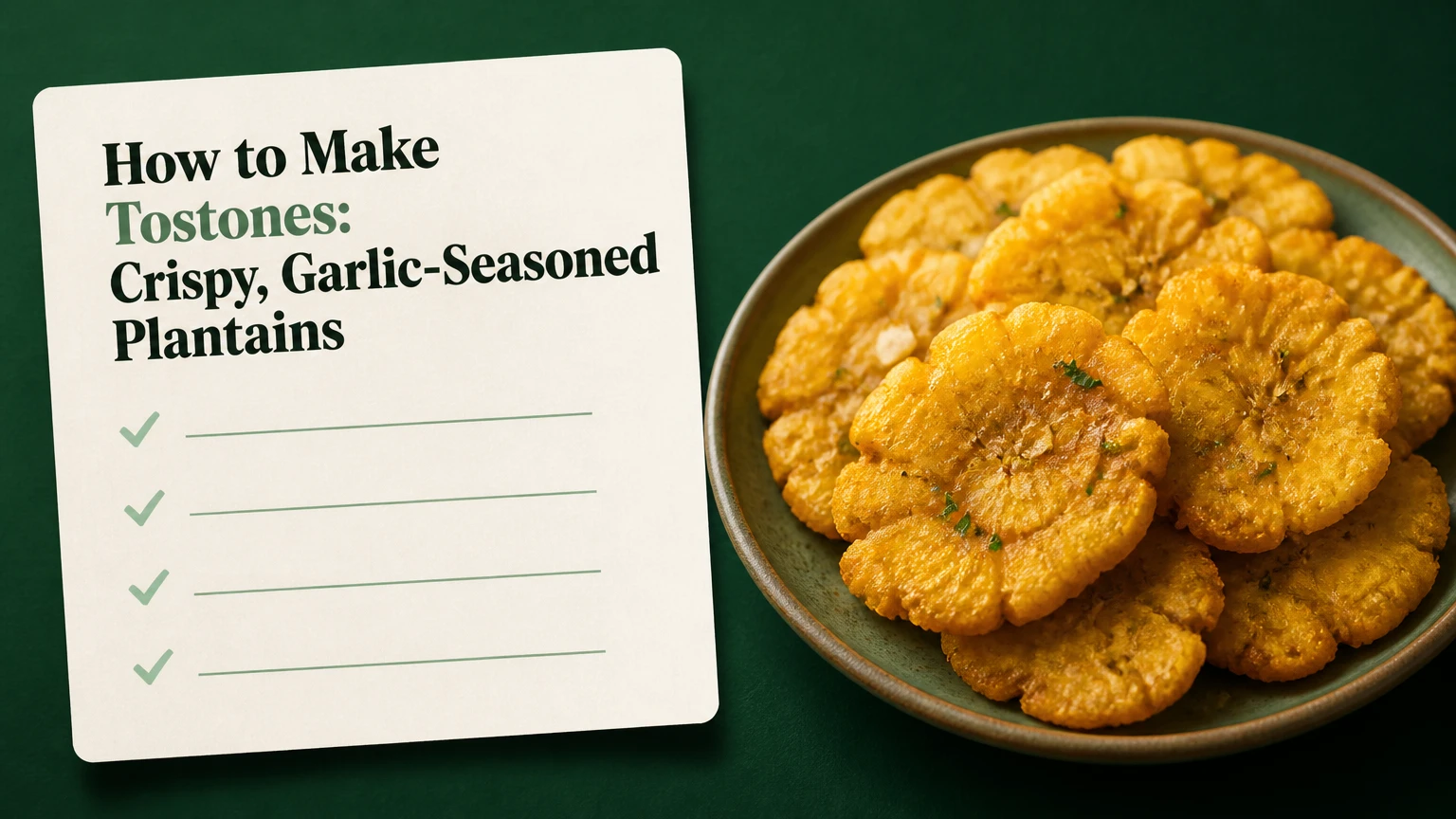
Tostones are twice-fried green plantain slices with a crisp, savory exterior and a tender, starchy center. To make them, peel and cut firm green plantains, fry the pieces until tender, flatten them, then fry them again at higher heat and salt them immediately. The complete stovetop method takes about 30 minutes.
Key Facts at a Glance
Use completely green, firm plantains, not yellow plantains intended for maduros.
Cut each piece 1-1.5 inches thick before the first fry.
Fry first at 325-350°F for about 6-8 minutes, turning once.
Flatten cooked pieces to approximately 1/4 inch before frying again.
Fry the flattened pieces at 375-400°F for 1-2 minutes per side.
One large plantain produces approximately 6-8 tostones.
What Are Tostones?
Tostones are savory plantain rounds that are fried, smashed, and fried again. The dish is common across the Caribbean and parts of Latin America, with regional differences in seasoning, thickness, dipping sauces, and fillings.
Green plantains contain dense starch and little of the soft sweetness associated with ripe plantains. Yellow or blackening plantains are better suited to maduros, which are softer, sweeter, and more prone to browning quickly in hot oil.
Tostones should have a rigid, crackly surface and a tender interior. A finished round that bends limply, feels oily, or remains hard in the center usually suffered from incorrect temperature control or insufficient first-fry cooking.
How Do Tostones Differ From Maduros?
Tostones use green plantains and produce a salty, potato-like side dish; maduros use ripe yellow plantains and produce a soft, caramelized preparation. The two dishes require different ingredients, cooking times, and texture expectations.
| Attribute | Tostones | Maduros | Plantain chips | Yuca fries |
|---|---|---|---|---|
| Main ingredient | Green plantain | Yellow or black plantain | Green plantain | Cassava root |
| Flavor | Savory, starchy | Sweet, caramelized | Salty, intensely crisp | Mild, dense, earthy |
| Typical cut | 1-1.5-inch chunks, then smashed | 1/2-inch diagonal slices | 1/16-1/8-inch slices | 1/2-inch batons |
| Frying process | Two frying stages | Usually one frying stage | One frying stage | Boil, then fry or bake |
| Center texture | Tender and meaty | Soft and sweet | Thin and brittle | Firm and fluffy |
Why Do Tostones Need Two Frying Stages?
Tostones need two frying stages because the first fry softens the dense plantain center, while the second fry removes surface moisture and creates a crisp crust. Smashing between the fries expands the exposed surface area, giving the final round more edges that can brown and harden.
During the first fry, moderate heat cooks the plantain without darkening its surface. The starch absorbs moisture and becomes pliable. A piece that cannot be pierced near its center will usually crack or crumble under the press.
The smash changes the geometry of the food. A 1-inch chunk becomes a thin disc with substantially more exposed area relative to its volume. The second fry then drives water from that expanded surface quickly, which is why the oil must be hotter and the frying time shorter.
The temperatures below are practical kitchen targets rather than a universal legal standard. Oil cools when food enters the pan, so a thermometer reading of 375°F before frying may fall temporarily to 350-360°F during a crowded batch.
Before You Start
A batch of eight to twelve tostones takes 10-15 minutes of active preparation and 15-20 minutes of cooking. The beginner-friendly version costs approximately $3-$7, depending on plantain prices and how much oil the kitchen already has.
Ingredients and Equipment
| Item | Quantity or specification | Purpose |
|---|---|---|
| Large green plantains | 2, about 12-16 ounces each | Provides approximately 12-16 pieces |
| Neutral oil | 4-6 cups in a deep vessel, or 1 inch in a skillet | Frying medium |
| Fine salt | 1/2-1 teaspoon, or to taste | Final seasoning |
| Heavy skillet or Dutch oven | 10-12-inch diameter | Holds stable frying heat |
| Tostonera, mug, or board | 1 flat pressing tool | Flattens softened plantain |
| Digital thermometer | Target range 325-400°F | Controls both frying stages |
| Slotted spoon and rack | 1 each | Transfers and drains pieces |
Canola, vegetable, corn, peanut, and refined avocado oil all work. Extra-virgin olive oil is a poor choice for this high-heat, relatively large-volume fry because its flavor can dominate and its smoke point varies by product.
Use a vessel that leaves at least 3 inches between the oil surface and the rim. Oil expands and bubbles around wet food, and a shallow, overfilled pan increases spill and burn risk.
How to Make Tostones
Follow the five steps below in sequence. The main success factor is not the pressing tool; it is cooking the plantain fully during the first fry before flattening it.
Step 1: Peel the Green Plantains
Cut off both ends of each plantain, then score the peel lengthwise four times with a paring knife. Pry the thick skin away through those cuts with your thumb or a butter knife, working horizontally rather than trying to pull the peel like a banana.
The flesh may leave a sticky film on your fingers. A lightly oiled knife or disposable gloves can make handling easier, although washing hands promptly also removes the residue.
You’ll know it worked when: the plantain is bare, intact, and free of deep knife cuts.
Common mistake: cutting into the flesh while scoring. Deep grooves create weak spots that can split during pressing.
Step 2: Cut Uniform Chunks
Slice each peeled plantain crosswise into pieces 1-1.5 inches thick. Keep the pieces as uniform as possible so they finish the first fry at the same time.
Thicker pieces produce a fuller, softer center but require longer first-fry cooking. Pieces below about 3/4 inch tend to become thin, rigid, chip-like rounds after pressing, especially if the second fry runs longer than two minutes.
Place the chunks in a bowl while the oil heats. Do not soak them in water unless you plan to dry them thoroughly, because water droplets create dangerous oil splatter.
You’ll know it worked when: the cut faces are flat and each piece is close to the same height.
Common mistake: using diagonal slices for standard tostones. Diagonal cuts can work, but their uneven thickness makes pressing and timing less predictable.
Step 3: Fry the Plantain Chunks
Heat 1 inch of oil in a heavy skillet, or enough oil to mostly submerge the pieces, to 325-350°F. Add the chunks in a single layer and fry for 3-4 minutes per side, turning once with a slotted spoon.
The first fry usually takes 6-8 minutes total. The pieces should become light yellow, soften throughout, and remain pale rather than brown. If the oil falls below about 300°F, remove some pieces or wait for recovery before continuing.
You’ll know it worked when: a fork enters the center with modest resistance, like it would in a cooked potato. The outside should not have a dark crust.
Common mistake: treating color as the only doneness test. Green plantain pieces can remain pale while their centers are still firm, so always test one with a fork.
Transfer the cooked chunks to a rack or paper towels for 1-2 minutes. Keep the oil in the skillet, but adjust the burner so it can reach the higher second-fry temperature without smoking.
Step 4: Smash Each Piece
Place one warm chunk between parchment paper, plastic wrap, or a cut-open food-safe bag. Press it straight down with a tostonera, flat-bottomed mug, small cutting board, or the base of a sturdy measuring cup.
Flatten each piece to approximately 1/4 inch thick. Press once with firm, even pressure instead of rocking the tool, which can tear the softened starch structure.
A tostonera gives consistent discs, but a mug works well for small batches. For filled tostones, use a cup-shaped press or a citrus squeezer to form a bowl rather than a flat round.
You’ll know it worked when: the disc holds together and has an even thickness with no raw-looking thick lump in the middle.
Common mistake: waiting until the chunks cool completely. Cold first-fried plantain becomes less flexible and is more likely to fracture.
If a piece crumbles, return the remaining unpressed chunks to the 325-350°F oil for 1-2 minutes, then test again. Do not force a raw center through the press.
Step 5: Fry the Smashed Rounds Again
Raise the oil to 375-400°F, then fry the flattened plantains in small batches for 1-2 minutes per side. Leave space around every piece, because crowding can drop the oil temperature enough to produce greasy rather than crisp tostones.
Remove the rounds when they are golden yellow, firm at the edges, and audibly crisp when tapped with a utensil. Transfer them to a wire rack or absorbent paper, then season with salt while their surface still carries a thin film of oil.
You’ll know it worked when: the edges feel rigid, the center remains tender, and no visible oil pools on the rack.
Common mistake: frying by the clock after the oil temperature has fallen. Start timing only after the oil returns near 375°F, especially when cooking more than four pieces at once.
Frying Targets by Batch Size
| Batch size | Oil depth | Pieces per batch | Typical temperature recovery | Total frying time |
|---|---|---|---|---|
| 1 plantain, skillet | 1 inch | 4-6 pieces | 30-60 seconds | 15-20 minutes |
| 2 plantains, skillet | 1 inch | 4-6 pieces | 45-90 seconds | 20-25 minutes |
| 2 plantains, Dutch oven | 2-3 inches | 6-8 pieces | 20-45 seconds | 15-20 minutes |
| 4 plantains, deep fryer | 3-4 inches | 8-10 pieces | 15-30 seconds | 25-35 minutes |
Which Oil and Pan Work Best?
A heavy 10-12-inch skillet with 1 inch of neutral oil is the most practical choice for two plantains. Cast iron retains heat well, while a deep Dutch oven reduces splatter and gives more room for temperature recovery.
| Cooking vessel | Typical oil amount | Temperature control | Cleanup and safety | Best use |
|---|---|---|---|---|
| Cast-iron skillet | 4-6 cups | Strong retention, manual adjustment | Moderate splatter, hot handles | Two-plantain batches |
| Stainless skillet | 4-6 cups | Faster temperature changes | Easier cleaning, more hot spots | Small batches |
| Dutch oven | 6-10 cups | Stable, deep oil column | Lower spill risk, heavier cleanup | Large batches |
| Electric deep fryer | 2-4 quarts | Built-in thermostat | Lid and basket reduce splatter | Frequent frying |
| Air fryer | 1-2 tablespoons | Program-controlled air heat | Lowest oil cleanup | Lower-oil adaptation |
A narrow skillet is not automatically more efficient. It may require less oil, but its small surface area forces crowding, which makes the second fry less crisp. For four or fewer tostones, a skillet is usually adequate; for a party batch, a Dutch oven or fryer is easier to control.
Can You Make Tostones Without Deep-Frying?
You can make tostones in an air fryer, but the result is usually drier and less blistered than oil-fried plantains. The air-fryer method works best when both sides receive oil after smashing.
- Cut the green plantain into 1-inch chunks and toss with 1 tablespoon oil.
- Air-fry at 350°F for 10 minutes, turning halfway.
- Smash the softened pieces to 1/4 inch.
- Brush or spray both sides with another 1-2 tablespoons oil.
- Air-fry at 400°F for 5-7 minutes, turning once.
- Salt immediately after removal.
Air-fryer baskets vary substantially in airflow and heating accuracy. Check the first batch after four minutes at 400°F, especially if the discs are thinner than 1/4 inch.
Oven-baked tostones are possible at 425°F on a preheated, oiled sheet pan, but they generally need 10-15 minutes after smashing and may brown unevenly. Oven preparation is useful when serving a large group, not when maximum fried texture is the priority.
How Can You Add Garlic Flavor Safely?
A garlic-water soak adds seasoning between the two fries, but wet plantain causes far more bubbling when it enters hot oil. For a controlled version, mix 1 cup warm water, 2 minced garlic cloves, and 1/2 teaspoon salt, then dip each smashed plantain for no more than 2-3 seconds.
Let excess liquid drain briefly before placing the disc into the 375°F oil. Keep your face and hands away from the pan, lower the piece gently with tongs, and never pour the soaking liquid into the skillet.
The traditional plain version is safer and often crisper because less water reaches the oil. Garlic water is best for experienced cooks who can manage splatter and who want a pronounced mojo-like flavor.
What Variations Are Worth Making?
Flat, traditionally seasoned tostones are the most reliable format for a side dish. Cup-shaped tostones rellenos require more shaping but create edible vessels for shrimp, shredded beef, pulled pork, or ceviche.
| Variation | Shape or ingredient | Filling or seasoning | Best serving situation |
|---|---|---|---|
| Traditional tostones | Flat, 1/4-inch discs | Salt, garlic sauce, mayoketchup | Rice, beans, seafood, roast meat |
| Garlic-water tostones | Flat, dipped after first fry | Garlic, salt, water | Strong savory flavor |
| Tostones rellenos | 2-3-inch cup | Shrimp, ropa vieja, pork | Party appetizer |
| Tostones de pana | Green breadfruit | Salt, garlic, lime | Seasonal Caribbean side |
| Plantain chips | 1/16-1/8-inch slices | Salt, paprika, chili | Snack or garnish |
Mayoketchup combines mayonnaise, ketchup, and garlic, commonly in approximately equal parts adjusted to taste. Mojo de ajo uses garlic, oil, and an acid such as lime juice or sour orange; add the sauce at the table so the crisp discs do not soften prematurely.
Common Problems and How to Fix Them
Tostones fail most often because the first fry did not cook the center or the second fry occurred at an insufficient temperature. The appearance of the failure usually identifies the stage that needs correction.
| Problem | Likely cause | Immediate fix | Prevention |
|---|---|---|---|
| Pieces crumble during pressing | Center remained raw | First-fry remaining chunks 1-2 minutes longer | Test with a fork before smashing |
| Tostones taste greasy | Oil below 350°F during second fry | Reheat oil and fry smaller batches | Monitor temperature after each batch |
| Exterior burns quickly | Plantain is yellow or oil exceeds 400°F | Lower heat and discard overripe pieces | Select uniformly green plantains |
| Center stays hard | Chunks are too thick or underfried | Return discs to moderate heat briefly | Use 1-1.5-inch cuts and test doneness |
| Surface remains pale and soft | Second fry too short or oil too cool | Fry 30-60 seconds longer at 375°F | Dry wet surfaces and avoid crowding |
| Oil splatters violently | Water entered hot oil | Turn off heat if unsafe, cover carefully | Dry pieces and skip garlic soak as a beginner |
A bitter taste generally indicates scorched garlic, overheated oil, or plantain pieces that developed dark spots before frying. Strain oil between batches if crumbs accumulate, because those fragments burn faster than the plantain.
One practical rule matters more than a sophisticated press: never smash a piece that does not yield to a fork. The press cannot repair an undercooked center.
Can You Prepare Tostones Ahead of Time?
You can complete the first fry and smashing several hours ahead, then refrigerate the flattened pieces in a covered single layer. The pieces should be dry before storage, and the second fry should happen immediately before serving.
For longer storage, freeze the first-fried, smashed plantains rather than finished tostones. Arrange them on a parchment-lined tray, freeze until solid, then transfer them to a labeled freezer bag for up to three months.
Fry frozen pieces directly at 375°F, adding approximately 30-60 seconds to the second-fry time. Do not thaw them on the counter, because condensation makes the oil splatter and can soften the surface.
Finished tostones are best within about 20 minutes. Refrigeration preserves safety but not the original texture; reheating in a 400°F air fryer for 3-5 minutes restores more crispness than microwaving.
Typical Cost and Yield
| Batch | Plantains | Finished quantity | Typical ingredient cost | Active time |
|---|---|---|---|---|
| Small snack | 1 large | 6-8 tostones | $1-$3 | 10 minutes |
| Family side | 2 large | 12-16 tostones | $3-$7 | 15 minutes |
| Party appetizer | 4 large | 24-32 tostones | $6-$12 | 25 minutes |
| Frozen preparation | 2 large | 12-16 first-fried pieces | $3-$7 | 20 minutes |
Prices vary by region and store. Latin American and Caribbean markets often sell green plantains individually, which makes it easier to buy the exact quantity needed.
How Should You Serve Tostones?
Serve tostones immediately with salt and a dipping sauce, because steam trapped during holding gradually softens the crust. A wire rack is better than a deep bowl for short holding because it allows moisture to escape from the underside.
Good pairings include black beans and rice, roasted pork, grilled shrimp, fried fish, avocado salad, and shredded chicken. Mayoketchup provides creamy acidity, while garlic sauce, lime crema, hot sauce, and cilantro-based sauces add sharper contrast.
For a meal, plan approximately 3-4 tostones per person as a side dish. For appetizers, plan 2-3 smaller rounds per person when fillings or other dishes are also present.
FAQ
Can I use green bananas instead of green plantains?
Green bananas are not a reliable substitute for green plantains because they are smaller, softer, and less starchy. Green plantains contain the dense flesh needed to survive two frying stages and pressing. If green bananas are the only option, cut them thicker and expect a softer, less substantial result.
Why are my tostones hard after frying?
Hard tostones usually come from pieces that were cut too thin, undercooked before pressing, or fried too long during the second stage. Use 1-1.5-inch chunks, confirm fork tenderness after the first fry, and remove flattened discs when their edges become rigid and golden rather than deeply brown.
Can I reuse the frying oil?
You can reuse clean neutral oil after it cools and passes through a fine strainer. Store it covered away from light, and discard it if it smells rancid, smokes at normal frying temperatures, becomes unusually dark, or contains many persistent crumbs. Plantain frying typically leaves fewer strong flavors than fish frying.
Should I salt plantains before frying?
Salt the tostones immediately after the second fry rather than before the first fry. Surface salt can draw moisture from the plantain and falls away during frying, while warm oil on the finished surface helps fine salt adhere evenly.
How many plantains do I need for four people?
Use two large green plantains for four people when tostones are a side dish, yielding approximately 12-16 rounds. Use three or four plantains for a main appetizer spread, especially if the pieces will be smaller or filled.
What is the best way to reheat tostones?
Reheat refrigerated tostones in a 400°F air fryer or convection oven for 3-5 minutes, turning once. A microwave warms the center but makes the crust chewy. Do not re-fry finished tostones for several minutes, because the exterior can burn before the interior heats.
The Bottom Line
To make tostones successfully, choose hard green plantains, fry thick chunks at 325-350°F until fork-tender, smash them to about 1/4 inch, and fry them again at 375-400°F in uncrowded batches. Salt the crisp rounds immediately and serve them within 20 minutes for the best texture. With those temperature, thickness, and timing controls, how to make tostones becomes a repeatable process rather than guesswork.