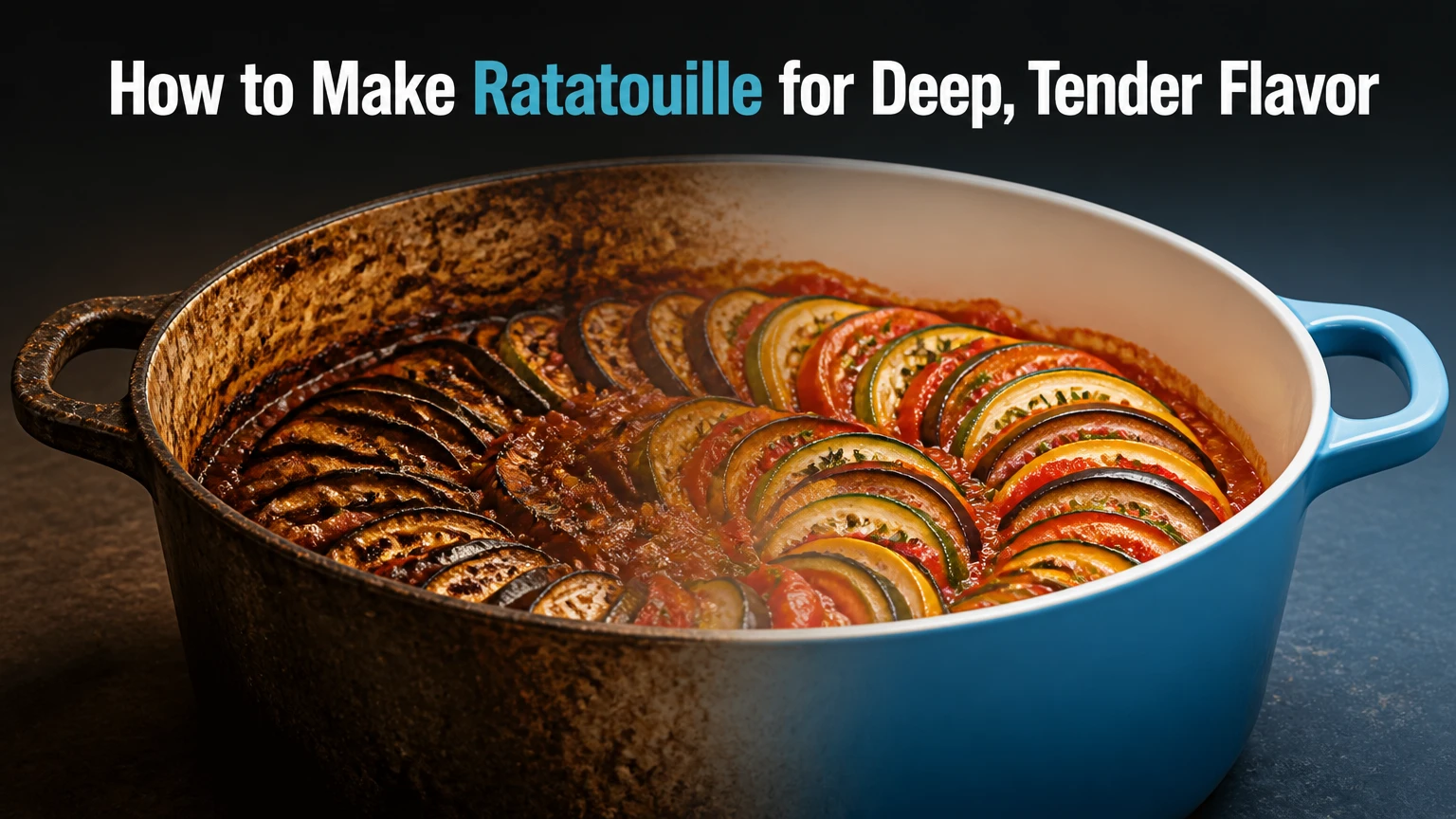
Ratatouille is a Provençal vegetable stew made with eggplant, zucchini, peppers, tomatoes, onion, garlic, olive oil, and herbs. To make it well, brown the eggplant and zucchini separately, build a concentrated tomato base, then simmer the vegetables gently for 30-40 minutes and rest the finished dish before serving.
Key Facts at a Glance
- Traditional ratatouille serves 4-6 people and takes about 75-100 minutes including chopping and resting.
- Separate browning gives eggplant and zucchini more concentrated flavor than adding every vegetable at once.
- A wide Dutch oven or sauté pan reduces steaming because vegetables remain in a shallow layer.
- Ratatouille is naturally vegan, vegetarian, dairy-free, and gluten-free when prepared with suitable stock and seasonings.
- The finished stew should be moist and glossy, not soupy, oily, or collapsed into purée.
- Refrigerated ratatouille keeps for 3-4 days under USDA Food Safety and Inspection Service guidance for cooked leftovers.
What Is Ratatouille?
Ratatouille is a slow-cooked vegetable dish associated with Nice and the Provence region of southeastern France. The name generally refers to a rustic stew rather than one fixed formula, so households vary the vegetable ratios, herbs, cooking order, and final texture.
The classic summer combination includes eggplant, zucchini, sweet peppers, ripe tomatoes, onion, garlic, olive oil, and basil. Fresh thyme, bay leaf, or a small amount of rosemary can deepen the sauce, but heavy seasoning can obscure the vegetables.
Ratatouille is not the same dish as a tian. A tian usually layers sliced vegetables and bakes them in a shallow vessel, while traditional ratatouille is cut into chunks and cooked as a stew. Confit byaldi, the refined preparation associated with the Pixar film, uses thinly sliced vegetables arranged over a cooked pepper-and-tomato sauce.
Why Does Ratatouille Taste Better After Resting?
Ratatouille improves after 20-30 minutes of resting because the tomato sauce redistributes through the cooked vegetables and the olive oil carries aromatic compounds across the dish. Refrigerated ratatouille often tastes more integrated on the second day, although reheating can soften the vegetables further.
The main cooking challenge is water management. Zucchini, tomatoes, and eggplant release substantial moisture, so a crowded pan produces a thin stew with steamed vegetables. Browning in batches and finishing uncovered corrects that problem without adding flour or starch.
Ingredients and Proportions
The following quantities produce 4-6 side-dish servings or 4 main-course servings. Use vegetables of similar size so the pieces finish together.
| Ingredient | Quantity | Preparation | Useful substitute |
|---|---|---|---|
| Eggplant | 450 g, about 1 large | 2.5 cm cubes | 2 small eggplants |
| Zucchini | 450 g, 2 medium | 2.5 cm cubes | Yellow summer squash |
| Bell peppers | 300 g, 2 medium | 2.5 cm pieces | Red, yellow, or orange peppers |
| Tomatoes | 800 g fresh or 1 x 28 oz can | Chopped or crushed | 700 g canned diced tomatoes |
| Yellow onion | 1 large, about 200 g | 1 cm dice | 2 medium shallots |
| Garlic | 4-6 cloves | Finely minced | 1.5 teaspoons garlic powder |
| Olive oil | 60-90 ml | Used in batches and to finish | Neutral oil for searing |
| Basil | 10-15 leaves | Torn or sliced | 1 teaspoon dried basil |
| Thyme and bay | 4 thyme sprigs, 1 bay leaf | Whole sprigs | 1 teaspoon dried thyme |
| Salt and pepper | 1.5 teaspoons salt initially | Adjust at the end | Fine sea salt and black pepper |
Use canned whole tomatoes when fresh tomatoes are pale, firm, or out of season. San Marzano tomatoes are a practical option, but the label alone does not make the stew better; draining excess juice and reducing the sauce matter more.
Fresh rosemary works in small amounts. One 8 cm sprig is usually enough for this quantity because its resinous flavor can dominate delicate zucchini and basil.
Do You Need to Salt Eggplant?
Salting eggplant is optional rather than mandatory. Modern eggplant varieties are generally less bitter than older types, but a 20-minute salt rest can remove surface moisture and slightly improve browning when the eggplant feels particularly wet.
To salt it, spread the cubes on a tray, toss with 1 teaspoon salt, wait 20 minutes, then pat them thoroughly dry. Do not rinse unless the pieces are heavily salted, because added water makes browning slower.
Before You Start
Ratatouille requires moderate knife work and about 75-100 minutes from whole vegetables to serving. Active cooking takes approximately 50-60 minutes, while 20 minutes of resting improves the final texture.
| Planning factor | Typical specification | Practical target |
|---|---|---|
| Yield | 4-6 side servings | 4 main servings |
| Prep time | 25-35 minutes | Uniform 2.5 cm pieces |
| Active cooking | 50-60 minutes | 30-40 minute simmer |
| Resting time | 20-30 minutes | Covered, off heat |
| Difficulty | Moderate | Batch frying required |
| Ingredient cost | $10-$18 typical | Varies by season and location |
| Best cookware | 5-7 litre Dutch oven | 30 cm sauté pan also works |
Prepare one large cutting board, a chef’s knife, a heatproof bowl for browned vegetables, a wooden spoon, and a wide heavy pot. A narrow 3-litre saucepan is a poor choice because the vegetables will stack deeply and release water faster than it can evaporate.
How Should You Cut the Vegetables?
Cut eggplant and zucchini into 2.5 cm cubes, peppers into similarly sized pieces, and onion into smaller 1 cm dice. Uniform pieces matter more than decorative knife work because small zucchini pieces can turn soft long before large eggplant cubes are tender.
Keep the vegetables in separate bowls before cooking. This arrangement prevents forgotten ingredients and allows each vegetable to enter the pan according to its moisture and browning needs.
The Traditional Stovetop Method
The traditional stovetop method uses five stages: prepare, brown the vegetables, soften the aromatics, reduce the tomato base, and simmer everything together. Follow the checkpoints below rather than relying only on the clock, because tomato water content and pan width change the cooking speed.
Step 1: Heat the Pan and Prepare the Oil
Set a 5-7 litre Dutch oven or wide sauté pan over medium-high heat for 2 minutes. Add 2 tablespoons, or 30 ml, of olive oil and wait until the surface shimmers but does not smoke.
Keep another 2-4 tablespoons of oil nearby. Eggplant may absorb some oil during the first minute, but repeatedly flooding the pan creates a greasy stew rather than a silkier one.
You will know the pan is ready when a cube of eggplant sizzles immediately on contact. If the vegetable sits silently, wait another 30 seconds.
Common mistake: Adding vegetables to lukewarm oil causes them to absorb oil before their surfaces brown.
Step 2: Brown the Eggplant and Zucchini Separately
Add half the eggplant in one layer and cook for 6-8 minutes, turning every 1-2 minutes, until several sides are golden brown and the cubes have softened slightly. Transfer the eggplant to a bowl, add 1 tablespoon oil if needed, and repeat with the remaining eggplant.
Brown the zucchini in two batches for 4-6 minutes per batch. Zucchini should show golden patches while retaining a firm center. Set it beside the eggplant.
A 30 cm pan generally handles 225 g of eggplant or zucchini per batch without severe crowding. If your pan is smaller, use more batches rather than raising the heat aggressively.
You will know it worked when: browned vegetables have visible color, dry-looking surfaces, and no pool of liquid beneath them.
Common mistake: Cooking eggplant and zucchini together fills the pan with water, so the vegetables steam before they can develop browned edges.
Step 3: Soften the Onion and Peppers
Reduce the heat to medium and add 1 tablespoon olive oil. Cook the diced onion and bell peppers with 1/2 teaspoon salt for 7-9 minutes, stirring occasionally, until the onion is translucent and the pepper edges begin to soften.
Add the minced garlic and cook for 45-60 seconds. Garlic should smell sweet and aromatic, not brown. Burned garlic can make the entire tomato base taste bitter, so remove the pot from the heat briefly if the pieces darken too quickly.
The onion and pepper mixture supplies the aromatic foundation. Unlike the eggplant, these vegetables should become soft before the tomatoes enter the pot.
You will know it worked when: the onion has lost its raw crunch and the peppers bend easily, but neither ingredient has browned heavily.
Common mistake: Adding garlic with the onion for the full 8 minutes often burns it before the onion softens.
Step 4: Reduce the Tomato Base
Add 800 g chopped fresh tomatoes or one 28-ounce can of whole tomatoes crushed by hand, including only enough juice to cover the bottom of the pan. Stir in thyme, bay leaf, black pepper, and 1/2 teaspoon salt.
Simmer uncovered over medium heat for 10-15 minutes. Stir occasionally until the tomatoes look thick and glossy rather than watery. The tomato base should leave a track when a spoon is drawn across the bottom.
Fresh tomatoes can release more water than canned tomatoes. If the sauce remains thin after 15 minutes, continue reducing before returning the browned vegetables.
You will know it worked when: the sauce coats the spoon and the bottom of the pan remains visible for roughly one second after stirring.
Common mistake: Adding all the vegetables before reducing the tomatoes traps water inside the pot and prolongs the final cooking time.
Step 5: Combine and Simmer Gently
Return the eggplant and zucchini to the pot. Stir gently so the cubes remain intact, then lower the heat to low. Cover the pot loosely and cook for 30-40 minutes, stirring every 8-10 minutes.
Keep the simmer gentle. Vigorous boiling breaks the vegetables apart and can produce a sauce with separated oil. A loose lid allows some steam to escape while retaining enough heat for even cooking.
During the final 10-15 minutes, remove the lid if the sauce looks thin. Add the remaining peppers and onion mixture at this point only if you prefer more distinct pepper texture, although the traditional approach combines them before the simmer.
You will know it worked when: a fork enters the eggplant easily, zucchini still has a recognizable shape, and the sauce clings to the vegetables.
Common mistake: Cooking until every piece collapses produces vegetable purée. Stop when the centers are tender, not when the edges disappear.
Step 6: Season, Finish, and Rest
Remove the bay leaf and thyme stems. Stir in torn basil, 1-2 tablespoons extra-virgin olive oil, and enough salt to make the tomato flavor clear.
Rest the ratatouille uncovered for 20 minutes. Taste after resting, then adjust salt, pepper, and acidity. If the tomatoes taste sharp, add 1/4 teaspoon sugar at a time, stopping as soon as the acidity rounds out.
Traditional ratatouille does not require balsamic vinegar. A few drops can be a modern finishing choice, but a large splash changes the dish toward a sweet, vinegar-forward vegetable braise.
You will know it worked when: the sauce is glossy but not oily, and the vegetables taste seasoned throughout rather than only on their surfaces.
Why Does Vegetable Order Matter?
Vegetable order matters because eggplant, zucchini, peppers, onion, and tomatoes release different amounts of water and need different cooking times. Separate browning concentrates flavor on the drier vegetables, while the tomato reduction creates a thick medium that finishes the softer ingredients without diluting them.
| Vegetable | Main cooking behavior | Initial cooking time | Final texture target |
|---|---|---|---|
| Eggplant | Absorbs oil and softens gradually | 6-8 minutes browning | Creamy center, intact edges |
| Zucchini | Releases water quickly | 4-6 minutes browning | Tender center, visible shape |
| Bell pepper | Softens without much liquid | 7-9 minutes sautéing | Flexible, slightly firm |
| Onion | Releases water and sugars | 7-9 minutes sautéing | Translucent, no raw crunch |
| Tomato | Forms the liquid sauce | 10-15 minutes reduction | Thick, spoon-coating base |
The goal is not maximum browning on every ingredient. Ratatouille benefits from contrast: browned eggplant, lightly colored zucchini, soft peppers, and a concentrated tomato sauce.
What Is the Right Texture?
The right texture is cohesive but chunky, with tender vegetables that remain identifiable in the sauce. A spoonful should hold together briefly on a plate rather than spread like soup or fall apart like baby food.
Texture is easier to control by removing the lid than by increasing the heat. Higher heat can scorch the tomato sugars while the centers of the vegetables remain undercooked.
Which Ratatouille Style Should You Choose?
Choose traditional casserole-style ratatouille for the deepest integration and easiest meal preparation, confit byaldi for presentation, and a quick one-pot version when dinner must be ready sooner. The three methods share ingredients but produce noticeably different textures.
| Style | Cookware and temperature | Typical total time | Best result | Main limitation |
|---|---|---|---|---|
| Traditional stew | Dutch oven, low simmer | 75-100 minutes | Integrated, tender sauce | Requires batch browning |
| Confit byaldi | Baking dish, 190°C | 100-140 minutes | Distinct slices, formal presentation | Longer slicing and assembly |
| Quick one-pot | Wide skillet, medium heat | 35-50 minutes | Fast, rustic vegetables | Less browned flavor |
| Sheet-pan version | Rimmed tray, 220°C | 50-70 minutes | Drier, roasted edges | Less saucy and cohesive |
How Is Confit Byaldi Different?
Confit byaldi uses thin rounds of zucchini, eggplant, squash, and tomato layered over piperade, a cooked pepper-and-tomato base. Cover the dish with parchment, bake at 190°C for about 75-90 minutes, then uncover for 15-20 minutes to brown the edges.
The Pixar film Ratatouille popularized this visually arranged version, but the presentation is not the only traditional form of ratatouille. Choose it when neat slices and individual vegetable textures matter more than a spoonable stew.
When Is the Quick Method Acceptable?
The quick method is acceptable when speed and minimal cleanup outweigh maximum browning. Sauté onion and peppers for 5 minutes, add garlic, then add the remaining vegetables and tomatoes; simmer uncovered for 25-35 minutes until tender.
Use a 30 cm skillet and no more than 1.2 kg total vegetables. Larger quantities will steam heavily, so use the traditional batch method instead.
Common Problems and Repairs
Ratatouille problems usually come from excess water, poor heat control, or late seasoning. Most batches can be repaired without discarding the vegetables.
| Problem | Likely cause | Repair | Prevention |
|---|---|---|---|
| Watery sauce | Covered pot or wet tomatoes | Simmer uncovered 10-20 minutes | Reduce tomato base first |
| Greasy eggplant | Cool pan or excess oil | Add tomatoes and reduce; skim surface oil | Preheat pan and use batches |
| Mushy vegetables | High heat or overcooking | Serve as a sauce over grains | Stop when fork-tender |
| Sharp tomato flavor | Underripe or acidic tomatoes | Add 1/4 teaspoon sugar and retaste | Use ripe or canned tomatoes |
| Bland stew | Insufficient salt or rest | Adjust salt after 20 minutes | Season in stages |
| Burnt bottom | Heat too high or thin pan | Transfer unburned food immediately | Use low heat after combining |
A watery batch is not automatically underseasoned. Salt cannot replace reduction, and adding more herbs to a thin sauce usually makes the flavor muddy.
A greasy batch often results from eggplant entering a cool pan. If the eggplant has absorbed oil, do not keep adding oil to force browning; continue with the other vegetables, then let the tomato base absorb and redistribute the existing fat.
Can You Change the Ingredients?
You can change ratatouille ingredients, but substitutions alter water content and cooking time. Preserve the balance of roughly 1.3-1.5 kg vegetables to 700-800 g tomatoes for a stew that remains substantial rather than soupy.
| Change | Quantity | Adjustment | Expected result |
|---|---|---|---|
| No eggplant | Add 450 g mushrooms | Brown mushrooms in batches | Meatier, less creamy |
| No zucchini | Add 450 g yellow squash | Reduce uncovered 5 minutes longer | Similar sweetness, softer texture |
| Fresh tomatoes unavailable | Use 800 g canned tomatoes | Reduce sauce 5-10 minutes longer | More consistent acidity |
| More protein | Add 400 g chickpeas | Stir in during final 10 minutes | Heavier vegan main dish |
| Lower oil | Use 45 ml total | Use nonstick pan and smaller batches | Less silky, still workable |
| Herb change | Use 1 teaspoon dried thyme | Add with tomatoes | More concentrated herbal flavor |
Ratatouille is naturally vegan and gluten-free when the ingredients are uncontaminated and no animal stock is added. Chickpeas, white beans, or lentils can turn it into a complete plant-based meal, although they should be cooked separately before entering the stew.
Do not add raw potatoes to the standard recipe. Potatoes need longer cooking, release starch, and can make the tomato sauce thick before the other vegetables are tender.
How Do You Store and Reheat Ratatouille?
Cool ratatouille in a shallow container and refrigerate it within 2 hours of cooking. USDA Food Safety and Inspection Service guidance places cooked leftovers in a 3-4 day refrigerator window; freeze portions for longer storage, ideally within 2-3 months for best texture.
Reheat one serving in a saucepan over medium-low heat for 6-10 minutes, stirring once or twice. Add 1 tablespoon water only if the sauce has tightened excessively, because reheating with a large amount of water recreates a thin stew.
Frozen ratatouille may become softer after thawing. That texture is suitable for pasta sauce, grain bowls, baked eggs, or toast, but it is less suitable when you want sharply defined vegetable cubes.
What Should You Serve With Ratatouille?
Serve ratatouille with crusty bread, rice, polenta, couscous, pasta, or a fried egg. The best pairing depends on whether the stew is a side dish or the main course.
For a light meal, use toasted sourdough and a green salad. For a more substantial plate, spoon the stew over creamy polenta or add chickpeas and serve it with rice. Ratatouille also works beside grilled fish or chicken, where its acidity offsets richer proteins.
Warm ratatouille is traditional in spirit, but room-temperature service can make the olive oil and herbs more noticeable. Remove it from the refrigerator 20-30 minutes before serving, then taste for salt because cold food suppresses seasoning.
Yield, Time, and Cost Adjustments
Scale ratatouille by weight rather than by vegetable count when possible. The following guide keeps the tomato-to-vegetable relationship stable.
| Servings | Total vegetables | Tomatoes | Olive oil | Simmer time |
|---|---|---|---|---|
| 2 | 650-750 g | 400 g | 30-45 ml | 25-35 minutes |
| 4 | 1.3-1.5 kg | 700-800 g | 60-75 ml | 30-40 minutes |
| 6 | 1.8-2.1 kg | 1,000-1,200 g | 90-120 ml | 40-50 minutes |
| 8 | 2.4-2.8 kg | 1,400-1,600 g | 120-150 ml | 45-60 minutes |
For six or more servings, use two wide pots or brown the vegetables in additional batches. Doubling the ingredients in one narrow Dutch oven does not simply double the cooking time; it changes the evaporation rate and can leave the center watery.
Can You Make Ratatouille in Advance?
You can make ratatouille one day ahead, and the flavor often becomes more unified after overnight refrigeration. Cook the vegetables slightly less than your final preferred tenderness because reheating continues to soften eggplant and zucchini.
For entertaining, prepare the stew up to 24 hours ahead, refrigerate it promptly, and reheat gently. Finish with fresh basil and olive oil immediately before serving rather than adding delicate herbs during the initial cooking.
FAQ
Is Ratatouille a Main Dish or a Side Dish?
Ratatouille can be either. Serve 300-350 g per person as a main dish with bread, rice, polenta, or chickpeas, or serve 150-200 g beside grilled meat, fish, or eggs. Its nutritional balance improves when beans, grains, or another protein accompanies the vegetables.
Can I Make Ratatouille Without Olive Oil?
You can make ratatouille with less olive oil, but completely removing it changes the texture and reduces the oil-soluble aroma carried by garlic and herbs. Use 45 ml for the full recipe in a nonstick pan, then finish with 1 teaspoon extra-virgin olive oil per serving if desired.
Why Is My Ratatouille Bitter?
Bitter ratatouille usually comes from scorched garlic, charred tomato solids, excessive rosemary, or an unusually bitter eggplant. Transfer the unburned stew to a clean pot, remove rosemary, and balance the sauce with a small amount of sugar only after checking its salt level.
Should Ratatouille Be Served Hot or Cold?
Ratatouille can be served hot, warm, or at room temperature. Hot service emphasizes the tomato sauce, while warm or room-temperature service makes the olive oil and herbs more apparent. Do not leave cooked ratatouille at room temperature for more than 2 hours.
Can I Use Frozen Vegetables?
Frozen peppers or zucchini can work in a quick version, but they release more water and brown poorly. Thaw and drain them first, then reduce the tomato base uncovered for an additional 10-15 minutes. Frozen eggplant is usually too soft for the traditional chunky texture.
Is Ratatouille the Same as the Pixar Dish?
The Pixar dish resembles confit byaldi, a baked arrangement of thinly sliced vegetables over piperade. Traditional ratatouille is usually a chunky stovetop stew. Both use Provençal ingredients, but their cutting style, cooking vessel, texture, and presentation differ.
The Bottom Line
To make ratatouille with rich flavor and intact vegetables, cut the produce evenly, brown eggplant and zucchini in separate batches, reduce the tomatoes before combining the ingredients, and simmer gently with the lid partly open. Rest the stew for 20 minutes, adjust seasoning afterward, and serve the finished ratatouille with bread, grains, eggs, or beans.