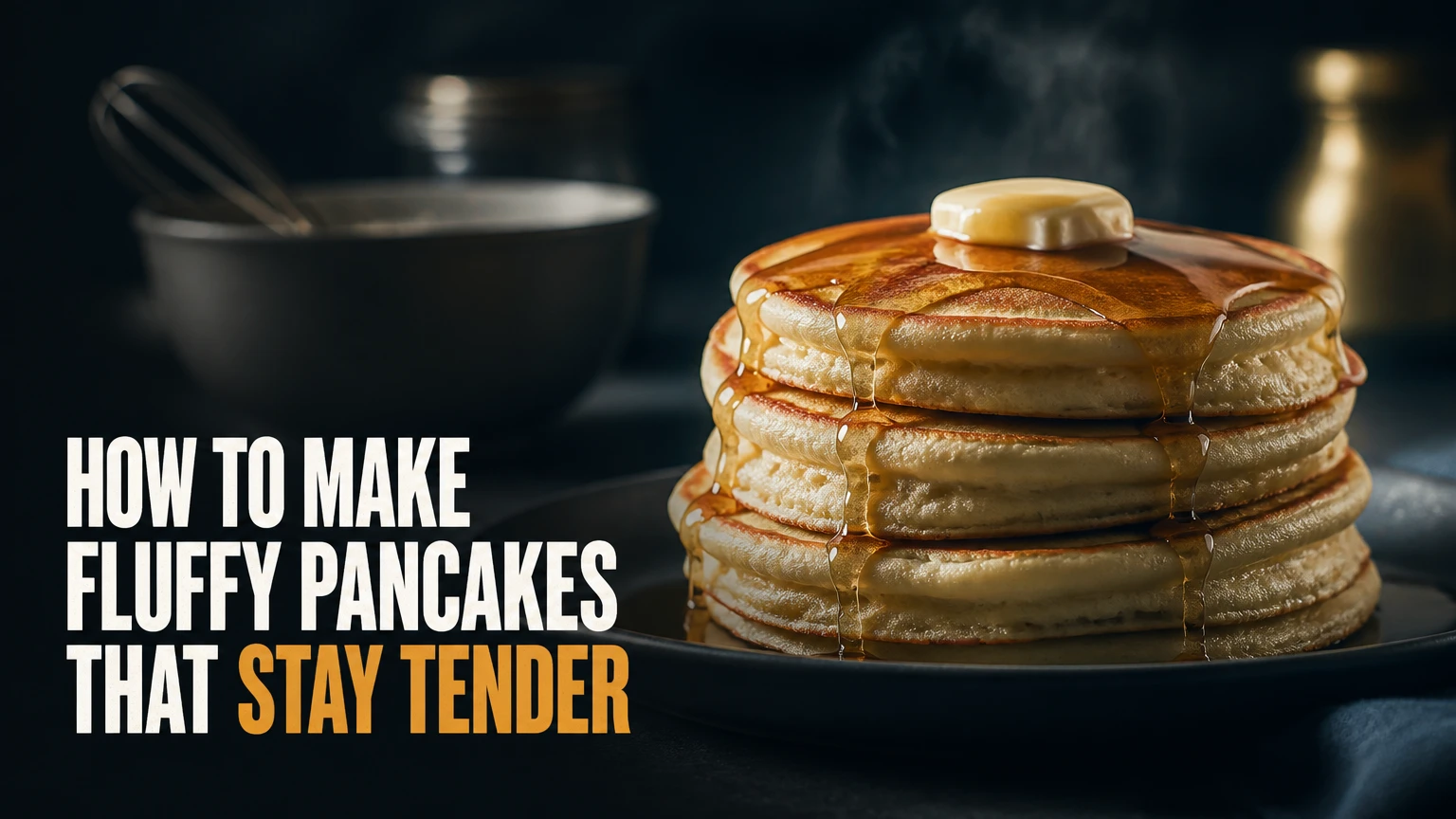
To make fluffy pancakes, whisk 200 g flour with sugar, baking powder, baking soda, and salt; combine with buttermilk, egg yolks, butter, and vanilla; then fold in whipped egg whites without smoothing the lumps. Cook 80 ml portions on a lightly greased 350-375°F surface until bubbles open and the edges look matte.
Key Facts
A reliable fluffy pancake batter is thick enough to mound briefly when poured.
Fresh baking powder provides most of the lift; buttermilk activates baking soda and adds tenderness.
Overmixing develops gluten and produces chewy, flat pancakes with tunnels.
A 350-375°F cooking surface usually browns the outside while allowing the center to set.
The first pancake calibrates heat, batter thickness, and cooking time.
A typical eight-pancake batch costs about $2-$4 and takes 25-30 minutes.
Why Does Pancake Batter Rise?
Fluffy pancakes rise when carbon dioxide and steam expand inside a flexible, partially set batter. Baking powder supplies carbon dioxide through its own acid-base reaction, while baking soda needs an acidic ingredient such as buttermilk; egg proteins and hydrated flour then set around those gas cells during cooking.
Gluten gives wheat pancakes enough structure to hold bubbles, but excessive gluten makes the crumb rubbery. Mixing flour only until the dry ingredients are moistened limits gluten development. Small lumps are desirable because they disappear as the batter hydrates and cooks.
Whipped egg whites add a second lift mechanism. They contribute air before the pancake reaches the pan, although the technique adds handling risk and does not compensate for weak leaveners or an overheated skillet. For everyday breakfasts, a well-balanced one-bowl batter can be nearly as tender with less work.
What makes pancakes thick rather than flat?
Thickness comes from batter viscosity, gas production, and cooking speed. A batter made with 200 g flour and about 300 g buttermilk should pour slowly from a spoon, spread only slightly, and form pancakes about 1.3-1.9 cm thick when cooked in 8 cm rounds.
Too much liquid creates thin pancakes even when the leaveners work. Too little liquid produces a mound that browns before the middle cooks. Ricotta, Greek yogurt, whole-wheat flour, and oat flour all increase batter resistance, so each may need additional liquid or a longer rest.
Ingredients for Eight Fluffy Pancakes
The following formula makes approximately eight pancakes measuring 8-10 cm across. Weighing flour and dairy gives more consistent results than using cups, because flour volume changes substantially with scooping and compression.
| Ingredient | Weight | Volume | Function |
|---|---|---|---|
| All-purpose flour | 200 g | 1 2/3 cups, spooned and leveled | Structure and starch |
| Granulated sugar | 25 g | 2 tablespoons | Browning and moisture retention |
| Baking powder | 8 g | 2 teaspoons | Primary carbon dioxide release |
| Baking soda | 2 g | 1/2 teaspoon | Reacts with buttermilk acid |
| Fine salt | 3 g | 1/2 teaspoon | Balances flavor |
| Full-fat buttermilk | 300 g | 1 1/4 cups | Hydration, acidity, tenderness |
| Unsalted butter, melted | 42 g | 3 tablespoons | Fat and browning flavor |
| Large eggs, separated | 100 g | 2 eggs | Yolks enrich; whites add air |
| Vanilla extract | 5 ml | 1 teaspoon | Flavor |
Can you use baking powder without baking soda?
Yes. Replace the baking soda with another 1 teaspoon of baking powder, but expect slightly less tang and a paler surface. Baking powder already contains an acid, so it does not depend on buttermilk for activation; baking soda is most useful when the batter contains buttermilk, yogurt, molasses, or lemon juice.
Do not keep adding leavener to increase height. Excess baking powder can create a bitter taste and a fragile crumb that collapses after cooking. The 8 g baking powder and 2 g baking soda in this formula are practical starting quantities, but brands vary in density and strength.
How to Make Fluffy Pancakes Step by Step
Before You Start
| Requirement | Practical specification |
|---|---|
| Total time | 25-30 minutes |
| Active preparation | 12-15 minutes |
| Cooking time | 10-14 minutes per batch |
| Yield | 8 pancakes, 8-10 cm wide |
| Difficulty | Moderate, because egg whites are separated |
| Pan | 25-30 cm nonstick skillet or electric griddle |
| Heat target | 350-375°F surface temperature |
| Portion size | 80 ml, approximately 1/3 cup |
| Typical batch cost | $2-$4 in the United States |
A balloon whisk, two mixing bowls, a flexible spatula, a 1/3-cup measure, and a thin turner are sufficient. Prepare toppings before cooking because pancakes are best served shortly after they leave the pan.
Step 1: Whisk the Dry Ingredients
Whisk the flour, sugar, baking powder, baking soda, and salt in a large bowl for 20-30 seconds. Break up visible clumps and distribute the leaveners evenly, but do not beat the flour aggressively for several minutes.
You will know this step worked when the dry mixture has one consistent color and no visible streaks of white baking powder or salt. The common mistake is measuring flour by dipping the cup into the bag, which can add 15-25% excess flour and create a stiff batter.
Step 2: Build the Wet Base
Whisk the buttermilk, melted butter, egg yolks, and vanilla in a separate bowl. Let the butter cool until warm rather than hot, because hot butter can partially cook the yolks and form greasy lumps.
The wet mixture is ready when the yolk disappears into the buttermilk and the butter is dispersed in small suspended droplets. Do not worry if the mixture looks slightly grainy. Cold buttermilk can cause melted butter to solidify, but the small flakes melt on the griddle.
Step 3: Whip the Egg Whites
Beat the two egg whites in a clean, grease-free bowl until they form soft to medium peaks, usually 2-3 minutes with a hand mixer. The peaks should hold briefly but bend at the tip rather than stand rigidly.
You will know the whites are ready when the bowl can be tilted without liquid sliding across the bottom. The common mistake is whipping to dry, stiff peaks, which break into curds during folding and remove more air than they add.
Step 4: Combine the Batter Gently
Pour the wet base into the dry ingredients and fold with a rubber spatula 8-12 strokes. Stop when no large dry pockets remain, even though the batter still contains pea-sized lumps and a few flour streaks.
Add the whipped whites in two portions. Cut the spatula through the center, sweep along the bottom, and turn the batter over itself until only a few white streaks remain. The batter should be thick, aerated, and pourable.
Step 5: Rest the Batter Briefly
Rest the batter for 5-10 minutes at room temperature. This allows flour particles to hydrate and gives the leaveners time to begin producing gas, but a 30-minute rest can reduce the lift because some bubbles escape before cooking.
The batter is ready when it has thickened slightly and still contains visible air pockets. Do not stir it smooth after resting. If the batter becomes too thick to portion, fold in 1 tablespoon of buttermilk at a time.
Step 6: Preheat and Condition the Pan
Heat a nonstick skillet or griddle to 350-375°F, or use medium-low heat on a stovetop burner. Test an electric griddle with an infrared thermometer when available; otherwise, a drop of water should sizzle and evaporate within roughly 2 seconds.
Rub the surface with a thin film of neutral oil, then wipe away the excess. A visible pool of butter causes patchy browning because the pancake fries in some areas and contacts dry metal in others.
Step 7: Portion Without Spreading
Scoop approximately 80 ml, or 1/3 cup, of batter onto the pan. Let the batter fall in one place and resist pressing or swirling it into a wider circle.
The pancake is correctly portioned when it settles into an 8-10 cm round with a slightly domed center. If the batter runs rapidly beyond 10 cm, add 1 tablespoon flour to the remaining bowl. If it stays in a stiff peak, add 1 tablespoon buttermilk.
Step 8: Cook the First Side
Cook for approximately 2-3 minutes without moving the pancake. Watch the surface rather than relying only on the clock, because cast iron, nonstick aluminum, and electric griddles transfer heat at different rates.
The first side is ready when the edges look dry, the surface loses its wet shine, and bubbles rise and leave open holes. A pancake that is brown underneath but glossy on top needs lower heat, not a premature flip.
Step 9: Flip and Finish
Slide a thin spatula fully under the pancake and turn it in one low, controlled motion. Cook the second side for 1-2 minutes until the pancake is puffed, lightly browned, and firm when pressed at the center.
You will know it is cooked when the center springs back rather than leaving a wet indentation. The USDA recommends cooking dishes containing eggs to 160°F for food safety; an instant-read thermometer inserted sideways into a thick pancake can verify that temperature without destroying the entire stack.
Which Pancake Method Should You Choose?
The separated-egg buttermilk method offers the best balance of height, tenderness, and reliability for most home cooks. A one-bowl baking-powder method is faster, while Japanese soufflé pancakes reach greater height but require low heat, ring molds, and careful steaming.
| Method | Typical height | Total time | Skill level | Best use |
|---|---|---|---|---|
| Separated buttermilk | 1.3-1.9 cm | 25-30 min | Moderate | Family breakfast |
| One-bowl diner style | 1.0-1.6 cm | 15-20 min | Easy | Weekday cooking |
| Japanese soufflé | 3.8-5 cm | 35-45 min | Advanced | Special presentation |
| Ricotta or yogurt | 1.3-2.5 cm | 25-35 min | Moderate | Moist, rich texture |
| Whole-wheat blend | 1.0-1.8 cm | 25-30 min | Easy | Higher-fiber variation |
When is the one-bowl method better?
Choose the one-bowl method when speed, cleanup, or mix-ins matter more than maximum height. Use 200 g flour, 2 teaspoons baking powder, 25 g sugar, 3 g salt, 300 ml milk, 2 eggs, 42 g melted butter, and 1 teaspoon vanilla; omit baking soda unless the milk is acidified.
Mix only until the flour disappears, then cook immediately after a 5-minute rest. This sturdier batter holds blueberries and chocolate chips better than whipped whites, but excessive mixing makes it chewy faster.
Are Japanese soufflé pancakes worth the extra work?
Japanese soufflé pancakes are worth the extra work when height and a custardy center are the priority. They are less suitable for feeding a family quickly because each pancake cooks slowly in a ring mold under a lid and can deflate within minutes if under-set.
Use a meringue-based batter, 7-8 cm ring molds, a covered skillet, and very low heat. Add a teaspoon of water beside the rings to create steam, then cook about 5-6 minutes per side. Do not expect the same browned, syrup-absorbing surface as a buttermilk pancake.
What Temperature and Timing Produce Even Browning?
A pancake surface between 350°F and 375°F usually gives the best balance between browning and internal cooking. Temperatures above 400°F can burn sugar and butter before the center sets, while temperatures below 325°F may produce pale, dry pancakes because the batter cooks slowly and loses steam.
| Pan symptom | Likely surface condition | Adjustment | Expected result |
|---|---|---|---|
| Pale after 3 minutes | Below 325°F | Increase heat 10-20°F | Browning begins sooner |
| Dark base, wet top | Above 400°F | Lower heat 25-40°F | Center cooks before crust burns |
| Uneven spots | Uneven grease or hot spots | Wipe oil thinly; preheat longer | More uniform color |
| Good color, raw center | Batter mound too thick | Reduce portion to 70 ml | Faster center setting |
| Flat, dry pancake | Batter too thin or overcooked | Add 1 tablespoon flour; shorten time | Thicker tender crumb |
Cast iron retains heat strongly, so reduce the burner after the first pancake if the second browns too quickly. Electric griddles recover temperature more consistently, but their thermostats can cycle 15-25°F around the displayed setting.
How Can You Adapt the Batter?
Fluffy pancakes can be adapted for dairy-free, gluten-free, whole-wheat, and high-protein diets, but substitutions change hydration and structure. Preserve the original batter’s thick, slowly flowing consistency rather than copying the liquid quantity blindly.
| Situation | Substitute | Quantity | Required adjustment |
|---|---|---|---|
| Dairy-free | Unsweetened soy milk plus lemon juice | 300 ml plus 15 ml lemon juice | Rest 5 minutes before use |
| No buttermilk | Whole milk plus lemon juice | 300 ml plus 15 ml lemon juice | Keep 1/2 teaspoon baking soda |
| Gluten-free | 1:1 gluten-free flour blend | 200 g | Rest 10 minutes |
| Whole-wheat | Whole-wheat flour | 100 g plus 100 g all-purpose | Add 15-30 ml milk if thick |
| Yogurt-based | Plain Greek yogurt plus milk | 180 g yogurt plus 120 ml milk | Use 2.5 teaspoons baking powder |
| Egg-free | Aquafaba or commercial egg replacer | Equivalent to 2 eggs | Skip whipped-white technique |
Gluten-free flour blends benefit from a longer hydration rest because rice flour and starches absorb liquid gradually. Dairy-free soy milk behaves more like dairy milk than almond milk because its protein helps brown and structure the pancake.
For blueberries, use 100 g fresh or frozen berries and place them on each pancake after portioning. Folding berries into the bowl can release juice, thin the batter, and create scorched spots. Add chocolate chips in portions of 75-100 g for a stable distribution.
Why Do Pancakes Turn Flat, Chewy, or Raw?
Flat pancakes usually result from expired leaveners, overmixed batter, excessive liquid, or a pan that is too cool. Raw centers usually result from oversized portions or excessive heat, which sets the crust before the internal batter reaches cooking temperature.
| Failure | Cause | Immediate fix | Prevention |
|---|---|---|---|
| Flat and chewy | Overmixing or old baking powder | Do not remix; start a fresh batch | Stop with lumps remaining |
| Raw center, burnt edge | Pan above 400°F | Lower heat and use 70 ml portions | Calibrate surface temperature |
| Pale, greasy spots | Too much butter or oil | Wipe pan nearly dry | Use a thin oil film |
| Deflates after flipping | Flip was early or forceful | Cook longer on side two | Wait for matte surface and holes |
| Bitter or soapy taste | Excess baking soda | Discard overly alkaline batter | Weigh or level soda |
| Dense white streaks | Egg whites underfolded | Gently fold remaining streaks | Add whites in two portions |
Expired baking powder is a frequent hidden cause. To test it, stir 1/2 teaspoon into hot water; vigorous immediate fizz indicates activity, while weak or delayed bubbling calls for replacement. This test does not measure exact strength, so fresh leavener is preferable for important batches.
A counterintuitive rule is that more bubbles in the bowl do not guarantee a taller pancake. Large bubbles formed during an extended rest often escape, whereas smaller bubbles retained in a thick batter expand inside the pan and create a more even crumb.
How Should You Store and Reheat Pancakes?
Cool pancakes completely, refrigerate them in an airtight container for up to 3 days, or freeze them in a single layer before transferring them to a freezer bag for up to 2 months. Reheat refrigerated pancakes in a toaster or 325°F oven, and reheat frozen pancakes directly without thawing.
Separate stacked pancakes with parchment if they will be refrigerated. Microwave reheating is fastest, about 20-30 seconds for two refrigerated pancakes, but it softens the crust and can create a rubbery edge if overheated.
For batch cooking, place finished pancakes on a wire rack rather than stacking them immediately. Steam trapped between hot pancakes condenses into water, softening the browned surfaces and making the bottom pancakes seem undercooked.
What Does a Batch Cost and How Long Does It Take?
A typical eight-pancake batch costs approximately $2-$4 using supermarket flour, eggs, butter, and buttermilk, although local dairy prices can move the total higher. Preparation takes 12-15 minutes, cooking takes 10-14 minutes, and the separated-egg method takes about 25-30 minutes from measuring to serving.
The cost estimate excludes cookware, energy, toppings, and specialty ingredients such as ricotta. Maple syrup, fruit, nuts, and chocolate can cost more than the pancake batter itself. A one-bowl version generally reduces preparation time by 5-10 minutes but gives up some aeration.
Frequently Asked Questions
Can I make fluffy pancakes without buttermilk?
Yes. Combine 300 ml whole milk with 15 ml lemon juice or white vinegar, then rest it for 5 minutes before mixing. The acidified milk supplies enough acidity for 1/2 teaspoon baking soda, although the flavor will be milder and the crumb may be slightly less tender than a full-fat buttermilk version.
Should pancake batter be thick or runny?
Fluffy pancake batter should be thick and slowly flowing, not solid or watery. A 1/3-cup portion should spread into an 8-10 cm round without requiring a spoon to flatten it. Add flour if the batter races across the pan, or add buttermilk one tablespoon at a time if it holds a stiff mound.
Why are my pancakes not fluffy even with baking powder?
Baking powder cannot overcome excessive flour, overmixing, a cool pan, or a batter that rests too long. Check leavener freshness, weigh the flour, mix only until the dry ingredients are moistened, and cook on a 350-375°F surface. These controls usually matter more than adding extra baking powder.
Can I make pancake batter the night before?
You can prepare the dry and wet mixtures separately overnight, refrigerated, then combine them in the morning. Do not mix and rest a fully leavened batter overnight because gas escapes and gluten continues hydrating, producing flatter pancakes. Whip and fold egg whites immediately before cooking.
How do I know when to flip pancakes?
Flip when the pancake edges look dry, the glossy surface turns matte, and bubbles rise and leave open holes. These visual signs are more reliable than a fixed timer because pan temperature, portion size, and batter thickness change cooking speed. Flip once, gently, and avoid pressing down.
Can I use pancake mix to make pancakes fluffier?
You can improve a boxed mix by following its liquid ratio, replacing some water with buttermilk, and avoiding overmixing. Do not automatically add extra baking powder because commercial mixes already contain a calibrated leavener blend. A spoonful of Greek yogurt can add tenderness, but it may require additional liquid.
The Bottom Line
The most dependable way to make fluffy pancakes is to use a thick buttermilk batter, fresh baking powder, limited mixing, and a 350-375°F pan. Separate and fold the egg whites when maximum tenderness matters, portion 80 ml mounds without spreading, and flip only after the surface turns matte with open bubbles. That process produces the height, soft crumb, and evenly browned surface that define reliable fluffy pancakes.