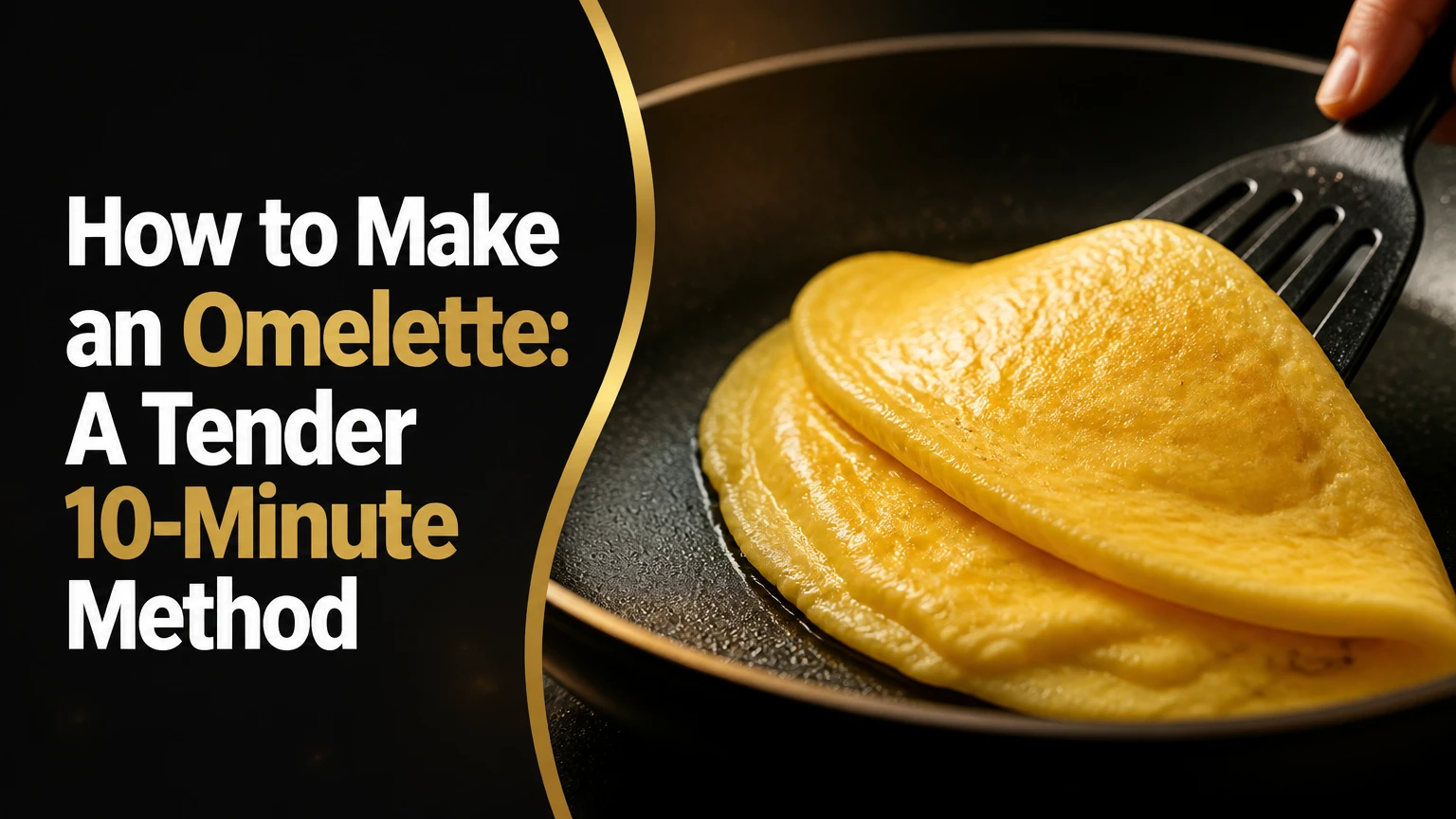
An omelette is made by cooking beaten eggs in butter or oil until the eggs are set, then folding them around a filling. For a tender two- or three-egg omelette, use a 20-centimeter nonstick pan, medium heat, pre-cooked fillings, and remove the pan while the surface remains slightly moist.
Key Facts at a Glance
A standard individual omelette uses 2 large eggs in a 20-centimeter, 8-inch pan.
A two-egg American omelette typically cooks in 3-5 minutes after preparation.
Cook mushrooms, onions, spinach, meat, and other wet fillings before adding them.
Butter should foam without browning when the eggs enter the pan.
The omelette folds most cleanly when the base is set but the top still looks glossy.
For food safety, the USDA advises, “Cook eggs until both the yolk and white are firm.”
Before You Start: Ingredients, Tools, and Timing
A two-egg omelette takes about 5-10 minutes from cracking eggs to plating, costs approximately $1-$3 at home depending on the filling, and requires only a bowl, fork, 20-centimeter nonstick skillet, flexible spatula, and warm plate. Medium-low to medium heat is safer than high heat because eggs continue cooking after the pan leaves the burner.
Ingredients for One American-Style Omelette
- 2 large eggs, approximately 100 grams without shells
- 1 tablespoon unsalted butter, or 1 teaspoon neutral oil
- 1/8 teaspoon fine salt
- 1/8 teaspoon black pepper
- 30-45 grams grated cheese, optional
- 60-90 grams total cooked filling, optional
Use 3 eggs when you want a thicker omelette or more filling capacity, but use a 25-centimeter, 10-inch pan for even setting. Four eggs in an 8-inch skillet produce a deep center and overcooked edges.
Which Pan Works Best?
A 20-centimeter nonstick pan is the most forgiving choice because a thin egg layer releases before its underside dries. Carbon steel gives excellent control after seasoning, while stainless steel needs more precise preheating and fat because wet egg bonds readily to bare metal.
| Pan type | Recommended size | Heat behavior | Release difficulty | Best use |
|---|---|---|---|---|
| Nonstick skillet | 20 cm for 2 eggs | Fast, even | Low | Beginner American omelette |
| Carbon steel | 20 cm for 2 eggs | Responsive, high heat tolerance | Medium | French-style omelette |
| Stainless steel | 20 cm for 2 eggs | Uneven on thin pans | High | Experienced cooks |
| Cast iron | 20 cm for 2 eggs | Slow, retains heat | Medium-high | Firm, browned omelette |
Avoid metal utensils on coated nonstick cookware. A silicone or heat-resistant nylon spatula protects the surface and bends under the egg without tearing it.
How Does an Omelette Cook?
An omelette cooks when egg proteins unfold and connect into a network that changes liquid egg into a soft solid. Heat first sets the thin outer layer, then moves inward; excessive heat tightens the protein network, forcing out water and creating a firm, rubbery texture.
Egg whites generally set around 60-65°C, while yolks set around 65-70°C, although the exact point changes with salt, dilution, pan temperature, and measurement method. The practical rule is more useful than chasing one number: stop direct heat when the surface is glossy and barely wet, because residual heat continues setting the center.
Salt seasons the eggs and slightly changes protein behavior, but salting before whisking does not reliably make a home omelette tough. High heat, prolonged cooking, and a thin dry base are the usual causes of toughness. Harold McGee’s On Food and Cooking explains the underlying trade-off: egg proteins become firmer as they form more bonds, but excessive bonding squeezes out moisture.
Why Does Butter Matter?
Butter contributes milk solids, browning risk, and a rounded flavor, while neutral oil tolerates higher temperatures and produces less flavor. Use butter over medium heat for a pale omelette; use oil when cooking on a hotter carbon-steel pan or when avoiding dairy.
The correct butter signal is a white foam that begins to settle without turning tan. Brown flecks indicate that milk solids are cooking, which is desirable for a nutty browned omelette but unsuitable for the pale surface of a classical French omelette.
How to Make an Omelette Step by Step
The following method makes one tender, folded American-style omelette in about 5 minutes of cooking time. The method uses gentle curds rather than aggressive scrambling, so the finished egg remains flexible enough to fold around cheese and cooked vegetables.
Step 1: Cook and Cool the Filling
Cook 60-90 grams of filling before heating the eggs, then drain or blot excess liquid and keep the filling warm. Sauté mushrooms until their released water evaporates, wilt spinach until dry, and heat ham or bacon until warm but not greasy.
You’ll know it worked when: the filling has no visible puddle and does not steam heavily.
Common mistake: adding raw mushrooms or tomatoes directly to the eggs. The vegetables release water inside the folded omelette, producing a watery center and weak structure.
Step 2: Whisk the Eggs
Crack 2 large eggs into a bowl, add 1/8 teaspoon salt and a small pinch of pepper, then whisk for 20-30 seconds. Break every visible strand of white, but stop when the mixture is uniform and lightly foamy rather than covered with large bubbles.
You’ll know it worked when: the yolk and white form one consistent yellow mixture with no clear streaks.
Common mistake: whisking so forcefully that a thick foam forms. Large bubbles collapse in the pan and can leave thin holes in the cooked sheet.
Step 3: Heat the Pan and Fat
Set a 20-centimeter nonstick skillet over medium heat for about 60 seconds, add 1 tablespoon butter, and swirl until it foams. Add the eggs immediately after the foam peaks, before the butter browns.
You’ll know it worked when: the eggs begin to thicken at the edges within 5-10 seconds without hissing violently.
Common mistake: starting with a cold pan. Cold cookware lets the butter soak into the egg mixture before the proteins begin setting, which encourages sticking.
Step 4: Set the Egg Base
Pour in the eggs and use a silicone spatula to pull the setting edges toward the center while tilting the pan so liquid egg flows into the gaps. Repeat for 20-30 seconds, then stop stirring when about 70-80% of the surface has thickened.
You’ll know it worked when: small soft curds support a continuous layer, while the top remains glossy and fluid in a few shallow patches.
Common mistake: stirring until the eggs resemble dry scrambled eggs. A dry curd layer cannot bend cleanly and will crack during folding.
Step 5: Add the Filling
Spread 30-45 grams of cheese and 60-90 grams of cooked filling across the center third of the omelette. Keep the filling at least 2 centimeters from the edge so the egg can close around it.
You’ll know it worked when: the filling sits in a narrow line rather than forming a heavy mound.
Common mistake: overfilling. More than approximately 150 grams total filling makes a two-egg omelette difficult to fold and cools the center before the exterior is ready.
Step 6: Fold and Plate
Remove the skillet from the heat, loosen the edges, and fold one third over the filling, followed by the opposite side or a simple half-fold. Slide the omelette onto a warm plate with the seam underneath, then serve immediately.
You’ll know it worked when: the exterior is intact, the filling remains enclosed, and the center feels soft when pressed.
Common mistake: waiting for the top to become fully dry. The last glossy layer acts as a flexible hinge; once dry, the omelette is more likely to split.
Which Omelette Style Should You Choose?
Choose an American omelette for reliable folding and substantial fillings, a French omelette for a pale custardy interior, a frittata for batch cooking, and a soufflé omelette for maximum height. These are different preparations, not interchangeable names for the same egg dish.
| Style | Egg texture | Surface | Typical time | Filling approach |
|---|---|---|---|---|
| American | Firm outside, soft center | Pale to golden | 5-8 minutes | Folded around 60-150 g |
| French | Creamy and barely set | Pale, unbrowned | 3-5 minutes | Light herbs, 30-60 g |
| Frittata | Fully set, sliceable | Open-faced | 15-25 minutes | Integrated, 150-300 g |
| Spanish tortilla | Dense potato and egg | Browned exterior | 25-40 minutes | Potato, onion, 300-500 g |
| Soufflé | Airy and tall | Pale, lightly browned | 8-12 minutes | Minimal, 30-60 g |
How Is a French Omelette Different?
A French omelette is a smooth, pale cylinder with a soft interior, made by shaking the pan and stirring continuously until small curds form. The cook rolls the egg rather than making a firm half-fold, then finishes it with butter or fine herbs.
Use 2 eggs, a 20-centimeter pan, and about 1 teaspoon butter. Keep the heat medium-high for the initial setting, agitate constantly, and plate as soon as the surface is barely set. A French omelette is not ideal for wet vegetables, thick meat, or a diner-style browned crust.
When Is a Frittata Better?
A frittata is better when serving four or more people, using leftovers, or preparing slices ahead of time. Cook 6-10 eggs with 300-500 grams of pre-cooked ingredients in a 25-centimeter oven-safe skillet, then finish the open-faced mixture in a 190°C oven until the center is set.
A frittata tolerates potatoes, roasted vegetables, sausage, and dense cheese better than a folded omelette. Its limitation is texture: the longer cooking time produces a firmer, less delicate egg matrix.
What Fillings Work Best?
The best omelette fillings are cooked, relatively dry, and small enough to distribute without tearing the egg. Keep the total filling near 60-90 grams for two eggs, and add cheese while the top is still moist so it softens before plating.
| Filling | Preparation | Amount for 2 eggs | Moisture control |
|---|---|---|---|
| Cheddar | Grate finely | 30-45 g | Add directly |
| Mushrooms | Sauté 5-7 minutes | 50-70 g | Cook until pan is dry |
| Spinach | Wilt and squeeze | 40-60 g | Remove squeezed liquid |
| Tomato | Seed and dice | 30-45 g | Drain on a towel |
| Ham | Dice and warm | 50-70 g | Blot surface fat |
| Herbs | Chop fresh | 1-2 tbsp | Add at the end |
| Salsa | Drain thoroughly | 30-45 g | Avoid watery liquid |
Cheese melts most evenly when finely grated. Sharp cheddar, Gruyère, Monterey Jack, feta, and goat cheese all work, but high-moisture mozzarella can release liquid unless used sparingly.
Can You Make an Omelette Without Milk?
Yes, milk is unnecessary for a tender omelette; eggs, salt, and controlled heat provide the required structure and moisture. Water can make the curds slightly lighter because it turns to steam, but more than 1 teaspoon per 2 eggs can thin the base and delay setting.
For a richer result, add 1 teaspoon cream or crème fraîche after whisking. For a lighter result, use 1 teaspoon water. Do not add enough liquid to make the egg mixture pour like a custard, because excess dilution increases cooking time and weakens folding strength.
How Do You Make a Fluffy Omelette?
Make a fluffy omelette by incorporating air during whisking and cooking the eggs in a slightly deeper layer. Whisk 3 eggs until lightly frothy, use a 20-centimeter pan, and cover the pan for 30-45 seconds after adding the filling.
A soufflé omelette creates substantially more volume by separating 2 eggs, whipping the whites to soft or medium peaks, and folding them into the yolks. Cook the mixture gently in a buttered pan, cover it, and serve within a minute because the foam structure collapses as steam escapes.
How Can You Make a Health-Conscious Omelette?
A health-conscious omelette can use one whole egg plus two egg whites, 1 teaspoon olive oil, and 100-150 grams of vegetables without sacrificing structure. Whole eggs retain the yolk’s fat-soluble nutrients and flavor, while additional whites increase protein and volume.
Vegetables still need pre-cooking. Frozen spinach should be thawed and squeezed, onions should be softened, and zucchini should be cooked until its surface moisture evaporates. Cooking spray lowers added fat, but a measured teaspoon of oil improves release in stainless steel or worn nonstick cookware.
Common Mistakes and How to Fix Them
Omelette failures usually come from excessive heat, excess moisture, or poor timing at the fold. The recovery depends on whether the problem occurs before folding, during release, or after the omelette reaches the plate.
| Problem | Likely cause | Immediate fix | Prevention |
|---|---|---|---|
| Omelette sticks | Pan too cool or damaged coating | Loosen with a thin spatula and add 1 tsp butter at edge | Preheat 60 seconds |
| Omelette tears | Surface fully dried | Fold smaller sections and cover with cheese | Fold while glossy |
| Watery center | Raw or wet filling | Return briefly to low heat, open side up | Cook and drain fillings |
| Rubbery egg | High heat or long cooking | Add sauce or soft cheese; do not recook | Remove at 70-80% set |
| Brown outside | Pan too hot | Lower heat immediately | Use medium heat |
| Filling falls out | Overfilled or edge-loaded | Fold in thirds and plate seam-side down | Keep filling in center third |
Why Does an Omelette Become Rubbery?
An omelette becomes rubbery when prolonged heat creates a tight egg-protein network that squeezes out water. High heat accelerates the process, but low heat can also produce rubberiness if the pan remains on the burner after the egg has already set.
Remove the skillet from the burner when the top is mostly set but still glossy. A 30-second rest on the plate is usually enough for carryover cooking. Adding salt, milk, or cheese cannot repair proteins that have already overcoagulated.
Why Is the Omelette Watery?
A watery omelette usually contains vegetables, cheese, or meat that released liquid after folding. Mushrooms, tomatoes, zucchini, frozen spinach, and salsa need draining or evaporation before they enter the egg.
If the omelette is still open, tilt it and spoon away visible liquid, then cook over low heat for 20-30 seconds. If it is already folded, avoid prolonged reheating because the egg will toughen before the moisture disappears.
How Do You Prevent Sticking?
Prevent sticking by using a clean pan, enough fat, and the correct release moment. Eggs release more easily after their bottom proteins set, so wait 10-15 seconds before testing an edge, then slide the spatula parallel to the pan rather than pressing downward.
A scratched or degraded nonstick coating increases sticking even when technique is correct. Replace cookware when the coating flakes, rather than compensating with excessive heat or oil.
How Long Does an Omelette Take and Cost?
A two-egg omelette typically takes 5-10 minutes and costs $1-$3 at home, while a frittata for four people usually takes 20-30 minutes and costs $6-$15 depending on cheese and meat. Restaurant prices vary by region, labor, and ingredients, so home estimates are more consistent than menu prices.
| Preparation | Servings | Active time | Total time | Typical home cost |
|---|---|---|---|---|
| Two-egg American | 1 | 5 minutes | 5-8 minutes | $1-$3 |
| Three-egg French | 1 | 5 minutes | 5-7 minutes | $1-$3 |
| Vegetable frittata | 4 | 10 minutes | 20-30 minutes | $6-$12 |
| Potato tortilla | 4-6 | 15 minutes | 30-40 minutes | $8-$15 |
Can You Prepare Omelettes Ahead?
A folded omelette is best served immediately and is not an ideal meal-prep food because reheating tightens the egg proteins. A frittata is better for refrigeration, since its firm structure tolerates reheating and slicing.
Refrigerate cooked egg dishes within 2 hours, or within 1 hour when ambient temperature exceeds 32°C, following USDA food-safety guidance. Store at 4°C or below and use within 3-4 days. Reheat until hot throughout, although the texture will be firmer than freshly cooked eggs.
Frequently Asked Questions
How Many Eggs Should You Use for One Omelette?
Use 2 large eggs for a thin, easy-to-fold individual omelette and 3 eggs for a thicker or more filling-heavy version. Match 2 eggs with a 20-centimeter pan and 3-4 eggs with a 25-centimeter pan; a small pan creates an uneven, thick center.
Should You Put Salt in Eggs Before Cooking?
Yes, you can salt eggs before cooking. Add approximately 1/8 teaspoon fine salt per 2 large eggs, then whisk normally. Early salting seasons the mixture evenly, while the more important texture variables are pan heat, cooking duration, and stopping before the surface dries.
Can You Use Olive Oil Instead of Butter?
Olive oil works in place of butter, particularly for vegetable omelettes or dairy-free cooking. Use 1 teaspoon extra-virgin olive oil over medium heat for flavor, or a neutral oil such as canola when cooking hotter; butter provides more browning and dairy flavor.
How Do You Flip an Omelette Without Breaking It?
Do not flip a filled omelette in the air. Loosen the edges, slide the spatula beneath one-third of the egg, fold that section over the filling, then tilt the pan and slide the omelette onto a plate seam-side down.
Is a Runny Omelette Safe to Eat?
A visibly runny omelette carries a greater food-safety risk than fully set eggs, especially for pregnant people, young children, older adults, and immunocompromised people. The USDA recommends firm yolks and whites; use pasteurized eggs if a soft center is preferred, and follow local food-safety guidance.
What Is the Difference Between an Omelette and Scrambled Eggs?
An omelette is cooked as a cohesive sheet that encloses or supports a filling, while scrambled eggs remain in separate curds and are usually stirred until softly or fully set. The same beaten egg mixture can become either dish, but agitation and final shape determine the result.
The Bottom Line
To make an omelette, whisk 2 eggs with salt, cook the fillings separately, heat butter in a 20-centimeter nonstick pan, stir the eggs until mostly set, add a modest filling, and fold while the surface remains glossy. Medium heat and early removal matter more than extra milk, elaborate equipment, or forceful whisking.