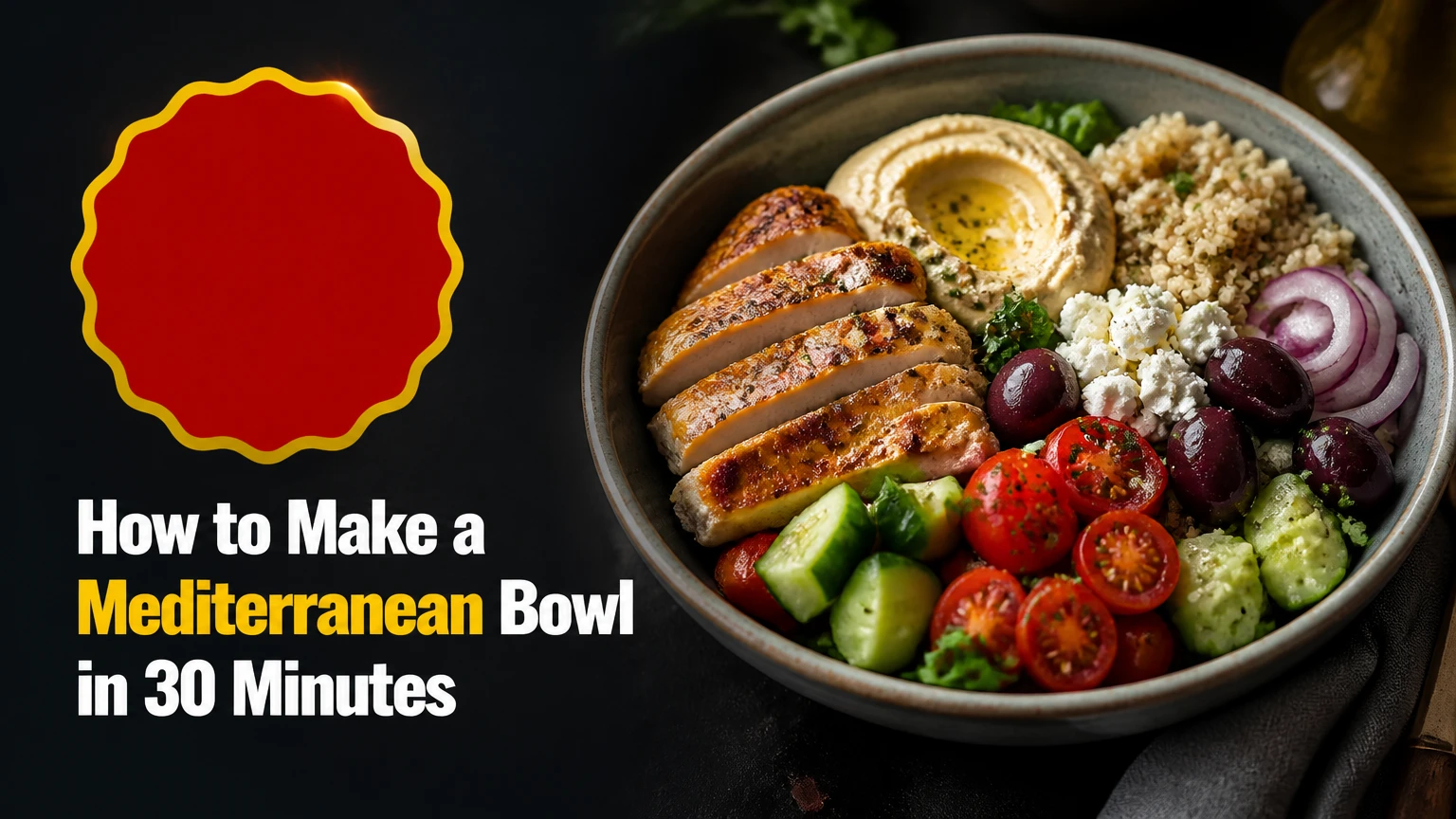
A Mediterranean bowl combines a grain or greens base, 3-4 ounces of protein, 1-2 cups of vegetables, a flavorful sauce, and a finishing garnish. To make one, cook or warm the base and protein, add fresh and roasted produce, then finish with hummus, tzatziki, tahini dressing, lemon, herbs, olives, or feta.
Key Facts at a Glance
- A typical Mediterranean bowl takes 25-30 minutes with quick-cooking grains and prepared hummus.
- One serving usually contains 450-700 calories, depending mainly on oil, grains, cheese, and sauce.
- A balanced bowl uses about 1 cup of base, 3-4 ounces of protein, 1-2 cups of vegetables, and 2-3 tablespoons of sauce.
- Cooked poultry and seafood should be refrigerated within 2 hours and generally used within 3-4 days.
- Couscous contains wheat, while quinoa, rice, buckwheat, and certified gluten-free oats do not naturally contain gluten.
- The strongest flavor contrast comes from combining acid, such as lemon or vinegar, with creamy, salty, fresh, and crunchy ingredients.
Before You Start
A single Mediterranean bowl needs one base, one protein, at least two vegetables, one sauce, and one acidic finishing ingredient. The quantities below make one substantial serving and provide a reliable starting point before personal adjustments.
| Component | Typical quantity | Examples | Preparation time |
|---|---|---|---|
| Base | 1 cup cooked | Quinoa, farro, bulgur, brown rice | 5-25 minutes |
| Protein | 3-4 ounces | Chicken, salmon, chickpeas, falafel | 0-20 minutes |
| Vegetables | 1-2 cups | Cucumber, tomato, zucchini, eggplant | 5-25 minutes |
| Sauce or dip | 2-3 tablespoons | Hummus, tzatziki, tahini | 2-5 minutes |
| Finish | 1-3 tablespoons | Feta, olives, herbs, lemon | 1 minute |
You need a medium bowl, knife, cutting board, skillet or sheet pan, measuring spoons, and a food thermometer for poultry or fish. A prepared grain, canned chickpeas, store-bought hummus, and prewashed greens can reduce active work to approximately 10 minutes.
The main success factor is moisture control. Cool cooked grains briefly, drain wet vegetables, and keep dressing separate if the bowl will sit longer than 30 minutes.
How to Make a Mediterranean Bowl: The 5-Step Method
The five-step method is base, protein, vegetables, sauce, and finish. The complete process takes about 25-30 minutes when roasting vegetables and cooking protein at the same time, and the bowl is ready when each bite contains a creamy element, an acidic element, a fresh element, and a substantial protein or legume.
Step 1: Prepare the Base
Choose 1 cup of cooked grains, a large handful of greens, or half of each. Quinoa and couscous work when speed matters; farro and brown rice provide more chew, while arugula and spinach reduce cooking and increase raw volume.
For a 30-minute bowl, simmer quinoa according to its package directions, use pre-cooked rice, or microwave a frozen whole-grain portion. Spread hot grains on a plate for 5 minutes so steam can escape before they touch greens or sauce.
You will know it worked when: the base is tender but separate, with no pool of water at the bottom.
Common mistake: Placing steaming grains on spinach wilts the greens and creates a wet base. Use warm grains beside greens, or cool them first.
Step 2: Cook or Add the Protein
Use 3-4 ounces of cooked chicken, salmon, shrimp, lamb kofta, falafel, lentils, or chickpeas. Season simply with 1 teaspoon olive oil, 1 teaspoon lemon juice, 1/4 teaspoon dried oregano, 1/4 teaspoon garlic powder, and a pinch of salt for each serving.
Cook chicken until the thickest part reaches 165°F, the food-safety temperature specified by the United States Department of Agriculture. Cook salmon until it flakes easily and reaches 145°F, or use fully cooked leftovers that were chilled promptly.
For a plant-based bowl, warm 3/4 cup chickpeas with cumin and smoked paprika, or use four small falafel pieces. Chickpeas add fiber and affordability; chicken adds more protein per calorie; salmon adds omega-3 fats but usually costs more.
You will know it worked when: the protein is seasoned throughout, moist inside, and safely cooked.
Common mistake: Overcooking lean chicken while preparing other components produces a dry bowl. Remove chicken as soon as it reaches temperature and rest it for 5 minutes.
Step 3: Add Fresh and Roasted Vegetables
Add 1-2 cups of vegetables in contrasting forms. Use cucumber and tomato for cool juiciness, roasted zucchini or eggplant for softness, bell pepper for sweetness, and pickled onion or pepperoncini for acidity.
For roasted vegetables, cut zucchini, eggplant, or peppers into 1-inch pieces, toss with 1 teaspoon olive oil per serving, and roast at 425°F for 18-25 minutes. Turn the pieces once so their edges brown rather than steam.
Keep vegetables in separate sections when serving immediately. Sectioning helps preserve texture and lets diners control salty, sour, creamy, and spicy bites. Toss chopped cucumber and tomato with salt only at the last moment because salt quickly draws out water.
You will know it worked when: at least one vegetable remains crisp and another has browned edges or a soft roasted texture.
Common mistake: Refrigerating tomatoes for several days dulls their texture. Store whole tomatoes at room temperature and cut them shortly before serving.
Step 4: Add a Sauce or Dip
Use 2-3 tablespoons of hummus, tzatziki, tahini dressing, baba ganoush, or Greek vinaigrette. Thick dips belong in a separate section of the bowl, while thin dressings can be drizzled across grains and vegetables.
A fast lemon-tahini dressing uses 1 tablespoon tahini, 1 tablespoon lemon juice, 1 tablespoon water, 1/2 teaspoon grated garlic, and a pinch of salt. Stir until thick, then add water by the teaspoon until it becomes pourable. Tahini may seize temporarily when acid is added; continued stirring and gradual water restore a smooth texture.
Tzatziki contributes coolness and dairy protein but contains less concentrated fat than tahini. Hummus provides chickpeas and sesame, while a vinaigrette gives the lightest mouthfeel but adds less creaminess.
You will know it worked when: the sauce coats food without flooding the bottom of the bowl.
Common mistake: Adding oil-heavy dressing by eye can increase a bowl by 100-200 calories. Measure the first serving, then adjust from a known baseline.
Step 5: Finish With Acid, Herbs, and Crunch
Add 1 teaspoon lemon juice or red wine vinegar, 1 tablespoon feta or olives, and 1 tablespoon chopped parsley, dill, mint, toasted seeds, or nuts. These finishing ingredients sharpen flavor after the grains and protein have absorbed seasoning.
Use olives and feta together in small amounts because both increase sodium. Toasted pumpkin seeds provide crunch without dairy, while fresh dill pairs especially well with cucumber, salmon, and yogurt sauces.
Taste one assembled bite before adding more salt. The sauce, olives, feta, and pickles may already provide enough sodium.
You will know it worked when: the bowl tastes bright rather than oily, and soft ingredients are balanced by something crisp.
Common mistake: Skipping acid makes a bowl taste flat even when the seasoning is adequate. Add lemon or vinegar before adding more salt.
Which Components Should You Choose?
The best Mediterranean bowl components depend on cooking time, dietary needs, texture, and budget. Quinoa is a useful gluten-free grain, farro delivers chew, chickpeas keep plant-based bowls inexpensive, and fresh vegetables prevent a meal-prepped bowl from becoming monotonous.
Which Base Should You Use?
| Base | Cooked serving | Typical cook time | Gluten status | Best use |
|---|---|---|---|---|
| Quinoa | 1 cup | 15-20 minutes | Naturally gluten-free | High-protein, quick bowls |
| Farro | 1 cup | 25-35 minutes | Contains gluten | Chewy meal-prep bowls |
| Bulgur | 1 cup | 10-15 minutes | Contains gluten | Fast, earthy bowls |
| Brown rice | 1 cup | 35-45 minutes | Naturally gluten-free | Budget batch cooking |
| Couscous | 1 cup | 5 minutes | Contains wheat | Fastest warm base |
| Greens | 2-3 cups raw | 0 minutes | Gluten-free | Lower-starch bowls |
Quinoa, rice, and greens are appropriate for gluten-free diets, but packaged sauces, spice blends, and falafel require label checks for cross-contact. Farro and couscous are not gluten-free even though both appear frequently in Mediterranean-style recipes.
Which Protein Works Best?
| Protein | Portion | Typical preparation | Fridge life after cooking | Main advantage |
|---|---|---|---|---|
| Chicken breast | 3-4 ounces | Pan-cook 12-16 minutes | 3-4 days | Lean, high-protein |
| Salmon | 3-4 ounces | Bake 10-14 minutes | 3-4 days | Rich flavor, omega-3 fats |
| Chickpeas | 3/4 cup | Warm 5-8 minutes | 3-4 days | Low cost, high fiber |
| Falafel | 4 pieces | Bake or air-fry 10-15 minutes | 3-4 days | Crisp plant-based option |
| Lentils | 3/4 cup | Warm 5 minutes if cooked | 3-4 days | Soft texture and fiber |
| Lamb kofta | 3-4 ounces | Pan-cook 8-12 minutes | 3-4 days | Strong savory flavor |
Animal proteins generally make it easier to reach a high protein target in a smaller portion. Legumes can provide comparable satiety when paired with whole grains and vegetables, but their protein density per calorie is usually lower.
How Do You Choose the Sauce?
| Sauce | Portion | Flavor profile | Typical key ingredients | Best pairing |
|---|---|---|---|---|
| Hummus | 2 tablespoons | Creamy, lemony | Chickpea, tahini, garlic | Falafel and roasted vegetables |
| Tzatziki | 2-3 tablespoons | Cool, tangy | Yogurt, cucumber, dill | Chicken, salmon, cucumber |
| Tahini dressing | 1-2 tablespoons | Nutty, rich | Sesame, lemon, garlic | Lentils and greens |
| Baba ganoush | 2 tablespoons | Smoky, soft | Eggplant, tahini, lemon | Lamb and roasted peppers |
| Greek vinaigrette | 1-2 tablespoons | Sharp, herbal | Olive oil, vinegar, oregano | Grain and tomato bowls |
A useful practitioner rule is to pair rich proteins with acidic sauces and mild proteins with assertive sauces. Salmon benefits from yogurt and dill, while chickpeas need lemon, garlic, pickles, or smoked spices to avoid a flat flavor profile.
How Do You Meal Prep a Bowl?
Mediterranean bowl meal prep works best when grains, proteins, roasted vegetables, fresh vegetables, and sauces are stored separately. Prepare four servings in about 45-75 minutes, refrigerate cooked components promptly, and assemble each bowl in under 5 minutes.
Cook 4 cups of grain, 1.5 pounds of chicken or an equivalent quantity of legumes, and 6-8 cups of vegetables. Divide grains, protein, and roasted vegetables among four containers, but keep greens, cucumber, tomatoes, herbs, feta, and sauce in separate containers when possible.
The FDA advises refrigerating perishable food within 2 hours, or within 1 hour when ambient temperatures exceed 90°F. The USDA recommends using refrigerated leftovers within 3-4 days, so a five-day plan requires freezing the final portion or cooking a second batch later in the week.
Reheat grains and protein separately until hot, then add cold produce and sauce. Never microwave dressed greens, cucumber, or tzatziki.
Nutrition, Cost, and Timing
A typical Mediterranean bowl contains 450-700 calories, 25-40 grams of protein, 45-60 grams of carbohydrates, 8-12 grams of fiber, and 15-25 grams of fat. Those ranges are practical estimates, not fixed nutrition values, because one tablespoon of olive oil contributes about 120 calories and toppings vary substantially.
The Mediterranean dietary pattern has stronger evidence than any individual bowl recipe. In the 2018 PREDIMED randomized trial published in The New England Journal of Medicine, adults at high cardiovascular risk assigned to a Mediterranean diet supplemented with extra-virgin olive oil or nuts had fewer major cardiovascular events than those assigned to a reduced-fat control diet.
The bowl format can support that pattern when its main ingredients are vegetables, legumes, whole grains, fish, nuts, seeds, and olive oil. A bowl dominated by refined grains, fried falafel, excessive cheese, and several tablespoons of oil should not automatically be described as nutritionally balanced.
| Bowl style | Typical calories | Protein | Typical homemade cost | Active time |
|---|---|---|---|---|
| Greens, chicken, hummus | 450-600 | 30-40 g | $4-$7 | 20-30 minutes |
| Quinoa, chickpeas, tahini | 500-700 | 18-26 g | $3-$5 | 20-30 minutes |
| Rice, salmon, tzatziki | 550-750 | 28-38 g | $6-$10 | 25-35 minutes |
| Farro, lentils, feta | 500-700 | 20-30 g | $3-$6 | 30-40 minutes |
| Prepared ingredients only | 450-700 | 20-35 g | $4-$8 | 5-10 minutes |
These are typical United States grocery ranges and change with region, brand, season, and organic purchasing. Bulk grains and dried lentils lower cost, while salmon, imported feta, and prepared dips raise it.
Adaptations for Different Situations
Mediterranean bowls are easy to modify, but substitutions change texture, nutrition, or regional accuracy. Avocado, sweet potato, and brown rice can work in a Mediterranean-inspired bowl, although they are modern additions rather than defining ingredients of traditional Mediterranean cuisines.
- Vegan: Use chickpeas, lentils, falafel, or white beans; replace tzatziki and feta with hummus, baba ganoush, or cashew yogurt.
- Dairy-free: Choose tahini, hummus, or olive-oil vinaigrette; check falafel and packaged dips for milk ingredients.
- Gluten-free: Use quinoa, rice, millet, or greens; exclude couscous, bulgur, and farro, and verify spice and hummus labels.
- Higher protein: Use 4 ounces chicken or fish, add 1/2 cup lentils, and retain vegetables rather than doubling cheese.
- Lower calorie: Use greens plus 1/2 cup quinoa, lean protein, 2 tablespoons tzatziki, and measured oil.
- No-cook lunch: Combine canned chickpeas, prewashed greens, cherry tomatoes, cucumber, olives, hummus, and lemon.
- Family dinner: Serve each component separately with pita so children can assemble their own portions.
Common Mistakes and Fixes
Why Does the Bowl Become Soggy?
Soggy bowls usually result from warm grains, salted vegetables, and dressing being stored together. Cool grains, pat cucumbers dry, salt tomatoes at serving, and place sauce in a leakproof container until eating.
Why Does the Bowl Taste Bland?
Blandness usually means the components lack acid, salt, or concentrated seasoning. Add lemon, red wine vinegar, pickled onions, oregano, garlic, or a measured pinch of salt before adding more oil.
Why Is the Bowl Too Salty?
Feta, olives, pickles, canned chickpeas, and prepared hummus can stack sodium in one serving. Rinse canned legumes, choose either olives or feta as the dominant salty ingredient, and use unsalted vegetables to restore balance.
Why Is the Protein Dry?
Lean poultry dries when it is cooked far beyond its safe internal temperature or reheated uncovered. Slice chicken after resting, store it with a spoonful of its cooking juices, and reheat it gently with a splash of water.
Why Does Tahini Dressing Turn Thick?
Tahini often thickens when lemon juice first contacts the sesame paste. Whisk continuously, then add water one teaspoon at a time until the dressing becomes smooth and pourable.
Is the Bowl Too Heavy?
A bowl can become dense when it contains a full grain serving, hummus, tahini, feta, olives, and oil together. Keep the grain at 1/2-1 cup, choose one creamy sauce, and use vegetables or greens for additional volume.
Which Bowl Formula Should You Choose?
Choose the bowl formula that matches the meal’s main constraint: speed, protein, budget, storage, or dietary restriction. The most practical default is quinoa or greens, lemon-herb chicken or chickpeas, cucumber and tomato, roasted vegetables, hummus, and lemon.
| Situation | Base | Protein | Sauce | Finishing ingredients |
|---|---|---|---|---|
| Fast weeknight dinner | Couscous | Chicken or chickpeas | Hummus | Tomato, cucumber, parsley |
| Vegan meal prep | Quinoa | Lentils or chickpeas | Tahini | Pickled onion, seeds |
| High-protein lunch | Greens and quinoa | Chicken or salmon | Tzatziki | Cucumber, dill, feta |
| Gluten-free dinner | Brown rice | Shrimp or falafel | Baba ganoush | Peppers, lemon |
| Lowest-cost option | Brown rice | Beans or chickpeas | Lemon vinaigrette | Cabbage, carrots, herbs |
One limitation matters: a Mediterranean bowl is a format, not proof that every ingredient follows a traditional Mediterranean diet. The nutritional result depends on portion size, preparation method, sodium, added oil, and the proportion of plants to processed toppings.
Frequently Asked Questions
Can I make a Mediterranean bowl without grains?
Yes. Replace the grain with 2-3 cups of greens, cauliflower rice, or chopped cabbage, then retain a 3-4-ounce protein, 1-2 cups of vegetables, and 2 tablespoons of sauce. A greens-based bowl lowers starch and calories but may need beans, lentils, or seeds for additional substance.
What can I use instead of feta?
Use olives, toasted seeds, avocado, nutritional yeast, or a dairy-free feta alternative. Olives and seeds provide salty or savory contrast, but avocado is not traditionally Mediterranean, so it creates a Mediterranean-inspired rather than region-specific bowl.
Can Mediterranean bowls be served warm?
Yes. Warm grains, roasted vegetables, chicken, fish, and legumes can share a bowl with cool cucumber, tomato, herbs, hummus, or tzatziki. Let hot ingredients cool briefly before adding delicate greens, and never heat yogurt sauce or fresh vegetables.
How much sauce should go in one bowl?
Use 2-3 tablespoons of sauce for a bowl containing about 2 cups of food. Start with less and add more after tasting, because hummus, tahini, feta, and olives can make the meal rich or salty quickly.
How long does a Mediterranean bowl last in the refrigerator?
Cooked grains, poultry, seafood, and legumes generally last 3-4 days when refrigerated promptly at 40°F or below. Fresh greens and cut vegetables lose texture sooner, so store wet produce and sauces separately and assemble portions close to mealtime.
What is the easiest Mediterranean bowl for beginners?
Start with microwaveable quinoa, canned chickpeas, cucumber, cherry tomatoes, hummus, feta, and lemon. This combination requires only rinsing, chopping, and assembly, and it teaches the core balance of grain, protein, fresh produce, creamy sauce, salt, and acid.
The Bottom Line
To make a Mediterranean bowl, combine about 1 cup of cooked grain or greens, 3-4 ounces of protein, 1-2 cups of vegetables, 2-3 tablespoons of sauce, and a bright garnish. The best Mediterranean bowl is assembled with moisture control, measured rich toppings, safe food storage, and enough lemon or vinegar to balance the fats.