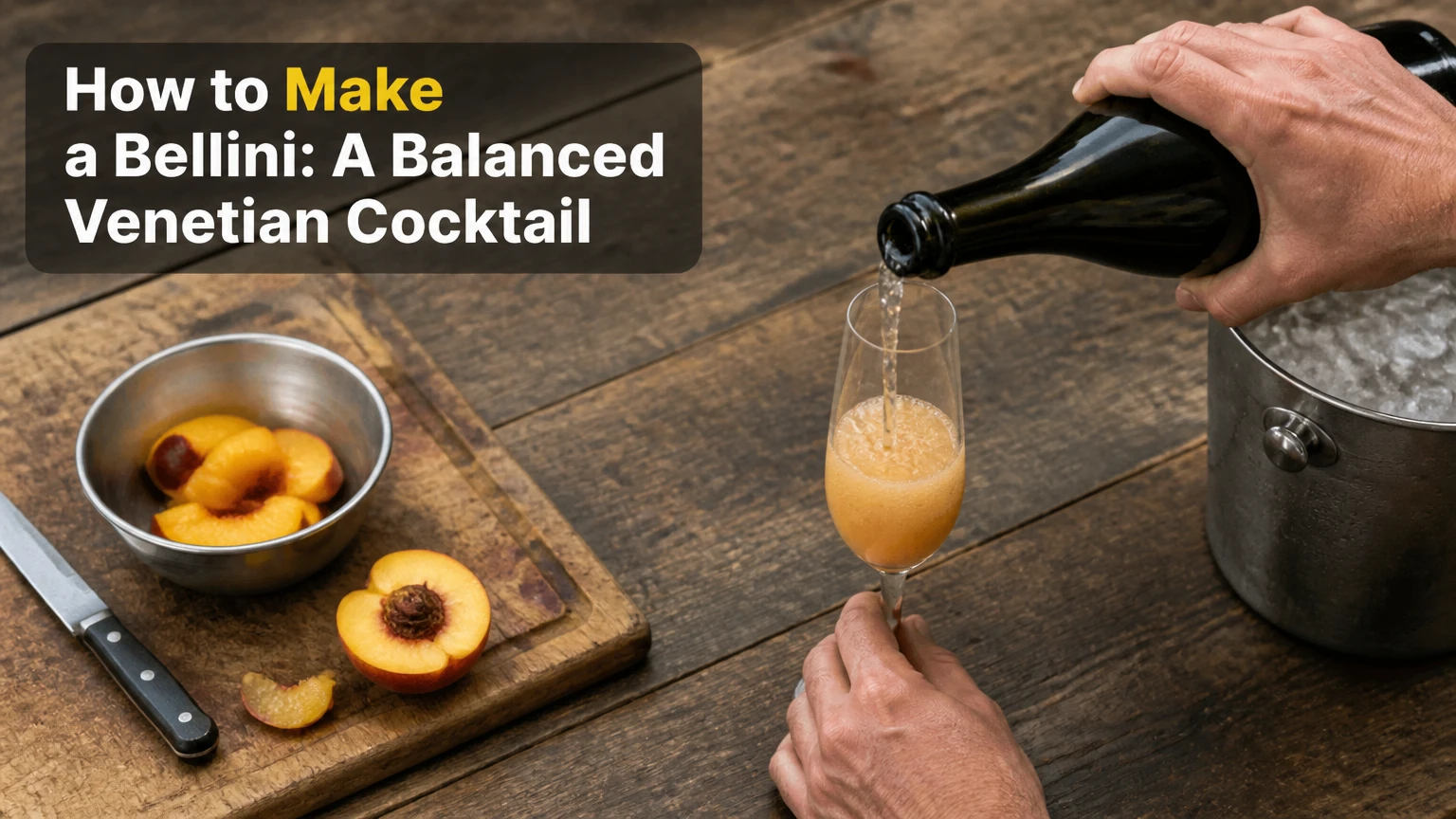
A Bellini is made by combining chilled white peach purée with chilled Prosecco, usually at a 2:1 wine-to-peach ratio. For one serving, add 2 ounces of smooth peach purée to a flute or coupe, pour in 4 ounces of Prosecco slowly, and gently fold once without shaking or adding ice.
Key Facts / At a Glance
A classic Bellini contains Prosecco and white peach purée or juice.
A practical starting ratio is 2 parts Prosecco to 1 part peach purée.
One 750-milliliter bottle of Prosecco makes about six 4-ounce servings.
A Bellini usually takes 5 minutes with prepared purée and 20 minutes with fresh fruit.
A 2:1 Bellini made with 11% ABV Prosecco is typically about 7-8% ABV.
Bellinis should be built in the serving glass, never shaken with carbonated wine.
What Is a Bellini?
A Bellini is a low-strength sparkling wine cocktail from Venice, made with Prosecco and white peach. Giuseppe Cipriani created the drink at Harry’s Bar in Venice in 1948, and the cocktail took its name from the Venetian painter Giovanni Bellini.
The familiar pale pink color is commonly linked to the blush tones in one of Giovanni Bellini’s paintings. That story is part of the drink’s established history, although the color also depends on peach variety, ripeness, skin pigment, and whether a small amount of raspberry is used.
The original drink was not defined by a single universally enforced recipe. Harry’s Bar used peach preparation that could vary with the fruit available, and modern bars use purée, strained juice, or peach nectar. The most reliable home formula is still simple: cold sparkling wine, ripe peach flavor, restrained sweetness, and minimal agitation.
Why does a Bellini foam so quickly?
Peach purée contains suspended fruit solids that provide nucleation points for dissolved carbon dioxide. When Prosecco meets those particles, carbon dioxide escapes faster, producing foam and reducing carbonation if the drink is poured aggressively or stirred repeatedly.
That effect is physical rather than a special chemical reaction. Very thick purée, warm ingredients, a narrow glass, and vigorous mixing all increase foaming. Straining the peach mixture, chilling it thoroughly, and pouring the wine slowly gives the bubbles more room to remain in solution.
What Do You Need Before You Start?
A single Bellini requires 2 ounces of peach purée and 4 ounces of chilled Prosecco, plus a flute, coupe, or small white-wine glass. The most important preparation factor is temperature: chill the wine, purée, and glass before combining them.
| Item | Quantity for 1 drink | Quantity for 6 drinks | Typical cost |
|---|---|---|---|
| White peach purée | 2 oz, 60 ml | 12 oz, 355 ml | $0.75-$2.00 |
| Prosecco | 4 oz, 120 ml | 24 oz, 710 ml | $1.50-$3.50 |
| Lemon juice, optional | 1-2 drops | 1 tsp | Under $0.10 |
| Simple syrup, optional | 0-1 tsp | 0-2 tbsp | Under $0.10 |
| Glassware | 1 flute or coupe | 6 glasses | Existing barware |
| Total preparation time | 5 minutes | 10-15 minutes | $2.25-$5.50 |
Use a 750-milliliter bottle for approximately six 4-ounce pours, although a generous pour, foam loss, or tasting during preparation may reduce the practical yield to five servings. A 375-milliliter half bottle produces about three standard Bellinis.
Which Prosecco should you choose?
Choose a chilled Prosecco labeled Brut or Extra Dry, depending on the sweetness of the peaches. Brut contains less residual sugar than Extra Dry, but Extra Dry is often a useful match for underripe or tart fruit because the finished cocktail contains more peach acidity than wine sweetness.
“Extra Dry” sounds drier than “Brut,” but Prosecco labeling follows technical sweetness categories rather than everyday English. Brut is generally up to 12 grams of sugar per liter, while Extra Dry is generally 12-17 grams per liter under European sparkling-wine classifications.
| Prosecco style | Typical sugar category | Best peach condition | Finished result |
|---|---|---|---|
| Brut | 0-12 g/L | Very ripe, sweet peaches | Crisp and restrained |
| Extra Dry | 12-17 g/L | Ripe or slightly tart peaches | Rounder and softer |
| Dry | 17-32 g/L | Very tart fruit or nectar-free recipe | Noticeably sweet |
| Prosecco DOCG | Quality designation, not sweetness level | Well-ripened fresh peaches | More regional fruit and structure |
Prosecco DOCG refers to Conegliano Valdobbiadene or Asolo production zones and does not automatically mean the wine is Brut. Check the sweetness term separately. Avoid heavily flavored sparkling wine, because added fruit flavor can overwhelm the peach.
How to Make a Bellini Step by Step
The following method makes one 6-ounce Bellini in about 5 minutes when the peach purée is already cold. The success factor is controlled temperature and pouring speed, not expensive glassware or complicated mixing.
Step 1: Make and strain the peach purée
Blend 3-4 ripe white peaches for approximately 4 servings, then pass the mixture through a fine-mesh sieve if the fruit is fibrous. Add lemon juice only when the purée needs brightness or oxidation control, and add simple syrup only when the peaches taste clearly tart.
- Wash and pit 3-4 peaches.
- Remove the skins if you want a pale, clean drink; keep them if the skins have attractive pink pigment.
- Blend the flesh for 20-30 seconds until smooth.
- Strain through a fine-mesh sieve for a lighter texture.
- Taste before adding anything.
- Add approximately 1 teaspoon lemon juice per 12 ounces of purée if needed.
- Add 1-2 teaspoons simple syrup only if the fruit lacks sweetness.
- Refrigerate the purée in a covered container for at least 1 hour.
You will know the purée is ready when it pours slowly but does not contain large fibers or chunks. The common mistake is adding lemon juice and sugar automatically; ripe white peaches can become too sharp or too sweet with both additions.
Store fresh purée for up to 24 hours in the refrigerator for best color and aroma. Freeze it in ice-cube trays for up to 2 months, then thaw the cubes overnight in the refrigerator and stir before using.
Step 2: Chill the wine, purée, and glass
Chill Prosecco to approximately 40-45°F, or 4-7°C, and chill the purée to the same range. Place the empty serving glass in the refrigerator for 20-30 minutes or the freezer for about 10 minutes.
Very cold ingredients reduce foam and slow carbon dioxide loss. However, placing a glass containing liquid in a freezer creates a breakage risk, and freezing the Prosecco can damage its texture or cause the bottle to rupture. Chill the bottle upright and open it only when assembly is ready.
You will know the setup is ready when the glass feels cold and no condensation has warmed the peach mixture. The common mistake is relying on a room-temperature purée and cold wine, which causes immediate foaming and leaves a flat drink.
Step 3: Add the peach base
Pour 2 ounces, or 60 milliliters, of peach purée into the chilled glass. For a drier, more wine-led Bellini, use 1.5 ounces of purée; for a dense brunch-style drink, use 2.5 ounces.
A 2:1 wine-to-purée ratio is the most useful starting point because it preserves sparkling texture while giving the peach a clear presence. Cipriani-style preparations can be more fruit-forward, so the ratio is a balance point rather than a legal definition.
You will know the quantity is right when the purée covers the bottom of the glass without filling more than one-third of a standard flute. The common mistake is pouring by eye into a narrow flute, which often produces a 3:1 or 1:1 drink without the maker realizing it.
Step 4: Pour Prosecco slowly
Open the Prosecco immediately before serving and pour 4 ounces, or 120 milliliters, slowly down the inside wall of the glass. Pause if foam rises toward the rim, then continue after the bubbles settle.
Pouring against the glass reduces the height of the falling liquid and limits the sudden release of carbon dioxide. A coupe is easier to fill and mix, while a flute preserves a taller stream of bubbles but gives foam less room.
You will know the pour is controlled when the foam rises briefly and falls below the rim without overflowing. The common mistake is pouring the entire amount quickly into the center of the purée.
Step 5: Fold once and serve immediately
Use a long bar spoon to lift the peach mixture gently from the bottom once or twice. Serve the Bellini immediately without ice, and garnish with a thin white peach slice if the fruit is fresh.
A Bellini does not need vigorous stirring because the wine and purée continue to integrate while the drink is consumed. Shaking is unsafe with carbonated wine and destroys the effervescence even when performed in a sealed shaker.
You will know the drink is ready when the color is evenly distributed and a fine stream of bubbles continues rising through the glass. The common mistake is repeatedly stirring to remove a denser layer of purée, which trades visual uniformity for a flat cocktail.
How Should the Finished Bellini Be Adjusted?
Adjust a Bellini after tasting the peach purée, not by adding sugar blindly to the completed glass. Peach ripeness changes sweetness, acidity, aroma, viscosity, and color, so the same published ratio can produce very different results across a season.
| Problem | Likely cause | Correction for 1 serving | Result |
|---|---|---|---|
| Too sweet | Sweet peaches plus Dry wine | Add 0.5 oz Brut Prosecco | Lower sugar and more lift |
| Too tart | Underripe peaches or excess lemon | Add 0.5 tsp simple syrup to purée | Softer fruit profile |
| Too thick | Unstrained purée or dense fruit | Add 0.5-1 oz Prosecco and fold once | Lighter texture |
| Too flat | Warm ingredients or overmixing | Replace with fresh chilled Prosecco | Restored carbonation |
| Too foamy | Fast pour or warm purée | Pause, then pour along the glass wall | Controlled head |
| Too pale | White flesh with little skin pigment | Add one raspberry to a purée batch | Pinker color |
A single raspberry can tint a batch, but raspberry is optional and changes the flavor. Grenadine is a poor substitute because even a small amount adds concentrated sugar and artificial color. If the peach mixture tastes good alone, the finished cocktail usually needs less sweetener than expected.
Which Peaches and Shortcuts Work Best?
Fresh white peaches offer the most floral aroma, but frozen peaches provide the most consistent off-season texture and price. Yellow peaches are acceptable when white peaches are unavailable, although they usually create a more acidic, orange-toned drink rather than an invalid cocktail.
| Peach option | Preparation time | Typical price per serving | Flavor and texture |
|---|---|---|---|
| Fresh white peaches | 20 minutes plus chilling | $1.00-$2.00 | Floral, soft, pale, seasonal |
| Fresh yellow peaches | 20 minutes plus chilling | $0.75-$1.50 | Brighter acidity, deeper orange |
| Frozen peach slices | 10 minutes plus thawing | $0.60-$1.25 | Consistent, slightly less aromatic |
| Peach nectar | 5 minutes | $0.50-$1.25 | Smooth, sweet, less fresh |
| Peach juice | 5 minutes | $0.50-$1.50 | Thin, clean, less creamy |
| Commercial peach purée | 5 minutes | $1.00-$2.50 | Reliable, brand-dependent sweetness |
Frozen peaches should thaw in the refrigerator rather than on a warm counter, because slow thawing limits separation and keeps the fruit cold. Blend thawed slices with no water initially; add water only if the blender cannot move the fruit.
Peach nectar works when speed matters, but check the label before adding syrup. Many nectars already contain sugar, and pairing them with Dry Prosecco can create a cloying drink. Use 1.5-2 ounces of nectar with 4 ounces of Brut Prosecco, then taste before adjusting.
A Bellini is not good for long storage after assembly. The drink loses carbonation quickly because fruit solids increase gas release, so make the purée ahead but combine the wine and fruit immediately before serving.
How Do Bellini Variations Compare?
The Bellini family includes drinks built from sparkling wine and fruit, but a Rossini or Tintoretto is not a Bellini simply because it uses Prosecco. The fruit determines the cocktail’s identity, while the sparkling wine determines much of its acidity, body, and carbonation.
| Drink | Sparkling base | Fruit component | Typical color | Best use |
|---|---|---|---|---|
| Bellini | Prosecco | White peach purée | Pale pink or peach | Summer brunch |
| Bellini Royale | Champagne | White peach purée | Pale gold or pink | Rich celebratory service |
| Rossini | Prosecco | Strawberry purée | Red or ruby | Berry-forward brunch |
| Tintoretto | Prosecco | Pomegranate juice | Deep pink | Tart winter service |
| Mimosa | Champagne or sparkling wine | Orange juice | Gold | Citrus breakfast service |
| Virgin Bellini | Alcohol-free sparkling wine | Peach purée | Pale peach | Nonalcoholic gatherings |
Champagne can replace Prosecco, but the result is a Bellini Royale with more pronounced acidity, yeast, and fine bubbles. Use a relatively soft Champagne if the peach is delicate; an aggressively austere wine can dominate the fruit.
The Rossini is the closest fruit comparison because it uses Prosecco and purée, yet strawberry has more obvious berry acidity and a darker color. The Tintoretto uses pomegranate juice rather than peach purée, so it is sharper and thinner.
How Do You Make Bellinis for a Group?
For six guests, chill 12 ounces of peach purée and one 750-milliliter bottle of Prosecco, then pour individual drinks using 2 ounces of purée and approximately 4 ounces of wine. Individual assembly gives the best carbonation, while a pitcher is faster but should be served within 5 minutes.
For a pitcher, add the cold purée first, pour in the cold Prosecco slowly, and fold once with a clean bar spoon. Do not prepare the pitcher more than 10 minutes before service, and do not add ice because melting water dilutes the fruit and wine.
A useful hosting workflow is to prepare measured purée portions in each glass before guests arrive. Keep the glasses refrigerated, open one bottle at a time, and finish each group of pours before opening another bottle.
| Guest count | Peach purée | Prosecco | Bottles required | Practical service |
|---|---|---|---|---|
| 2 | 4 oz | 8 oz | 1 half bottle or partial full bottle | Build individually |
| 4 | 8 oz | 16 oz | 1 full bottle | Build individually |
| 6 | 12 oz | 24 oz | 1 full bottle | Individual or pitcher |
| 12 | 24 oz | 48 oz | 2 full bottles | Use two small batches |
| 20 | 40 oz | 80 oz | 3 full bottles | Build in rounds |
Two smaller pitchers are better than one large pitcher for 12 or more guests because the first servings otherwise sit while the last servings are poured. This is a practical service rule, not a requirement of the cocktail.
Can You Make a Bellini Without Alcohol?
Yes. Replace Prosecco with chilled alcohol-free sparkling wine for the closest nonalcoholic result, using 2 ounces of peach purée and 4 ounces of sparkling wine per serving. Choose a dry product with noticeable acidity because peach nectar and sweet alcohol-free wines can become syrupy together.
Ginger ale creates a sweeter, spicier version and works best with 1.5 ounces of purée rather than 2 ounces. Sparkling water produces the least sweet drink, but it lacks the wine-like acidity and aroma that normally balance peach.
Add lemon juice to the purée only when needed, and avoid adding extra syrup until after tasting. Alcohol-free sparkling wines vary widely in sweetness, so the bottle’s sugar level matters more than its label style.
Common Bellini Mistakes and How to Fix Them
Why did the Bellini overflow?
The usual causes are warm purée, a fast central pour, or a very thick mixture. Let the foam settle, pour the remaining Prosecco along the glass wall, and refrigerate the next purée batch more thoroughly.
Why did the Bellini go flat?
Overstirring and warm ingredients release carbon dioxide before the drink reaches the guest. Replace the assembled drink with fresh Prosecco rather than trying to revive it with soda, which changes the flavor and dilution.
Can you shake a Bellini?
No. A sealed cocktail shaker can build dangerous pressure when carbonated wine is added, and shaking also strips the drink of its bubbles. Build the Bellini directly in the glass and fold gently once.
Why is the drink brown or orange?
Oxidized peach flesh, yellow peaches, or excessive skin pigment can shift the color toward brown or orange. Use fresh white peaches, limit air exposure, add a small amount of lemon juice when appropriate, and avoid grenadine-heavy coloring.
Why is the peach layer separating?
Separation results from dense purée, insufficient integration, or natural differences in fruit fiber and wine density. Strain the purée, use 1.5-2 ounces per serving, and make one gentle lift with a bar spoon immediately before serving.
Is ice appropriate in a Bellini?
No ice is needed in a properly chilled Bellini. Ice dilutes the drink as it melts and can reduce the apparent peach flavor, although an ice bucket should be used to keep unopened wine and a prepared pitcher cold.
What Does a Bellini Cost and How Strong Is It?
A homemade Bellini typically costs about $2.25-$5.50 per serving, depending on peach price and the Prosecco used. Restaurant pricing is commonly much higher, often about $12-$22, because it includes labor, glassware, venue costs, and service.
A 2:1 Bellini made with 4 ounces of 11% ABV Prosecco and 2 ounces of alcohol-free peach purée contains approximately 0.44 fluid ounces of pure alcohol. Dividing that alcohol across 6 ounces of drink gives a typical strength near 7.3% ABV before accounting for exact pour size and wine strength.
The drink is lower in alcohol than a full glass of Prosecco but is not alcohol-free. A 6-ounce serving can still contain roughly the alcohol found in a standard 4-ounce wine pour, so brunch service should include measured pours and a nonalcoholic option.
FAQ
What glass is best for a Bellini?
A chilled flute preserves carbonation and gives the drink a classic appearance, while a coupe provides more room for controlled mixing and foam. A small white-wine glass is the easiest option for home service because its wider opening reduces overflow risk and makes the peach aroma easier to smell.
How long does homemade peach purée last?
Fresh peach purée is best within 24 hours when covered and refrigerated at 40°F, or 4°C, or below. Freeze unused purée in measured portions for up to 2 months, thaw it in the refrigerator, and discard it if it develops fermentation, mold, or an off smell.
Can canned peaches replace fresh peaches?
Canned peaches can replace fresh fruit when drained thoroughly, but their syrup changes the sweetness and produces a softer, less floral flavor. Blend drained peaches without additional sugar, use Brut Prosecco, and adjust with lemon juice only after tasting the purée.
Should a Bellini be dry or sweet?
A Bellini should taste peach-forward but balanced by sparkling wine acidity, so the ideal sweetness depends on the fruit and Prosecco. Start with ripe peaches and Brut or Extra Dry Prosecco, then add a small amount of syrup only when the combined drink tastes sharp.
How many peaches are needed for a Bellini party?
Three to four medium peaches usually produce about 12 ounces of strained purée, enough for six servings at 2 ounces each. Buy an extra peach when the fruit is small, bruised, or unusually fibrous because straining removes some weight and volume.
Is peach schnapps used in a Bellini?
Peach schnapps is not required in a traditional Bellini and usually makes the drink sweeter and more alcoholic. Use peach schnapps only for a deliberately stronger modern variation, limiting the amount to approximately 0.25-0.5 ounce per serving and reducing added syrup.
The Bottom Line
To make a Bellini, chill every ingredient, blend and strain ripe white peaches, add 2 ounces of purée to a glass, pour in 4 ounces of Prosecco slowly, and fold once. The best Bellini is served immediately, without ice, with sweetness adjusted to the peaches rather than copied mechanically from a fixed recipe.