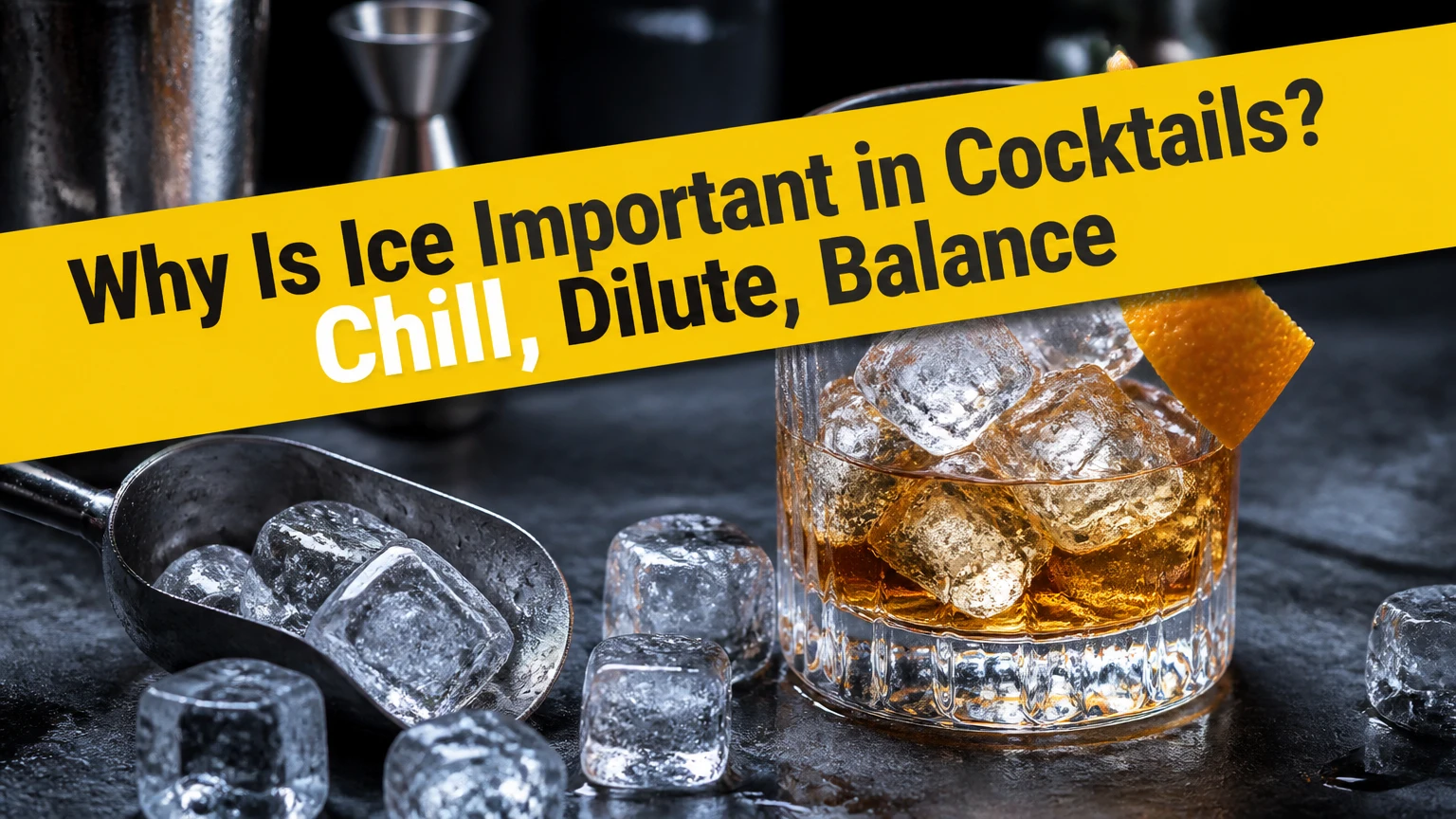
Ice is important in cocktails because it controls chilling, dilution, texture, aroma, and serving stability at the same time. As ice absorbs heat, some of it melts into the drink, lowering alcohol intensity and changing concentration; its size, shape, temperature, and quantity determine how quickly those changes occur.
Key Facts at a Glance
- Cocktail ice chills a drink by absorbing heat as solid water melts.
- Dilution commonly contributes about 15-25% of a shaken or stirred cocktail’s final volume, but the result varies by recipe and technique.
- Larger ice pieces melt more slowly because they expose less surface area relative to their volume.
- A full shaker chills efficiently because cold, abundant ice reduces frictional warming and limits prolonged melting.
- Shaking adds aeration and emulsification, while stirring preserves clarity and a denser, silkier texture.
- Clear ice improves appearance and structural durability, but it does not automatically produce a better-tasting cocktail.
Why Is Ice Important in Cocktails?
Ice is important in cocktails because a drink’s final balance depends on both temperature and water content. A Martini, Daiquiri, or Old Fashioned mixed without controlled ice will usually taste hotter, sharper, and less integrated than the same recipe mixed with appropriate chilling and dilution.
Ice also changes physical texture. Shaking with ice introduces air into citrus, egg white, dairy, and fruit mixtures, while stirring moves liquid smoothly with less aeration. The serving ice then determines how long the drink stays cold and how quickly additional water enters the glass.
Dave Arnold, author of Liquid Intelligence (2014), summarizes the professional view directly: “Ice is the most important ingredient in a cocktail.” The statement is intentionally broad, but the practical point is precise: ice is an active recipe component, not empty space in the glass.
What Does Ice Actually Add?
Ice contributes four measurable functions:
- Heat transfer: Ice absorbs energy from warmer liquid.
- Dilution: Meltwater lowers ethanol concentration and adjusts syrup, acid, and bitter intensity.
- Agitation: Ice creates impact and shear during shaking or rolling.
- Service control: Glass ice maintains a lower temperature after pouring.
A cocktail is therefore a mixture of spirits, modifiers, water, and dissolved gases. Removing ice changes the water fraction and the physical structure, even when every measured liquid remains identical.
How Does Ice Chill a Cocktail?
Ice chills a cocktail through the latent heat of fusion, the energy required for solid water at approximately 0°C to become liquid water. Liquid transfers heat to the ice, the ice melts, and that phase change removes substantially more energy than simply warming a solid or liquid by one degree.
The familiar rule, “You cannot chill with ice without some dilution,” is accurate for ordinary bar ice. A frozen cube must melt to absorb its largest useful share of heat, so the cooling process creates water inside the drink. A freezer or chilled metal vessel can lower temperature with less dilution, but ordinary ice cannot separate those outcomes.
Alcohol and dissolved sugar lower the freezing point of the mixture. A very cold cocktail can reach below 0°C, although the exact temperature depends on alcohol by volume, sugar, water, and the measurement method. The often-quoted range of -4°C to -7°C is possible for some strong mixtures, but it is not a universal target for every cocktail.
Why Does Dilution Improve Flavor?
Dilution reduces ethanol’s sensory burn and changes the concentration of every other ingredient. Water can also help volatile aromatic compounds leave the liquid and reach the nose, which makes botanicals, citrus oils, oak notes, and fruit aromas easier to perceive.
A spirit-forward drink usually needs less water than a sour. An Old Fashioned may taste balanced after roughly 10-20% dilution, while a shaken Daiquiri can commonly need about 20-30%, depending on the starting recipe and ice. These are typical practitioner ranges, not fixed laws.
How Much Does Ice Dilute a Cocktail?
A properly shaken or stirred cocktail commonly gains about 15-25% of its final liquid volume from meltwater, although recipe, ice condition, vessel shape, and mixing duration can move the result outside that range. A 90 milliliter pre-dilution drink may finish near 105-120 milliliters after mixing.
Fixed timing cannot guarantee fixed dilution. A 12-second shake with large, hard cubes behaves differently from a 20-second shake with wet, cracked refrigerator ice. The useful control variables are ice mass, surface area, starting temperature, agitation, and drink volume.
| Drink and technique | Typical mixing time | Typical dilution range | Finished temperature range |
|---|---|---|---|
| Old Fashioned, stirred | 20-35 seconds | 10-20% | -1 to 2°C |
| Manhattan, stirred | 25-40 seconds | 15-25% | -2 to 1°C |
| Daiquiri, shaken | 10-15 seconds | 20-30% | -4 to -1°C |
| Whiskey Sour, shaken | 12-18 seconds | 20-30% | -4 to -1°C |
| Gin and tonic, built | 0 seconds mixing | 0-5% initially | 1-5°C |
Which Ice Type Should You Use?
The best ice type depends on the drink’s required heat transfer, dilution rate, presentation, and consumption time. Dense medium cubes are the most useful general-purpose choice for shaking and stirring, while large-format ice fits slow-sipping drinks and crushed ice fits recipes designed around rapid melt.
Surface area explains much of the difference. A large cube has less exposed area per gram of ice than several small fragments, so it melts more slowly under the same conditions. Cracks increase exposed edges and create meltwater quickly.
| Ice format | Typical dimensions | Surface-area behavior | Best application | Main limitation |
|---|---|---|---|---|
| Standard cube | 25-30 mm per side | Medium | Shaking, stirring, highballs | Cracks when poorly stored |
| Large cube | 45-55 mm per side | Low | Old Fashioned, Negroni | Slow to chill a warm drink |
| Sphere | 50-65 mm diameter | Low | Spirit-forward serves | Often difficult to remove from glass |
| Pebble ice | 8-15 mm pieces | High | Julep, swizzle, tiki drinks | Rapid dilution |
| Collins spear | 120-150 mm long | Low | Highballs and tall drinks | Requires suitable glassware |
| Crushed ice | 3-10 mm fragments | Very high | Bramble, cobbler, frozen-style builds | Becomes watery quickly |
When Should You Use Standard Cubes?
Use standard cubes when a recipe requires fast, repeatable chilling during shaking or stirring. A shaker filled to roughly two-thirds or three-quarters with hard cubes provides enough thermal mass for a typical two-serving cocktail without leaving excessive empty space for uncontrolled splashing.
Standard cubes are also suitable for highballs. Filling the glass reduces the volume of warm liquid around each piece of ice, helping the drink remain cold while preserving carbonation. Sparse ice often produces a warmer, flatter highball because the remaining liquid warms faster.
When Are Large Cubes or Spheres Better?
Large cubes and spheres are better for drinks consumed slowly after mixing, especially an Old Fashioned, Boulevardier, or neat pour over ice. Their low surface-area-to-volume ratio slows ongoing dilution, so the drink remains cold without rapidly becoming watery.
Large ice is not ideal inside a shaker. One large cube may not provide enough contact area to chill a full batch quickly, and a sphere can obstruct movement. A practical method is to shake or stir with standard cubes, then strain over one large clear cube in the serving glass.
Why Is Crushed Ice Deliberately Fast-Melting?
Crushed and pebble ice are designed to melt quickly because their water contribution is part of the drink’s intended structure. Mint juleps, swizzles, cobblers, and many tiki drinks rely on rapid chilling, frost formation, and gradual dilution during a short drinking window.
Crushed ice should be packed firmly and replenished when necessary. A drink designed for pebble ice may taste correctly diluted after five minutes but watery after twenty minutes, especially in a warm room or thin glass.
Shaking or Stirring: Which Uses Ice Differently?
Shaking and stirring both chill and dilute, but shaking adds aeration and more violent contact while stirring preserves clarity and viscosity. Shaking suits citrus, juice, dairy, egg white, and thick syrups; stirring suits clear spirit-based drinks whose texture should remain polished and transparent.
| Method | Typical duration | Texture result | Suitable drink examples | Primary risk |
|---|---|---|---|---|
| Stirring | 20-45 seconds | Clear, silky, dense | Martini, Manhattan, Negroni | Under-dilution with too little ice |
| Hard shaking | 10-18 seconds | Aerated, bright, frothy | Daiquiri, Margarita, Whiskey Sour | Over-dilution with cracked ice |
| Short shake | 8-12 seconds | Lightly aerated | High-acid sours | Warm center if shaker is underfilled |
| Rolling | 8-15 seconds | Clearer, less aerated | Bloody Mary | Weak chilling in a warm vessel |
A full mixing glass is usually easier to control than a half-filled one. More ice does not automatically mean more dilution: a larger ice mass lowers the drink’s temperature faster, which reduces the fraction of ice that must melt to reach the target temperature.
What Is a Reliable Starting Point?
For a stirred drink, begin with 20-30 seconds of smooth agitation using cold, solid cubes. For a shaken drink, begin with 12-15 seconds of hard shaking and strain immediately. Taste the result, then adjust time or ice condition rather than changing several variables at once.
The bar spoon, shaker, and mixing glass should be cold when possible. A warm vessel consumes part of the ice’s cooling capacity before the cocktail receives the benefit.
What Ice Works Best for Different Cocktail Styles?
Cocktail style determines whether the priority is rapid dilution, low dilution, aeration, or temperature retention. Recipe structure matters more than visual appearance, so clear ice in a Margarita does not compensate for the wrong water balance.
| Cocktail style | Recommended mixing ice | Recommended serving ice | Reason |
|---|---|---|---|
| Citrus sour | Hard 25-30 mm cubes | No ice, rocks, or fresh cubes | Fast chill and controlled dilution |
| Spirit-forward stirred drink | Medium cubes | One 45-55 mm cube | Efficient mix, slow serving melt |
| Highball | Medium cubes | Full glass of cubes or spear | Cold liquid and stronger carbonation |
| Mint julep | Pebble ice | Packed pebble ice | Frost, dilution, and texture |
| Tiki or swizzle | Crushed or pebble ice | Mounded crushed ice | High surface area supports the recipe |
| Egg-white cocktail | Hard cubes after dry shake | Fresh cubes or no ice | Aeration followed by chilling |
Fresh serving ice matters when a cocktail is strained from the shaker. Reusing the spent shaking ice can transfer warm meltwater and fractured surfaces into the glass, causing faster and less predictable dilution.
How Do You Make Clear Cocktail Ice at Home?
Directional freezing produces clearer ice by freezing water from one direction, which pushes dissolved gases and many impurities toward the unfrozen end. A small insulated cooler without a lid is the practical home method, although the result still depends on freezer temperature, water chemistry, container size, and extraction technique.
Step 1: Choose the Container
Use a clean, food-safe insulated cooler that fits inside the freezer with its lid removed. A container around 10-15 liters can produce a usable block, but the freezer must have enough vertical clearance for the water depth and surrounding airflow.
Step 2: Add Suitable Water
Fill the cooler with filtered tap water, leaving several centimeters of headspace for expansion. Filtering can reduce chlorine and mineral flavors, but boiling alone does not reliably make clear ice because dissolved gas can remain or return during cooling.
Step 3: Freeze From the Top Down
Place the open cooler in a freezer set near -18°C, the common domestic freezer setting, and check it after approximately 18-30 hours. Remove the block while a small liquid pocket remains beneath the clear upper section; freezing the entire container traps the final impurities inside.
Step 4: Cut and Store the Block
Release the block, drain the cloudy base, and cut the clear section with a clean serrated knife and ice pick, or use a purpose-built cutting system. Store finished pieces in a sealed freezer bag to limit odor absorption and surface frost.
You will know the process worked when the upper ice is transparent enough to see through and the bottom portion contains the cloudy residue. Perfect optical clarity is unnecessary for flavor, and home directional freezing is a labor-intensive choice rather than a requirement for competent cocktails.
What Are the Most Common Ice Mistakes?
The most common ice mistakes are using wet or cracked cubes, filling a shaker too sparsely, leaving drinks on spent ice, and choosing large ice for rapid mixing. Each mistake changes the rate of heat transfer, so the drink may become warm, weak, or unevenly diluted even when the liquid measurements are correct.
| Problem | Likely cause | Sensory result | Practical fix |
|---|---|---|---|
| Watery cocktail | Cracked ice or excessive mixing | Thin body, muted aroma | Use hard cubes and shorten mixing |
| Warm cocktail | Too little ice or warm vessel | Alcoholic heat, dull flavor | Fill the vessel and pre-chill it |
| Cloudy ice | Omnidirectional freezing | Poor appearance, weaker structure | Use directional freezing |
| Fast melting serving cube | Small size or large cracks | Rapid post-pour dilution | Use a 45-55 mm cube |
| Flat highball | Sparse ice and warm mixer | Reduced fizz, soft flavor | Fill the glass with cold ice |
| Off-flavor ice | Freezer odor or stale storage | Plastic, onion, or fish notes | Seal ice and discard contaminated batches |
Wet ice is not always defective, but surface meltwater makes the starting water content unpredictable. Drain the ice bin or shake off loose meltwater before adding cubes to a shaker.
An underfilled shaker is a frequent professional error during busy service. The liquid sloshes through warm air and contacts the metal unevenly, while a tightly packed shaker transfers heat more efficiently and reaches a cold endpoint sooner.
Is Dry Ice Safe in Cocktails?
Dry ice is unsafe when a drinker could touch or swallow the solid material, and it should not be used as ordinary cocktail ice. Solid carbon dioxide sublimates into gas rather than providing useful recipe dilution, while residual pellets can cause severe cold burns or internal injury if ingested.
Dry ice can create theatrical fog in a controlled display, but the drink must remain isolated until every piece has completely sublimated. Food-safe service requires trained handling, ventilation, protective gloves, and a verified absence of solid carbon dioxide before consumption.
A fog effect is not a substitute for chilled, potable water ice. For normal home bartending, standard or clear water ice is the safer and more useful choice.
Can You Make a Cocktail Without Ice?
You can make a cocktail without ice, but you must replace ice’s cooling and dilution functions separately. A pre-diluted bottled cocktail, freezer-chilled spirit, refrigerator-cold mixer, or chilled metal vessel can lower temperature, while measured water supplies the missing dilution.
The method works best for drinks intended for batch service or precise preparation. For example, a bottled Negroni can receive measured water before refrigeration, while a freezer Martini can be mixed with a controlled water percentage and served cold without ice.
Ice-free service is less forgiving at home because small measurement errors become obvious. It also removes the gradual cooling and dilution that some drinkers enjoy from a large serving cube.
How Much Does Cocktail Ice Equipment Cost?
Typical home ice equipment ranges from about $10 for basic cube trays to $100 or more for insulated clear-ice systems and heavy cutting tools. Commercial specialty ice machines often cost several thousand dollars before installation, filtration, drainage, cleaning, and maintenance.
| Equipment | Typical consumer price | Production or capacity | Best use | Ongoing concern |
|---|---|---|---|---|
| Silicone cube tray | $8-$25 | 8-16 cubes per batch | Everyday drinks | Odor absorption |
| Large-cube mold | $15-$45 | 4-8 cubes per batch | Old Fashioned service | Slow 18-30 hour freeze |
| Insulated clear-ice mold | $45-$150 | 1 block per batch | Transparent large cubes | Cutting and storage |
| Lewis bag and mallet | $15-$40 | Hand-crushed batches | Juleps and swizzles | Wet fabric storage |
| Countertop ice maker | $100-$300 | Approximately 10-30 kg per day | Frequent home service | Cleaning and melt cycle |
| Commercial specialty machine | $2,000-$10,000+ | Dozens of kilograms daily | Bar operations | Plumbing and sanitation |
Prices vary by country, capacity, brand, and installation requirements. A home bartender usually gains more from hard, odor-free standard cubes than from an expensive machine that produces attractive ice but receives poor storage and cleaning.
How Should You Store Ice?
Store cocktail ice in a clean, covered container away from strong freezer odors, and use a dedicated scoop rather than hands or glassware. Ice absorbs volatile compounds from an exposed freezer, so uncovered cubes can acquire aromas from onions, seafood, cardboard, or old food.
Keep cubes below the freezer’s warmest areas and avoid repeatedly thawing and refreezing them. Frosty surfaces do not automatically mean contamination, but large surface cracks indicate thermal cycling that accelerates melting during service.
For a home bar, produce only the amount likely to be used within several days. A smaller fresh batch often tastes better than a large bag stored beside aromatic food for a month.
FAQ
Does More Ice Mean More Dilution?
More ice does not necessarily mean more dilution during a short mixing cycle. A full shaker contains greater thermal mass, reaches a lower temperature faster, and can therefore melt less total ice than a sparse shaker that requires prolonged agitation. Cracked or warm ice can reverse that advantage.
Should You Use Distilled Water for Clear Ice?
Distilled water can reduce mineral flavor, but it does not guarantee perfectly clear ice. Directional freezing controls the movement of gases and impurities more effectively than distillation alone. Filtered water is usually sufficient for good-tasting home ice when freezer odors are controlled.
Why Does a Cocktail Taste Better After It Rests Briefly?
A short rest allows temperature and dissolved water to become more uniform, while bubbles from shaking begin to settle. The effect is most noticeable in foamy sours and heavily aerated drinks. Spirit-forward stirred cocktails usually need less resting because stirring introduces little air.
Can You Reuse Ice From a Shaker?
Do not reuse spent shaking ice as the primary serving ice when maximum control matters. Shaking ice has warmer, fractured surfaces coated with diluted cocktail, so it melts faster and can make the finished drink watery. Reuse is acceptable for informal, immediately consumed drinks if the trade-off is understood.
Why Does Clear Ice Last Longer?
Clear ice often lasts longer because directional freezing produces a more uniform, dense piece with fewer internal cracks and trapped air pockets. Transparency itself does not slow melting. A cloudy cube of equal size can perform well if it is solid and free from structural fractures.
The Bottom Line
Why is ice important in cocktails? Ice determines how a cocktail chills, dilutes, smells, feels, and holds its balance after pouring. Use hard medium cubes for shaking and stirring, large-format ice for slow sipping, and crushed or pebble ice only when rapid dilution belongs to the recipe.
Control the variables that matter: fill the vessel, use clean ice, match surface area to drinking speed, and strain onto fresh serving ice when precision matters. Clear ice improves presentation and durability, but sound temperature and dilution technique matter more than visual perfection.