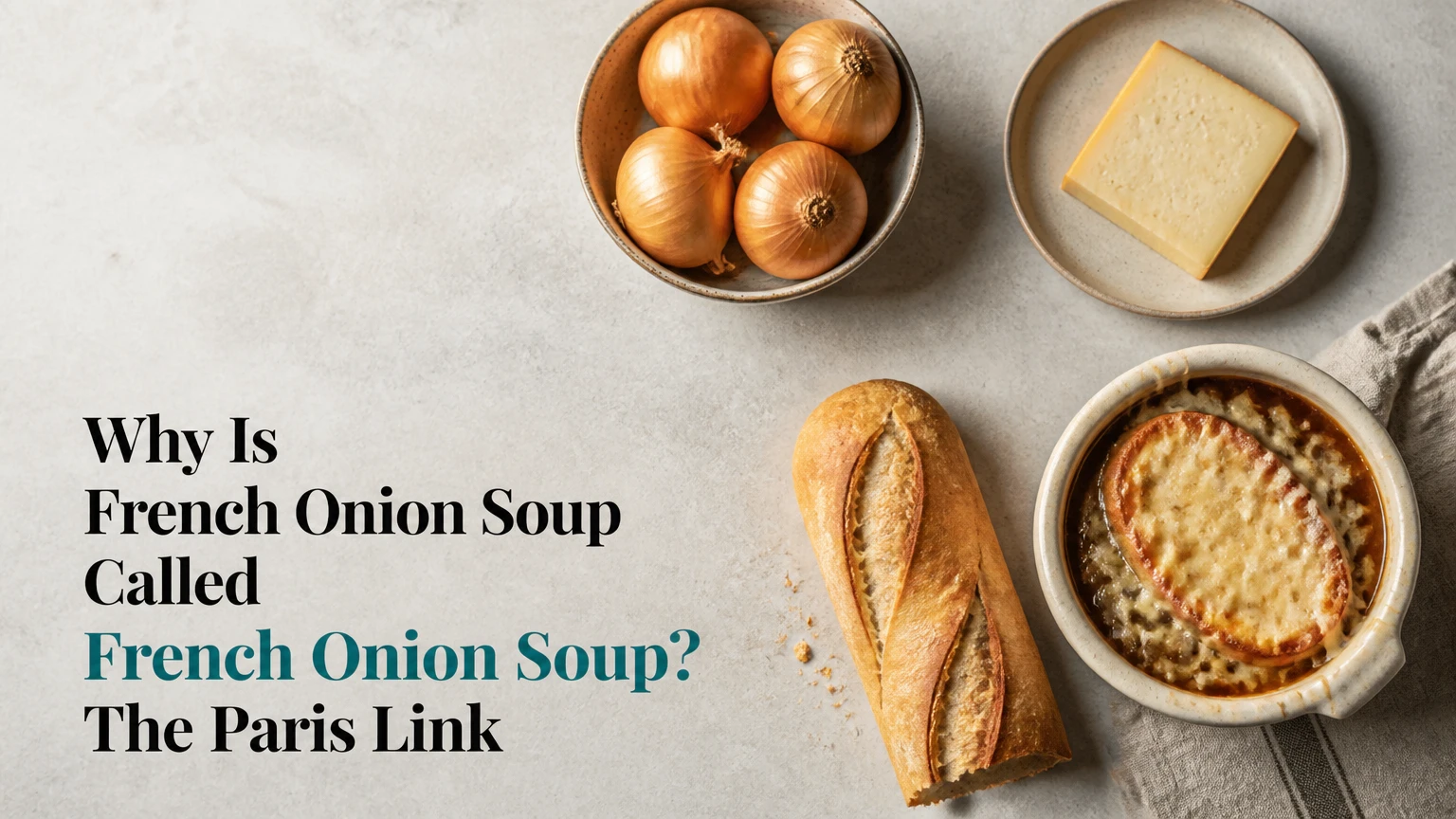
French onion soup is called French onion soup because the modern dish is identified with French cooking, especially the Parisian soupe à l’oignon gratinée, rather than because France invented every onion soup. Ancient societies ate onion soups, but the French version developed a recognizable combination of slowly browned onions, savory stock, toasted bread, and melted cheese.
Key Facts at a Glance
- French onion soup refers to a French-style onion soup, usually finished with bread and browned cheese.
- The French name soupe à l’oignon gratinée means onion soup finished under heat until its topping browns.
- Roman-era onion soups provide historical precedent, not proof of the modern recipe’s direct origin.
- Parisian markets, particularly Les Halles, helped popularize the soup as an inexpensive late-night meal.
- “French” describes the dish’s culinary identity and technique; it does not mean every ingredient originated in France.
- The deepest flavor comes from controlled browning, deglazing, and a concentrated broth, not from cheese alone.
What Does French Onion Soup Mean?
French onion soup means an onion soup prepared in a recognizably French style, most often with deeply browned onions, beef or mixed stock, toasted bread, and a cheese crust. The classic restaurant presentation is soupe à l’oignon gratinée, in which the filled bowl goes under a broiler or salamander.
The name therefore contains two pieces of information. “Onion soup” identifies the principal ingredient, while “French” signals the culinary tradition, flavor profile, and serving method associated with France. A plain broth containing boiled onions is onion soup, but it is not automatically French onion soup.
The style is especially associated with Paris. English-speaking cookbooks and restaurants adopted “French onion soup” as the practical translation of the French dish, even though French speakers generally use soupe à l’oignon or soupe à l’oignon gratinée.
What Makes It French?
The French identity comes from a combination of technique and presentation:
- Onions are cooked slowly until sweet, brown, and concentrated.
- The browned cooking residue is deglazed with wine, stock, or another liquid.
- The soup is served with a toasted bread slice and a browned cheese topping.
- The result is presented as a composed first course, rather than as a basic household broth.
No single ingredient proves that a bowl is French. Gruyère is strongly associated with the dish, but Comté, Emmental, Beaufort, and sometimes Parmesan appear in French and international versions.
When Did the Modern Dish Appear?
The modern French onion soup has ancient antecedents but no universally accepted inventor or single birth date. Onion soups existed in Roman cooking and remained practical across Europe because onions were inexpensive, stored well, and added sweetness to otherwise modest meals.
French culinary history usually places the recognizable Parisian form within the early modern period, with its strongest cultural association developing in the 18th and 19th centuries. The Larousse Gastronomique treats onion soup as an established French preparation, while culinary historians generally distinguish the broad family of onion soups from the later gratinée topped with bread and cheese.
A popular story credits Stanislas Leszczyński, the former king of Poland and father-in-law of Louis XV, with encountering onion soup at an inn near Châlons and bringing the recipe to Versailles. The story appears in culinary tradition, but it should be treated as an origin legend rather than conclusive documentation.
Did Roman People Eat French Onion Soup?
Roman people ate onion-based soups, but they did not eat the modern French onion soup known today. Roman precedent establishes that onions were used in broths long before France existed as a modern nation; it does not establish an uninterrupted recipe lineage.
The distinction matters because “originated from an ancient ancestor” and “was invented in ancient Rome” are different claims. The modern dish depends on later French techniques, restaurant presentation, and the gratinée topping.
| Historical layer | Approximate period | What it establishes | What it does not establish |
|---|---|---|---|
| Roman onion broths | Antiquity | Onions were used in inexpensive soups | The modern cheese-topped recipe |
| French onion preparations | 17th-18th centuries | Onion soup entered French culinary writing and practice | A certain inventor |
| Parisian popularization | 18th-19th centuries | Markets and eateries made the dish widely recognizable | That Paris created all onion soups |
| International restaurant style | 19th-20th centuries | Bread and browned cheese became defining markers abroad | One fixed global recipe |
Why Is French Onion Soup Associated With Paris?
French onion soup became associated with Paris because market workers, travelers, and late-night customers encountered hearty onion soup around the city’s food markets, especially Les Halles. The association combines documented urban food culture with later storytelling, so Les Halles is best described as a center of popularization rather than the certain birthplace of the recipe.
Les Halles was Paris’s central wholesale market until its dismantling in the 1970s. Its long trading hours supported cafés and vendors serving filling foods to workers and nighttime customers. Onion soup suited that setting because onions were inexpensive, stock could be prepared in quantity, and bread and cheese turned a liquid dish into a substantial meal.
The market connection also explains why the soup acquired a restorative reputation. A bowl served hot after work or drinking was salty, fatty, sweet, and carbohydrate-rich. Those properties made it satisfying, although the popular idea that French onion soup medically cures a hangover is not a clinical claim.
Is French Onion Soup a Peasant Dish or a Restaurant Dish?
French onion soup has both a humble household history and a restaurant identity. Onions and bread made the original type economical, while long browning, good stock, and a carefully browned cheese crust later gave the dish a more elaborate culinary presentation.
That dual identity remains visible today. A home cook can make a credible version with yellow onions and supermarket stock, but a restaurant may use veal stock, aged Comté, toasted baguette, and individual ceramic crocks. The dish is inexpensive at its base and labor-intensive in execution.
How Do the Onions Create the Flavor?
French onion soup gets its characteristic flavor from moisture loss, sugar concentration, caramelization, and Maillard browning. Those reactions overlap during cooking, but they are not identical: caramelization breaks down sugars through heat, while the Maillard reaction involves reducing sugars reacting with amino compounds.
Raw onions contain roughly 85-90% water, depending on variety and growing conditions. As water evaporates, the onions collapse and their natural sugars become more concentrated. The onions may take 45-90 minutes to reach a deep brown stage in a heavy pot, depending on quantity, pan width, heat, and stirring.
A common simplified explanation says that onion sugar caramelizes at exactly 160°C or 320°F. That is misleading because the onion mass remains near the boiling point of water for much of the early cooking, and different sugars and surface conditions brown across different temperatures.
Are Caramelization and the Maillard Reaction the Same?
Caramelization and the Maillard reaction are separate browning processes that can occur together in French onion soup. Onion sugars contribute to caramelization, while amino compounds in the onions and concentrated cooking surface contribute to Maillard browning.
The practical consequence is more useful than a single temperature. Keep the pan hot enough to evaporate water and brown the onions, but not so hot that the exposed sugars scorch before the interior softens. Black flecks indicate burning, not superior caramelization.
Julia Child’s Mastering the Art of French Cooking gives the practitioner’s rule in direct terms: “The onions must be cooked slowly.” That instruction captures the central technique better than an exact clock time, because a wide pan may brown onions faster than a crowded Dutch oven.
Which Ingredients Define the Classic Version?
The classic French onion soup profile uses yellow or white onions, butter or another cooking fat, beef or veal stock, a small amount of wine or fortified wine, bread, and a firm melting cheese. Thyme and bay leaf are common seasonings, while garlic and flour vary by recipe.
Stock determines the soup’s body more than most home cooks expect. Gelatin-rich beef or veal stock gives a rounder mouthfeel, while chicken stock produces a lighter, cleaner result. A mixed stock can preserve savoriness without making the bowl excessively dark or heavy.
| Component | Common classic choice | Typical quantity for 4 servings | Functional role |
|---|---|---|---|
| Onions | Yellow onions | 1.2-1.6 kg | Sweetness and volume |
| Cooking fat | Unsalted butter | 45-60 g | Browning and aroma |
| Stock | Beef, veal, or mixed stock | 1.2-1.5 L | Salinity and body |
| Deglazing liquid | Dry white wine or sherry | 120-180 ml | Lifts fond and adds acidity |
| Bread | Baguette or country loaf | 4 slices, 2 cm thick | Structural topping |
| Cheese | Gruyère, Comté, or Emmental | 160-220 g | Melted gratin crust |
Why Is Gruyère Used?
Gruyère is used because it melts evenly, browns well, and provides nutty, savory flavor without becoming excessively oily. French versions also use Comté, Emmental, or Beaufort, so Gruyère is traditional and practical rather than mandatory.
Cheese choice changes the topping’s behavior. Young Gruyère melts smoothly, aged Comté adds sharper flavor, and low-moisture mozzarella stretches well but lacks the characteristic nutty profile. Cheddar creates a valid adaptation, not the most traditional French result.
| Cheese | Melting behavior | Flavor character | Best use |
|---|---|---|---|
| Gruyère | Smooth, moderate stretch | Nutty, savory | Classic international style |
| Comté | Even melt, strong browning | Fruity, alpine, complex | More distinctly French variation |
| Emmental | Soft melt, mild browning | Mild, milky, nutty | Budget-friendly traditional substitute |
| Beaufort | Creamy melt | Floral, alpine | Rich regional interpretation |
| Provolone | Stretchy, browned edges | Smoky, sharper | Modern bistro adaptation |
What Does Gratinée Mean?
Gratinée means finished with a browned surface, usually created by exposing a dish topped with cheese, breadcrumbs, or both to intense heat. Soupe à l’oignon gratinée therefore means onion soup with a gratin topping, not merely onion soup that happens to contain cheese.
The bread performs two jobs. It adds texture and absorbs enough broth to connect the liquid soup with the cheese crust. A dry baguette slice remains on the surface longer than soft sandwich bread, which quickly becomes saturated and sinks.
A reliable assembly uses hot soup, toasted bread, and 40-50 grams of grated cheese per bowl. The cheese should reach close to the rim so it bonds to the crock and browns as a continuous lid.
How Is the Soup Finished Under the Broiler?
Ladle hot soup into heatproof crocks, place one thoroughly toasted bread slice on each portion, cover the bread with grated cheese, and broil until the top is bubbling with brown spots. Use a baking sheet to move the crocks safely and keep the rims clear of spills.
The broiler must be watched continuously. Cheese can pass from golden to burned in under two minutes, especially under a strong gas or infrared element. The bowl itself also becomes dangerously hot, so serve it on a plate or heatproof mat.
How Long Does French Onion Soup Take?
French onion soup typically takes 1.5-2.5 hours of cooking, plus 15-20 minutes of preparation and 5-10 minutes for final assembly. A four-serving batch commonly uses 1.2-1.6 kilograms of onions, which reduce dramatically during browning.
The cost depends mainly on cheese and stock. A typical homemade batch costs about $12-$25 for four servings in the United States, while restaurant pricing commonly ranges from $9-$18 per bowl, with location and stock quality producing large differences.
| Planning measure | Typical home range | Restaurant range | Main variable |
|---|---|---|---|
| Raw onions for 4 bowls | 1.2-1.6 kg | 180-300 g per bowl | Onion reduction |
| Active preparation | 20-35 minutes | 5-12 minutes at service | Mise en place |
| Onion cooking | 45-90 minutes | 45-120 minutes in batches | Pan size and heat |
| Total home time | 1.5-2.5 hours | Not applicable | Stock preparation |
| Homemade cost | $3-$6 per serving | $9-$18 per bowl | Cheese and broth |
How Is French Onion Soup Different From Onion Soup?
French onion soup is a specific, French-associated style of onion soup, while onion soup is a broader category that includes clear, creamy, spiced, and regional preparations. The French version is usually defined by deeply browned onions and a bread-and-cheese gratinée.
The word “French” is not a guarantee of authenticity. A bowl with lightly softened onions, watery stock, and unmelted cheese may be sold under the name, but it lacks the technique that gives the style its identity.
| Feature | French onion soup | Generic onion soup | Cream of onion soup | Japanese onion soup |
|---|---|---|---|---|
| Onion treatment | Browned 45-90 minutes | Softened or boiled 10-30 minutes | Softened and puréed | Thinly sliced, simmered |
| Base | Beef, veal, or mixed stock | Water or varied stock | Milk, cream, or roux | Dashi or clear stock |
| Topping | Toasted bread and melted cheese | Usually none | Croutons may appear | Scallions or herbs |
| Texture | Clear broth with onion strands | Clear or chunky | Thick and creamy | Clear and delicate |
| Typical flavor | Sweet, savory, toasted | Onion-forward | Rich and mild | Umami, light, aromatic |
Which Variations Still Deserve the Name?
Vegetarian, alcohol-free, gluten-free, and lighter versions can still reasonably be called French onion soup when they retain the defining onion-browning and gratinée structure. Removing beef stock or wine changes the recipe, but it does not erase the French culinary format.
A vegetarian version benefits from mushroom stock, dried porcini, soy sauce, or a small amount of miso. These ingredients replace some of the savory depth normally supplied by beef or veal. Use them carefully because excess soy or miso can make the soup taste distinctly nontraditional.
An alcohol-free version can deglaze with unsalted stock plus a teaspoon or two of sherry vinegar. Gluten-free diners need certified gluten-free bread and stock, because both packaged broth and bakery products can contain undeclared wheat ingredients.
What Is the Best Broth for French Onion Soup?
Rich beef or veal stock produces the most traditional full-bodied result, while chicken stock makes a lighter soup and mushroom stock provides the strongest vegetarian alternative. The best choice depends on the desired body, dietary restrictions, and salt level.
| Broth choice | Typical flavor | Body | Best situation |
|---|---|---|---|
| Beef stock | Dark, savory, meaty | Medium to high | Traditional restaurant style |
| Veal stock | Rounded, gelatinous | High | Formal classic preparation |
| Chicken stock | Clean, moderate savoriness | Low to medium | Lighter home version |
| Mushroom stock | Earthy, umami-rich | Low to medium | Vegetarian adaptation |
What Commonly Goes Wrong?
The most common failures are rushed onions, scorched fond, weak stock, soggy bread, and cheese that burns before the soup is hot. Each problem has a specific correction, and adding more cheese rarely repairs a poorly developed broth.
Rushed onions remain pale and sharp because their water has not evaporated. Scorched onions contain black, bitter particles that spread through the entire soup after deglazing. Soft bread disappears because it absorbs broth faster than the cheese topping can stabilize it.
How Can You Fix Bitter Onions?
Bitter onions cannot be fully repaired once a large amount has burned, but mild scorching can sometimes be reduced by transferring the unburned onions to a clean pot and leaving the black residue behind. Do not scrape black fond into the stock.
The practitioner’s visual checkpoint is a uniform deep gold to mahogany color, not a mixture of pale slices and black fragments. A tablespoon of water can loosen a sticking pan during browning, but water does not rescue burnt sugar.
Why Does the Bread Sink?
Bread sinks when it is too soft, too thin, or insufficiently toasted before assembly. Use 2-centimeter slices from a day-old baguette, toast them until dry through the center, and place them on soup that is already fully hot.
Cheese coverage also matters. A cheese layer reaching the crock’s inner edge forms a structural seal around the bread, which slows liquid absorption and keeps the topping intact until serving.
Can You Prepare French Onion Soup Ahead?
French onion soup is well suited to advance preparation because the onions and broth can be cooked one or two days before service. Store the cooled broth in a covered refrigerator container, then reheat it thoroughly before adding bread and cheese.
Keep the topping separate. Toasted bread becomes soggy in stored soup, and pre-melted cheese loses its crisp browned surface. Assemble individual portions immediately before broiling, which preserves the contrast between liquid broth, resilient bread, and molten cheese.
Refrigerated soup should be cooled promptly in shallow containers and reheated until steaming throughout. A typical home batch keeps for 3-4 days under proper refrigeration, although the exact safe period depends on refrigerator temperature and handling.
How Can You Judge an Authentic Bowl?
An authentic-tasting French onion soup has sweet, concentrated onion flavor, a savory broth with enough acidity to prevent heaviness, and a topping that remains distinct from the liquid. The onions should taste developed rather than raw, sugary, or burnt.
Use this five-point check when ordering or evaluating a recipe:
- Onion color: deep golden brown, with no widespread black scorching.
- Broth strength: savory and concentrated, not simply salty.
- Acidity: wine, sherry, or another acidic element prevents a flat finish.
- Bread structure: toasted enough to hold its shape for several minutes.
- Cheese crust: fully melted, browned, and attached to the rim.
The label alone is weak evidence. Technique supplies the identity.
Frequently Asked Questions
Is French onion soup actually from France?
Yes, the modern culinary style is French and is especially associated with Paris, but France did not invent the general idea of cooking onions in broth. Ancient Roman and other European onion soups supplied broad precedents, while the French version developed its own browned-onion, stock, bread, and cheese presentation.
Who invented French onion soup?
No inventor has been conclusively established. A popular tradition credits Stanislas Leszczyński with introducing an onion soup to Versailles, but historians treat that account cautiously. The modern dish emerged through gradual culinary development rather than a securely documented single invention.
Why is cheese put on French onion soup?
Cheese creates the gratinée topping that distinguishes the classic presentation from plain onion soup. Gruyère, Comté, Emmental, or Beaufort melts over toasted bread, browns under intense heat, and adds fat and savory flavor to the concentrated onion broth.
Does French onion soup always contain beef broth?
French onion soup does not always contain beef broth. Beef or veal stock gives the most traditional rich profile, but chicken, vegetable, and mushroom broths are valid adaptations. A vegetarian version remains recognizable when it preserves slowly browned onions, toasted bread, and a melted cheese topping.
Is French onion soup healthy?
French onion soup can provide vegetables and fluid, but restaurant portions may contain substantial sodium, butter, bread, and cheese. A typical serving’s nutrition varies too widely for one reliable figure, so people managing sodium, saturated fat, or gluten should inspect the stock, bread, and cheese choices.
The Bottom Line
French onion soup is called French onion soup because the modern browned-onion, stock-based, bread-and-cheese preparation belongs to French culinary tradition, particularly the Parisian soupe à l’oignon gratinée. Ancient onion soups explain the ingredient’s long history, but France supplied the recognizable technique and presentation. That is why why is french onion soup called french onion soup has a culinary answer rather than a purely linguistic one: “French” identifies the style, not the exclusive origin of onions or soup.