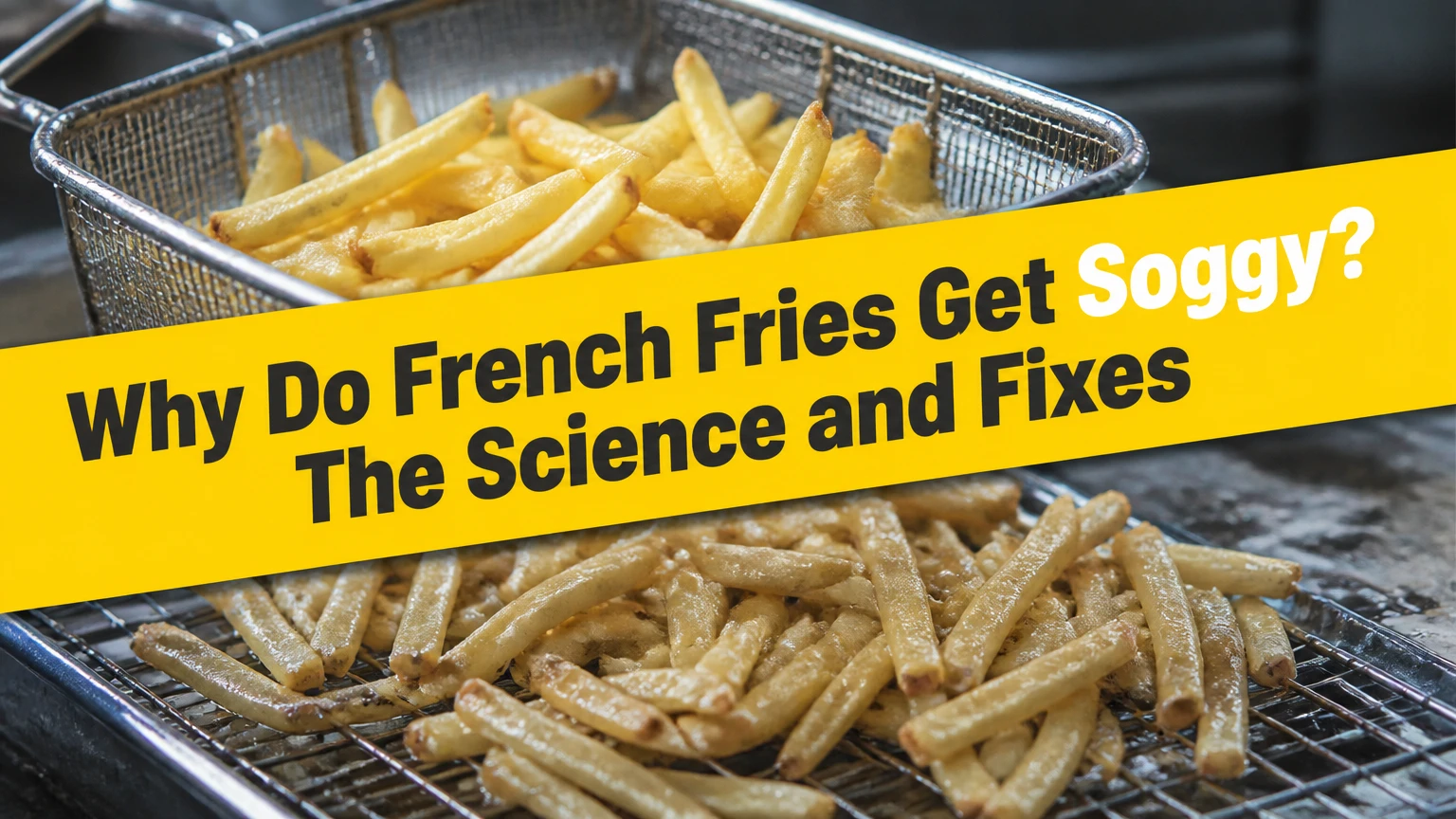
French fries get soggy because moisture moves from the hot potato interior into the dry, crisp crust as the fry cools. Steam and condensation rehydrate the starch structure that created the crunch, while sealed packaging traps water against the surface. Low frying temperatures, overcrowding, thick cuts, and excess oil accelerate the same texture failure.
Key Facts at a Glance
- A raw potato is typically about 80% water by weight, according to USDA FoodData Central entries for common raw potatoes.
- French fry crispness comes from a dry, porous starch crust surrounding a moist, cooked center.
- Moisture migration is the main reason a crisp fry softens during cooling.
- A sealed plastic container can make fries limp faster than an open paper bag because escaping steam condenses inside.
- Double frying works because the first fry cooks the center and the second fry rapidly dries the surface.
- Microwave reheating usually softens fries because it heats internal water without efficiently drying the crust.
Why Do French Fries Get Soggy?
French fries get soggy when water leaves the cooked potato center and rehydrates the crust. Freshly fried potatoes have a hot, moist interior and a comparatively dry exterior; during cooling, vapor moves through the potato’s pores, then condenses or binds to gelatinized starch at the surface.
The crisp shell is not a permanent coating. It is a fragile structure made from dehydrated potato cells, gelatinized starch, small pores, and a thin layer of frying oil. When water enters those pores, the starch becomes flexible instead of brittle, so the fry bends rather than snaps.
Container design determines how quickly that happens. Fries placed in a sealed box create a humid microclimate, while fries spread on a wire rack allow vapor to escape. The difference can appear within 5-15 minutes, depending on cut thickness, serving temperature, humidity, and packaging.
What happens inside a fry?
A fried potato has two texture zones: a dry crust and a moist core. Heat gelatinizes starch and softens the potato’s internal cell structure, while surface evaporation removes water and leaves behind a rigid, porous layer.
As the fry cools, the temperature difference between the center and exterior decreases. Steam moves toward cooler regions, and the surface absorbs some of that moisture. Condensed liquid water is even more damaging because it wets the crust directly instead of passing gradually through the structure.
The result is a familiar progression: crisp, then leathery, then limp. Oiliness can accompany the change, but oil is not the primary cause of ordinary post-frying sogginess.
How Does Moisture Migration Destroy Crispness?
Moisture migration destroys crispness by changing dry, glassy starch into hydrated, flexible starch. The process begins as soon as a French fry leaves the fryer, although the visible texture change may take several minutes.
Step 1: Frying creates a moisture gradient
During frying, water near the potato surface turns into vapor and escapes. The interior remains wetter because its distance from the hot oil and crust slows evaporation.
The surface therefore contains less water than the center. This gradient creates the conditions for later moisture movement.
Step 2: Cooling changes vapor movement
A fry fresh from oil can exceed 150°C at the surface, while its center remains close to the boiling point of water. Once removed, the surface cools rapidly through contact with air, a plate, or packaging.
Hot vapor moves through the crust toward cooler areas. If the surrounding air is humid or the container is closed, the vapor has nowhere effective to escape.
Step 3: The crust absorbs water
Gelatinized potato starch holds its crisp shape only while sufficiently dry. Water plasticizes the starch, meaning it makes the molecular structure more flexible and less brittle.
This is why a small amount of moisture can eliminate a strong crunch without making the fry visibly wet. The crust’s internal structure has changed before droplets appear.
Step 4: Condensation adds surface water
Steam that contacts a cooler lid, bag wall, or foil surface can condense into liquid water. Those droplets fall back onto the fries and create localized soft spots.
The bottom layer usually suffers first because it contacts a plate or container floor. A wire rack prevents that contact and gives vapor a route out.
Is starch retrogradation the main cause?
Starch retrogradation contributes to the stale, firm, or rubbery texture of older fries, but it is not the main explanation for fries becoming limp within 10 minutes. Immediate sogginess mainly results from moisture redistribution and condensation.
Retrogradation occurs as cooked starch molecules reorganize during cooling and storage. It matters more after refrigeration or extended holding, when fries become stale rather than simply soft. Reheating can remove some water, but it cannot fully rebuild the original potato-cell structure.
Which Frying Variables Make Fries Soggy?
Oil temperature, batch size, potato variety, cut thickness, and surface drying determine how much moisture and oil remain in a French fry. A properly fried potato has a cooked center, a dry crust, and limited oil retention.
Why does overcrowding cause greasy fries?
Overcrowding causes greasy fries because a large load of cold potatoes absorbs heat faster than the oil can replace it. When oil temperature drops, water escapes more slowly, the crust takes longer to dry, and the potato spends more time in contact with oil.
For home frying, a typical practical rule is to keep potatoes below roughly one-quarter to one-third of the oil’s surface area. A thermometer is more reliable than visual bubbling. Many batches perform well with a first fry around 150-165°C and a second fry around 180-190°C, although exact settings vary by cut and equipment.
The most useful diagnostic is texture. Fries that are pale, limp, and greasy immediately after frying usually experienced insufficient heat or an overloaded batch.
Does the potato variety matter?
Potato variety matters because starch content and dry matter influence crust formation. Russet Burbank and similar high-dry-matter potatoes usually produce a fluffier interior and a drier, more durable crust than waxy red or new potatoes.
High-water potatoes can still make good fries, but they release more moisture during cooking and often need more surface drying. Frozen commercial fries compensate through controlled blanching, drying, par-frying, and sometimes coatings.
Does thickness change the sogginess timeline?
Thickness changes the moisture reservoir inside each fry. Thin shoestring fries have a high surface-area-to-volume ratio, so they crisp quickly but cool and soften quickly. Thick wedges retain heat longer but contain more internal water that can eventually migrate outward.
| Fry style | Typical crisp window | Internal texture | Main failure mode |
|---|---|---|---|
| Shoestring, 3-5 mm | 5-10 minutes | Thin, low-moisture center | Rapid cooling |
| Standard, 8-10 mm | 10-20 minutes | Fluffy center | Steam softening crust |
| Steak fry, 15-20 mm | 15-25 minutes | Dense, moist center | Internal moisture migration |
| Wedge, 20-30 mm | 15-30 minutes | Large tender core | Wet interior and soft skin |
| Battered, 8-12 mm | 20-45 minutes | Coated, crisp shell | Coating absorbs vapor |
These are typical serving ranges, not laboratory guarantees. A humid kitchen, closed container, or crowded fryer can shorten every window.
How Can You Keep French Fries Crispy?
Keep fries crispy by reducing surface moisture, controlling oil temperature, frying in small batches, and venting steam immediately after cooking. The most reliable home method is a two-stage fry followed by brief draining on a rack rather than on absorbent paper.
What is the best home frying method?
Use high-starch potatoes, uniform cuts, thorough drying, and two frying stages.
- Cut evenly. Make fries about 8-10 mm thick so pieces finish at similar times.
- Rinse or soak. Place cut potatoes in cold water for 20-30 minutes to remove loose surface starch.
- Dry completely. Pat with towels and air-dry until no visible water remains. Wet potatoes cause dangerous oil spatter and delay crust formation.
- First-fry the centers. Fry at approximately 150-165°C for 4-7 minutes, depending on thickness, until the potatoes are tender but lightly colored.
- Cool the fries. Rest them on a rack for at least 10 minutes. A longer 20-30 minute rest can improve separation between cooking stages.
- Finish at higher heat. Fry at approximately 180-190°C for 2-4 minutes until golden and crisp.
- Drain and season. Use a wire rack for 1-2 minutes, then salt while the surface still carries a thin film of oil.
You will know the method worked when the exterior resists bending and the interior breaks into a fluffy, moist crumb. A common mistake is placing the first batch directly into a bowl, where trapped steam softens the underside before the second batch finishes.
Should fries drain on paper towels or a rack?
A wire rack is usually better than a flat layer of paper towels because it exposes the bottom surface to air. Paper towels remove some surface oil, but they also hold the fries against a humid, warm surface.
For a small batch, use a rack over a sheet pan. For a very large batch, spread the fries in one layer rather than piling them, because stacked fries create their own steam pocket.
Does salting early make fries soggy?
Salting immediately after frying is best. Salt applied hours before frying can draw water toward the potato surface and increase wetness, but salt sprinkled shortly before serving is not normally responsible for rapid sogginess.
The more important seasoning issue is timing after frying. Salt dissolves in surface moisture, so heavily salted fries can feel less crisp as the salt solution spreads across the crust. Season lightly in the fryer basket or immediately after draining.
Which Packaging Keeps Fries Crisp?
Vented packaging keeps fries crisp longer because it allows steam to escape instead of converting into liquid water. No package preserves restaurant-fryer crispness indefinitely because every fry contains a moist center.
| Container or handling method | Steam escape | Typical result after 15 minutes | Best use |
|---|---|---|---|
| Open wire rack | Very high | Crispest surface | Immediate serving |
| Vented cardboard carton | High | Moderately crisp | Short delivery |
| Open paper bag | Medium-high | Some softening | Transport under 15 minutes |
| Closed cardboard box | Low | Soft bottom and lid-side crust | Short holding only |
| Foil wrap | Very low | Steamed, limp crust | Keeping food hot briefly |
| Plastic or foam clamshell | Very low | Condensation and sogginess | Avoid for crisp fries |
A restaurant should leave headspace around the fries and use vents above and below the food. A diner can improve takeout texture by opening the bag slightly during transport, transferring fries to a rack on arrival, and reheating them uncovered.
Packaging improves the odds, but it cannot solve a poor fry. Fries placed in a vented box while still pale and oil-heavy will remain disappointing.
What Is the Best Way to Fix Soggy Fries?
The best way to fix soggy fries is to reheat them uncovered with dry, circulating heat. An air fryer is usually the fastest household option, while a hot oven handles larger quantities more evenly; neither method restores fries that have absorbed large amounts of water.
| Reheating method | Setting and time | Best quantity | Expected texture |
|---|---|---|---|
| Air fryer | 190-205°C for 3-6 minutes | 1-2 servings | Crispest recovery |
| Convection oven | 220°C for 5-10 minutes | 2-4 servings | Even, moderately crisp |
| Skillet | Medium-high heat, 4-8 minutes | 1-2 servings | Crisp edges, uneven center |
| Deep fryer | 180-190°C for 60-120 seconds | Large batches | Closest to fresh frying |
| Microwave | High power, 30-90 seconds | 1 serving | Soft, sometimes chewy |
Preheat the air fryer or oven, spread fries in one layer, and avoid adding oil unless the fries are visibly dry. Shake or turn them halfway through heating. A microwave is useful for warming the interior, but it usually increases softness because it does not provide enough dry airflow.
How do you fix delivery fries?
Transfer delivery fries from the closed container to a rack as soon as possible. Reheat at 200°C in an air fryer for approximately 3-5 minutes, or at 220°C in a convection oven for 5-8 minutes.
Do not rinse the fries, cover them with foil, or pile them into a deep dish. Those actions retain water. Fries that are merely soft can recover; fries that are saturated, cold, and heavily oil-laden may remain greasy after reheating.
For food safety, reheat promptly rather than leaving cooked potatoes at room temperature for extended periods. Crispness is a quality issue, but time and temperature control still determines whether leftovers are safe to eat.
Why Are Fries Soggy Straight Out of the Fryer?
Fries that are soggy straight out of the fryer usually have insufficient surface dehydration, an overloaded batch, wet potatoes, or oil temperature that recovered too slowly. The problem differs from post-frying sogginess because the crust never became dry and rigid in the first place.
| Symptom | Likely cause | Corrective action | Verification |
|---|---|---|---|
| Pale and limp | Oil below target temperature | Fry a smaller batch at 180-190°C for finishing | Golden, rigid crust |
| Dark outside, hard inside | Oil too hot or cut too thick | Lower heat and extend first fry | Tender center |
| Greasy surface | Temperature crash or long frying time | Reduce load and use fresh, hot oil | Dry surface after draining |
| Crisp top, wet bottom | Flat bowl or stacked fries | Use a rack and single layer | Air reaches underside |
| Uneven color | Irregular cuts or crowded basket | Cut uniformly and separate pieces | Similar color across batch |
| Fast softening | Sealed container or humid room | Vent packaging and serve on rack | Steam visibly escapes |
A thermometer should measure the oil, not the fryer wall or basket. Oil can read 190°C before potatoes enter and fall substantially after a large load is added.
Can air frying prevent sogginess?
Air frying can produce crisp fries when the pieces are dry, lightly coated, and arranged with space between them. It cannot remove moisture efficiently from a crowded basket, and it usually produces a thinner crust than deep frying because the potato has less direct oil contact.
For frozen fries, follow the package temperature but shake the basket frequently. For fresh-cut fries, dry them carefully and use a small amount of oil, typically 1-2 teaspoons per 500 grams of potatoes. Crowding is the most common air-fryer failure.
How Do Different Fry Types Resist Sogginess?
Battered or starch-coated fries usually resist surface softening longer than plain fries because the coating creates a thicker, drier barrier. Shoestring fries become crisp fastest but lose heat fastest, while thick fries remain hot longer and hold more moisture.
Commercial frozen fries often outperform raw hand-cut fries during holding because manufacturers control cut size, blanching, par-frying, freezing, and coating. That advantage comes with a trade-off: coatings can add a distinct crunch and a less purely potato-like texture.
| Preparation | Typical hold time | Texture advantage | Limitation |
|---|---|---|---|
| Hand-cut, single-fried | 5-10 minutes | Fresh potato flavor | High moisture variability |
| Hand-cut, double-fried | 10-20 minutes | Strong crust and fluffy center | More labor and oil |
| Frozen plain fries | 10-20 minutes | Consistent size | Can dry out during overcooking |
| Starch-coated frozen fries | 20-45 minutes | Extended surface crunch | Coating changes bite |
| Beer-battered fries | 20-40 minutes | Thick protective shell | Heavy, less potato-forward |
These ranges describe typical serving performance under open or vented conditions. Closed packaging can reduce the practical advantage of every preparation.
What Mistakes Make Fries Soggy?
The most damaging mistakes are trapping steam, frying too many pieces at once, skipping the drying stage, and reheating with moist heat. Each mistake changes a different part of the texture system.
- Sealing fries immediately: Condensation wets the crust. Use vented packaging or leave the container partially open.
- Piling fries in a bowl: The lower pieces absorb vapor from the upper pieces. Spread the batch across a rack.
- Skipping the soak and dry: Loose starch can make surfaces gummy, while residual water delays browning and creates spatter.
- Using a microwave for crispness: Microwave energy heats water efficiently but does not dry the exterior.
- Trusting the burner setting: The same dial can produce different oil temperatures in different pans. Use a thermometer.
- Holding fries under a heat lamp too long: Warmth without adequate airflow dries some edges while steam softens other areas.
One counterintuitive rule matters most: hotter is not always better. An excessively hot second fry can brown the exterior before the center has finished cooking, producing dark, rigid edges around an underdone interior.
How Long Do French Fries Stay Crisp?
French fries commonly remain at their best for about 5-20 minutes, depending on cut, frying method, humidity, airflow, and packaging. Thin fries can soften within 5-10 minutes, while double-fried or coated fries may hold a recognizable crunch for 20-45 minutes under favorable conditions.
Fresh fries should be served immediately when possible. For a delayed meal, keep them on a rack in a warm oven around 90-110°C with the door slightly open if the appliance allows it, but avoid long holding because the interior dries and the crust eventually becomes leathery.
Restaurant operators balance crispness against food safety, energy use, and throughput. A heat lamp alone does not stop moisture migration; airflow, vented containers, and a high-recovery fryer address separate parts of the problem.
FAQ
Do fries get soggy because they absorb oil?
Fries can become greasy when oil temperature falls or frying lasts too long, but ordinary cooling sogginess mainly comes from water moving into the crust. Oil and water create different defects: excess oil produces a heavy, slick mouthfeel, while moisture-softened starch produces limpness.
Why do homemade fries get soggy faster than restaurant fries?
Homemade fries often vary in thickness, contain more surface water, and lack the controlled blanching and par-frying used for many commercial frozen products. Restaurants also use larger fryers with stronger temperature recovery and purpose-built vented packaging, although takeout fries still soften during transport.
Does soaking potatoes make fries crispier?
A 20-30 minute cold-water soak can remove loose surface starch that otherwise makes cut potatoes stick and brown unevenly. Soaking does not make fries crisp by itself; potatoes must be dried thoroughly afterward, because residual water delays crust formation and causes oil spatter.
Can you make fries crisp again without oil?
You can restore some crispness without adding oil by reheating fries in a preheated air fryer or convection oven. Dry circulating heat removes surface moisture, but it cannot fully reverse a crust that has collapsed or a fry that has absorbed substantial oil.
Why are the bottoms of fries soggy?
The bottoms become soggy because they contact a plate, bowl, or container floor where steam accumulates and cannot escape. A wire rack solves much of the problem by exposing the underside to air and preventing condensed water from pooling beneath the fries.
Are thicker fries less likely to get soggy?
Thicker fries stay hot longer, but they contain a larger reservoir of internal moisture. They may remain crisp slightly longer than shoestring fries in open air, yet they can soften substantially once that moisture reaches the crust, especially inside sealed packaging.
The Bottom Line
French fries get soggy because cooling drives moisture from the tender potato center into the dry starch crust, while containers often trap the resulting steam as condensation. Small batches, thorough drying, accurate oil temperatures, two-stage frying, wire-rack draining, and vented packaging slow the process. To recover soft fries, use uncovered dry heat rather than a microwave, and serve them quickly after reheating.