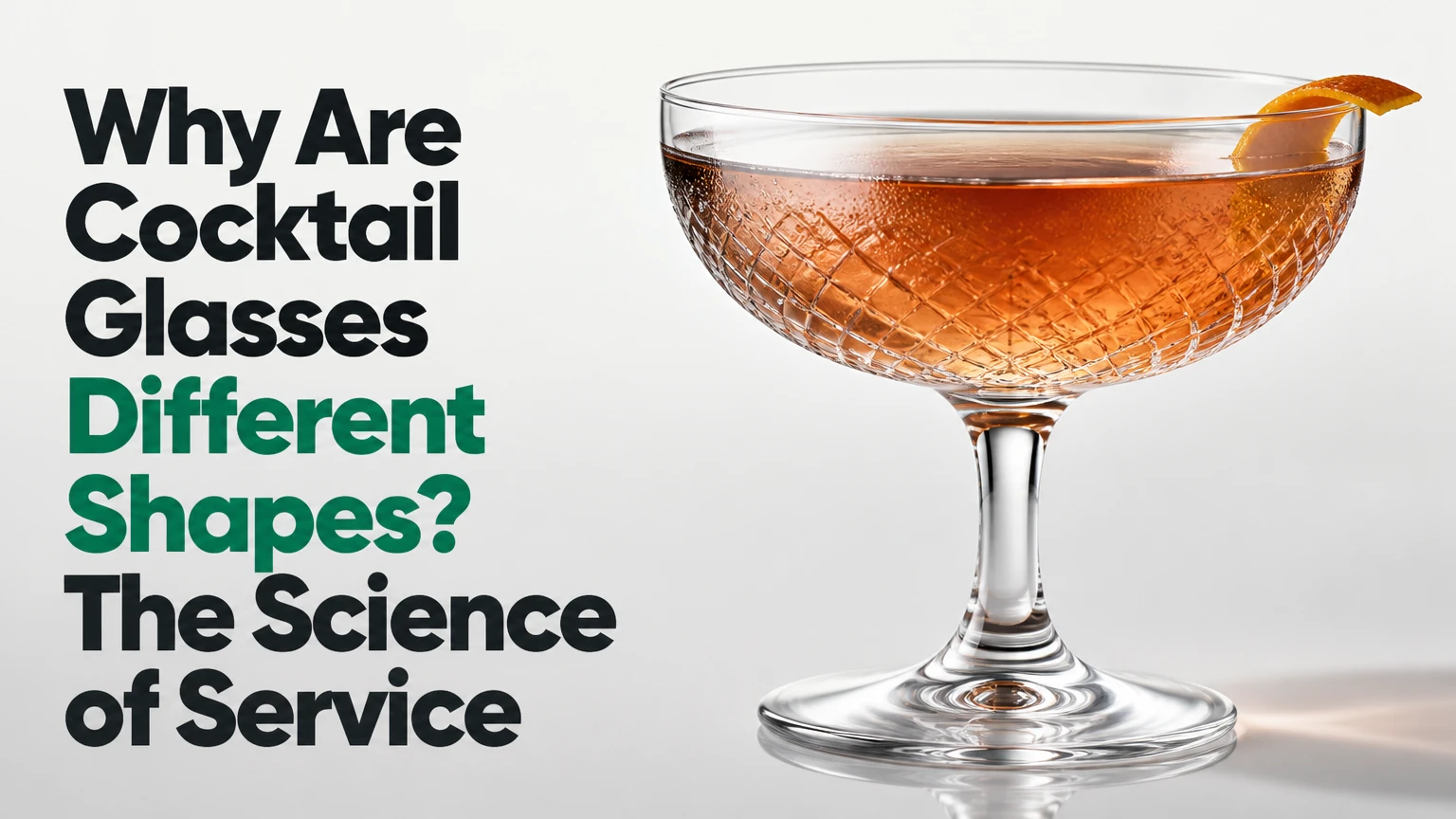
Cocktail glasses have different shapes because each design manages temperature, aroma, carbonation, liquid flow, ice, and drinking stability in a different way. A stem can reduce heat transfer from the hand, a narrow flute-like bowl can retain bubbles, and a broad bowl can release aromas, but glass shape influences experience rather than creating fixed taste zones on the tongue.
Key Facts at a Glance
- Cocktail glass shape changes the drink’s temperature, aroma concentration, carbonation retention, and mouthfeel.
- A stem reduces direct contact between a warm hand and a chilled bowl, but it cannot stop warming indefinitely.
- Tall, narrow highballs usually preserve carbonation longer than wide rocks glasses because they expose less liquid surface area.
- Martini glasses, coupés, and Nick & Nora glasses are designed for cocktails served without ice, usually called “up” drinks.
- A practical cocktail glass should hold the finished drink at roughly 75-85% of its capacity.
- The classic tongue map is inaccurate; glass rims influence flow and posture, not fixed sweet, salty, sour, or bitter zones.
Why Are Cocktail Glasses Different Shapes?
Cocktail glasses are different shapes because cocktails differ in serving temperature, carbonation, aroma, ice format, volume, and alcohol concentration. Glassware creates a controlled interface between the liquid and the drinker: the bowl affects evaporation, the rim affects pouring, the base affects stability, and the stem affects how the hand transfers heat.
Glassware does not change a cocktail’s chemical recipe. It changes how quickly compounds leave the liquid, where the liquid first contacts the mouth, how much air reaches the drink, and how securely the vessel remains on the table. Those changes can be noticeable, especially with aromatic spirits, sparkling mixers, and drinks served very cold.
The design also reflects practical history. Cocktail glasses developed alongside manufactured ice, refrigeration, carbonated mixers, commercial glassmaking, and changing service customs. A pre-Prohibition cocktail may contain 75-100 mL, while a contemporary bar may serve 180-250 mL including dilution and mixer. The same glass cannot present both volumes equally well.
What does glassware change, and what does it not change?
Glassware can change perceived aroma, warming rate, carbonation loss, spill risk, and the tactile sensation of the rim. Glassware cannot repair an unbalanced recipe, prevent dilution after ice melts, or direct liquid to a scientifically fixed taste region.
A wide bowl gives aromatic compounds more access to the air above the drink. A tapered bowl can retain and concentrate some vapors near the nose. A thin rim reduces the amount of glass felt against the lips, while a heavy base improves stability but adds weight and thermal mass.
How Does Glass Shape Control Temperature?
Cocktail glass shape controls temperature mainly through hand contact, exposed surface area, glass mass, and pre-chilling. A stemmed glass moves the gripping point away from the liquid-filled bowl, whereas a tumbler places warm fingers directly against the vessel holding the drink.
Heat transfer still occurs through the surrounding air and the glass itself. A stem is therefore a delay mechanism, not insulation in the strict sense. A chilled Martini in a thin stemmed glass may remain appealing for 10-20 minutes, but the exact period depends on room temperature, glass thickness, drink volume, and whether the drink contains ice.
A 37°C hand is much warmer than a cocktail served at approximately 0-4°C. Direct palm contact creates a strong temperature gradient, particularly when the glass is thin and the drink volume is small. A thick rocks glass slows short-term warming through greater thermal mass, although the hand eventually heats its outside surface.
Which drinks benefit most from a stem?
Stemmed glasses benefit small, cold drinks served without ice, including Martinis, Manhattans, Daiquiris, and Sidecars. These drinks depend on remaining cold after straining because there is no remaining ice to absorb hand heat or maintain the serving temperature.
Stemware is less important for a drink built over ice. In a Negroni served on a large cube, the ice controls temperature and dilution while the drinker often holds the base or sides briefly. A stemmed vessel can still improve presentation, but its thermal advantage is smaller.
Pre-chilling produces a larger immediate benefit than choosing a stem alone. Fill the glass with ice and cold water for 2-5 minutes, or place suitable glassware in a refrigerator for 15-30 minutes. Never add ice to a hot glass directly from a dishwasher because uneven contraction can crack or shatter it.
How Does Shape Change Aroma?
Cocktail glass shape changes aroma by controlling liquid surface area, headspace, vapor concentration, and the distance between the drink and the nose. A broad bowl exposes more liquid, while a tapered opening holds volatile compounds closer to the drinker’s nose during a sip.
Ethanol evaporates readily and carries aromatic compounds from gin botanicals, citrus oils, vermouth, whisky esters, and bitters. A wide coupé can release citrus and fruit aromas quickly, but the same exposure may make a delicate drink seem more alcoholic or cause its aroma to dissipate sooner.
A Glencairn or snifter uses a bulbous lower bowl and a narrowed rim. The bowl provides headspace for swirling, while the opening concentrates vapors near the nose. That geometry suits neat whisky or brandy better than a carbonated cocktail, because swirling accelerates bubble loss.
The sensory effect is not determined by width alone. Liquid temperature, alcohol strength, garnish, agitation, and fill level alter aroma more dramatically than small differences between premium glass shapes. A lemon expression over a Martini adds a burst of oil at the surface, while a large amount of empty glass above a small pour dilutes the visual and aromatic impression.
Does a wider rim always make a cocktail better?
A wider rim does not always improve a cocktail. Wide openings help drinkers smell botanical, citrus, and fruit notes, but they increase surface exposure, spill risk, and the speed of carbonation loss.
A narrow opening can make a high-proof spirit seem more concentrated because ethanol vapors accumulate near the nose. Some drinkers prefer that concentration; others experience it as alcohol burn. Glass selection should match the intended aroma profile rather than maximize openness in every case.
Does a Glass Send Liquid to Taste Zones?
A glass does not reliably send liquid to fixed taste zones because the traditional tongue map is scientifically inaccurate. Sweet, sour, salty, bitter, and umami receptors are distributed across the tongue, so rim design influences flow, posture, and sip size rather than assigning a cocktail to one taste area.
A flared rim may encourage a broader, faster sip, while a narrow rim can produce a smaller, more concentrated stream. The drinker’s head angle, lip position, cocktail viscosity, rim thickness, and drinking speed also affect the first mouth sensation.
Rim geometry still matters. A thin, cleanly cut rim usually feels less intrusive than a thick rolled rim. A curved rim can direct liquid smoothly across the lips, while a sharp or uneven rim can make a polished cocktail feel clumsy.
A 2013 review in Chemical Senses by Linda Bartoshuk and colleagues helped reinforce that taste perception does not follow the simplistic tongue-map model. The practical conclusion is precise: glassware changes delivery and perception, but it does not route sweetness to one exclusive tongue section.
Why Are Highballs Tall and Narrow?
Highballs are tall and relatively narrow because their drinks contain a large proportion of carbonated mixer, long ice, and liquid volume that benefits from a smaller exposed surface. Less exposed surface generally slows carbon dioxide escape compared with a wide, shallow tumbler.
A Collins glass commonly holds about 300-420 mL, while a smaller highball often holds 240-350 mL. The tall format accommodates a vertical column of ice that chills the drink and reduces the amount of free liquid exposed directly to warm air.
Carbonation also depends on nucleation sites, agitation, temperature, pressure, and the mixer’s original carbonation. Scratched glass, rough ice, vigorous stirring, and a warm drink release carbon dioxide faster. A narrow glass cannot preserve bubbles indefinitely.
A champagne flute uses the same broad principle, although sparkling wine and sparkling cocktails have different service requirements. The narrower column slows surface loss, while intentional nucleation points in some glass bases create a visible stream of bubbles.
What makes a highball lose carbonation quickly?
A highball loses carbonation quickly when it is warm, over-stirred, poured into a wide glass, or served with excessive headspace. Crushing or shaking a carbonated drink is especially risky because pressure changes and agitation drive carbon dioxide out before the drink reaches the table.
Pour the chilled mixer last, stir gently for about 5-8 seconds, and serve immediately. Keep the glass cold, use intact ice, and leave enough room for a controlled pour without creating a large unstable foam cap.
Which Glass Fits Each Cocktail?
The best cocktail glass matches the drink’s final volume, ice requirement, carbonation, aroma, and service speed. The table below uses typical capacities and retail prices in the United States; prices vary by brand, crystal content, decoration, and whether glasses are sold individually or in sets.
| Glass style | Typical capacity | Best cocktail formats | Main design advantage | Typical price per glass |
|---|---|---|---|---|
| Martini, V-shaped | 150-240 mL | Martini, Manhattan, Cosmopolitan | Wide aroma exposure and formal presentation | $5-$35 |
| Coupé | 180-300 mL | Daiquiri, Sidecar, French 75 | Curved bowl reduces spills compared with steep V walls | $6-$40 |
| Nick & Nora | 120-180 mL | Martini, Manhattan, Last Word | Small bowl, stable footprint, concentrated aroma | $7-$35 |
| Highball or Collins | 300-420 mL | Gin and tonic, Mojito, Tom Collins | Tall ice column and carbonated mixer capacity | $4-$25 |
| Rocks or double old fashioned | 240-360 mL | Negroni, Old Fashioned, Whiskey Sour | Stable base and large-cube capacity | $4-$40 |
| Snifter or Glencairn | 175-250 mL | Brandy, whisky, neat spirits | Tapered opening concentrates aroma | $8-$50 |
How do Martini, coupé, and Nick & Nora glasses differ?
Martini, coupé, and Nick & Nora glasses all serve strained cocktails without ice, but their bowl geometry creates different trade-offs. Martini glasses have a wide, steep V bowl and a high visual profile; coupés have a broad curved bowl; Nick & Nora glasses have a smaller, taller, often bell-shaped bowl.
| Feature | Martini glass | Coupé glass | Nick & Nora glass |
|---|---|---|---|
| Typical capacity | 150-240 mL | 180-300 mL | 120-180 mL |
| Spill resistance | Low to moderate | Moderate to high | High |
| Aroma exposure | High | High | Moderate to high |
| Best finished drink volume | 90-150 mL | 100-180 mL | 75-120 mL |
| Crowded-bar stability | Low | Moderate | High |
| Common substitution | Coupé or Nick & Nora | Martini or Nick & Nora | Small wine or coupé |
The Martini glass is visually distinctive but poorly suited to walking guests or uneven tables because its wide rim increases sloshing. A coupé is more forgiving, while a Nick & Nora often gives the best balance of aroma, capacity, and spill control for classic cocktails.
Why are rocks glasses short and heavy?
Rocks glasses are short and heavy because spirit-forward drinks are commonly built over large ice, served in modest volumes, and consumed near the table rather than carried around. A broad base reduces tipping, and a thick bottom tolerates muddling, large cubes, and repeated commercial handling.
A rocks glass is not automatically better for every short cocktail. Its wide opening releases aroma quickly and allows a Negroni or Old Fashioned to warm faster than a smaller stemmed vessel. The shape works because ice remains in the drink and the format prioritizes stability.
What Specifications Matter More Than Appearance?
Capacity and rim diameter matter more than decorative shape when choosing cocktail glassware. The finished drink should normally occupy about 75-85% of the bowl, leaving enough headspace for aroma and enough room to avoid spills.
| Cocktail format | Finished volume | Recommended glass capacity | Preferred rim or body feature |
|---|---|---|---|
| Stirred up cocktail | 75-120 mL | 120-180 mL | Narrow-to-medium rim, 70-90 mm diameter |
| Shaken sour | 90-150 mL | 150-240 mL | Medium bowl, 75-100 mm rim |
| Short drink over ice | 90-150 mL plus ice | 240-360 mL | 80-95 mm body, heavy base |
| Highball with mixer | 250-350 mL | 300-420 mL | Tall body, 55-70 mm opening |
| Neat whisky or brandy | 30-60 mL | 175-250 mL | Bulbous bowl, 35-55 mm opening |
| Sparkling cocktail | 100-180 mL | 180-300 mL | Narrow column or stable tapered bowl |
Oversized glassware creates a common mismatch. A 90 mL Manhattan poured into a 250 mL Martini glass looks undersized, exposes more air, and can seem warmer and less aromatic because the drink occupies too little of the bowl.
Glass material also changes handling. Soda-lime glass is inexpensive and durable; lead-free crystal can offer thinner rims and greater clarity; traditional lead crystal is heavier and unsuitable for some commercial or regulatory contexts. The sensory improvement from premium crystal usually comes from rim thinness and manufacturing precision, not a magical change in flavor.
Is crystal better than ordinary glass?
Lead-free crystal can be better for thin rims, clarity, weight, and finish, but it does not automatically make a cocktail taste better. Durable soda-lime glass is often the better choice for parties, outdoor service, dishwashers, and bars with high breakage.
Riedel, Schott Zwiesel, and Libbey offer distinct construction choices, but brand does not replace correct capacity or suitable geometry. A modestly priced, thin-rimmed Nick & Nora can outperform an expensive oversized Martini glass for a 90 mL stirred drink.
How Do Stemmed Glasses Differ From Tumblers?
Stemmed glasses isolate the bowl from the hand and emphasize aroma or presentation, while tumblers prioritize stability, durability, ice capacity, and fast service. Neither category is universally superior because the drink’s temperature and ice format determine how much each advantage matters.
| Decision factor | Stemmed glass | Rocks tumbler | Highball tumbler |
|---|---|---|---|
| Hand-to-drink heat | Lower during stem handling | Higher through bowl contact | Moderate through body contact |
| Stability | Lower, especially V-shaped designs | High, low center of gravity | Moderate to high |
| Ice capacity | Usually no ice | One large cube or sphere | Vertical column of ice |
| Carbonation retention | Poor for wide bowls | Poor to moderate | Moderate to high |
| Dishwasher practicality | Often lower | High | High |
| Best environment | Seated, formal service | Home and commercial bars | Parties and long drinks |
Stemware is fragile and top-heavy. Tumblers are less expressive for delicate aromas but tolerate crowded service, casual handling, and repeated washing. A bar program should normally own both categories rather than force every drink into one universal vessel.
What Are Common Cocktail Glassware Mistakes?
The most damaging glassware mistakes are capacity mismatch, warm serviceware, excessive agitation, unsafe thermal changes, and choosing appearance over stability. Each failure changes temperature, dilution, aroma, carbonation, or spill risk.
- Using an oversized bowl: Pour a 90-120 mL drink into a 150-180 mL vessel, not a 250-300 mL showpiece. The smaller vessel gives the drink a balanced fill and reduces exposed headspace.
- Skipping pre-chilling: Fill the serving glass with ice and water for 2-5 minutes, then dump it immediately before straining. A warm glass absorbs energy from the cocktail as soon as the liquid enters.
- Adding carbonation too early: Add soda, tonic, or sparkling wine after the non-carbonated ingredients and ice are ready. Stir gently for 5-8 seconds to limit gas loss.
- Using a wide glass for a fizzy drink: Move a Mojito, Gin and Tonic, or French 75 into a tall or narrower vessel. A rocks glass provides stability but sacrifices bubble retention.
- Introducing ice to hot glass: Let dishwasher-heated glassware cool naturally for at least 15 minutes before adding ice. Rapid temperature change can create uneven stress.
- Muddling in thin stemware: Muddle fruit, herbs, or sugar in a mixing tin or rocks glass. Thin stemmed bowls are not designed to withstand direct force.
A practitioner rule of thumb is simple: match the glass to the drink’s final state, not its ingredient list. A Daiquiri may contain rum, lime, and sugar, but after shaking it is cold, diluted, and served up, so a coupé or Nick & Nora fits better than a rocks glass.
How Many Glasses Does a Home Bar Need?
A functional home bar needs two styles for broad coverage: four rocks glasses and four coupés or Nick & Nora glasses. Add four highballs if you regularly serve carbonated drinks, tall mixed drinks, water, or nonalcoholic beverages.
| Home-bar setup | Glasses to buy | Typical total cost | Drinks covered | Main limitation |
|---|---|---|---|---|
| Minimalist | 4 rocks, 4 coupés | $50-$150 | Short, up, and many sours | Limited tall-drink service |
| Frequent host | 4 rocks, 4 highballs, 4 Nick & Nora | $90-$250 | Most classics and parties | More storage space |
| Enthusiast | 4 rocks, 4 highballs, 4 coupés, 4 specialty glasses | $150-$500 | Neat spirits and specialized formats | Higher breakage and clutter |
| Commercial starter | 12-24 rocks, 12-24 highballs, 12-24 up glasses | $250-$900 | Repeated service and replacements | Less emphasis on delicate rims |
Choose durable, stackable glassware when children, outdoor tables, dishwashers, or crowded parties are involved. Choose thinner lead-free crystal when seated service, aroma evaluation, and tactile refinement matter more than replacement cost.
A Nick & Nora can replace a Martini glass for most home recipes, especially drinks between 75 and 120 mL. It cannot reproduce the broad visual presentation or wide surface exposure of a traditional Martini bowl, so the substitution changes presentation rather than cocktail identity.
The Bottom Line
Why are cocktail glasses different shapes? Cocktail glassware uses geometry to manage heat transfer, aroma release, carbonation, liquid flow, ice, capacity, and stability. The most useful choice is not the most dramatic shape; it is the vessel whose size and structure fit the drink’s final volume and serving condition.
Use a stemmed, narrow-to-medium vessel for cold cocktails served without ice, a rocks glass for short drinks with large ice, and a tall highball for carbonated mixers. Use a tapered aromatic glass for neat spirits. Correct capacity often matters more than price, crystal branding, or historical appearance.
Frequently Asked Questions
Does glass shape really affect cocktail taste?
Glass shape affects perceived flavor mainly through aroma, temperature, sip size, and texture at the rim. The recipe’s ingredients remain unchanged, but a wide bowl may release more citrus or botanical aroma while a narrow opening concentrates vapors. The effect is real, although it is usually subtler than changing dilution, garnish, or serving temperature.
Can you serve every cocktail in one glass?
You can serve many cocktails in one durable rocks glass, but a two-style setup performs better. Rocks glasses handle ice and short drinks, while coupés or Nick & Nora glasses handle strained drinks without ice. Add highballs when carbonated or mixer-heavy drinks make up a regular part of your menu.
Why do sparkling cocktails use narrow glasses?
Sparkling cocktails use narrow glasses because a smaller exposed surface can slow carbon dioxide escape. Cold liquid, clean glass, gentle stirring, and immediate service also matter. A narrow glass cannot preserve carbonation after vigorous shaking, prolonged warming, or repeated sipping has already released much of the dissolved gas.
Should a Martini glass be chilled?
A Martini glass should be chilled because the cocktail is usually strained without ice and has little thermal protection after service. Fill the bowl with ice and water for 2-5 minutes, then discard the contents before straining. Refrigerator chilling for 15-30 minutes works when the glass is suitable and fully dry.
Is a coupé better than a Martini glass?
A coupé is usually better for spill resistance and broad cocktail versatility, while a Martini glass provides a more dramatic presentation and a wider aromatic opening. Neither is categorically superior. Choose a coupé for crowded tables or frequent shaken sours, and choose a Martini glass when visual tradition matters most.
Why does a cocktail glass have a stem?
A cocktail glass has a stem to keep the hand away from the bowl, reduce direct heat transfer, and provide a formal grip for drinks served cold without ice. The stem also raises the bowl for presentation. It does not prevent warming completely, and a chilled glass still warms in a hot room.