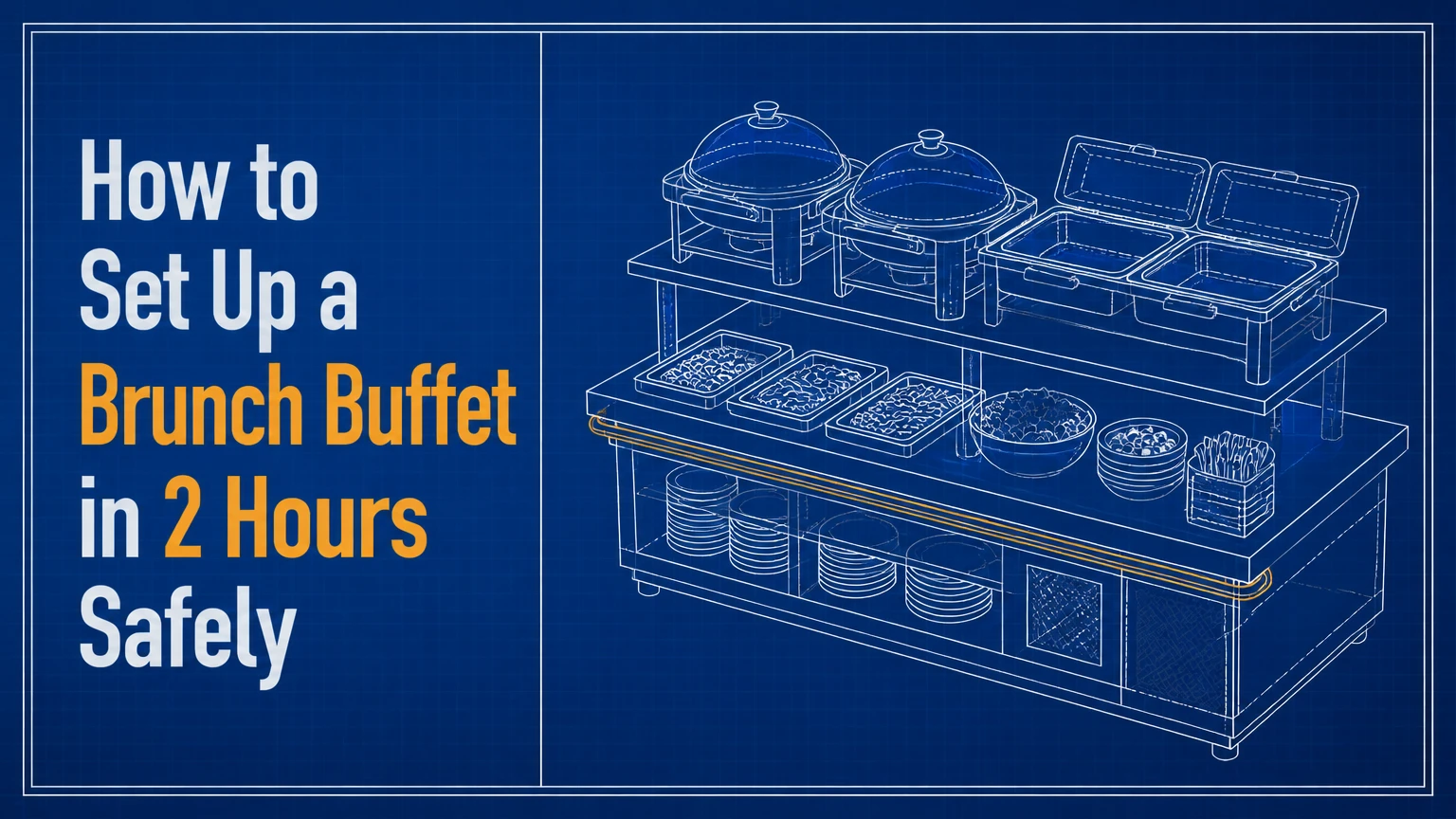
A brunch buffet is a self-service meal that combines breakfast and lunch foods, usually served between 10:00 AM and 2:00 PM. To set up a brunch buffet, choose a balanced menu, create a one-way food line, separate beverages, prepare perishable dishes in batches, and keep hot foods at least 140°F and cold foods at or below 40°F.
Key facts at a glance
Plan approximately 6-8 savory food portions and 3-4 sweet or fruit portions per guest.
A two-hour setup works best when most chopping, baking, labeling, and cooking happens the day before.
Put plates first, followed by cold foods, hot foods, condiments, and napkins or utensils at the exit.
Use a separate beverage table to prevent coffee and juice service from blocking the food queue.
USDA guidance limits unrefrigerated perishable food to 2 hours, or 1 hour when the air temperature exceeds 90°F, approximately 32°C.
Hold hot food at 140°F or higher and cold food at 40°F or lower, checking with a food thermometer.
Before You Start: Time, Cost, and Equipment
A home brunch buffet for 10-12 guests typically requires 3-5 hours of advance work, 2 hours of final setup, and approximately $12-$35 per person before alcohol. The final cost depends most on meat, seafood, specialty pastries, and whether you cook or purchase the main dishes.
| Planning factor | Typical home range | Practical target |
|---|---|---|
| Guest count | 6-50 people | 10-12 for one host |
| Final setup time | 90-120 minutes | Finish 15 minutes before arrival |
| Food and drink cost | $12-$35 per person | $18-$25 for a mixed menu |
| Buffet table length | 6-12 feet | 8 feet for 10-16 guests |
| Food stations | 2-4 stations | Food, beverages, dessert |
| Serving equipment | 1 utensil per dish | 2 backups behind the table |
Prepare two 6-foot tables for 10-16 guests, or one 8-foot table with both-sided access. Gather dinner plates, small plates, bowls, forks, knives, spoons, napkins, serving tongs, ladles, slotted spoons, chafing dishes or electric warmers, ice tubs, labels, painter’s tape, and a probe thermometer.
A brunch buffet does not require professional catering equipment. A slow cooker can hold scrambled eggs or oatmeal, while an insulated cooler with ice can protect yogurt and cut fruit. Avoid placing disposable foil pans directly on a tablecloth because heat and condensation can damage the surface.
How much food should you buy?
Buy approximately 1.25 times the expected number of eaters for flexible dishes such as fruit, potatoes, bread, and pastries. Purchase closer to the expected count for expensive proteins, because buffet guests tend to sample several items rather than eat a full restaurant-sized portion of every dish.
| Food category | Per-person serving target | Quantity for 12 guests |
|---|---|---|
| Eggs or egg dish | 1.5 eggs | 18 eggs |
| Bacon or sausage | 2-3 pieces | 30-36 pieces |
| Potatoes or grains | 1 cup cooked | 12 cups |
| Pastries, muffins, or bread | 1.5 pieces | 18 pieces |
| Fresh fruit | 1 cup | 12 cups |
| Yogurt or parfait base | 1/2 cup | 6 cups |
| Coffee or tea | 2-3 cups | 24-36 cups |
| Juice or brunch cocktails | 2 glasses | 24 servings |
These are typical planning figures, not guarantees. Children, long events, alcohol, and a late brunch increase beverage and carbohydrate demand.
Step 1: Choose a Menu With Three Food Roles
Choose one substantial protein, two filling starches, two fresh or chilled foods, one bakery group, and one sweet centerpiece. A successful brunch buffet gives guests a savory route, a sweet route, and a lighter route without requiring every dish to be cooked at the same moment.
For 10-12 people, a reliable menu is a 9-by-13-inch vegetable quiche, 3 pounds of breakfast potatoes, 2 pounds of bacon or sausage, 18 pastries or muffins, 12 cups of fruit, 6 cups of yogurt, and one French toast or pancake preparation. Add toast or bagels only if guests need a gluten-free or vegetarian substitute.
Keep the menu to six or seven core dishes. Every additional hot dish creates another pan, utensil, label, refill decision, and food-safety checkpoint. A host who cooks alone usually gets better results from one egg dish and one hot protein than from made-to-order omelets, waffles, and pancakes together.
Which buffet style fits the event?
A continental buffet suits early, casual gatherings; a hot buffet fits a meal-length event; and an action station works only when staffing and equipment support cooking during service. The best choice depends on labor, holding time, kitchen capacity, and guest expectations rather than visual variety alone.
| Buffet style | Typical cost per person | Equipment | Labor during service | Best use |
|---|---|---|---|---|
| Continental and pastry | $8-$18 | Platters, bowls, coffee maker | 15-30 minutes | 6-20 guests, early arrivals |
| Hybrid cold and hot | $12-$35 | One warmer, platters, ice | 30-60 minutes | Home brunch, 8-30 guests |
| Traditional hot buffet | $20-$45 | 2-4 warmers, thermometer | 45-90 minutes | Holidays, showers, 12-40 guests |
| Action station | $35-$80+ | Griddle, waffle iron, chef space | 1-3 staff members | Weddings, corporate events |
| Toast or bagel bar | $10-$24 | Toaster, boards, chilled toppings | 20-45 minutes | Budget events, vegetarian groups |
A hot buffet feels more complete, but eggs, pancakes, and French toast lose quality when held too long. An action station offers the freshest food but forces a cook to remain engaged with guests. For most home hosts, the hybrid format is the strongest compromise.
Step 2: Build the Room Flow Before Decorating
Place the buffet away from a wall when more than 20 people will eat, allowing guests to approach from both sides. Put beverages on a separate table at least 4-6 feet away, because coffee customization and juice refills create longer pauses than plate collection.
Arrange the food line in consumption order:
Entrance → plates → cold fruit and salads → pastries → hot starches → eggs and proteins → condiments → napkins and utensils → exit
Some hosts place cutlery first because it looks orderly, but utensils at the end leave guests’ hands free while they serve food. If children or older adults need easier access, place a second utensil basket at the start without duplicating every item.
For a narrow room, use two parallel tables with a 4-foot walking lane. For more than 50 guests, use two identical buffet tracks rather than one oversized line. Duplicate high-demand foods such as eggs, potatoes, coffee, and juice, but keep specialty sauces at only one clearly labeled station.
How should the buffet table be layered?
Use a stable base, a height layer, and a service layer. A neutral tablecloth protects the surface, sturdy risers lift large dishes, and serving utensils remain beside their matching food rather than at a distant utensil pile.
Use wooden crates, restaurant risers, or inverted sheet pans that cannot slide under weight. Keep the tallest item below eye level, place heavy chafing dishes directly on the table, and leave at least 3 inches between hot pans. A decorative riser that rocks under a 12-pound casserole is a safety hazard, not an efficient use of space.
Label each dish with its name and major allergens, such as eggs, milk, wheat, soy, peanuts, tree nuts, or sesame. Use separate tongs for gluten-free bread and ordinary bread, and never rely on guests to remember which utensil touched which dish.
Step 3: Prepare the Menu on a Reverse Timeline
Begin three days before service by confirming the guest count, dietary restrictions, venue, menu, shopping list, and equipment. Buy shelf-stable goods and beverages first, then purchase delicate produce and dairy one day before the event.
One day before service, bake muffins or pastries, cook and chill quiche, wash sturdy fruit, prepare sauces, cut vegetables, assemble labels, and set out serving platters. Marinate meats, but do not cut bananas or apples until the service day unless an acidic treatment is planned.
| Time before arrival | Work to complete | Foods or equipment |
|---|---|---|
| 3 days | Confirm count and restrictions | Menu, shopping list, labels |
| 1 day | Bake, chop, assemble, chill | Pastries, fruit, quiche, sauces |
| 2 hours | Set tables and nonperishables | Linens, plates, risers, signage |
| 90 minutes | Start long-cook or reheat items | Potatoes, quiche, sausage |
| 45 minutes | Cook final hot foods | Eggs, bacon, French toast |
| 20 minutes | Load warmers and ice bowls | Chafing dishes, yogurt, fruit |
| 0 minutes | Open service and monitor | Thermometer, backup utensils |
At the two-hour mark, lay linens, position tables, arrange risers, stack plates in piles of no more than 10, and place labels. Start coffee equipment only if it can operate safely without an extension cord crossing a walkway.
At 90 minutes, begin foods that tolerate holding, such as roasted potatoes, baked egg dishes, and sausage. At 45 minutes, cook bacon and final eggs. At 20 minutes, transfer hot food into preheated warmers and place chilled foods over ice.
Step 4: Separate Hot, Cold, and Made-to-Order Foods
Keep hot dishes in covered chafing dishes, electric roasters, or slow cookers set to a safe holding temperature. Keep yogurt, cream, smoked salmon, cut fruit, and dairy-based sauces in shallow bowls over ice, with the bowl base surrounded by ice rather than merely resting beside it.
The USDA Food Safety and Inspection Service states, “When in doubt, throw it out,” and its consumer guidance uses a 2-hour limit for perishable food at room temperature, reduced to 1 hour when temperatures exceed 90°F. The 32°C figure often repeated in buffet advice is approximately 90°F, but the one-hour rule applies to the hotter condition, not to every setting above 32°C.
The FDA Food Code 2022 uses 135°F as the minimum hot-holding temperature for many food-service operations, while USDA consumer guidance commonly recommends 140°F or higher for hot foods. Using 140°F at home provides a conservative buffer, but food must be reheated thoroughly before holding.
| Food | Holding method | Target temperature | Maximum practical display period |
|---|---|---|---|
| Scrambled eggs | Chafing dish or slow cooker | 140°F or higher | 45-60 minutes |
| Bacon and sausage | Covered warming pan | 140°F or higher | 60-90 minutes |
| Yogurt and cream | Bowl over ice | 40°F or lower | 60-90 minutes |
| Cut fruit | Chilled platter over ice | 40°F or lower | 90 minutes |
| Smoked salmon | Ice bed, covered | 40°F or lower | 60 minutes |
| Pancakes and waffles | Ventilated tray | 140°F or higher | 20-30 minutes |
Check the thickest part of food with a calibrated probe thermometer, not the surface of the pan. Stir eggs and oatmeal before testing, because edges may be hotter than the center. Replace a nearly empty pan with a fresh small batch instead of topping new food onto old food.
Step 5: Set Up the Beverage Station Separately
Place coffee, tea, water, juice, milk, cream, sugar, stirrers, and cups on a separate table. Put cups first, followed by coffee and tea, then milk and sweeteners, with a waste bowl at the end.
A beverage station should hold at least one 64-ounce coffee carafe for every eight to ten coffee drinkers, one quart of juice per six guests, and 12-16 ounces of water per guest for a two-hour brunch. Provide sparkling wine separately from juice if serving mimosas, and follow local alcohol laws and responsible-service practices.
Pre-chill juice and sparkling wine overnight. Fill ice buckets shortly before service, and keep dairy in a small ice-filled tub rather than a room-temperature pitcher. The most common beverage failure is a coffee queue that blocks plates and forces guests to reach across hot food.
Step 6: Protect Texture and Appearance
Serve waffles, pancakes, and French toast in small batches on wire racks set over sheet pans, leaving the lid partially open so steam can escape. Closed metal pans trap moisture and soften crisp surfaces within minutes.
Toss apples, bananas, and avocados with lemon juice or pineapple juice shortly before display, using approximately 1 tablespoon of juice per 2 cups of cut fruit. The treatment slows browning, but it does not preserve texture indefinitely. Keep cut fruit covered and chilled until 15-20 minutes before guests arrive.
Place sauces, whipped cream, syrup, jam, hot sauce, and butter in small containers that can be refilled. Large bowls look abundant but encourage contamination, spills, and waste when guests use the wrong utensil.
Step 7: Open the Buffet in Controlled Batches
Open cold food first if guests arrive early, then release hot dishes when the main group is ready to eat. Keep backup pans in the refrigerator or oven until needed rather than exposing the entire supply at once.
Give each dish one serving utensil and place three or four backups in a concealed basket behind the buffet. Mark allergy-sensitive tools with colored tape, and replace any utensil that falls on the floor immediately.
Walk the line before inviting guests. Confirm that every dish has a label, every pan has a utensil, hot foods are at target temperature, cold foods are on ice, and the exit is clear. The host should refill from behind the table, never carry a full hot pan through the guest queue.
Step 8: Clear and Chill Food on Schedule
Start clearing perishables after 90 minutes if guests are still eating slowly. Refrigerate leftovers before the two-hour limit, divide large quantities into shallow containers, and discard food that has exceeded the safe room-temperature window.
The USDA recommends refrigerating leftovers promptly and using shallow containers to accelerate cooling. Do not place a deep, steaming casserole directly into a crowded refrigerator, because its center may remain warm while nearby food also rises in temperature.
Serve pastries and whole fruit longer than cut fruit, yogurt, eggs, meat, and dairy sauces. Label leftovers with the preparation date, and use refrigerated cooked eggs and meats within three to four days according to USDA leftovers guidance.
Common Mistakes and How to Fix Them
One oversized hot buffet
A single 12-foot line looks impressive but creates a queue around the most popular dishes. Split the line into two tracks or duplicate eggs and potatoes, which usually move faster than pastries and condiments.
Cooking everything after guests arrive
Made-to-order eggs, waffles, bacon, and coffee exceed one host’s capacity quickly. Cook one fresh item during service, such as waffles, and prepare the remaining hot dishes in advance.
Putting drinks beside the plates
Coffee customization creates a bottleneck at the first station. Move cups, coffee, cream, and sugar to another table, then place water and juice at the far end of that station.
Filling pans too deeply
A deep pan cools unevenly and makes reheating slow. Use shallow pans, smaller batches, and a probe thermometer at the center of each replacement pan.
Mixing allergen utensils
A shared tong can transfer wheat, nuts, or dairy into an otherwise suitable dish. Label serving tools, separate gluten-free and nut-containing foods, and keep packaged ingredient labels available for questions.
Decorating before solving access
Flowers, candles, and risers consume the same surface needed for plates and utensils. Set the working layout first, then add decorations that occupy less than 10% of usable table space.
Useful Variations for Different Situations
For six guests in a small kitchen
Use one 6-foot table for food and a counter for beverages. Choose baked eggs, roasted potatoes, pastries, fruit, yogurt, and coffee. Six guests can be served with one hot holding dish and one chilled bowl, so extra equipment adds clutter rather than capacity.
For vegetarian or vegan guests
Make the main egg dish vegetarian and offer plant-based sausage, roasted mushrooms, chickpeas, avocado, and dairy-free yogurt. Keep vegan butter and spreads in separate labeled containers, because shared knives can transfer dairy.
For gluten-free guests
Use potatoes, fruit, eggs, yogurt, and certified gluten-free muffins as the foundation. Keep gluten-free bread on its own board with dedicated tongs, and place it before wheat bread only if cross-contact controls are reliable.
For an outdoor brunch
Place the buffet in shade, use wind-resistant tablecloth clips, and keep chilled food in lidded containers over ice. In warm weather, display smaller portions and replace them frequently. The USDA one-hour limit applies when outdoor temperatures exceed 90°F.
For 50 or more guests
Use two identical buffet lines, two beverage points, and at least one person assigned to replenishment. A caterer should plan approximately 1 server per 25-30 guests for a staffed buffet, while an unstaffed home setup needs duplicate equipment and a restricted menu.
What Does a Brunch Buffet Cost?
A budget-conscious brunch can cost $8-$15 per person with eggs, potatoes, fruit, purchased pastries, and coffee. A mixed home menu with bacon, quiche, specialty drinks, and higher-quality bakery items usually costs $18-$35 per person, while staffed action stations often exceed $35.
| Budget level | Menu example | Equipment cost | Food cost per person |
|---|---|---|---|
| Budget | Eggs, potatoes, fruit, muffins, coffee | $0-$40 | $8-$15 |
| Standard | Quiche, bacon, pastries, yogurt, juice | $25-$100 | $18-$35 |
| Premium | Smoked salmon, specialty pastries, cocktails | $75-$200 | $30-$55 |
| Catered action | Omelets, waffles, carving service | $150-$500+ | $35-$80+ |
Prices vary by region, season, alcohol selection, and whether tables or warmers must be rented. Spending on a second warming unit often improves service more than buying a fifth menu item.
FAQ
How far in advance should a brunch buffet be set up?
Complete the physical table arrangement 90-120 minutes before guests arrive, but keep perishable food refrigerated until the final 20 minutes. Bake, chop, label, and assemble most components the day before. Start coffee 15-20 minutes before service so the first pot remains fresh.
What food should go first on a brunch buffet?
Place plates first, followed by cold fruit and salads, pastries, hot starches, proteins, sauces, napkins, and utensils. This order gives guests free hands for serving and keeps heavy pans away from the beginning of the queue.
Can pancakes and waffles be made ahead?
Pancakes and waffles can be made 20-30 minutes ahead if held on wire racks that allow steam to escape. Do not seal them immediately in a deep chafing dish, because trapped steam softens the surface. For longer holding, serve smaller fresh batches.
How do you keep scrambled eggs from drying out?
Cook scrambled eggs slightly below their final texture, transfer them to a preheated covered warmer, and stir every 10-15 minutes. Add a small amount of cream or butter before cooking, but do not use liquid to disguise eggs that have already dried out.
How many tables are needed for a brunch buffet?
A 10-12-person brunch usually needs one 6-8-foot food table and a separate 4-6-foot beverage table. Groups above 20 benefit from two-sided access, while groups above 50 generally need two food lines to prevent a single queue.
Should a brunch buffet have dessert?
A brunch buffet does not require a separate dessert course, but one sweet centerpiece improves menu balance. French toast casserole, cinnamon rolls, fruit tart, or mini pastries can fill that role without adding another service station.
The Bottom Line
To set up a brunch buffet successfully, prepare the labor-intensive foods the day before, limit the menu to dishes one host can monitor, arrange the line in eating order, and separate beverages from food. Use small replenishment batches, verify 140°F hot holding and 40°F cold holding, and remove perishables within the USDA time limits.