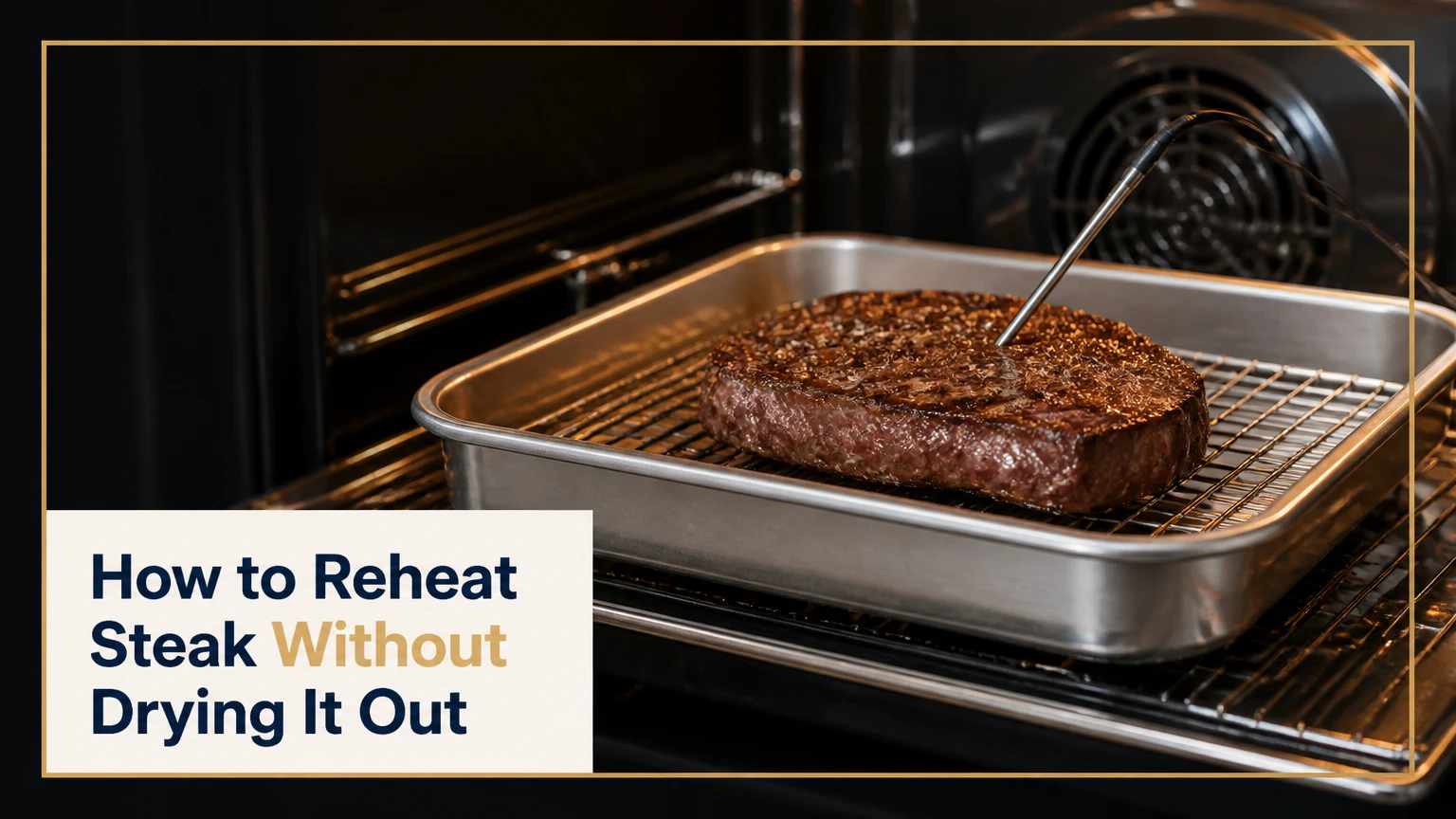
To reheat steak without drying it out, warm the meat gently in a 250°F oven until nearly hot, then sear it briefly in a very hot skillet to restore the crust. For a 1- to 1 1/2-inch steak, the process usually takes 25-35 minutes. Use a microwave only when speed matters more than texture.
Key Facts at a Glance
- A 250°F oven followed by a 30-45-second-per-side sear gives thick steak the best balance of moisture and crust.
- The USDA recommends reheating leftovers to 165°F, while lower internal temperatures are texture targets rather than complete food-safety endpoints.
- Refrigerated cooked steak should generally be used within 3-4 days, according to the USDA Food Safety and Inspection Service.
- A wire rack prevents the underside from steaming while the oven warms a whole steak.
- Thin steak and sliced steak reheat faster in a covered skillet than in an oven.
- Microwave steak at 50% power in 30-second intervals to reduce hot spots and rubbery edges.
What Determines the Best Reheating Method?
Steak thickness determines reheating time more than steak weight. A 1 1/2-inch ribeye can warm gradually in an oven, while a 1/2-inch flank steak may overcook before its surface becomes hot.
The original doneness also matters. Rare and medium-rare steaks have less tolerance for reheating because a small amount of additional cooking creates a noticeable gray band. Medium and well-done steak can tolerate more heat, but aggressive reheating still squeezes out moisture.
Choose the method by matching the meat to the equipment:
| Steak condition | Best method | Typical time | Main reason |
|---|---|---|---|
| Whole steak, 1 inch or thicker | Oven plus skillet | 25-35 minutes | Gradual center warming |
| Whole steak, under 1 inch | Covered skillet | 8-12 minutes | Faster heat transfer |
| Sliced steak | Covered skillet or microwave | 3-8 minutes | Small pieces warm evenly |
| Premium steak, precise doneness | Sous vide | 45-75 minutes | Controlled water temperature |
| Steak bites | Air fryer | 4-7 minutes | Fast dry-surface heating |
| Frozen cooked steak | Low oven, then skillet | 45-70 minutes | Gentle thawing and warming |
The best texture comes from minimizing the time the steak spends above its final serving temperature. A thermometer is more reliable than a timer because steak thickness, starting temperature, pan material, and bone content vary.
How Does Reheating Steak Without Drying It Out Work?
Gentle heat limits the amount of new protein contraction before the center reaches serving temperature. A short, high-heat finish then dries and browns the exterior without exposing the interior to prolonged heat.
Steak loses quality when its muscle proteins contract and push out water. High heat applied directly to a cold steak creates an overcooked outer ring before the center becomes warm. The result is a gray band, firmer fibers, and less apparent juiciness.
The reverse-sear approach solves that mismatch. The oven warms the center at a moderate rate, and the skillet supplies the final surface browning. The sear should restore the crust, not cook the steak from cold.
A practical quality target is about 110-125°F for a steak that was already fully cooked and is being served immediately. That target is not the same as the USDA safety recommendation. USDA FSIS advises reheating leftovers to 165°F, so diners who need strict leftover reheating compliance should use 165°F and accept a greater texture loss.
Why Does Reheated Steak Turn Gray?
Reheated steak turns gray when direct heat overcooks the outer layers before the center warms. A hot pan, full-power microwave, or long air-fryer cycle can create a broad gray ring even when the middle remains only warm.
The gray appearance is primarily a doneness change, not proof that the meat has spoiled. Sour odor, sticky or slimy surfaces, unusual discoloration, or storage beyond the recommended window are stronger reasons to discard the steak.
Food safety and eating quality are separate controls. Low-temperature reheating may preserve medium-rare texture, but it does not automatically satisfy the USDA 165°F leftover guideline.
How to Reheat Steak in the Oven and Skillet
The oven and skillet method is the best general technique for a whole steak at least 1 inch thick. Heat the steak on a rack at 250°F until its center reaches about 110-115°F for a quality-focused warm-up, then sear it in a smoking-hot skillet for 30-45 seconds per side.
Before You Start
| Requirement | Typical specification |
|---|---|
| Time | 25-35 minutes for a refrigerated 1-1 1/2-inch steak |
| Difficulty | Moderate, mainly thermometer control |
| Cost | $0 if equipment is available, $10-$25 for oil and aromatics |
| Tools | Oven, rimmed sheet, wire rack, skillet, instant-read thermometer |
| Ingredients | 1 tsp to 1 tbsp high-heat oil, optional 1 tsp butter |
| Prerequisite | Steak refrigerated within 2 hours of cooking |
Step 1: Check the Steak and Preheat the Oven
Inspect the steak before cooking. USDA FSIS says, “Leftovers can be kept in the refrigerator for three to four days,” provided the refrigerator remains at 40°F or below.
Discard steak that sat at room temperature for more than 2 hours, or more than 1 hour when the surrounding temperature exceeded 90°F. Preheat the oven to 250°F, and do not rely on a 15-minute counter rest to make an unsafe steak safe.
You’ll know this step worked when: the steak is within the safe storage window and the oven has reached 250°F.
Common mistake: Leaving steak on the counter for an hour or longer. The center gains little useful warmth, while the surface spends more time in the bacterial growth range.
Step 2: Place the Steak on a Rack
Pat the steak dry with paper towels, then place it on a wire rack inside a rimmed baking sheet. Keep the steak uncovered so moisture does not collect against the surface.
A rack allows hot air to reach the underside and reduces steaming. Add no oil at this stage because oil on the cold surface can slow drying and create splatter during the final sear.
You’ll know this step worked when: the surface feels dry and the steak sits above the sheet on all sides.
Common mistake: Placing the steak directly on the baking sheet. The contact side may steam and remain pale.
Step 3: Warm the Center Slowly
Insert an instant-read thermometer horizontally into the thickest section, avoiding bone and large fat pockets. Heat until the center reaches 110-115°F for a texture-first serving target, or continue to 165°F if following the USDA leftover-reheating standard.
A 1-inch boneless steak often takes 20-25 minutes from refrigerator temperature. A 1 1/2-inch bone-in ribeye can require 30-40 minutes. Begin checking early because ovens vary by 15°F or more.
| Steak thickness | 250°F oven time, typical | First temperature check |
|---|---|---|
| 1/2 inch | 10-15 minutes | 8 minutes |
| 1 inch | 20-25 minutes | 15 minutes |
| 1 1/2 inches | 30-40 minutes | 25 minutes |
| 2 inches | 40-55 minutes | 35 minutes |
You’ll know this step worked when: the thermometer reading is stable in the thickest part and the surface remains dry rather than wet.
Common mistake: Cooking by the clock alone. A thin strip steak can overshoot while a cold bone-in steak remains cool.
Step 4: Sear the Surface Briefly
Heat a cast-iron or stainless-steel skillet over high heat for 3-5 minutes. Add 1 teaspoon to 1 tablespoon of avocado, canola, grapeseed, or refined peanut oil, then sear the steak for 30-45 seconds per side.
Add 1 teaspoon butter, a crushed garlic clove, or a rosemary sprig only during the last 10-15 seconds. Butter burns easily during a prolonged high-heat sear, while the short finish adds aroma without darkening the crust excessively.
You’ll know this step worked when: the surface is browned, the fat is sizzling, and the steak has not gained a thick gray edge.
Common mistake: Searing for 2 minutes per side. That duration reheats the interior again and can erase the original doneness.
Step 5: Rest Briefly and Slice Correctly
Rest the steak for 2-5 minutes, then slice against the grain. A long rest is unnecessary because the meat is already cooked and the sear is brief.
Cutting against the grain shortens the muscle fibers, which improves tenderness even when reheating has firmed the steak slightly. Serve immediately with pan juices, compound butter, or a small amount of warm beef broth.
You’ll know this step worked when: the center remains moist and the slices separate easily across the visible grain.
Common mistake: Cutting parallel to the grain. Long fibers make moderately overcooked leftovers seem tougher than they are.
Which Reheating Method Should You Choose?
The oven and skillet method is the strongest choice for thick whole steak, while a covered skillet is faster for thin cuts and an air fryer is practical for steak bites. Sous vide offers the most precise temperature control, but it requires careful food-safety handling and rarely justifies its setup for ordinary leftovers.
| Method | Equipment cost, typical | Time | Best steak format | Main drawback |
|---|---|---|---|---|
| Oven plus skillet | $0-$150 existing equipment | 25-55 min | Whole steak, 1 inch or thicker | Slow for lunch |
| Covered skillet | $0-$60 | 8-15 min | Thin steak or slices | Less crust control |
| Sous vide | $80-$250 | 45-75 min | Premium whole steak | Bag and temperature management |
| Air fryer | $60-$200 | 4-10 min | Bites and thin pieces | Dries exposed edges |
| Microwave, 50% power | $0-$300 | 1-3 min | Sliced steak | Uneven heating and weak crust |
When Is Sous Vide Worth Using?
Sous vide is worthwhile for an expensive, thick steak when precise internal temperature matters more than speed. Seal the steak without excess liquid, heat the water bath to the intended serving temperature, dry the steak thoroughly, and finish it in a very hot skillet.
A bath at 120-130°F may preserve a rare or medium-rare texture, but that range does not independently meet the USDA 165°F reheating recommendation. Time and temperature together determine pasteurization, and safe sous vide schedules depend on steak thickness, starting temperature, and validated cooking tables.
For a home cook prioritizing food safety, reheating to 165°F is the simpler standard. For a healthy adult serving a properly chilled steak immediately, a lower quality target may be chosen with awareness of the trade-off.
Do not add a large pat of butter to the bag. Butter can dilute the steak’s flavor, and the skillet finish works better when the exterior is completely dry.
Can You Reheat Steak in a Covered Skillet?
A covered skillet is effective for thin steak, flank steak, skirt steak, or slices when you add a small amount of moisture and use moderate heat. Warm 1-2 tablespoons of beef broth or water in the pan, add the steak, cover, and heat over low to medium-low for 2-4 minutes per side.
Turn the steak once or twice rather than repeatedly flipping it. Remove the lid during the final 30-60 seconds if the surface needs drying, then sear briefly in an uncovered pan.
This method creates a humid environment that protects lean cuts, but it softens the original crust. Use it for tacos, sandwiches, rice bowls, or thin steaks where tenderness matters more than a crisp exterior.
Can You Reheat Steak in an Air Fryer?
An air fryer can reheat steak bites and thin pieces in 4-7 minutes at 300-325°F. For a whole 1-inch steak, use 250-275°F if the appliance allows it, check after 5 minutes, and finish with a 30-second skillet sear when a crust matters.
Air fryers circulate dry, fast-moving air, so exposed corners lose moisture quickly. Lightly brush the steak with 1 teaspoon oil or place a small foil tent over thick portions during the first few minutes.
Air fryers are less suitable for filet mignon or thin, lean slices than for ribeye cubes, cooked steak bites, or breaded steak. Overcrowding lowers airflow and creates uneven reheating.
How Do You Reheat Steak in the Microwave?
Microwave steak in uniform slices at 50% power, covered with a damp paper towel, for 30-second intervals. Turn or rearrange the slices after each interval and stop as soon as the center is warm.
Use 1 teaspoon of broth, water, or pan sauce per serving if the steak is lean. Arrange slices in a single layer rather than stacking them, because stacked pieces heat unevenly.
A microwave is the fastest method, but it produces the weakest crust and the largest temperature variation. If possible, microwave the steak until nearly warm, then sear it in a hot skillet for 20-30 seconds per side.
For strict food-safety compliance, verify that the thickest piece reaches 165°F. A warm center below that temperature is a quality result, not a USDA-compliant leftover-reheating result.
How Do You Reheat Sliced or Frozen Steak?
Sliced steak reheats best in a covered skillet with a tablespoon of broth or sauce, while frozen cooked steak requires a low oven and significantly more time. Do not thaw frozen steak on the counter; thaw it in the refrigerator or heat it directly using a gentle method.
For frozen whole steak, place the unwrapped steak on a rack in a 250°F oven. Check the center after 35 minutes, then continue in 10-minute increments until it reaches the chosen endpoint. Pat it dry and sear it only after the center has warmed.
Frozen steak may develop more surface dryness because ice crystals disrupt muscle cells. A sauce-based application, such as a cheesesteak, steak tacos, or stroganoff, hides that texture better than serving thick slices alone.
| Situation | Recommended process | Typical duration | Best finishing addition |
|---|---|---|---|
| Refrigerated slices | Covered skillet, low heat | 4-8 min | Beef broth or pan sauce |
| Refrigerated steak bites | Air fryer at 300°F | 4-7 min | 1 tsp oil per 8 oz |
| Frozen whole steak | Oven at 250°F | 45-70 min | Skillet sear |
| Frozen slices | Microwave at 50% power | 2-4 min | Damp paper towel |
| Lean overcooked steak | Skillet with sauce | 3-6 min | Broth, butter, or gravy |
What Are the Most Common Reheating Mistakes?
The most damaging reheating mistakes are excessive heat, inaccurate temperature measurement, surface moisture, and unsafe storage. Each problem has a practical recovery strategy, although no method can fully restore moisture that has already been expelled.
- Using full microwave power: High power creates hot edges and a cool center. Use 50% power and 30-second intervals.
- Searing before warming the center: A cold steak develops a dark crust before its interior is ready. Warm first, then sear.
- Adding butter too early: Butter burns in a smoking-hot skillet. Add it during the final 10-15 seconds.
- Covering a whole steak in the oven: Trapped steam softens the crust. Use a rack and leave the steak uncovered.
- Overcrowding the pan or air fryer: Crowding lowers contact heat and airflow. Reheat portions in a single layer.
- Trusting a timer instead of a thermometer: Thickness and bone structure change heating speed. Probe the thickest section.
If steak is already dry, slice it thinly against the grain and warm it for 1-2 minutes in beef broth, gravy, butter, or a pan sauce. Use the recovered meat in a cheesesteak, tacos, fried rice, eggs, or stroganoff rather than serving it as a thick standalone portion.
How Long Is Cooked Steak Safe to Keep?
Cooked steak is generally safe in the refrigerator for 3-4 days when chilled promptly in a refrigerator at 40°F or below. Refrigerate the steak within 2 hours of cooking, or within 1 hour when the ambient temperature is above 90°F.
Store the steak in a shallow airtight container so it cools quickly. Do not use smell alone as a safety test because harmful bacteria may not produce a noticeable odor.
Freeze steak when it will not be used within four days. Wrap individual portions tightly in freezer paper, foil, or a freezer bag, remove excess air, label the date, and use the best-quality portions within about 2-3 months.
The USDA 165°F standard applies to reheated leftovers, not merely to the original cooking event. Reheating can reduce some microbial risk, but it cannot reliably correct every toxin or storage failure.
How Can You Improve the Final Texture?
The best texture comes from controlling moisture before, during, and after reheating. Dry the surface before a skillet sear, add liquid only when using a covered skillet or sauce, and slice against the grain after a short rest.
Use a neutral high-smoke-point oil for browning. Avocado, canola, grapeseed, and refined peanut oil tolerate high skillet temperatures better than extra-virgin olive oil or butter.
A small amount of compound butter works well after cooking. Mix softened butter with black pepper, garlic, parsley, or blue cheese, then place about 1 teaspoon on each serving while the steak rests.
Sauce is a better rescue tool than additional heat. Warm au jus, peppercorn sauce, chimichurri, mushroom sauce, and beef broth add perceived juiciness without forcing the steak to a higher internal temperature.
One practitioner rule matters most: stop heating earlier than instinct suggests. The skillet, plate, and residual heat continue warming the steak after the burner is off.
Frequently Asked Questions
Can You Reheat Steak Twice?
You can reheat steak twice, but each heating cycle increases moisture loss and food-safety exposure. Reheat only the portion you will eat, cool any unused portion promptly, and return it to refrigeration within two hours. A sauce-based dish usually tolerates a second reheating better than a thick, medium-rare steak.
Should You Add Water When Reheating Steak?
Add 1-2 tablespoons of broth or water when reheating sliced steak in a covered skillet, but do not pour water over a whole steak in the oven. Liquid protects lean slices by creating steam, while liquid on a whole steak softens the crust and prevents effective browning.
Is Ribeye Easier to Reheat Than Filet Mignon?
Ribeye is generally easier to reheat than filet mignon because its intramuscular fat helps preserve a juicy texture during moderate reheating. Filet mignon is lean and can become dry quickly, so use a 250°F oven, a thermometer, and a very brief sear.
Can You Reheat Steak Without Oil?
You can reheat steak without oil in an oven, microwave, or nonstick skillet, but a small amount of oil improves surface browning during a final sear. Use about 1 teaspoon for one steak. If the steak already has a fatty crust, dry-pan searing may be sufficient.
Why Is My Reheated Steak Tough Even Though It Is Not Dry?
Reheated steak can feel tough because heat contracts the muscle fibers and slicing parallel to the grain leaves long fibers intact. Cut the steak thinly against the grain, serve it with sauce, and reduce the next reheating cycle’s temperature and duration.
Can You Reheat Steak in Gravy or Sauce?
You can reheat steak in gravy or sauce, especially when the original steak is already overcooked or sliced thin. Keep the sauce below a hard boil, warm the meat for 2-4 minutes, and remove it once the center reaches the serving temperature you intend to use.
The Bottom Line
The most reliable answer to how to reheat steak is to warm a thick whole steak on a rack in a 250°F oven, verify the center with a thermometer, and finish it with a 30-45-second-per-side skillet sear. Use a covered skillet for thin or sliced steak, an air fryer for bites, and a 50%-power microwave when speed outranks crust and tenderness. For food safety, remember that the USDA recommends reheated leftovers reach 165°F, while lower temperatures are texture-focused serving targets.