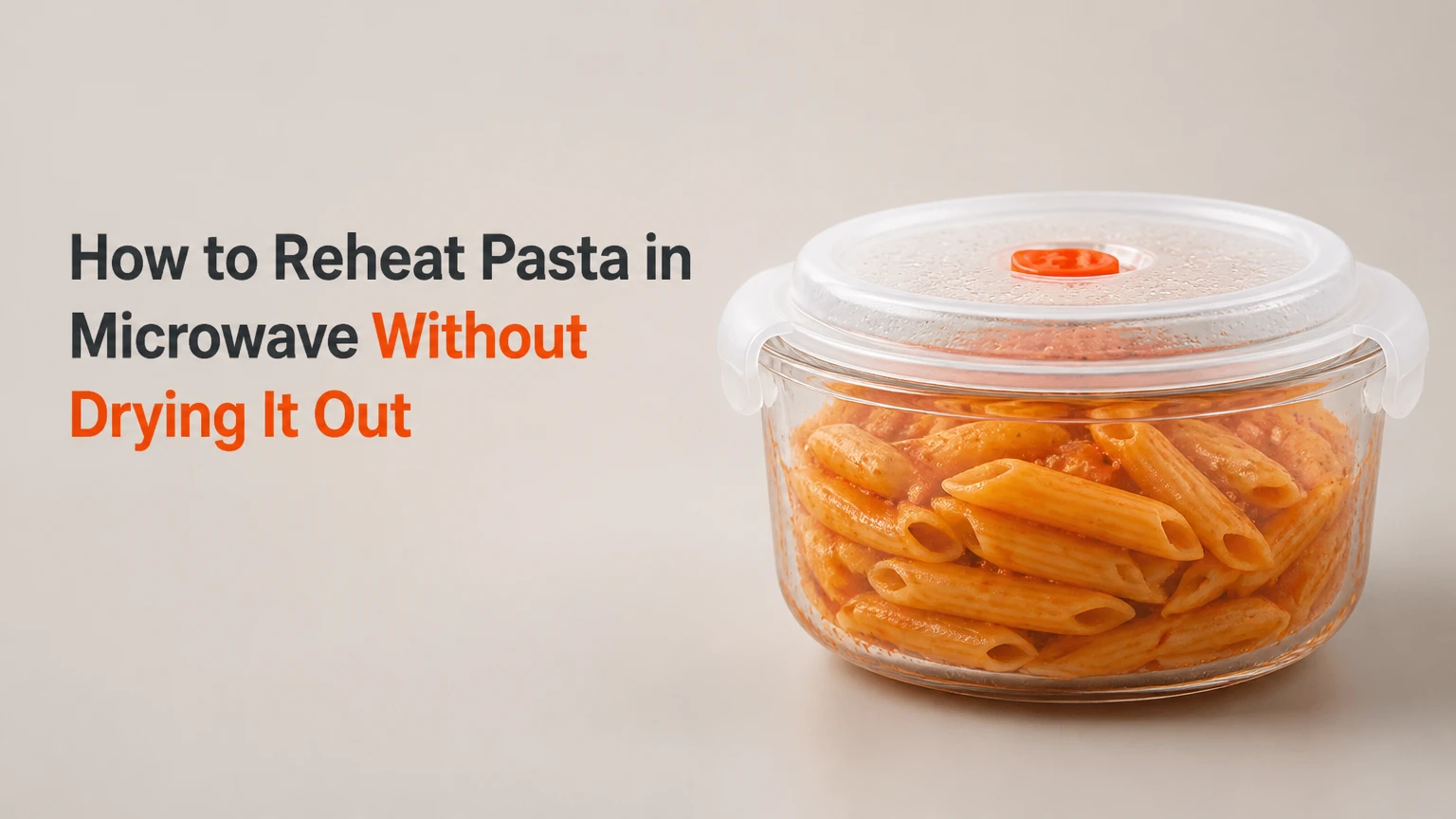
To reheat pasta in a microwave, place one serving in a shallow microwave-safe dish, add 1-2 tablespoons of water or suitable liquid, cover, and microwave at 50%-70% power for 60 seconds. Stir, cover again, and heat in 30-second intervals until the center reaches 165°F (74°C), then rest covered for 1 minute.
Key Facts at a Glance
- One refrigerated serving of pasta usually reheats in 1.5-3 minutes at 50%-70% microwave power.
- Plain pasta needs 1-2 tablespoons of water or broth per serving because refrigeration makes starch firmer and drier.
- A microwave-safe plate, damp paper towel, or vented microwave-safe cover traps steam and limits moisture loss.
- Cream, cheese, and egg-based sauces need 50% power and 30-second intervals to reduce splitting.
- The safe reheating target for leftovers is 165°F (74°C), measured in the thickest or coolest part.
- Refrigerated cooked pasta should generally be used within 3-4 days when cooled and stored promptly.
Before You Start
A single serving takes about 2-4 minutes from plating to serving, including stirring and resting. The method costs approximately half a cent to one cent in electricity in the United States when a 1,000-watt microwave runs for 2-4 minutes at an electricity rate near $0.16 per kilowatt-hour.
| Requirement | Typical value | Practical choice |
|---|---|---|
| Pasta quantity | 1-2 cups, 150-300 g | Reheat one serving at a time |
| Liquid | 1-2 tablespoons | Water, broth, milk, or cream |
| Microwave power | 50%-70% | Use medium power when available |
| Heating time | 1.5-3 minutes | Add 30-second intervals |
| Cover | 1 microwave-safe item | Plate, damp towel, or vented lid |
| Container | Glass or ceramic | Use a shallow dish, not a deep bowl |
Use glass or glazed ceramic marked microwave-safe. Transfer pasta from takeout boxes, foil containers, metal-trimmed dishes, and plastic containers that lack microwave-safety labeling. A container can remain cool while its contents become dangerously hot, so material appearance alone is not a reliable safety test.
Why Does Refrigerated Pasta Dry Out?
Refrigerated pasta becomes firm because cooked starch undergoes retrogradation, a process in which starch molecules realign and hold water less freely. Microwave heating then converts available water into steam, and uncovered pasta loses that steam before the interior softens.
The effect is strongest in plain noodles with little sauce. Long strands also form dense bundles, so the microwave heats the outside of the bundle faster than the middle. A shallow layer, added liquid, and a cover address those three problems by increasing exposure, supplying moisture, and retaining steam.
A microwave does not heat food literally from the center outward. Microwave energy creates heat unevenly wherever absorbable water and other dielectric materials respond to the electromagnetic field. Turntable movement, container shape, food density, and microwave wattage all affect the result.
How to Reheat Pasta in Microwave
Microwave reheating works best when you divide one serving into a shallow layer, add measured liquid, cover it, use medium power, stir once or twice, and rest the dish before eating. The complete process normally takes 1.5-3 minutes for refrigerated pasta and requires only one dish.
Step 1: Portion the Pasta Into a Shallow Dish
Place 1-2 cups of cooked pasta in a microwave-safe glass or ceramic dish. Separate clumps with a fork, then spread the pasta into a layer no deeper than about 2 inches.
For dense spaghetti or linguine, arrange the strands in a loose ring with a small opening in the center. The ring shape reduces the distance heat must travel and leaves fewer cold spots than a compact mound.
Success checkpoint: Pasta should be distributed loosely, with no frozen or refrigerator-cold block at the center.
Common mistake: Heating a full storage container at once. Large masses warm unevenly and usually need longer exposure, which dries the edges before the middle becomes hot.
Step 2: Add the Right Liquid
Add 1-2 tablespoons of liquid per serving, distributing it across the pasta rather than pouring it into one spot. Use water or broth for plain pasta, 1 tablespoon of milk for Alfredo, and a small splash of water for tomato-based sauce.
Oil is not a substitute for water. Oil can coat noodles, but it does not create the steam needed to soften retrograded starch. For pesto or aglio e olio, add water during reheating and refresh the sauce with a teaspoon of pesto or olive oil after heating.
Success checkpoint: The pasta looks lightly moistened, not submerged. A small amount of liquid should remain in the dish after heating.
Common mistake: Adding a large quantity of water to sauced pasta. Excess water dilutes flavor and can create a thin, separated sauce.
Step 3: Cover the Dish and Vent It
Cover the dish with a microwave-safe plate, a damp paper towel, or a vented microwave lid. If using microwave-safe plastic wrap, leave one corner slightly open so steam can escape without sealing pressure inside the dish.
A damp paper towel is useful in an office microwave because it holds steam against the pasta and limits tomato-sauce splatter. A plate gives stronger coverage for sauced meals, while a vented lid is the most repeatable option for meal preparation.
Success checkpoint: Steam remains inside the dish, but the cover is not airtight.
Common mistake: Using a sealed jar, tightly clipped container, or non-vented cover. Steam pressure can force the lid off or cause hot liquid to erupt when opened.
Step 4: Microwave at 50%-70% Power
Microwave one serving at 50%-70% power for 60 seconds. Lower power gives moisture time to migrate through the pasta and reduces the hot outer layer that develops when full power rapidly evaporates surface water.
A microwave labeled 1,000 watts delivers approximately 500-700 watts at these settings, although power cycling varies by model. If the oven has no adjustable power setting, use 30-second bursts at full power and stir more often.
Success checkpoint: The edges are warm and the pasta has softened, but the sauce is not boiling aggressively.
Common mistake: Starting at 100% power for two minutes. That approach often produces steaming-hot edges, a cool center, chewy noodles, and a broken dairy sauce.
Step 5: Stir and Redistribute the Heat
Remove the cover carefully, stir from the outside toward the center, and spread the pasta back into a shallow layer. Rotate the dish if the microwave turntable does not rotate automatically.
Stirring interrupts standing-wave hot spots and moves cooler pasta into warmer areas. For lasagna or baked ziti, cut the portion into smaller pieces before stirring when possible.
Success checkpoint: No cold clump remains in the center, and liquid or sauce coats the noodles evenly.
Common mistake: Checking only the surface temperature. Microwave food can have hot edges and a cold interior, particularly in dense dishes.
Step 6: Finish in 30-Second Intervals and Rest
Cover the dish again and microwave for 30 seconds at 50%-70% power. Repeat once if needed, then let the pasta stand covered for 1 minute so heat and moisture equalize.
For food-safety verification, place an instant-read thermometer into the thickest or coolest portion. The USDA Food Safety and Inspection Service advises consumers to “reheat leftovers to 165 F,” and the equivalent metric target is 74°C.
Success checkpoint: The pasta is hot throughout, the sauce is fluid, and the measured center reaches 165°F when a temperature check is practical.
Common mistake: Continuing to microwave after the pasta is already hot. Residual heat continues cooking noodles and can turn soft pasta mushy.
How Long Should Pasta Go in the Microwave?
One refrigerated serving generally needs 1.5-3 minutes total, while a dense baked portion often needs 3-5 minutes. Timing changes with food mass, starting temperature, sauce moisture, container depth, and microwave wattage, so 30-second finishing intervals are more reliable than one fixed time.
| Pasta situation | Amount | Power | Typical total time |
|---|---|---|---|
| Plain noodles | 1 cup, 150 g | 50% | 1-2 minutes |
| Tomato-sauce pasta | 1.5 cups, 225 g | 60%-70% | 1.5-2.5 minutes |
| Cream or cheese pasta | 1.5 cups, 225 g | 50% | 2-3 minutes |
| Pesto or oil-based pasta | 1 cup, 150 g | 50% | 1-2 minutes |
| Baked ziti or lasagna | 300 g portion | 50%-60% | 3-5 minutes |
| Frozen sauced pasta | 300 g portion | 50% | 5-8 minutes |
The table gives typical household timings, not guarantees. A 700-watt microwave may need substantially longer than a 1,200-watt model, while a deep ceramic dish can add heating time because its center remains insulated by surrounding food.
How Much Liquid Does Each Pasta Type Need?
Plain pasta benefits from the most added water because it has no sauce reservoir, while tomato sauce usually needs only a tablespoon. Dairy sauces need restrained heating and a compatible liquid, and pesto is best refreshed after the pasta has warmed.
| Pasta type | Added liquid per serving | Power | Key handling instruction |
|---|---|---|---|
| Plain spaghetti or penne | 1-2 tbsp water or broth | 50% | Toss with butter or oil after heating |
| Marinara or tomato sauce | 1 tbsp water | 60%-70% | Cover well and stir halfway |
| Alfredo or cheese sauce | 1 tbsp milk or cream | 50% | Heat in 30-second intervals |
| Carbonara | 1 tsp water or milk | 30%-50% | Stop before the egg sauce boils |
| Pesto or aglio e olio | 1 tsp water | 50% | Add fresh pesto after heating |
| Lasagna or baked ziti | 2 tbsp water around edges | 50%-60% | Cut into smaller portions first |
Plain Pasta
Plain refrigerated pasta reheats most evenly with 1-2 tablespoons of water, a covered dish, and medium power. Toss the warmed noodles with butter, olive oil, sauce, or a teaspoon of reserved pasta water after heating.
Boiling water can restore plain noodles more evenly than a microwave when texture matters most: place the pasta in a heatproof strainer, immerse it in simmering water for 20-40 seconds, and drain thoroughly. That method does not suit sauced pasta.
Tomato-Based Sauce
Marinara, arrabbiata, and meat sauce tolerate microwave reheating better because their water content produces steam. Add 1 tablespoon of water per serving, cover against splatter, and stir after 60-90 seconds.
Tomato sauce can pop as trapped steam forms beneath thick patches of sauce. Use a vented cover and open it away from your face, since the released steam and sauce may be very hot.
Cream, Cheese, and Carbonara
Cream, cheese, and carbonara sauces need 50% power, a small amount of milk or water, and short intervals because high heat can separate fat from water and coagulate egg proteins. Stir after every 30 seconds and stop when the sauce is hot, not boiling.
A split Alfredo can sometimes be improved by stirring in 1 tablespoon of warm milk or cream off heat. Carbonara is especially difficult to microwave because direct high heat can scramble the egg component; gentle warming is preferable to reaching a rolling boil.
Pesto and Oil-Based Sauces
Pesto and aglio e olio should be reheated with about 1 teaspoon of water rather than extra oil. Heat the pasta gently, then add a small spoonful of fresh pesto, grated cheese, or olive oil after microwaving to preserve aroma and color.
Fresh basil in pesto can darken during prolonged heating. The best texture usually comes from storing sauce separately and combining it with hot pasta outside the microwave.
Baked Pasta
Lasagna and baked ziti need 3-5 minutes at 50%-60% power for a typical 300-gram portion. Cut a large slice into smaller pieces, add 2 tablespoons of water around the edges, cover, and stir or reposition halfway through if the structure allows it.
Do not rely on a bubbling cheese surface as proof that the center is hot. Dense layers can retain a cool middle while the exposed cheese becomes rubbery or overcooked.
Is Microwave-Reheated Pasta Safe?
Microwave-reheated pasta is safe when the original leftovers were cooled promptly, stored at 40°F (4°C) or below, used within about 3-4 days, and reheated to 165°F (74°C). Reheating reduces live bacteria, but it does not reliably destroy every heat-resistant toxin or bacterial spore.
Bacillus cereus is associated with starchy foods, including rice and pasta, when cooked food remains warm for extended periods. The USDA 165°F target is a reheating standard, not a guarantee that poorly stored food becomes safe again. Discard pasta left at room temperature for more than 2 hours, or for more than 1 hour when ambient temperatures exceed 90°F (32°C).
Store leftovers in shallow containers so they cool faster, refrigerate them promptly, and label the storage date. Do not taste food to decide whether it is safe, because harmful bacteria and toxins may not change its smell or appearance.
What Should You Avoid When Reheating Pasta?
The most damaging mistakes are using full power for too long, skipping liquid, heating a dense mound, and covering the food with an unsafe or sealed material. Each mistake creates a different failure, so the correction should address the actual cause.
- Do not use metal or foil. Metal can arc and damage the microwave; transfer the meal to glass or ceramic.
- Do not use an unlabeled plastic container. Heat can deform some plastics, particularly with oily sauces.
- Do not seal the cover. Steam needs a controlled vent.
- Do not add oil instead of water. Oil lubricates noodles but does not restore lost moisture.
- Do not reheat a large batch in one dense mound. Divide the food into servings.
- Do not keep reheating after the sauce boils. Boiling increases the chance of rubbery noodles and separated dairy sauce.
How Do You Fix Dry or Uneven Pasta?
Dry pasta can often be recovered with 1 tablespoon of water, a damp cover, and 30 seconds at 50% power. A cold center requires redistribution and shorter repeated heating, while a split cream sauce needs off-heat stirring rather than more microwave time.
| Problem | Likely cause | Recovery method |
|---|---|---|
| Dry, stiff edges | No liquid or uncovered heating | Add 1 tbsp water, cover, heat 30 sec at 50% |
| Cold center | Dense mound or no stirring | Spread into a ring, stir, heat 30 sec |
| Oily cream sauce | Excessive power or time | Add 1 tbsp warm milk, stir off heat |
| Watery tomato sauce | Too much added liquid | Rest uncovered 1 minute, then stir |
| Rubbery noodles | Full power or overcooking | Add 1 tsp water, cover, heat 20-30 sec |
| Splattered microwave | Uncovered sauce | Use a vented plate or damp paper towel |
A thermometer is helpful when reheating thick baked pasta, but it is less useful for a thin noodle portion because inserting the probe can be difficult. In every case, stir the food before judging its final temperature.
Microwave or Stovetop: Which Method Is Better?
A microwave is the fastest and lowest-cleanup choice for one serving, while a covered skillet usually gives better control over delicate sauces and larger portions. Plain pasta can also be refreshed in boiling water, but that method requires a pot and works only when sauce is absent or separated.
| Method | One-serving time | Equipment | Best texture result | Main limitation |
|---|---|---|---|---|
| Microwave | 1.5-3 minutes | Dish and cover | Soft, evenly warmed pasta | Hot spots and drying |
| Covered skillet | 5-8 minutes | Skillet and spatula | Best sauce control | More cleanup |
| Boiling-water refresh | 20-40 seconds after boiling | Pot and strainer | Closest plain-pasta texture | Unsuitable for most sauces |
| Conventional oven | 20-35 minutes | Covered baking dish | Strong baked-pasta result | High energy and slow preheat |
A skillet is the better choice for two or more servings of cream sauce because gentle stirring and added milk can rebuild a smoother emulsion. The microwave wins for a lunch portion when speed, low cleanup, and convenience outweigh a small texture trade-off.
Variations for Common Situations
Reheating Pasta at Work
Transfer the pasta to a microwave-safe bowl, add 1 tablespoon of water, cover it with a clean damp paper towel, and use medium power for 2 minutes, stirring once. This setup limits splatter and works well when the office microwave has only a basic timer.
Avoid reheating directly in a disposable takeout box unless the manufacturer explicitly labels it microwave-safe. Remove metal handles, foil seals, and plastic film before starting.
Reheating Meal-Prep Pasta
Divide meal-prep pasta into 150-225 gram portions before refrigeration. Reheat each portion with its sauce separately when possible, because noodles retain better texture when they do not sit in sauce for several days.
For planned leftovers, cook pasta 1-2 minutes short of the package’s al dente instruction. Refrigeration and reheating will soften it further, so slightly undercooked pasta is less likely to become mushy.
Reheating Frozen Pasta
Frozen pasta should be covered and heated at 50% power in 60-90-second intervals, with stirring after each interval. Add 1-2 tablespoons of liquid per serving, and expect approximately 5-8 minutes for a 300-gram portion.
Thawing overnight in the refrigerator produces more even results. Do not refreeze pasta that has already been thawed and reheated unless it has been handled according to safe cooling and storage practices.
Time and Electricity Cost
A 1,000-watt microwave running for 2 minutes consumes about 0.033 kilowatt-hours. At $0.16 per kilowatt-hour, the electricity cost is approximately $0.005, or half a cent; a 4-minute cycle costs about one cent at the same rate.
| Microwave rating | Run time | Energy used | Cost at $0.16/kWh |
|---|---|---|---|
| 700 watts | 3 minutes | 0.035 kWh | $0.006 |
| 900 watts | 2 minutes | 0.030 kWh | $0.005 |
| 1,000 watts | 2 minutes | 0.033 kWh | $0.005 |
| 1,200 watts | 2 minutes | 0.040 kWh | $0.006 |
Actual household cost changes with local electricity prices and the microwave’s duty cycle. The calculation excludes the small standby electricity draw and assumes the stated power rating represents average operating consumption.
Expert Rules for Better Results
- Use steam before sauce. Pasta texture improves when the noodle absorbs moisture before a delicate sauce is exposed to sustained heat.
- Heat portions, not containers. A shallow 200-gram portion warms more evenly than a 600-gram mound and needs less total exposure.
- Stop early. Residual heat continues softening starch during the covered 1-minute rest, so the final microwave burst should leave the pasta slightly below its desired texture.
- Separate fragile ingredients. Fresh herbs, pesto, grated cheese, and crisp toppings retain more flavor when added after reheating.
- Measure liquid once. Adding repeated splashes without stirring creates watery pockets and makes sauce consistency harder to control.
Frequently Asked Questions
Can You Reheat Pasta Twice in a Microwave?
You can reheat pasta twice only when it was cooled promptly, refrigerated continuously, and reheated thoroughly each time. Quality declines with every heating cycle because starch absorbs and releases moisture repeatedly. Reheat only the portion you will eat, rather than warming the entire container and returning leftovers to the refrigerator.
Can You Microwave Pasta Without Water?
You can microwave heavily sauced pasta without added water, but plain refrigerated noodles usually become dry or rubbery. Tomato sauce may supply enough moisture for a short cycle, while cream sauce benefits more from a teaspoon or tablespoon of milk. Covering the dish remains useful even when no liquid is added.
Why Does Pasta Explode in the Microwave?
Pasta sauce can splatter or burst when trapped steam rapidly expands beneath thick sauce patches. A loose cover or vented lid lets steam escape while containing most droplets. Stirring before heating also breaks up sealed pockets, especially in thick marinara, ragù, and cheese sauce.
Can You Reheat Pasta in a Plastic Container?
You can reheat pasta in plastic only when the container is specifically labeled microwave-safe and the cover is vented according to its instructions. Transfer food from foam, damaged, unlabeled, or metal-trimmed packaging to glass or ceramic. Oily sauces can become hotter than watery foods and may deform unsuitable plastic.
How Do You Reheat Pasta Without Making It Mushy?
Use 50%-60% power, add only 1-2 tablespoons of liquid, stir once, and stop as soon as the center is hot. A covered 1-minute rest finishes softening the noodles without prolonged microwave exposure. Cooking pasta slightly under al dente also improves its texture after reheating.
Should You Reheat Pasta Sauce Separately?
Reheat pasta sauce separately when the sauce contains eggs, cream, delicate cheese, or fresh pesto. Warm the noodles with a little water, heat the sauce at low power in short intervals, and combine them afterward. Tomato sauce can usually be reheated with the pasta in one covered dish.
The Bottom Line
To reheat pasta in microwave, use one serving, a shallow microwave-safe dish, 1-2 tablespoons of suitable liquid, a vented cover, and 50%-70% power. Stir after 60 seconds, finish in 30-second intervals, and rest covered for 1 minute. Check that the center reaches 165°F when food-safety verification is needed, and treat cream sauce, baked pasta, and frozen portions with shorter, gentler heating cycles.