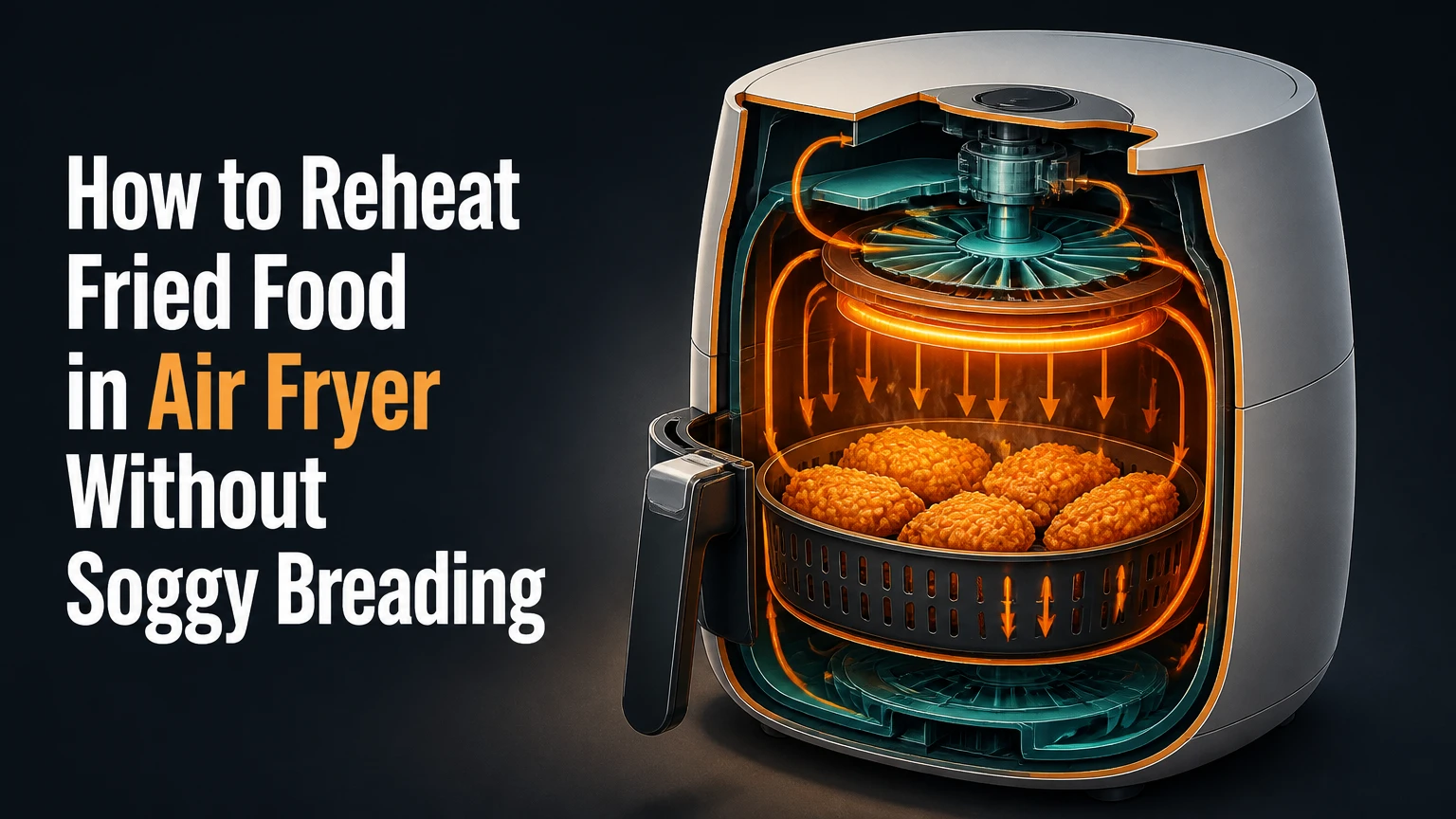
To reheat fried food in an air fryer, preheat it to 350-375°F, arrange refrigerated pieces in one layer, and cook for 3-12 minutes depending on thickness. Shake small foods or flip larger pieces halfway through, then rest them for 1-2 minutes. The best results come from dry surfaces, open airflow, and gradual heating.
Key Facts at a Glance
Refrigerated fries typically need 350°F for 3-5 minutes.
Bone-in fried chicken typically needs 375°F for 8-12 minutes.
A single layer with gaps produces a crisper crust than a crowded basket.
USDA Food Safety and Inspection Service guidance says leftovers should reach 165°F before serving.
A light mist of high-smoke-point oil can repair dry breading, but most fried food needs no added oil.
Lower the temperature by 25°F when the crust browns before the center becomes hot.
Why Does an Air Fryer Reheat Fried Food Well?
An air fryer reheats fried food by combining radiant heat from the element with fast-moving convection air. The airflow removes surface moisture that condensed inside the refrigerator, while moderate heat warms the interior and reactivates some residual oil in the crust.
Freshly fried breading contains a dry outer structure and a warmer, moist interior. Refrigeration changes that balance: moisture migrates toward the crust, starches firm, and the coating loses its brittle texture. The air fryer reverses part of that process without immersing the food in new oil.
The result is usually crisper than microwave reheating and faster than a full-size oven. However, an air fryer cannot fully restore food whose coating has absorbed sauce, whose crust has detached, or whose interior has already dried during the original cooking.
What determines the reheating result?
Food thickness, coating type, starting temperature, basket loading, and sauce level determine the result more than the air fryer brand. A thin onion ring may burn in four minutes, while a thick bone-in thigh remains cold in the center at the same setting.
Air fryers also vary in power and airflow. A compact 2-quart basket may heat a small batch quickly, while a large toaster-oven air fryer may require a longer preheat but handle more pieces. Treat the first batch as calibration, especially when using an unfamiliar appliance.
What Should You Do Before Reheating?
Before reheating fried food, verify that the leftovers were chilled within two hours and stored at 40°F or below. Remove excess sauce, blot visible moisture, and prepare a clean basket, tongs, and an instant-read thermometer for thick meat pieces.
Before You Start
| Requirement | Typical value | Why it matters |
|---|---|---|
| Preheat time | 3-5 minutes | Stabilizes basket temperature |
| Cooking temperature | 350-375°F | Balances crust browning and interior heating |
| Oil amount | 0-1 teaspoon per 1 pound | Prevents unnecessary greasiness |
| Basket load | 1 layer, 0-1 inch overlap | Preserves airflow |
| Rest time | 1-2 minutes | Lets crust firm after cooking |
| Safety target | 165°F internal temperature | Applies to reheated meat, poultry, and many leftovers |
The FDA Food Code uses 165°F as a reheating benchmark for many cooked foods, and USDA Food Safety and Inspection Service consumer guidance also tells households to reheat leftovers to 165°F. Texture does not prove safety, so use a thermometer for thick chicken, seafood, filled pastries, and food that has been reheated unevenly.
Do not leave perishable leftovers at room temperature for extended periods simply to remove refrigerator chill. A short 5-10 minute tempering period may reduce the temperature gradient, but it does not replace safe storage or thorough reheating.
How to Reheat Fried Food in Air Fryer
Use five controlled steps: preheat, dry and arrange the food, select a food-specific temperature, turn or shake halfway, and rest before serving. The active cooking time usually ranges from 3-12 minutes, while basket spacing is the main factor controlling crispness.
Step 1: Preheat the Air Fryer
Preheat the air fryer to 350°F for fragile or thin foods and 375°F for thicker breaded chicken. Run the appliance empty for 3-5 minutes, unless the manufacturer specifically prohibits empty preheating.
A preheated basket begins crisping the coating immediately. That matters for fries and onion rings, which can soften if they spend too long warming in a cool chamber. Preheating matters less for thick chicken, where controlled interior heating is more important than immediate crust exposure.
You will know this step worked when: the air fryer reaches its set temperature or completes its preheat signal.
Common mistake: starting delicate food at 400°F. The coating can darken before the cold center warms.
Step 2: Dry and Arrange the Food
Blot condensation from refrigerated fried food with a paper towel, then place pieces in one layer with visible gaps between them. Use the basket base for most foods, and avoid stacking unless the appliance includes a rack designed for multi-level airflow.
Do not automatically add oil. Fries, chicken, tenders, and egg rolls usually retain enough surface fat to brown again. If the coating looks pale and chalky, apply approximately 1 teaspoon of canola, avocado, or grapeseed oil per pound of food using a refillable mister or pastry brush.
You will know this step worked when: air can pass around every piece and no wet surface is visibly pooling.
Common mistake: filling the basket to capacity. Crowding traps steam and creates a soft crust, even when the air fryer is set correctly.
Step 3: Set the Temperature and Time
Set the temperature according to the food’s thickness and moisture content, then begin with the low end of the time range. Thin foods need quick surface crisping; thick foods need slower heating to prevent a burnt exterior and cold interior.
| Food | Refrigerated setting | Frozen setting | Turn or shake |
|---|---|---|---|
| French fries | 350°F, 3-5 minutes | 375°F, 8-12 minutes | Shake every 2 minutes |
| Tater tots | 350°F, 4-6 minutes | 375°F, 8-10 minutes | Shake once or twice |
| Chicken nuggets | 370°F, 4-6 minutes | 375°F, 8-10 minutes | Flip once |
| Bone-in fried chicken | 350-375°F, 8-12 minutes | 350°F, 16-22 minutes | Flip once |
| Chicken tenders | 370°F, 5-7 minutes | 375°F, 9-12 minutes | Flip once |
| Onion rings | 350°F, 3-4 minutes | 375°F, 7-9 minutes | Flip gently |
| Egg rolls | 360°F, 4-6 minutes | 375°F, 8-12 minutes | Turn once |
| Breaded fish | 350°F, 5-8 minutes | 375°F, 10-14 minutes | Flip gently |
| Fried shrimp | 350°F, 3-5 minutes | 375°F, 7-9 minutes | Turn once |
| Fried pizza or calzone | 360°F, 4-7 minutes | 375°F, 8-12 minutes | Turn if uneven |
These are typical household ranges, not universal guarantees. A thick 1-inch chicken breast, a tightly packed basket, and a low-powered toaster-oven model may require additional time. Check early because reheated food progresses faster than raw food.
You will know this step worked when: the coating becomes firm and browned while the center approaches serving temperature.
Common mistake: applying the same 400°F setting to every food. High heat is appropriate for some frozen products but often burns thin breading.
Step 4: Shake or Flip Halfway Through
Shake fries, tots, popcorn shrimp, and small nuggets halfway through cooking. Flip chicken, fish, egg rolls, and large tenders with silicone or nylon tongs so the second side receives direct airflow.
Movement corrects two common problems: contact-side softening and uneven browning. Handle fragile fish and onion rings gently because aggressive shaking can tear the coating and expose moist filling.
You will know this step worked when: both sides show similar color and the food no longer rests on one persistently damp contact point.
Common mistake: flipping too early, before the crust has firmed. Wait roughly halfway through the listed cooking time unless the food is sticking or burning.
Step 5: Check, Rest, and Serve
Check texture visually, then measure the center of thick meat or filled food with an instant-read thermometer. Remove crisp items as soon as the crust firms, and rest them for 1-2 minutes on a plate or wire rack rather than inside the warm basket.
The center of poultry and many mixed leftovers should reach 165°F. Thin fries do not require a thermometer, but a firm surface, visible browning, and a hot center indicate completion.
You will know this step worked when: the crust stays firm after one minute and the filling is hot without steam-softening the exterior.
Common mistake: covering the food immediately. Foil, a lid, or a sealed container traps steam and reverses the crisping work.
What Temperature and Time Does Each Fried Food Need?
Most refrigerated fried foods reheat between 350°F and 375°F for 3-12 minutes. Fries and onion rings need short, high-airflow heating, while bone-in chicken and thick filled foods need lower heat or extra time to warm safely.
French Fries, Tater Tots, and Hash Browns
Reheat refrigerated fries at 350°F for 3-5 minutes, shaking every two minutes. Spread them across the basket rather than forming a pile, and add no oil unless the fries look unusually dry.
Frozen fries require a different method because ice and surface moisture must evaporate first. Use 375°F for 8-12 minutes, shake twice, and add 1-3 minutes only if the center remains cold or the exterior lacks firmness.
Fried Chicken and Chicken Tenders
Reheat bone-in chicken at 350-375°F for 8-12 minutes, turning halfway through. Use 350°F for large breasts or thighs when the crust browns rapidly, and verify that the thickest portion reaches 165°F without touching the bone.
Chicken tenders, strips, and nuggets heat more evenly because their thickness is consistent. Use 370°F for 4-7 minutes when refrigerated and 375°F for 8-12 minutes when frozen. A light oil mist helps only when the breading has dried.
Fish, Shrimp, and Other Seafood
Reheat breaded fish at 350°F for 5-8 minutes and fried shrimp at 350°F for 3-5 minutes when refrigerated. Turn seafood gently once, because thin fillets and loose coatings can break under vigorous shaking.
Seafood dries faster than potato products. Stop cooking when the coating firms and the center is hot; extending the time for darker browning can produce tough fish even when the crust looks attractive.
Egg Rolls, Spring Rolls, and Onion Rings
Reheat refrigerated egg rolls at 360°F for 4-6 minutes and onion rings at 350°F for 3-4 minutes. Turn both once, but handle onion rings carefully because their coating can separate from the onion as trapped steam expands.
If wrappers look dry, mist lightly with oil before cooking. Avoid wet sauces until serving, since soy sauce, gravy, ranch dressing, and cheese sauce soften fried coatings within minutes.
How Do You Reheat Frozen Fried Food?
Frozen fried food usually needs 375°F for 7-22 minutes, depending on thickness, and should go directly from the freezer into a single layer. Do not thaw breaded foods first unless the package instructions require it, because thawing adds surface water and encourages sogginess.
| Frozen food | Temperature | Typical time | Best checkpoint |
|---|---|---|---|
| Fries | 375°F | 8-12 minutes | Crisp edges and hot center |
| Nuggets | 375°F | 8-10 minutes | 165°F center for poultry |
| Egg rolls | 375°F | 8-12 minutes | Wrapper firm and filling hot |
| Breaded fish | 375°F | 10-14 minutes | Flaky center and firm crust |
| Bone-in chicken | 350°F | 16-22 minutes | 165°F at thickest point |
| Mozzarella sticks | 350°F | 5-8 minutes | Coating firm before cheese leaks |
Frozen products often contain a factory-applied oil coating, so additional oil can make the surface greasy. Check the package first, because commercial frozen foods may specify a temperature that differs from homemade leftovers.
Is an Air Fryer Better Than a Microwave or Oven?
An air fryer is usually the best method for restoring crispness to one or two servings, while a microwave is fastest for soft foods and an oven is more practical for large batches. Deep-frying can produce the crispest crust, but it adds oil, cleanup, and splatter.
| Method | Typical time | Capacity | Texture result | Best use |
|---|---|---|---|---|
| Air fryer | 3-12 minutes | 1-4 servings | Crisp coating | Fries, chicken, tenders |
| Microwave | 1-3 minutes | 1-2 servings | Soft or chewy crust | Sauced food, urgent reheating |
| Conventional oven | 15-25 minutes | 4-12 servings | Crisp but less intense | Family-size batches |
| Toaster oven | 8-18 minutes | 2-6 servings | Moderate crispness | Flat foods and pizza |
| Deep fryer | 3-6 minutes | 2-6 servings | Very crisp and oily | Restaurant-style texture |
A hybrid method can solve competing needs. Microwave a thick chicken piece for 30-60 seconds at reduced power, then air fry it at 350°F for 3-5 minutes. The microwave warms the center, while the air fryer repairs the exterior, although the crust will rarely match a fully air-fried piece.
An air fryer is not ideal for heavily sauced wings, loose cheese, wet batter, or foods with a delicate custard filling. Use a lower temperature, a small heatproof dish, or a separate sauce application when the filling could leak.
What Mistakes Make Fried Food Soggy or Dry?
The most common air-fryer reheating mistakes are excess moisture, overcrowding, excessive heat, and overcooking. Each failure has a different correction, so increasing the temperature is not a universal solution.
| Problem | Likely cause | Immediate correction | Next-batch adjustment |
|---|---|---|---|
| Soggy crust | Crowded basket or wet surface | Separate pieces and cook 2-3 minutes longer | Blot food and use one layer |
| Burnt coating, cold center | Temperature too high | Reduce by 25°F and add 3-6 minutes | Start at 350°F |
| Dry chicken | Excessive time or thin meat | Add sauce after heating | Check at 6-8 minutes |
| Flying wrappers | Lightweight food and strong fan | Use a rack or trivet | Place heavier pieces above edges |
| Leaking cheese | Temperature too high or time too long | Remove at first bubbling | Use 325-350°F |
| Uneven browning | No turning or poor spacing | Rotate pieces immediately | Turn halfway through |
Should You Use Foil or Parchment?
Use perforated parchment or a small foil sling only when food might stick or leak, and never block the basket’s main airflow. A solid sheet under a full load can reduce circulation, retain moisture, and create a pale underside.
Do not place loose parchment in a preheating basket. The fan can lift it into the heating element. Add food on top of parchment so its weight holds the liner down, and follow the appliance manufacturer’s guidance.
How Much Oil Should You Add?
Use no added oil for most fries, tots, chicken, and commercial frozen breaded foods. For visibly dry homemade breading, use approximately 1 teaspoon per pound, distributed as a fine mist rather than poured into the basket.
Choose oils with smoke points above the selected cooking temperature, such as refined avocado, canola, grapeseed, or vegetable oil. Avoid aerosol propellants when the appliance manufacturer warns that they can damage nonstick surfaces; a refillable mister gives more control.
How Do You Plan Multiple Batches?
Plan one layer per batch and add roughly 3-5 minutes for a second batch if the basket cools between loads. A 4-quart basket commonly handles about 1-2 servings of fries or four small chicken pieces without serious crowding, while an 8-quart model can usually handle twice that amount.
| Appliance size | Practical fries load | Chicken load | Typical batch time |
|---|---|---|---|
| 2-quart basket | 8-12 ounces | 2 small pieces | 3-10 minutes |
| 4-quart basket | 12-20 ounces | 3-4 pieces | 4-12 minutes |
| 6-quart basket | 20-28 ounces | 4-6 pieces | 5-14 minutes |
| 8-quart basket | 28-40 ounces | 6-8 pieces | 6-16 minutes |
| Air-fryer oven | 24-40 ounces | 6-10 pieces | 8-18 minutes |
A dual-basket appliance helps only when the foods need different settings. Fries at 350°F and bone-in chicken at 375°F should use separate zones, but a shared basket is simpler when all items need the same temperature and finishing time.
For a large family meal, a conventional oven may beat repeated air-fryer batches. The oven takes longer to preheat, but its 15-25 minute cycle can finish six or more servings at once without the quality loss caused by stacking.
How Do You Adjust for an Unfamiliar Air Fryer?
Adjust an unfamiliar air fryer in 25°F increments and inspect food two minutes before the listed minimum time. Compact high-powered baskets often brown thin coatings faster than large air-fryer ovens, so the same displayed temperature does not guarantee the same result.
Place a thermometer in the thickest part of chicken or fish without touching bone. If the center is below 165°F while the crust is already dark, reduce the setting by 25°F and continue heating in 2-3 minute intervals.
A practical calibration rule is to treat the first batch as a test: record the appliance, food weight, starting temperature, setting, and final texture. That record turns a broad 3-12 minute range into a repeatable household setting.
Frequently Asked Questions
Can I reheat fried food without preheating the air fryer?
Yes, but a cold-start cycle commonly adds 2-4 minutes and may produce less even browning. Cold starts work adequately for thick chicken and large portions, while preheating gives better results for fries, onion rings, and other thin foods that need immediate surface drying.
Why does my air-fried chicken remain cold inside?
Cold chicken usually indicates excessive temperature, excessive thickness, or overcrowding. Reduce the air fryer setting by 25°F, separate the pieces, and continue in 3-minute intervals until the thickest portion reaches 165°F. A thermometer is more reliable than judging the crust color.
Can I reheat fried food in its takeout container?
No. Paperboard, plastic, foam, printed coatings, and adhesives are not designed for direct air-fryer heat and may melt, smoke, or ignite. Transfer the food to the basket or a heat-safe accessory rated for the appliance’s temperature.
How do I reheat fried food without making it greasy?
Start without oil, blot surface moisture, and use a single layer. Added oil is appropriate only for visibly dry breading, and approximately 1 teaspoon per pound is usually enough. Excess oil can make the crust heavy because reheating does not remove all surface fat.
Can I reheat fried food with gravy or sauce?
Reheat the fried food separately, then add gravy or sauce immediately before serving. Wet sauces soften breading through moisture migration, so placing sauced food directly in the basket generally produces a crisp exterior only briefly, if at all.
How long are fried-food leftovers safe in the refrigerator?
Use refrigerated leftovers within 3-4 days when stored at 40°F or below, following USDA consumer guidance. Discard food that remained at room temperature for more than two hours, or more than one hour when the surrounding temperature exceeded 90°F.
The Bottom Line
Reheating fried food in an air fryer works best at 350-375°F, with 3-12 minutes of cooking, one-layer spacing, and a halfway shake or flip. Use 350°F for fragile or thick foods, 375°F for frozen products, and a thermometer for poultry or dense fillings. Add sauce after reheating, rest crisp items for 1-2 minutes, and lower the temperature whenever the coating browns before the center reaches 165°F.