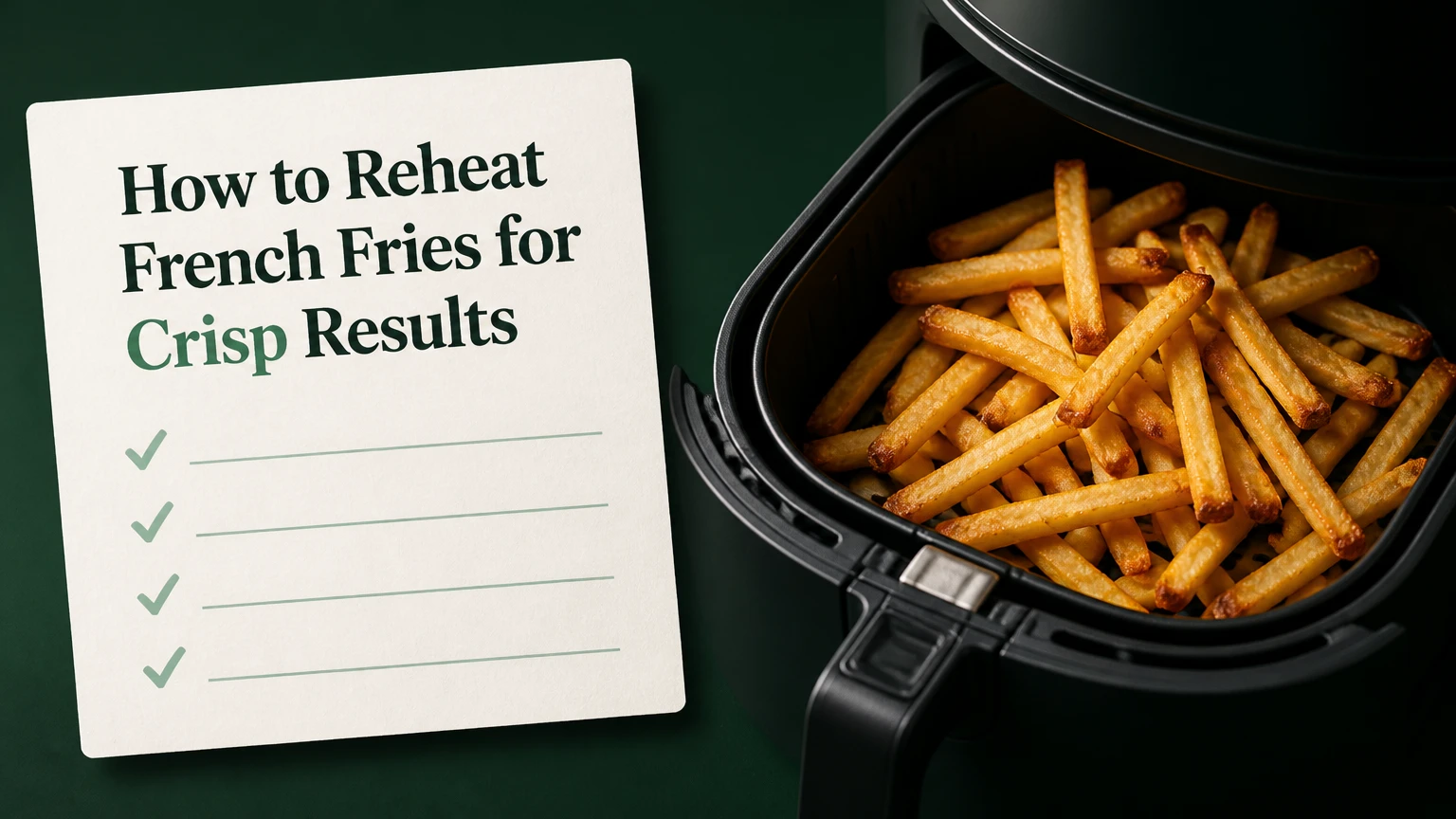
To reheat French fries, use high, dry heat and arrange the leftovers in a single layer so surface moisture can escape. Air-fry them at 375°F for 3-5 minutes, bake them at 425°F for 5-10 minutes, or crisp them in a lightly oiled skillet for 4-6 minutes. Season immediately after heating.
Key Facts at a Glance
An air fryer reheats one or two servings of French fries in 3-5 minutes at 375°F.
A conventional oven reheats larger batches best at 425°F for 5-10 minutes.
A skillet needs about 1 teaspoon of oil per serving and 4-6 minutes over medium to medium-high heat.
A single layer prevents steam from softening the crust.
Refrigerate cooked fries within 2 hours and use them within 3-4 days.
A microwave warms fries quickly but usually produces a soft, chewy exterior.
Why Leftover Fries Turn Soggy
Leftover French fries become soggy because moisture migrates from the potato center into the fried surface while the fries cool. The cooked potato starch also reorganizes during cooling, so the interior can become firmer, drier, or slightly chalky instead of fluffy.
Fresh frying creates a dry, porous crust around a moist interior. During refrigeration, water moves through the potato structure toward the cooler, drier surface. A sealed container can worsen the problem because condensation collects on the fries rather than evaporating.
Reheating works when heat evaporates surface water quickly enough to restore a dry crust. The interior warms more gently, softening the starch and returning some tenderness. High heat alone is not sufficient if the fries are piled together, because trapped vapor replaces the moisture that the cooking surface is trying to remove.
Food science explains why airflow and spacing matter more than simply increasing the temperature. A crowded basket or pan heats the fries, but the released steam remains nearby. A single layer exposes more surface area to moving hot air and allows water vapor to leave.
Should You Dry Fries Before Reheating?
Drying the fries briefly improves crispness when condensation is visible. Pat the surface with a paper towel, but do not soak or rinse cooked fries, because added water must later be driven out and can make the center mealy.
Leave fries that are merely cool and dry at room temperature for 5 minutes while the appliance heats. For fries stored in a tightly sealed container, blot obvious moisture before adding oil. Do not leave perishable leftovers unrefrigerated for extended periods just to dry them.
Before You Start
The reheating method depends on portion size, fry thickness, and the texture you want. The following preparation checklist prevents most failures before heat is applied.
| Item | Typical requirement | Why it matters |
|---|---|---|
| Leftover fries | 1-4 servings, about 3-12 ounces | Determines basket or pan crowding |
| High-smoke-point oil | 1 teaspoon per serving | Replaces some lost surface fat |
| Air fryer | 375°F, 3-5 minutes | Fastest crisping for small portions |
| Oven and baking sheet | 425°F, 5-10 minutes | Best for 3 or more servings |
| Heavy skillet | Medium to medium-high, 4-6 minutes | Strong browning and direct contact |
| Paper towel | 1-2 sheets | Removes condensation before heating |
| Instant-read thermometer | Optional, 165°F target | Confirms thorough reheating of leftovers |
Use a neutral oil such as canola, avocado, grapeseed, or refined peanut oil. Olive oil can work at moderate skillet temperatures, but extra-virgin olive oil may smoke if a pan becomes very hot. Oil spray should be a thin mist, not a wet coating.
Are Refrigerated Fries Safe to Reheat?
Refrigerated fries are generally suitable for reheating when they were chilled within 2 hours, stored at 40°F or below, and used within 3-4 days. Discard fries that smell sour, feel slimy, show mold, or sat at room temperature for more than 2 hours, or 1 hour above 90°F.
The USDA Food Safety and Inspection Service advises, “Refrigerate leftovers within 2 hours.” Reheating does not reliably reverse every food-safety problem created by prolonged room-temperature storage, so time and storage conditions matter more than the final cooking temperature.
Store fries in a shallow, covered container after they stop visibly steaming. A shallow layer cools faster than a deep pile. Avoid sealing very hot fries immediately if condensation will drip back onto the crust, but do not delay refrigeration beyond the safe time limit.
Which Method Gives the Crispiest Fries?
The air fryer usually gives the best balance of crispness, speed, and low oil use for one or two servings. A skillet produces the strongest direct browning, an oven handles the largest quantity, and a deep fryer most closely reproduces freshly fried texture while requiring substantially more oil and cleanup.
| Method | Temperature | Typical active time | Practical capacity | Oil requirement |
|---|---|---|---|---|
| Air fryer | 375°F | 3-5 minutes | 1-2 servings | 0-2 teaspoons |
| Conventional oven | 425°F | 5-10 minutes | 3-8 servings | 1-2 teaspoons per serving |
| Toaster or convection oven | 400-425°F | 5-9 minutes | 1-3 servings | 1-2 teaspoons total |
| Skillet | Medium to medium-high | 4-6 minutes | 1-2 servings | 1-2 teaspoons per serving |
| Deep fryer | 350-375°F | 1-2 minutes | 2-6 servings | 1-2 quarts in appliance |
The deep fryer is not automatically the best choice. It gives the most convincing restaurant-style crust, but it also adds handling risk, oil disposal, and a greater chance of over-browning thin fries. For ordinary leftovers, the air fryer or skillet usually offers better effort-to-result value.
How to Reheat French Fries Step by Step
A reliable process has six actions: remove excess moisture, choose a temperature, preheat the cooking surface when applicable, add minimal oil, heat in one layer, and season after cooking. The most important factor is surface exposure, because trapped steam prevents the crust from drying.
Step 1: Sort, Dry, and Separate the Fries
Remove fries with visible sauce, cheese, gravy, or wet toppings before reheating. Separate clumps with your fingers and blot condensation from the surface using a paper towel.
Keep heavily coated fries separate from plain fries because sauces burn before the potato becomes crisp. Discard fries with spoilage signs rather than trying to mask them with high heat.
You will know this step worked when: individual fries no longer stick together and the surface feels moist but not wet.
Common mistake: adding oil before removing condensation. Oil spreads unevenly over a wet surface and can make the fries greasy.
Step 2: Match Heat to Fry Type
Set the appliance according to thickness and composition rather than applying one temperature to every fry. Standard and thin potato fries tolerate 375-425°F, while sweet potato fries benefit from slightly shorter cooking because their sugars brown quickly.
| Fry type | Air fryer setting | Oven setting | Typical time |
|---|---|---|---|
| Shoestring or thin-cut | 350-375°F | 400-425°F | 3-5 minutes |
| Standard fast-food cut | 375°F | 425°F | 4-8 minutes |
| Crinkle-cut or curly | 375-390°F | 425°F | 5-9 minutes |
| Steak or thick-cut | 375°F | 425°F | 7-12 minutes |
| Waffle fries | 375°F | 425°F | 5-8 minutes |
| Sweet potato fries | 350-375°F | 400-425°F | 4-8 minutes |
Start at the lower end when fries are thin, darkened, or already heavily browned. Start at the higher end when the fries are thick and the interior is cold. Temperature adjustments of 25°F are more useful than adding large amounts of oil.
You will know this step worked when: the selected setting reflects both thickness and browning risk.
Common mistake: using 425°F for delicate shoestring fries and walking away. Thin edges can burn in under 4 minutes.
Step 3: Air-Fry the Fries
Arrange French fries in a single layer in an air-fryer basket, mist them lightly with oil, and cook at 375°F for 3-5 minutes, shaking after 2 minutes. Begin checking thin fries at 3 minutes and thick fries at 5 minutes.
For one serving, use approximately 1 teaspoon of oil, or less if the fries still look glossy. A 5.8-quart basket generally handles one to two servings without severe overlap, although the usable capacity varies with fry shape and basket design.
Do not assume preheating is always necessary. A preheated air fryer gives a faster first burst of heat, but many models reach working temperature quickly enough that adding 1-2 minutes produces the same practical result. Follow the appliance manual if it specifies a preheat cycle.
You will know it worked when: the surface feels rigid when tapped, the edges look dry, and the center is hot rather than chalky.
Common mistake: filling the basket beyond one layer. Reheat two batches instead of doubling the time, because prolonged heating dries the interior.
Step 4: Use a Hot Oven for Large Batches
Heat an empty, sturdy baking sheet in a 425°F oven for at least 5 minutes, then spread lightly oiled fries across it in one layer. Bake for 5-10 minutes, turning the fries once halfway through, and add 2-4 minutes for thick-cut pieces.
A preheated metal sheet transfers heat directly to the underside, which improves browning compared with a cold tray. Parchment can reduce sticking, but it also insulates the contact surface slightly; use bare metal when the sheet is clean and the fries are lightly oiled.
Use the middle or upper-middle rack for balanced heating. A broiler can finish the surface for 30-60 seconds, but it requires constant watching because thin fries can go from golden to burnt rapidly.
You will know it worked when: the fries release easily from the sheet, the underside has browned spots, and the thickest pieces are hot in the center.
Common mistake: covering the tray with foil. Foil can trap steam around the fries and reduce the dry heat needed for crisping.
Step 5: Crisp Fries in a Skillet
Heat a heavy skillet over medium to medium-high heat, add 1-2 teaspoons of oil per serving, and place the fries in a loose single layer. Cook for 2 minutes without moving, toss or turn, then cook for another 2-3 minutes until the edges brown.
Cast iron and carbon steel retain heat well, while a nonstick pan reduces sticking but may brown less aggressively. A 10-inch skillet suits one to two servings; a larger quantity should be cooked in batches rather than packed into one pan.
For thick steak fries, reduce the heat to medium after the first side browns. For flavor, add rosemary, garlic, paprika, or black pepper only during the last minute, since fresh garlic can burn if added at the start.
You will know it worked when: the fries have browned contact points and yield softly when bitten rather than snapping dry.
Common mistake: stirring continuously. Constant movement prevents sustained pan contact and produces pale, uneven surfaces.
Step 6: Deep-Fry for Restaurant-Style Texture
Heat fresh or properly filtered frying oil to 350-375°F and lower a small batch of fries into the oil for 1-2 minutes. Remove them when the exterior is crisp, drain them on a rack or paper towel, and season while hot.
Use a deep pot or certified fryer with enough headspace to contain bubbling oil. Never add wet fries to hot oil, never fill the vessel more than halfway, and never use water to control an oil fire. Turn off the heat and cover the vessel if a grease fire begins, then contact emergency services if it does not stop immediately.
Deep-frying is most useful for thick-cut fries that have become leathery or for cooks who already have hot oil available. It is a poor choice for a small snack when cleanup and oil disposal outweigh the texture improvement.
You will know it worked when: bubbling decreases, the crust firms, and the fries drain without looking soaked in oil.
Common mistake: frying a large cold batch at once. The oil temperature drops, causing greasy fries instead of crisp fries.
How Should Thick-Cut and Specialty Fries Be Adjusted?
Thick-cut fries need more time at moderate heat, while sweet potato fries need shorter heating at a lower temperature because their sugar content promotes fast browning. Waffle and curly fries benefit from shaking or turning because their irregular shapes create uneven hot and cool zones.
Steak fries can be reheated in an air fryer at 375°F for 6-9 minutes or in a 425°F oven for 8-12 minutes. If the exterior darkens before the center warms, lower the temperature by 25°F and extend the time.
Sweet potato fries should start at 350°F in an air fryer or 400°F in an oven. Check them after 4 minutes. Their softened texture may not become as crisp as a potato fry because sweet potato flesh contains different moisture and sugar proportions.
Waffle fries should remain in a single layer with space around the openings. Curly fries should be shaken at least once, while crinkle-cut fries may need an extra minute because their ridges hold more moisture.
What Changes for Fast-Food Fries?
Fast-food fries usually need less oil than homemade fries because their original frying process leaves a thin fat layer on the surface. Reheat one serving at 375°F in an air fryer for 3-4 minutes, or use a skillet with about 1 teaspoon of oil.
For fries from McDonald’s, Burger King, or similar restaurants, remove paper packaging before refrigeration because trapped heat and condensation soften the crust. Separate fries from burgers, sauces, and steam-producing foods before storage.
Very thin fast-food fries can burn quickly. Check at 2-3 minutes in an air fryer and turn them once in a skillet. Salt after reheating because old salt may have drawn additional moisture to the surface.
Is the Microwave Ever Useful?
A microwave is useful for warming the interior of fries, but it is usually a poor standalone method for restoring crispness. Microwave energy excites water throughout the potato, creating steam that softens the crust instead of evaporating moisture from the exterior.
The claim that a microwave makes fries permanently mushy is too strong. A microwave does not permanently alter every fry beyond recovery, but repeated microwaving can make the texture rubbery, and the appliance cannot create the dry surface conditions produced by an oven, skillet, or air fryer.
If speed matters more than crispness, microwave fries on a paper towel in 20-30-second intervals until warm. For a better compromise, microwave thick fries for 20-40 seconds to warm the center, then finish them in a hot skillet or air fryer for 1-3 minutes.
Common Mistakes and How to Fix Them
Reheating errors usually involve excess moisture, excessive heat, or too many fries in the cooking area. The correction should address the cause rather than simply adding time.
| Problem | Likely cause | Specific correction |
|---|---|---|
| Burnt outside, cold center | Heat too high for thick fries | Lower setting by 25°F and add 2-4 minutes |
| Limp and greasy surface | Crowded pan or cold oil | Use one layer and preheat the surface |
| Dry, cardboard-like texture | Too much time or no residual fat | Reduce cooking by 1-2 minutes and mist lightly |
| Pale, uneven browning | Continuous stirring or overlap | Leave fries still for 2 minutes before turning |
| Smoke from appliance | Excess oil or sugary coating | Use less oil and reduce heat to 350-375°F |
| Soggy after cooking | Condensation in storage or sealed tray | Blot moisture and serve immediately on an open rack |
Why Are Fries Burning Before the Center Gets Hot?
Fries burn outside and remain cold inside when the cooking surface is too hot for their thickness. Lower the oven or air fryer by 25°F, spread the fries farther apart, and extend cooking in 1-2-minute increments.
Do not routinely tent fries with foil during reheating. Foil traps steam and can soften the crust. If a very thick fry needs protection, use a lower temperature first, then remove any cover and finish with dry heat.
How Do You Fix Limp, Greasy Fries?
Limp, greasy fries usually result from crowding, insufficient preheating, or too much oil. Transfer the fries to a hot, dry surface in a single layer and cook them for 1-3 additional minutes without adding more fat.
A wire rack helps an oven expose both sides to hot air. In a skillet, drain excess oil and return the fries briefly to the pan after the oil has stopped pooling. Serve immediately because crispness declines as steam condenses during cooling.
How Do You Fix Dry Fries?
Dry fries need less reheating time and a small amount of surface fat, not a long low-temperature cook. Mist approximately 1 teaspoon of oil per serving, heat only until the crust firms, and avoid holding the fries in a warm oven afterward.
Salt, spice blends, grated cheese, and herbs should be added after cooking. Salt applied before reheating can draw moisture toward the surface, while cheese and sugar-based sauces can burn before the potato warms.
Which Method Fits Your Kitchen?
| Situation | Recommended method | Setting and time | Main limitation |
|---|---|---|---|
| One serving after takeout | Air fryer | 375°F, 3-4 minutes | Basket space |
| Three or more servings | Oven | 425°F, 5-10 minutes | Longer preheat |
| No air fryer available | Skillet | Medium heat, 4-6 minutes | Requires attention |
| Very thick steak fries | Air fryer or skillet | 375°F, 6-9 minutes | Center warms slowly |
| Maximum restaurant-style crust | Deep fryer | 350-375°F, 1-2 minutes | Oil and safety concerns |
| Soft interior is the priority | Microwave, then skillet | 20-40 seconds, then 1-3 minutes | More handling |
A busy student with one serving should choose the air fryer. A family serving several portions should use the oven. A cook without specialized equipment can achieve strong results in a skillet, provided the fries are not crowded.
The oven is not good for a single handful when preheating consumes more time than the cooking itself. The deep fryer is not good for casual reheating when oil management creates more work than the leftovers justify.
How Much Time and Money Does Each Method Need?
Typical operating costs vary by electricity rates, appliance wattage, and oil prices, but the equipment and ingredient demands are predictable. Air fryers use little oil, ovens consume more energy during preheating, and deep fryers require the highest consumable input.
| Method | Typical batch time | Typical added oil | Typical operating or consumable cost |
|---|---|---|---|
| Air fryer | 3-5 minutes | $0-$0.05 | About $0.02-$0.08 in electricity |
| Oven | 5-10 minutes plus preheat | $0.02-$0.10 | About $0.08-$0.30 in electricity |
| Skillet | 4-6 minutes | $0.03-$0.15 | About $0.03-$0.12 in oil and energy |
| Deep fryer | 1-2 minutes | $0.10-$0.60 | About $0.15-$0.80 including oil use |
These figures are typical household estimates, not fixed prices. A long oven preheat can cost more than the final reheating cycle, while a skillet remains economical for a small portion. Cost should be evaluated with cleanup and batch capacity, not energy alone.
Expert Rules for Better Reheated Fries
- Heat the surface, not just the air. A preheated metal tray or skillet transfers energy directly into the crust, while a cold surface absorbs heat during the period when browning should begin.
- Use oil as a thin thermal bridge. A light film improves contact and browning, but a tablespoon poured over one small serving creates a greasy layer that traps moisture.
- Stop before the fries look perfect. Residual heat continues softening the center for roughly 30-60 seconds after removal, while prolonged appliance time dries the potato rapidly.
- Judge the thickest fry. Thin pieces can look finished while a steak fry remains cold inside. Test one thick piece before serving the batch.
- Serve on an open surface. A closed bowl traps steam under the fries and can undo crisping within minutes; use a plate or rack with room for vapor to escape.
Frequently Asked Questions
Can You Reheat Fries the Next Day?
Yes, fries can be reheated the next day when they were refrigerated within 2 hours and stored at 40°F or below. Air-fry them at 375°F for 3-5 minutes, checking early for thin fries. Fries stored uncovered may be drier, so a very light oil mist can improve the crust.
Should You Add Salt Before or After Reheating?
Add salt after reheating. Salt applied before cooking can draw moisture toward the surface, while hot oil and residual surface moisture help new seasoning adhere after the fries leave the appliance. Add sauces separately because wet toppings soften the crust quickly.
Can You Reheat Fries Without Oil?
You can reheat fries without oil, especially when they still look glossy from their original frying. An air fryer or hot oven can restore reasonable crispness, but a teaspoon or less per serving helps fries that look dry, pale, or leathery.
Why Do Fries Get Soggy in a Container?
Fries get soggy in a container because retained heat turns internal moisture into condensation, which settles on the crust. Refrigerate leftovers safely, but use a shallow container, avoid packing fries while steaming hot, and reheat them uncovered on a hot surface.
Can You Reheat Fries Twice?
You can reheat fries twice for texture, but repeated heating makes them progressively drier and increases handling and storage risk. Reheat only the portion you plan to eat, keep the remaining fries refrigerated, and discard leftovers that exceed the 3-4-day storage window.
What Is the Best Way to Reheat French Fries Without an Air Fryer?
The best method without an air fryer is a preheated skillet for one or two servings, or a 425°F oven for a large batch. Use a single layer, minimal oil, and 4-6 minutes in a skillet or 5-10 minutes in an oven, turning once.
The Bottom Line
To reheat French fries successfully, remove condensation, use high dry heat, apply only a thin film of oil, and leave space between pieces. Choose an air fryer for one or two servings, an oven for a large batch, or a skillet when direct browning and hands-on control matter. The best results from how to reheat french fries come from stopping as soon as the crust is crisp and serving immediately.