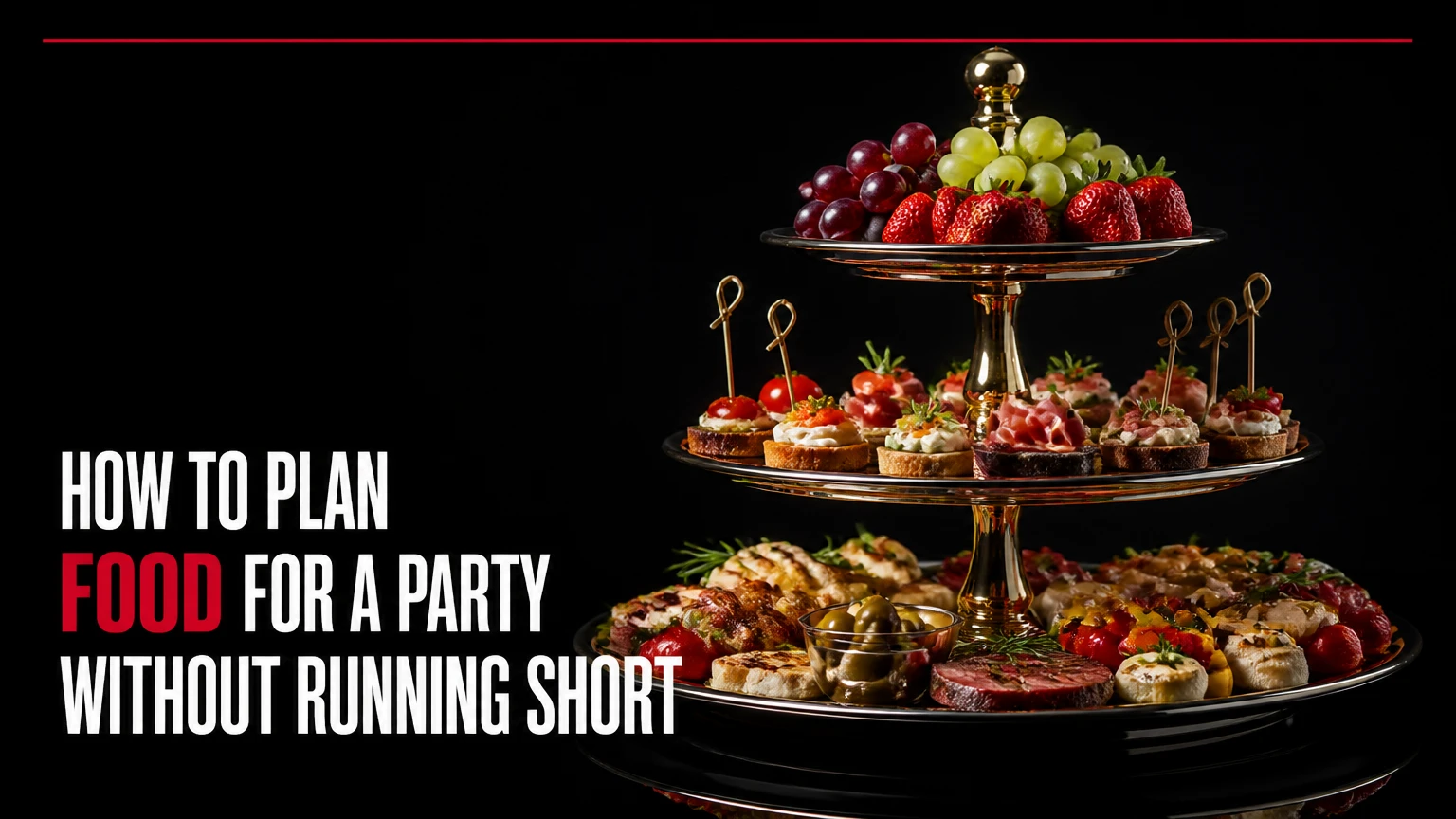
Planning food for a party means matching the menu, quantity, budget, preparation time, serving method, and food-safety controls to the guest list and event schedule. Start by defining whether guests need a meal or snacks, calculate portions by food category, select dishes that hold well, and reserve enough time for shopping, preparation, service, and replenishment.
Key Facts at a Glance
A full lunch or dinner typically requires 450-600 grams of combined food per adult, including the main dish and sides.
A cocktail-style event lasting 2-3 hours usually needs 12-16 appetizer pieces per guest.
A meal that overlaps 6:00 PM-9:00 PM should be planned as dinner, while a 2:00 PM-5:00 PM gathering usually needs lighter food.
Refrigerate perishable food within 2 hours, or within 1 hour when outdoor temperatures exceed 90°F (32°C), according to USDA guidance.
Hold hot food at 140°F (60°C) or above and cold food at 40°F (4°C) or below.
The most reliable party menu contains several make-ahead dishes and only one or two items requiring last-minute cooking.
What Should You Decide Before Planning Party Food?
Party food planning begins with five decisions: guest count, event duration, meal expectation, venue capacity, and dietary requirements. These decisions determine the amount of food, the cooking equipment, the serving format, and the number of dishes that can safely reach guests at the right temperature.
Write the answers down before choosing recipes:
- Guest count: Separate confirmed adults, children, uncertain guests, and vendors or staff.
- Time: Record arrival time, food-service time, and scheduled end time.
- Meal expectation: Classify the event as a meal, substantial snacks, dessert reception, or drinks-only gathering.
- Venue: Note oven capacity, refrigerator shelves, outlets, tables, sinks, shade, and weather exposure.
- Dietary needs: Ask for allergies, vegan or vegetarian requirements, gluten avoidance, kosher or halal needs, and foods guests cannot tolerate.
A two-hour birthday party at 3:00 PM does not need the same menu as a four-hour anniversary dinner beginning at 6:30 PM. The schedule changes both appetite and portion requirements.
How Do You Estimate the Real Guest Count?
Use the confirmed guest count, then add a 5-10% buffer for a seated meal when attendance is reliable. For an open-house event, a casual invitation, or a party where guests may bring companions, use a 10-15% buffer and prioritize foods that can be replenished in small batches.
Children usually consume less than adults, but age matters. A teenager at an evening buffet may eat an adult portion, while a preschooler may eat one-third to one-half of an adult portion. Count hosts, entertainers, delivery staff, and hired servers separately if they will eat.
Step 1: Match the Menu to the Event
Choose the service style and menu size before buying ingredients. A practical home-hosted meal usually works best with one main protein or vegetarian centerpiece, two sides, one salad or vegetable dish, bread or another starch, and one dessert.
The following structure prevents both repetition and excessive labor:
| Event type | Typical duration | Food target per guest | Practical menu |
|---|---|---|---|
| Afternoon snacks | 2-3 hours | 6-10 small pieces | Dip, fruit, savory bites, dessert |
| Cocktail reception | 2-3 hours | 12-16 appetizer pieces | Four to six savory categories plus dessert |
| Dinner buffet | 3-4 hours | 450-600 g total food | Main, 2-3 sides, salad, bread, dessert |
| Brunch buffet | 2-3 hours | 350-500 g total food | Egg dish, starch, fruit, pastry, protein |
| Dessert party | 2-3 hours | 2-3 dessert portions | Cake, small pastries, fruit, coffee, tea |
Menu variety means contrast, not a high dish count. Combine soft and crisp textures, rich and acidic flavors, hot and cold foods, and different colors. A menu of creamy pasta, cheesy potatoes, bread, and cake may be filling but will feel heavy because every item has a similar texture and richness.
Which Foods Are Easiest to Serve?
Make-ahead salads, braised meats, baked pasta, grain dishes, roasted vegetables, dips, sliced fruit, and sheet-pan desserts are usually easier to serve than fried foods, individual steaks, delicate pastries, or dishes that require simultaneous pan work.
Use a complexity budget. At a home party, choose no more than one high-attention dish, such as a roast that needs carving or a live taco station. The remaining menu should tolerate a 20-30 minute delay without losing quality.
Step 2: Choose a Service Style
The best service style depends on guest count, seating, kitchen access, staff, and the degree of portion control required. Buffet service is the most flexible choice for many home parties, while plated service gives better portion control but requires precise timing and more labor.
| Service style | Suitable guest count | Staffing need | Equipment need | Main limitation |
|---|---|---|---|---|
| Plated dinner | 4-24 at home | 1 server per 8-12 guests | Individual plates, table seating, coordinated kitchen | Food must leave the kitchen on schedule |
| Buffet | 10-100+ | 1 person per 25-40 guests for replenishment | Serving table, chafers, utensils, labels | Queue and temperature management |
| Finger food | 8-75 | 1 person per 25-35 guests | Trays, napkins, small plates, waste bins | High piece-by-piece preparation |
| Food station | 15-150 | 1 attendant per station | Station equipment, power, signage | Lines form if output is slow |
| Potluck | 10-100 | 1 coordinator | Labels, shared table, serving utensils | Quantity and dietary coverage vary |
For a buffet, place plates first, then cold dishes, hot dishes, starches, proteins, sauces, and cutlery at the end. Put beverages in a different area so guests collecting drinks do not block people serving food.
Plated meals are not ideal when the kitchen has one small oven, limited counter space, or no serving help. Finger food is not automatically easier because assembling 150 individual bites can require more labor than producing one large casserole.
Step 3: Calculate How Much Food You Need
Calculate party food by category rather than by a single total weight. For a full meal, plan approximately 200-250 grams of boneless main protein per adult, 150-200 grams of combined sides, and enough salad, bread, sauce, and dessert to complete the menu.
These are practical planning baselines, not laboratory measurements. Adjust for the event schedule, guest appetite, menu richness, and whether additional food will be available.
| Food category | Per-adult planning amount | Example for 25 adults | Adjustment |
|---|---|---|---|
| Boneless main protein | 200-250 g | 5-6.25 kg raw or purchased, depending on yield | Add 10% for large appetites |
| Bone-in main protein | 300-350 g | 7.5-8.75 kg | Increase for bones and trimming |
| Combined side dishes | 150-200 g | 3.75-5 kg | Use the lower end with several starters |
| Salad or vegetables | 100-150 g | 2.5-3.75 kg | Use the higher end for vegetarian guests |
| Bread or rolls | 1-1.5 pieces | 25-38 pieces | Add gluten-free bread separately |
| Dessert | 1-1.5 portions | 25-38 portions | Use 1.5-2 portions for varied mini desserts |
| Appetizers before a meal | 4-6 pieces per hour | 100-150 pieces for one hour | Reduce if dinner starts quickly |
| Cocktail-party appetizers | 12-16 pieces total | 300-400 pieces for 2-3 hours | Include filling items such as skewers or pastry |
For 10 adults eating dinner, 2-2.5 kilograms of boneless main protein, 1.5-2 kilograms of sides, 10-15 bread portions, and 10-15 dessert servings provide a workable starting point. For 50 adults, the corresponding main-protein range is 10-12.5 kilograms, with 7.5-10 kilograms of sides.
How Many Appetizers Should You Make?
Serve 4-6 appetizer pieces per person per hour when a meal follows. For an appetizer-only cocktail party, serve 12-16 pieces per person over two to three hours, including at least one filling option such as a savory tart, meatball, sandwich triangle, or substantial vegetable bite.
Count pieces, not platters. A tray containing 24 crostini is 24 servings only if each guest takes one. If the same tray is the only food available for an hour, it will disappear quickly.
How Much Food Should You Buy for Uncertain RSVPs?
Plan 80% of the maximum possible attendance as the base, then add flexible food that can stretch to the full number. Rice, pasta, beans, bread, salad greens, fruit, dips, and soup are easier to scale than individually portioned fish or steak.
Do not increase every item equally. Add approximately 10% to starches and vegetables, but reserve expensive protein in a chilled backup portion that can be cooked only if attendance warrants it.
Step 4: Build a Safe, Inclusive Menu
Design the core menu so guests with common restrictions can eat a complete plate rather than a token side dish. Naturally gluten-free grains, roasted vegetables, beans, fruit, and plain grilled proteins can support many guests when sauces and toppings remain separate.
Ask guests to identify allergies rather than simply preferences. An allergy requires ingredient checking and cross-contact prevention, while a preference may allow substitutions. Never promise that a food is allergen-free unless you can control the ingredients, preparation surfaces, utensils, and packaging.
Use separate labels for:
- Contains peanuts, tree nuts, milk, egg, wheat, soy, fish, or shellfish
- Vegan
- Vegetarian
- Gluten-free
- Halal or kosher, only when the preparation meets the relevant requirements
Prepare allergen-sensitive dishes first with clean equipment, cover them, and place them away from shared serving utensils. A gluten-free salad becomes unsuitable when guests use a crouton-covered spoon in the bowl.
What Is the 70/30 Menu Rule?
A useful host rule is to make at least 70% of the menu cold, room-temperature, baked, or slow-cooked, leaving no more than 30% for last-minute assembly or cooking. The ratio is a workload safeguard rather than a formal industry standard.
For example, a dinner menu might include braised chicken, couscous salad, roasted vegetables, hummus, bread, and cake. Only the chicken reheating and vegetable finishing require active timing, so one delayed task will not disrupt the entire meal.
Step 5: Create the Shopping and Preparation Schedule
Separate shopping into shelf-stable, durable fresh, and highly perishable purchases. A staggered schedule protects quality and prevents the refrigerator from becoming overloaded two days before guests arrive.
| Time before party | Buy or complete | Avoid doing too early |
|---|---|---|
| 30-21 days | Confirm menu, guest questions, caterer, rentals | Buying perishable ingredients |
| 14-7 days | Order specialty meat, check equipment, freeze suitable items | Finalizing quantities without RSVP review |
| 5-4 days | Pantry goods, drinks, disposables, canned items | Washing delicate greens |
| 2 days | Produce, dairy, eggs, fresh bread orders | Cooking crisp fried foods |
| 1 day | Chop durable vegetables, make sauces, marinate, bake stable desserts | Cutting apples or herbs that brown quickly |
| Party morning | Assemble stations, cook make-ahead dishes, chill drinks | Leaving food uncovered |
| 2 hours before | Reheat, bake, set tables, prepare serving utensils | Starting several unrelated recipes |
| 30 minutes before | Dress salads, garnish, open beverages, set labels | Putting all food out at once |
Write a prep list by equipment rather than only by recipe. For example, list “oven, 11:00-11:45, roast vegetables” and “refrigerator, shelf two, chill salad,” because the real constraint is often appliance capacity.
Step 6: Map Equipment, Space, and Portions
Assign every dish a serving vessel, utensil, label, and location before cooking. Sticky notes on empty platters reveal missing bowls, inadequate ladles, and dishes that are too large for the table.
For 25 buffet guests, a typical setup needs 25 dinner plates, 25 forks, 25 knives, 40-50 napkins, one serving utensil per dish, two beverage stations or beverage points, and at least two waste bins. Use smaller platters and replenish them rather than placing the entire supply of food on the table.
Check power requirements before selecting electric warming trays. A home circuit may trip when several warmers, a microwave, and a coffee maker run simultaneously. Chafing dishes, insulated coolers, and stovetop reheating can reduce electrical demand.
How Should You Arrange the Buffet?
Place the buffet against a wall or along a table at least 36 inches deep, keep the beverage station separate, and leave approximately 36 inches of walking clearance wherever guests queue. Put labels before dishes arrive, especially when dietary information affects a guest’s choices.
Create a second access point for bread, condiments, or dessert when the line exceeds 20-25 guests. Long single-file queues often result from one bottleneck item, such as a carving station or a single serving spoon.
Step 7: Cook, Hold, and Replenish Food Safely
Food safety depends on time and temperature, not appearance. The FDA Food Code identifies 41°F-135°F as the temperature danger zone for time-temperature control foods, while USDA consumer guidance uses 40°F-140°F for home food-safety instructions; use the stricter operational targets of 40°F or below for cold food and 140°F or above for hot food.
USDA FSIS gives the practical instruction, “When in doubt, throw it out.” That rule matters when a host cannot verify how long a perishable dish has been sitting out or whether it stayed cold.
Use these controls:
- Keep cold salads, dairy dips, seafood, and cut fruit in shallow containers over ice or in a refrigerator.
- Keep hot foods in an oven, slow cooker, or chafing dish that maintains at least 140°F.
- Put out small portions and replace them from refrigerated or heated backup batches.
- Refrigerate leftovers within 2 hours, or within 1 hour when the temperature is above 90°F.
- Use a food thermometer rather than judging safety by warmth or smell.
- Discard food that has remained in the danger zone beyond the safe time limit.
Do not use a slow cooker to rapidly heat a cold roast or casserole. Reheat food quickly in an oven, stovetop pan, or microwave, then transfer it to the holding device.
How Much Should Party Drinks, Ice, and Coffee Cost?
A practical beverage baseline is two drinks per guest during the first hour and one drink per guest for each additional hour, with water available throughout. For a three-hour event with 25 adults, plan approximately 100 alcoholic or nonalcoholic drink servings before adjusting for children, drivers, and guests who do not drink alcohol.
| Beverage or supply | Typical amount per guest | Example for 25 guests | Planning note |
|---|---|---|---|
| Still or sparkling water | 500-750 ml | 12.5-18.75 liters | Increase for outdoor heat |
| Total drink servings | 4 for 3 hours | 100 servings | Includes alcoholic and nonalcoholic drinks |
| Ice | 0.5-1 kg | 12.5-25 kg | Use more for outdoor tubs |
| Coffee | 1 cup for a breakfast or dessert event | 25 cups | Add decaf when service lasts over 2 hours |
| Wine | 5 glasses per 750 ml bottle | 5 bottles for 25 glasses | Use 1 bottle per 4-5 drinking adults |
| Soft drinks or juice | 250-350 ml | 6.25-8.75 liters | Offer unsweetened water separately |
Drink consumption varies substantially, so these figures are typical planning amounts rather than guarantees. Buy extra water first, because unopened water is easier to store and safer to retain than opened perishable beverages.
How Can You Reduce the Party Food Budget?
Lower the cost by choosing one expensive centerpiece and building the rest of the menu around seasonal produce, grains, legumes, bread, and sauces. A taco bar, baked-potato station, pasta buffet, lentil salad, or chili service can feed more people with less labor than individual steaks or composed plates.
| Budget level per guest | Menu approach | Typical cost pressures | Best control |
|---|---|---|---|
| Low, $8-$15 | Pasta, chili, tacos, dips, seasonal fruit | Protein and beverages | Buy bulk staples and limit menu count |
| Moderate, $15-$30 | Chicken, grain sides, salad, dessert | Specialty ingredients | Use one premium item |
| Higher, $30-$60 | Seafood, roast, plated starters, multiple desserts | Labor and rentals | Choose buffet or hybrid service |
| Catered premium, $60+ | Staffed stations or plated courses | Service, transport, equipment | Confirm minimums and overtime fees |
Prices vary by city, season, caterer, and currency, so local quotes should replace these broad planning bands. Ask caterers whether delivery, staffing, rentals, tax, service charges, and leftovers are included.
A counterintuitive saving is reducing menu breadth. Six dishes do not necessarily feel more generous than four well-portioned dishes, but they create more ingredients, containers, utensils, and leftovers.
Which Party-Food Variations Need Different Plans?
Different party formats change the quantity formula and the preparation sequence. Use the following variations instead of applying a dinner-buffet plan to every event.
Outdoor Party
Increase water and ice, protect food from direct sun, and use covered containers. Keep perishable food in coolers until service, and replace small trays frequently because outdoor heat accelerates warming.
Potluck
Assign categories rather than asking everyone to bring “something.” Request a specific quantity, serving utensil, allergen label, and whether the dish arrives hot, cold, or at room temperature.
Children’s Party
Provide familiar foods in small portions, such as fruit, sandwiches, pizza slices, or vegetable sticks. Keep choking-risk foods, hot liquids, and alcohol away from children’s serving and activity areas.
Cocktail Party
Replace the dinner formula with 12-16 pieces per guest over two to three hours. Include at least one filling item, and provide napkins, small plates, and waste bins at multiple points.
Vegetarian or Vegan Main Menu
Use a protein-rich centerpiece such as beans, lentils, tofu, eggs, or dairy, depending on the requirements. A salad alone is not an adequate vegetarian main course for a long evening event.
Common Mistakes and How to Fix Them
Starting too many hot dishes
Failure: Three or more dishes require the oven or stovetop during the final 30 minutes.
Fix: Move one dish to a cold salad, one to a slow cooker, or one to a reheatable casserole.
Treating appetizers as decoration
Failure: Guests eat the appetizers for two hours because dinner is delayed.
Fix: Increase to the cocktail-party range or provide a substantial appetizer such as flatbread, dumplings, or stuffed potatoes.
Forgetting yield loss
Failure: The host buys 5 kilograms of bone-in meat expecting 5 kilograms of edible portions.
Fix: Apply trimming and bone-loss allowances, then verify the package yield or recipe output.
Serving everything at once
Failure: The buffet becomes crowded, food cools, and leftovers sit exposed.
Fix: Put out half the supply, label backup containers, and replenish at planned intervals.
Mixing allergen-safe and regular utensils
Failure: A safe dish becomes contaminated by a shared serving spoon.
Fix: Use dedicated utensils, place the safe dish first in the line, and explain the controls to guests.
Ignoring leftovers
Failure: The host has no shallow containers or refrigerator space.
Fix: Reserve one refrigerator shelf, prepare take-home containers, and cool leftovers in shallow portions.
How Long and How Much Work Does Party Food Planning Take?
A simple 10-person menu can require 3-5 hours of active work across two days, while a 25-person buffet commonly needs 6-10 hours of active preparation plus shopping and cleanup. A 50-person home event may require additional cooks, rented equipment, or a caterer because refrigerator, oven, and serving capacity become the limiting factors.
A reliable schedule protects the final hour. The host should be dressing salads, reheating food, and setting trays then, not chopping every vegetable or beginning a complex recipe.
FAQ
How Far Ahead Can You Prepare Party Food?
Prepare sauces, cooked grains, braised meats, baked desserts, and durable vegetable components one to three days ahead, depending on the recipe and storage instructions. Cut delicate greens, fruit that browns, fried foods, and crisp garnishes closer to service because refrigeration can damage texture.
What Is the Easiest Party Menu for 20 People?
A practical 20-person menu includes one baked or slow-cooked main, two sides, one salad, bread, dip, and one dessert. Examples include pulled chicken with slaw and rolls, baked pasta with salad and garlic bread, or chili with toppings and cornbread.
Should I Cook More Food or Offer More Choices?
Cook adequate quantities of fewer dishes rather than small quantities of many choices. Four complementary dishes reduce shopping, oven conflicts, labeling, and cleanup while giving guests enough food to build a satisfying plate.
How Do I Plan Food for Guests Who Arrive at Different Times?
Use foods that remain safe and appealing in batches, such as sandwiches, dips, grain salads, soup, fruit, and individually portioned desserts. Keep backup portions chilled or heated, and replenish the serving table instead of leaving the entire meal exposed.
How Do I Keep a Buffet From Becoming Wasteful?
Use smaller serving platters, refill them from protected backup containers, and avoid combining fresh food with an older tray. At the end of service, package food promptly only if it remained within safe temperature and time limits.
Is Catering Better Than Cooking for a Large Party?
Catering is usually better when attendance exceeds the home kitchen’s equipment capacity, the event requires plated timing, or the host must participate socially. Home cooking is often more economical for 10-25 guests when the menu uses make-ahead dishes and the host has enough refrigeration and serving space.
The Bottom Line
To plan food for a party, first classify the event as a meal, substantial snacks, cocktail service, or dessert gathering. Confirm the guest count, calculate each food category, choose a service style that matches the venue, and design most of the menu for advance preparation. Keep hot food at 140°F or above, cold food at 40°F or below, replenish in small batches, and reserve your final hour for finishing rather than starting major dishes.