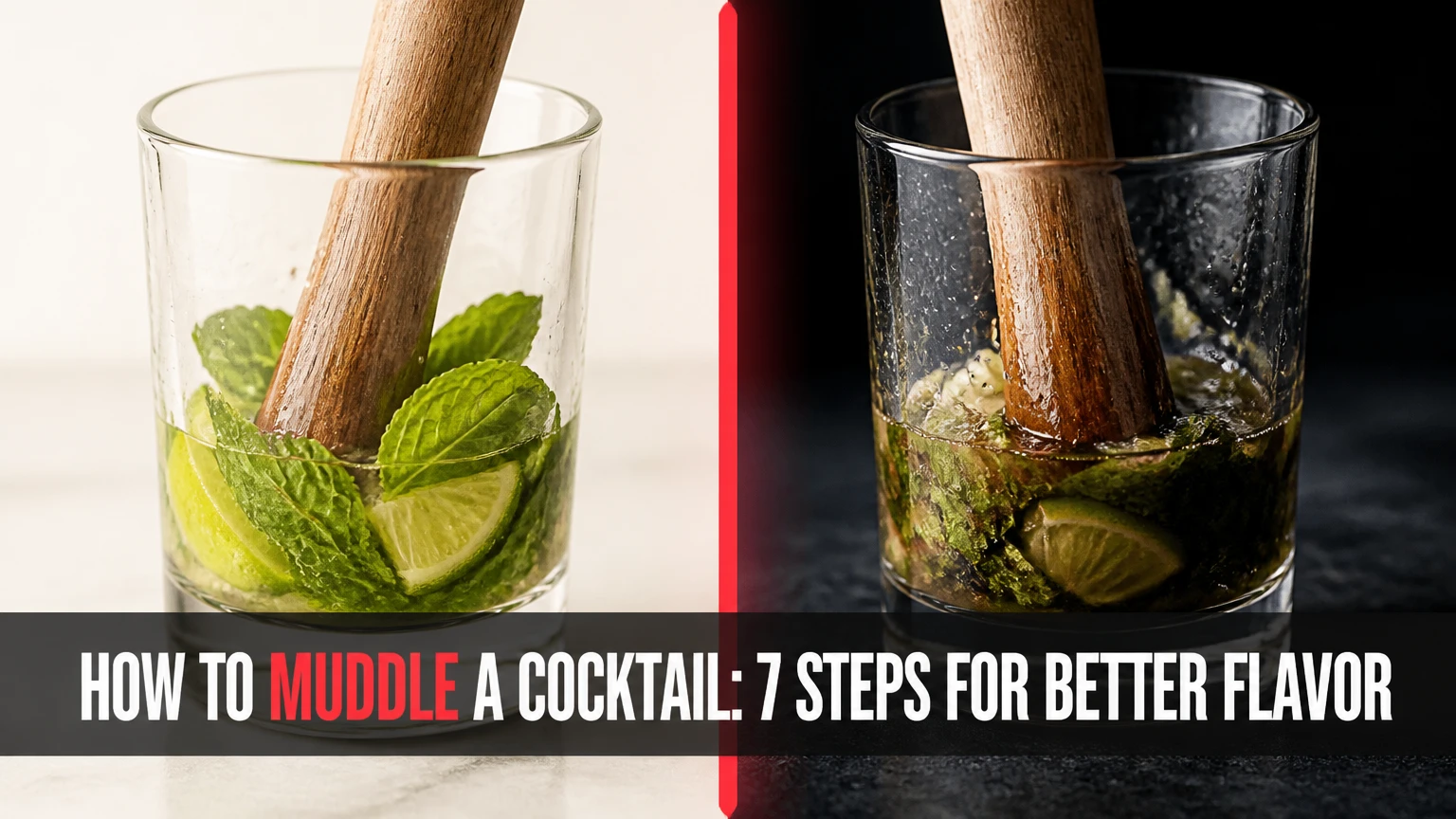
To muddle a cocktail, place fresh fruit, herbs, or sugar in a sturdy glass or shaker, add a small amount of liquid, and press gently with a muddler to release juice and aromatic oils. Use light presses for mint and basil, firmer pressure for citrus and berries, then add ice and the remaining ingredients.
Key Facts at a Glance
Mint usually needs 4-6 gentle presses and about 5 seconds.
Lime wedges and berries generally need 6-10 firmer presses and 10-15 seconds.
A flat-bottomed muddler bruises herbs more evenly than a toothed muddler.
Add syrup, sugar, juice, or spirit before muddling delicate herbs.
Use a heavy-bottomed rocks glass, mixing glass, or shaker tin, never thin glass.
Muddling extracts flavor; it does not replace shaking, stirring, chilling, or dilution.
What Does Muddling Do?
Muddling is a cocktail technique that uses controlled pressure to release juice, aromatic oils, and soluble flavor compounds from fresh ingredients. The muddler compresses plant tissue against the vessel, but the correct pressure depends on whether the ingredient is a leaf, citrus wedge, berry, spice, or sugar cube.
A muddler does not improve every ingredient. Mint benefits from bruising because its aromatic oils sit near the leaf surface, while a lime wedge needs enough pressure to release juice from the pulp. Excessive force can crush peel, shred leaves, and introduce bitter compounds.
The practical objective is selective extraction. A Mojito needs aromatic mint and lime juice, not pulverized green leaves. A Caipirinha needs lime juice and some peel oil, but excessive pressure can bring out more white pith bitterness. An Old Fashioned usually needs sugar and bitters dissolved, with the orange peel expressed separately rather than aggressively mashed.
How does muddling release flavor?
Muddling uses compression and limited friction to rupture plant cells and expose their contents. Herb leaves contain aromatic oils in surface glands and internal tissue; citrus contains juice in pulp vesicles and fragrant oils in the colored flavedo of the peel.
The technique becomes unpleasant when friction dominates. Shredded herbs release chlorophyll and tannins, producing grassy or bitter notes. Crushed citrus pith contributes limonin and other bitter flavors. A press-and-twist motion gives enough contact to extract flavor while limiting unnecessary abrasion.
Before You Start
| Requirement | Typical specification | Practical target |
|---|---|---|
| Preparation time | 2-4 minutes | Measure ingredients first |
| Muddling time | 5-15 seconds | Stop when the visual checkpoint appears |
| Difficulty | Beginner | Pressure control matters most |
| Home equipment cost | $8-$25 | Plastic, wood, or silicone muddler |
| Main vessel | 400-700 milliliters | Heavy rocks glass or shaker tin |
| Ingredients | 6-8 mint leaves or 2-3 lime wedges | Scale to one drink |
| Finishing equipment | Ice, strainer, fine mesh | Use for pulp-heavy drinks |
Wash herbs, fruit, and the muddler before starting. Remove damaged mint leaves, cut citrus into manageable wedges, and measure syrup or sugar in advance. A clean setup prevents the common mistake of continuing to press while searching for the next ingredient.
A 10-inch muddler gives most home bartenders enough reach inside a shaker tin. A 6-8-inch model is more comfortable in a rocks glass, but it may leave your knuckles close to the rim.
How to Muddle a Cocktail in 7 Steps
Step 1: Choose a Safe Vessel
Place ingredients in a heavy-bottomed rocks glass, mixing glass, or stainless steel shaker tin. A sturdy double Old Fashioned glass works for direct-build drinks, while a shaker tin gives more room for fruit and reduces the chance of striking fragile glass.
Do not muddle in a wine glass, thin pint glass, champagne flute, or decorative stemware. Downward pressure can crack or shatter thin walls, and the resulting injury risk is greater than the convenience of using the final serving glass.
You’ll know it worked when: the vessel stays stable under firm hand pressure and does not flex or rock.
Common mistake: holding a narrow glass in one hand while pressing hard with the other. Set the vessel on a stable counter instead.
Step 2: Add a Liquid Cushion
Add the sweetener, citrus juice, bitters, or 15-30 milliliters of spirit before muddling delicate ingredients. The liquid helps distribute flavor, reduces dry friction, and dissolves sugar or aromatic compounds into the drink.
The advice to never muddle dry is too absolute. A sugar cube and bitters can be muddled briefly in an Old Fashioned, and a dry berry can be pressed when the goal is simply to break its skin. For mint and basil, however, a small liquid cushion is the safer default.
Typical starting quantities are 7.5-15 milliliters of simple syrup for herbs, 5-10 milliliters of water or spirit for a sugar cube, and the measured citrus juice when the recipe includes it.
You’ll know it worked when: the bottom of the vessel has a thin film of liquid rather than dry leaves scraping against glass.
Common mistake: adding the entire cocktail before muddling, which makes it harder to control pressure and can over-dilute the drink.
Step 3: Add and Arrange the Ingredients
Add 6-8 mint leaves for one Mojito, 2-3 lime wedges for a Caipirinha, or 5-8 berries for a fruit-forward sour. Keep herbs near the bottom and place large fruit pieces cut-side down when possible.
Remove thick citrus ends and obvious seeds before pressing. Do not strip mint leaves from every stem if the recipe uses small sprigs, but avoid woody stems because they contribute little aroma and can add harsh vegetal flavor.
| Ingredient | One-drink quantity | Pressure | Typical time | Desired result |
|---|---|---|---|---|
| Mint leaves | 6-8 leaves | Gentle | 4-6 presses, about 5 seconds | Aromatic, mostly intact leaves |
| Basil leaves | 4-6 leaves | Gentle | 3-5 presses, about 5 seconds | Bruised leaves, sweet aroma |
| Lime wedges | 2-3 wedges | Firm | 6-10 presses, 10-15 seconds | Juice released, peel partly flattened |
| Raspberries | 5-8 berries | Medium | 6-8 presses, 8-12 seconds | Broken berries, visible juice |
| Blackberries | 4-6 berries | Firm | 6-10 presses, 10-15 seconds | Crushed pulp and released juice |
| Ginger slices | 3-5 thin slices | Firm | 8-12 presses, 10-20 seconds | Fibers broken, strong aroma |
You’ll know it worked when: the ingredient shows the required physical change without becoming an unstructured paste.
Common mistake: combining mint with hard citrus wedges and applying enough force for the lime. Muddle the lime first, then bruise the mint with fewer presses.
Step 4: Hold the Muddler Correctly
Grip the muddler with your dominant hand and place your palm over its top. Keep the handle vertical, use your wrist for control, and stabilize the vessel with your other hand only if the glass is broad and sturdy.
A flat-bottomed tool is easier to control because it distributes pressure over a larger area. A toothed tool concentrates force at small points, which works for berries and ginger but can shred mint in two or three strokes.
You’ll know it worked when: you can stop immediately without the tool slipping or striking the vessel wall.
Common mistake: gripping the muddler near its base and using your entire arm. That creates excessive force and makes accidental glass contact more likely.
Step 5: Press and Twist According to the Ingredient
Press down and rotate the muddler approximately 45-90 degrees, then lift and reposition. Use four to six gentle presses for herbs, but six to ten firmer presses for citrus or berries. The goal is controlled release, not pulverization.
Mint should smell stronger after muddling while remaining visibly recognizable. Lime should yield juice and show flattened pulp. Berries should break open, but the number of presses matters less than the texture because berry size and ripeness vary.
Muddling is finished when the extraction target is reached. Continuing for another 20 seconds rarely creates a more balanced drink, especially with herbs.
You’ll know it worked when: the aroma rises immediately from mint, the lime has released juice, or the berry skins have visibly split.
Common mistake: treating every ingredient like a lime. Firm pressure that extracts citrus efficiently can turn basil into bitter green fragments.
Step 6: Add Ice, Shake, Stir, or Build
Add the remaining spirits, liqueurs, juices, and ice after muddling. Shake a citrus-and-fruit drink for about 10-15 seconds, stir a spirit-forward drink for about 20-30 seconds, or build a carbonated drink directly in the serving glass.
A Mojito is commonly built with rum, lime, sugar, mint, and ice before soda water is added. Do not shake carbonated water in a sealed shaker. Add soda after shaking and strain or pour into the final glass.
An Old Fashioned usually benefits from stirring rather than shaking because whiskey, sugar, bitters, and dilution should remain clear and composed. Muddling the orange peel directly into the drink is optional and often produces more bitterness than expressing the peel over the surface.
You’ll know it worked when: the drink is cold, the sweetener is dissolved, and the texture matches the recipe.
Common mistake: adding soda before shaking. Carbonation expands under pressure and can force liquid from the shaker.
Step 7: Strain and Garnish
Use a Hawthorne strainer for shaken drinks and add a fine-mesh strainer when berries, seeds, or shredded herbs are present. Double-straining creates a cleaner texture, but it is not mandatory for every cocktail.
A Mojito may be served with some mint and pulp, while a raspberry sour is often better without seeds. A fine-mesh strainer can also remove small fragments created by a toothed muddler.
Strain promptly after shaking. Leaving muddled herbs and fruit in the ice for several minutes allows continued extraction and can increase bitterness or vegetal notes.
You’ll know it worked when: the drink has the intended clarity and no large fragments interfere with sipping.
Common mistake: forcing thick berry pulp through a fine strainer with a spoon. That pushes solids through the mesh and makes the drink cloudy.
Which Muddler Should You Use?
The best muddler depends on the ingredient and cleaning routine. A smooth flat-bottomed wood or composite tool is the safest all-purpose choice for herbs, while a toothed plastic tool is more efficient for berries, ginger, and tough fruit skins.
| Muddler type | Typical size and price | Best ingredients | Main advantage | Main limitation |
|---|---|---|---|---|
| Flat-bottomed hardwood | 8-10 inches, $10-$25 | Mint, basil, sugar cubes | Broad, gentle contact | Hand-wash and dry immediately |
| Toothed plastic or resin | 7-10 inches, $8-$15 | Berries, ginger, citrus | Breaks firm skins quickly | Shreds delicate herbs |
| Stainless steel with silicone head | 8-10 inches, $12-$20 | Mixed home use | Dishwasher-friendly body and grip | Head may loosen over time |
| One-piece composite | 8-10 inches, $15-$30 | High-volume service | No seam or detachable joint | Less traditional feel |
| Bar spoon plus syrup | 8-12 inches, $5-$15 | Light herb bruising | No separate muddler needed | Limited pressure and surface area |
Wood is comfortable and gentle, but porous surfaces require immediate washing and complete drying. Stainless steel is hygienic and durable, although bare metal can mark some glassware and feels less forgiving when the user presses too hard.
A professional bar may prefer a one-piece composite muddler because a detachable rubber head can loosen during repeated service. Home users gain more from easy cleaning and comfortable control than from maximum crushing power.
Can You Muddle a Cocktail Without a Muddler?
A sturdy bar spoon, the end of a rolling pin, or a clean wooden dowel can replace a muddler for light herb bruising. Do not use a knife handle, metal utensil with a sharp edge, or any tool that can chip, split, or shed material into the drink.
A bar spoon works well for dissolving sugar and gently pressing mint against the base of a rocks glass. A rolling pin can crush berries in a shaker tin, but its large diameter makes fine control difficult. For citrus, squeezing the wedges by hand and expressing the peel often gives cleaner results than improvising with a tool.
The alternative should match the extraction goal. Use shaking for herbs that need aroma without fragments, syrup for repeated fruit flavor, and expressed peel for citrus oil without pith.
Common Muddling Mistakes and How to Fix Them
| Failure mode | What caused it | Result | Recovery |
|---|---|---|---|
| Shredded mint | Toothed muddler or 10-plus hard presses | Bitter, grassy flavor | Strain, add fresh mint as garnish, rebalance sweetness |
| Bitter lime | Excessive pressure on peel and pith | Harsh citrus finish | Add fresh measured syrup and dilute slightly |
| Weak fruit flavor | Underripe fruit or too little contact | Thin, watery cocktail | Add fresh juice or fruit syrup |
| Broken glass | Thin vessel or angled impact | Injury and contaminated drink | Discard the entire drink and inspect the area |
| Cloudy texture | Berry pulp forced through mesh | Seeds and solids remain | Re-strain through clean fine mesh |
| Undissolved sugar | Dry cube not crushed or enough liquid | Sweetness settles at the bottom | Add 5-10 milliliters of water and stir |
Why does muddled mint taste bitter?
Muddled mint tastes bitter when excessive pressure tears the leaves and extracts chlorophyll, tannins, and other vegetal compounds. Mint should be bruised until aromatic, usually with four to six light presses, rather than reduced to a paste.
To fix an over-muddled Mojito, strain out the leaves, add fresh lime and syrup in measured amounts, and use a new mint sprig as the garnish. Do not attempt to hide strong bitterness with a large amount of sugar because the resulting drink becomes sweet and still tastes muddy.
A counterintuitive practitioner rule is to smell before pressing again. If the mint aroma is already obvious, additional force is more likely to damage the flavor than improve it.
What happens when you muddle citrus too aggressively?
Aggressive citrus muddling releases juice, peel oil, and bitter pith compounds at the same time. The white pith becomes especially noticeable when thick wedges are crushed against the vessel base for more than 15 seconds.
Cut wedges into smaller pieces, remove excess pith when practical, and use firm vertical presses with limited twisting. For a cleaner citrus profile, squeeze the juice separately and express a thin peel over the finished drink.
How Should Muddling Change for Different Cocktails?
Mojito
Use 6-8 mint leaves, 15-22.5 milliliters of lime juice, and 7.5-15 milliliters of simple syrup. Gently press the mint in the sweetener and lime for about 5 seconds, add rum and ice, shake briefly or swizzle, then top with soda.
Keep the mint mostly intact. Small leaf fragments are traditional in some presentations, but shredded leaves make the drink bitter and clog a straw.
Caipirinha
Use 2-3 lime wedges and 10-15 milliliters of superfine sugar or syrup with cachaça. Press the wedges firmly enough to release juice, but stop before the peel collapses into a pulp-heavy mass.
Because the drink includes lime peel, the balance between juice and bitterness is especially sensitive. Ripe, thin-skinned limes usually require less force than dry, thick-skinned fruit.
Old Fashioned
Use a sugar cube, 2-3 dashes of Angostura aromatic bitters, and 5-10 milliliters of water. Briefly press until the sugar is mostly dissolved, then add whiskey and ice and stir for 20-30 seconds.
Do not muddle an orange slice into the drink unless a rustic, cloudy style is intended. Express an orange peel over the surface, rub its colored side around the rim, and discard or garnish according to the recipe.
Berry sour
Use 5-8 ripe berries with syrup or citrus juice, then press until the skins split. Shake with the spirit and ice for 10-15 seconds, and double-strain to remove seeds.
A toothed muddler can help with blackberries, but a flat tool gives better control for raspberries, which collapse quickly.
How Do You Muddle a Cocktail for a Crowd?
For four drinks, multiply the fruit and sweetener but muddle herbs in batches rather than crushing 24-32 leaves together. A large batch encourages uneven pressure, and the bottom leaves can become overworked before the upper leaves contact the tool.
Prepare citrus juice, syrup, and spirits in a pitcher, then bruise mint separately in small portions shortly before serving. Add ice and soda only when the drinks are poured so dilution and carbonation remain predictable.
| Batch size | Mint leaves | Lime wedges | Muddling approach | Typical active time |
|---|---|---|---|---|
| 1 drink | 6-8 | 2-3 | One vessel | 5-15 seconds |
| 4 drinks | 24-32 | 8-12 | Herbs in 2 batches | 1-2 minutes |
| 8 drinks | 48-64 | 16-24 | Herbs in 4 batches | 3-5 minutes |
| 12 drinks | 72-96 | 24-36 | Use juice and mint syrup | 5-8 minutes |
For parties, mint syrup or a lightly infused syrup provides more consistent flavor than muddling a large quantity of leaves. Fresh mint garnish can restore aroma without filling every glass with fragments.
Time, Cost, and Yield
Muddling one cocktail typically takes 5-15 seconds, excluding ingredient preparation. A basic home setup costs about $13-$40 when a muddler, shaker tin, fine-mesh strainer, and sturdy glass must all be purchased.
| Setup | Equipment included | Typical cost | Drinks supported | Best use |
|---|---|---|---|---|
| Minimal | Bar spoon and sturdy glass | $5-$15 | 1-2 at a time | Mint and sugar |
| Home standard | Muddler, shaker, strainer | $25-$60 | 1-4 at a time | Mojitos and sours |
| Home advanced | Flat muddler, tins, mesh strainer | $45-$90 | 1-8 at a time | Fruit cocktails |
| Bar service | One-piece composite tool and tins | $20-$45 per station | 20-plus per hour | Repeated service |
These are typical retail ranges, not fixed prices. Imported hardwood, commercial composite tools, and specialty strainers can cost more, while a basic plastic muddler may cost less.
Expert Rules That Improve Results
- Use aroma as the endpoint for herbs. Mint does not need a specific visual collapse; its smell tells you when surface oils have been released.
- Separate juice extraction from peel-oil extraction. Squeeze citrus for juice, then express the colored peel for aroma when bitterness is a concern.
- Match tool geometry to tissue strength. Toothed heads belong with berries and ginger, while broad flat bases reduce damage to basil and mint.
- Strain for texture, not automatically for appearance. Removing every leaf fragment can reduce the rustic character of a Mojito, while berry seeds usually create an unwanted drinking texture.
- Do not confuse more extraction with better balance. A muddler can increase intensity and bitterness simultaneously, so stopping early is often the professional choice.
FAQ
Should you muddle mint before or after adding alcohol?
Add a small amount of syrup, juice, or spirit before muddling mint, then add the remaining alcohol afterward. The liquid cushion reduces dry friction and helps capture aromatic compounds, while delaying the full spirit measurement makes pressure easier to control and prevents accidental over-dilution.
Can you muddle ice with fruit?
Avoid muddling ice with fruit in glass because hard ice can create impact stress and damage the vessel. Add ice after the fruit has been pressed, then shake or stir according to the cocktail. Crushed ice can be added before a gentle swizzle, but it should not be used as a substitute for controlled muddling.
Is a wooden or metal muddler better?
A flat-bottomed wooden muddler is usually better for mint and basil because its broad surface applies gentle, even pressure. A stainless steel or silicone-headed muddler is easier to sanitize and more suitable for frequent washing. Choose toothed plastic only when berries, ginger, or firm fruit skins need aggressive breakdown.
How many times should you muddle fruit?
Press fruit about six to ten times, usually for 10-15 seconds, then inspect the result. Stop when the fruit is visibly flattened or split and its juice has been released. Ripeness changes the required pressure, so a soft raspberry may need half as many presses as a firm blackberry.
Can muddling make a cocktail too strong?
Muddling can make a cocktail taste too intense by extracting bitter peel compounds, vegetal leaf material, or concentrated fruit solids. It does not usually increase the alcohol percentage directly, but it can make the spirit seem harsher when bitterness or acidity overwhelms the sweetener and dilution.
The Bottom Line
To muddle a cocktail successfully, use a sturdy vessel, add a small liquid cushion, and match pressure to the ingredient. Bruise mint for about five seconds, press citrus and berries for 10-15 seconds, then finish with the correct ice, shaking, stirring, and straining method. The goal of how to muddle a cocktail is controlled flavor extraction, not maximum force.