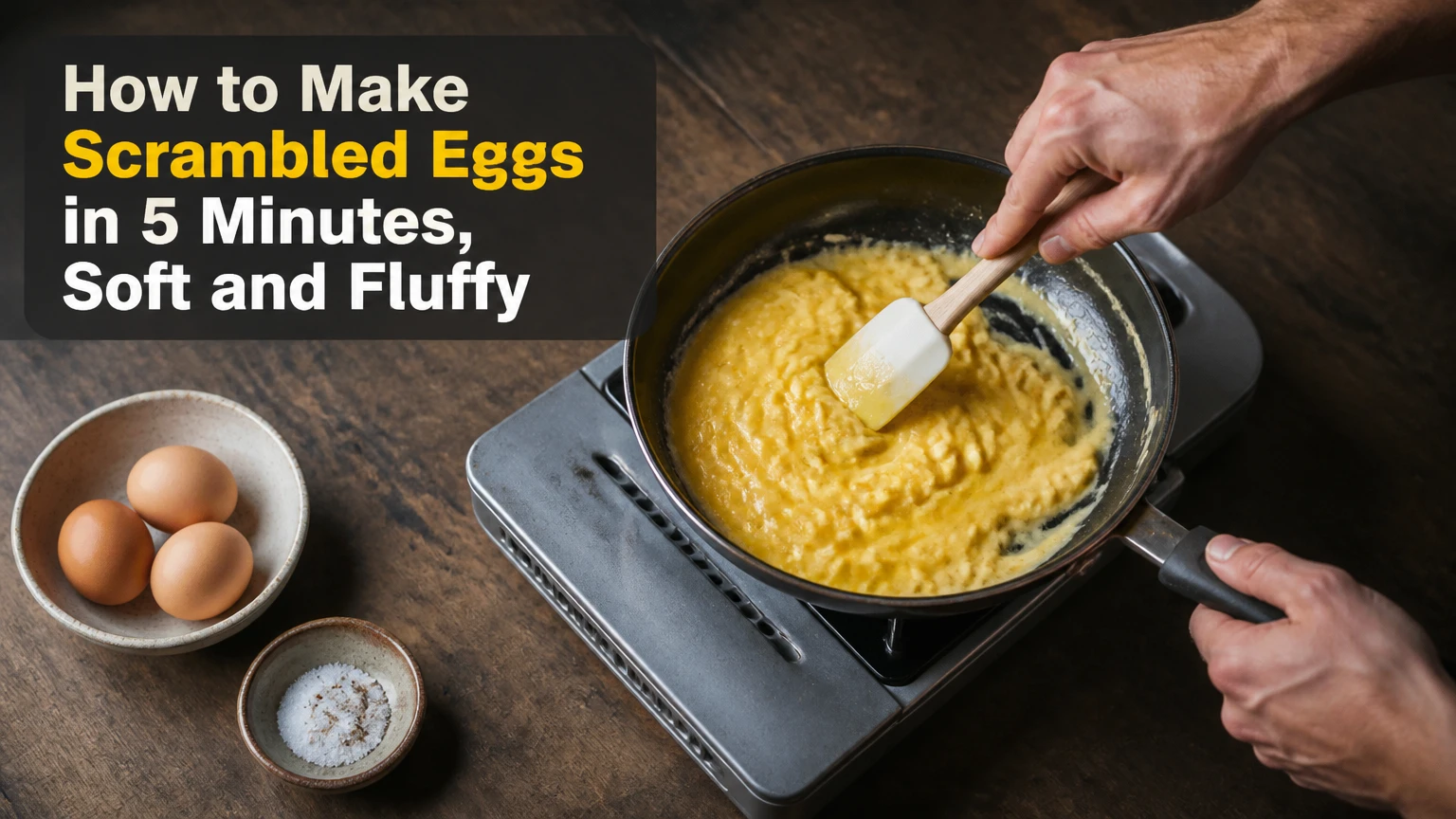
Scrambled eggs are made by whisking eggs until the yolks and whites are combined, then gently cooking and folding them in a buttered pan. For soft, medium-curd eggs, cook 2 large eggs over medium-low heat for about 2-3 minutes, remove the pan while the eggs remain glossy, and plate them immediately.
Key Facts at a Glance
- Two large scrambled eggs typically require 1 tablespoon of butter, 2-3 minutes of cooking, and an 8-inch nonstick skillet.
- Medium-low heat produces larger, softer curds than high heat, which makes eggs firm and rubbery quickly.
- Scrambled eggs continue cooking from residual heat after the skillet leaves the burner.
- Salt can be added before cooking for evenly seasoned eggs or immediately afterward for maximum volume.
- Cooked eggs should reach 160°F, or 71°C, according to the United States Department of Agriculture Food Safety and Inspection Service.
- Typical ingredient cost is about $0.50-$2.00 per serving, depending on egg size, butter, and optional cheese.
Before You Start
| Requirement | Typical specification | Why it matters |
|---|---|---|
| Serving size | 2 large eggs per person | Produces about 120-150 g cooked egg |
| Preparation time | 1-2 minutes | Covers cracking, whisking, and seasoning |
| Cooking time | 2-3 minutes | Suits soft, medium-curd eggs |
| Total time | 4-5 minutes | Includes preparation and plating |
| Difficulty | Beginner | Requires heat control, not specialized technique |
| Pan | 8-inch nonstick skillet | Gives 2 eggs a shallow, controllable layer |
| Fat | 1 tablespoon unsalted butter | Prevents sticking and adds flavor |
| Tool | Silicone spatula and bowl | Supports scraping and folding without damaging nonstick coating |
| Typical cost | $0.50-$2.00 per serving | Varies with egg and topping prices |
Use a 10-inch skillet for 4-6 eggs. A larger pan spreads a small batch too thin, so the eggs set before you can create soft folds. Have toast, plates, and toppings ready before turning on the burner because the final 20 seconds determine whether the curds stay creamy or become dry.
How Many Eggs Should You Cook?
Cook 2 large eggs per person for a main breakfast portion, or 1 egg per person when scrambled eggs accompany toast, vegetables, or a larger meal. Use 1 tablespoon of butter for every 2-4 eggs, adjusting downward only if the pan has a highly effective nonstick surface.
Egg size changes the finished amount. Two large eggs provide roughly 100 grams of raw liquid and yield approximately 120-150 grams after butter is included. For a crowd, cook no more than 6 eggs in a standard 10-inch pan unless you deliberately want a slower, softer scramble.
Choose the Batch Size
| Eaters | Eggs | Recommended pan | Typical cook time |
|---|---|---|---|
| 1 light portion | 1 large | 6-8 inch nonstick | 1-2 minutes |
| 1 main portion | 2 large | 8-inch nonstick | 2-3 minutes |
| 2 main portions | 4 large | 10-inch nonstick | 3-4 minutes |
| 3 main portions | 6 large | 10-12 inch nonstick | 4-5 minutes |
| 4 or more portions | 8-10 large | 12-inch skillet or two pans | 5-7 minutes |
Step 1: Whisk the Eggs Thoroughly
Crack 2 large eggs into a bowl, add 1/8 teaspoon of fine salt, and whisk with a fork for 30-45 seconds. Break every yolk and continue until no clear strands of egg white remain; the mixture should be uniform yellow with a few small bubbles.
Thorough whisking disperses the yolk, white, salt, and any added liquid before heat sets them in place. A fork is sufficient for two eggs, while a whisk becomes useful for batches of six or more. Avoid whisking in the pan, where uneven streaks can set before the mixture is integrated.
You will know Step 1 worked when the liquid pours as one consistent mixture without transparent ribbons. The common mistake is stopping as soon as the yolks disappear. That produces alternating firm white pieces and softer yolk pockets.
Step 2: Heat the Pan and Melt the Butter
Place an 8-inch nonstick skillet over medium-low heat for about 60 seconds, add 1 tablespoon of unsalted butter, and wait until the butter melts and foams without browning. Pour in the eggs when the foam is active but the pan gives only a quiet hiss.
Butter should coat the cooking surface without developing brown milk solids. On an electric or induction cooktop, medium-low is commonly around 3-4 on a 10-point control, but burners differ, so visual and audible cues are more reliable than a dial number.
The pan is ready when butter foam moves across the surface and a drop of egg begins setting gently rather than snapping into a crust. A loud sizzle means the skillet is too hot. Lower the burner and wait 20-30 seconds before adding the eggs.
Which Pan and Heat Should You Use?
An 8-inch nonstick pan over medium-low heat is the most forgiving setup for two eggs because the coating reduces sticking while the small diameter keeps the mixture thick enough to fold. Stainless steel can work with more butter and precise preheating, while cast iron retains heat aggressively and demands earlier removal.
| Pan type | Best heat level | Butter for 2 eggs | Main advantage | Main risk |
|---|---|---|---|---|
| Nonstick, 8-inch | Medium-low | 1 tablespoon | Easy release and gentle control | Coating damage above high heat |
| Stainless steel, 8-inch | Low-medium | 1-1 1/2 tablespoons | Strong browning control and durability | Sticking if eggs enter a cool pan |
| Seasoned cast iron, 8-inch | Low | 1 tablespoon | Stable heat and even cooking | Residual heat can overcook curds |
| Carbon steel, 8-inch | Low-medium | 1 tablespoon | Responsive surface after seasoning | Eggs stick if seasoning is poor |
Step 3: Fold the Eggs Into Soft Curds
Pour the whisked eggs into the center of the buttered skillet and leave them undisturbed for 8-10 seconds. When a thin layer begins to set, draw a silicone spatula from the outside edge toward the center, pause, and repeat from a new angle every 3-5 seconds.
Use broad strokes rather than chopping. Each sweep should lift a soft sheet and fold it over itself, leaving some uncooked egg in contact with the pan. Tilt the skillet slightly if needed so liquid runs into open spaces.
Continue for about 60-90 seconds. Medium-curd eggs should form distinct folds about 2-4 centimeters wide, with no liquid pooling underneath. The common mistake is stirring continuously from the first second. Constant agitation makes small curds and increases contact with the hot pan, which is useful for French-style eggs but not for a pillowy breakfast scramble.
Step 4: Remove the Pan Before the Eggs Look Fully Done
Take the skillet off the burner when the eggs are approximately 85-90% set, still glossy, and holding soft folds. Let the residual heat finish the curds for 10-20 seconds, then slide the scrambled eggs onto a warm plate immediately.
The finished eggs should look moist, not liquid. A small sheen is desirable; a separate puddle of raw egg is not. If a food thermometer is used, the thickest portion should reach 160°F, or 71°C, for food safety. USDA FSIS states, “Cook eggs until both the yolk and white are firm,” while its egg-dish guidance uses 160°F as the safe internal temperature.
The common mistake is leaving eggs in the hot skillet while preparing toast. A cast-iron pan can continue transferring enough heat to turn a soft scramble firm within 30-60 seconds. Plate first, then garnish.
Why Heat Control Determines Texture
Scrambled eggs become firm when heat causes egg proteins to unfold and bond into a network that traps water. Moderate heating creates a loose network and tender curds; excessive heat or prolonged cooking tightens the network, squeezes out moisture, and produces rubbery or watery eggs.
The often-repeated claim that eggs begin setting at exactly 62-65°C is too simple for household cooking. Egg white and yolk proteins set at different temperatures, salt and fat alter the result, and the skillet surface can be far hotter than the egg mixture. A probe reading near 71°C is a safety target, not a universal texture boundary.
Milk, cream, and butter change texture through different mechanisms. Butter mainly lubricates the pan and contributes fat, cream adds fat with relatively little water, while milk adds water that can make a large batch looser if overused. Water can create steam and a lighter texture, but only when the eggs are removed promptly.
Which Liquid Makes Eggs Fluffier?
For 2 large eggs, 1 teaspoon of water produces the lightest texture with minimal risk, while 1 tablespoon of heavy cream produces a richer, denser result. Milk is acceptable at 1-2 teaspoons, but larger quantities increase the chance of watery eggs unless the mixture is cooked thoroughly.
| Addition for 2 eggs | Quantity | Texture effect | Best use |
|---|---|---|---|
| No liquid | 0 teaspoons | Dense, concentrated egg flavor | Toast or plated breakfast |
| Water | 1 teaspoon | Light, slightly aerated curds | Fluffy hard or medium scramble |
| Whole milk | 1-2 teaspoons | Mild, soft, moderately creamy | Family breakfast |
| Heavy cream | 1 tablespoon | Rich, slow-setting, custardy | French-style eggs |
| Crème fraîche | 1 tablespoon | Tangy, creamy finish | Stir in off heat |
Do not treat dairy as a cure for high heat. Cream may slow setting, but it cannot prevent overcooked proteins if the skillet remains hot after the eggs are finished.
How Do Soft-Curd and Medium-Curd Eggs Differ?
Soft-curd eggs are stirred almost continuously over very low heat for 5-8 minutes, producing small, custard-like curds. Medium-curd eggs are folded intermittently over medium-low heat for 2-4 minutes, producing larger, pillowy pieces that suit most breakfast plates.
| Style | Heat | Stirring pattern | Typical time | Finished texture |
|---|---|---|---|---|
| French soft-curd | Very low | Constant whisking or stirring | 5-8 minutes | Custard-like and spoonable |
| Medium-curd | Medium-low | Fold every 3-5 seconds | 2-4 minutes | Large, soft, glossy folds |
| Hard scramble | Medium | Stir and chop every 10-15 seconds | 1-3 minutes | Firm and mostly dry |
| Sandwich scramble | Medium-low | Broad folds, minimal breaking | 3-4 minutes | Firm enough to hold filling |
French-style eggs are excellent on toast but poor for carrying in a container because their high moisture and soft structure collapse quickly. Hard scrambled eggs work inside burritos and breakfast sandwiches, but their longer exposure to heat removes the tenderness that makes fresh eggs appealing.
When Should You Add Salt, Cheese, and Vegetables?
Add salt either immediately before cooking or 10-15 minutes earlier for evenly seasoned, slightly more tender curds. Add shredded cheese during the final 20-30 seconds, and cook wet vegetables separately until their moisture has evaporated before combining them with the eggs.
Early salting does not require a 15-minute wait to work. If breakfast is rushed, seasoning immediately before whisking gives a reliable result. Salt added after cooking preserves maximum apparent volume but can taste uneven because the finished curds no longer redistribute seasoning easily.
Vegetables are the main source of unexpected liquid. Mushrooms, spinach, zucchini, tomatoes, and frozen peppers should be sautéed first, then drained or patted dry. Fresh chives, parsley, dill, and scallions can be added after the heat is off.
Add-In Timing
| Ingredient | Preparation | Quantity for 2 eggs | Add time |
|---|---|---|---|
| Cheddar | Grated | 25-30 g | Final 20-30 seconds |
| Feta | Crumbled and drained | 25 g | Off heat |
| Mushrooms | Sliced and sautéed dry | 60 g raw | Final 30 seconds |
| Baby spinach | Wilted and squeezed dry | 30 g | Final 20 seconds |
| Chives | Finely sliced | 1 tablespoon | After plating |
| Cherry tomatoes | Halved and sautéed | 60 g | Final 30 seconds |
One practitioner rule is worth remembering: never use a watery topping to compensate for dry eggs. Salsa, tomatoes, and crème fraîche belong on the plate after cooking, where their moisture stays distinct instead of steaming the curds.
Can You Make Scrambled Eggs Without Butter?
Yes. Use 1 teaspoon of olive oil for 2 eggs in a good nonstick pan, or use cooking spray for the lowest-fat option, although the eggs will have less browning-free richness and may feel slightly less silky.
For dairy-free eggs, whisk the eggs with 1 teaspoon of water and cook them over medium-low heat. For a richer plant-based variation, 1 teaspoon of extra-virgin olive oil in the mixture adds fat, but it does not behave exactly like butter because butter contains milk solids and water.
Avoid replacing butter with a large quantity of oil. More fat does not create softer curds once the egg proteins are overcooked, and excess oil can make a small serving greasy.
How Can You Adapt the Method to Other Appliances?
A microwave makes scrambled eggs in about 90-120 seconds, while cast iron needs lower heat and earlier removal because it stores more thermal energy. Both methods work, but neither gives the same edge-to-center control as a small nonstick skillet.
Microwave Method
Beat 2 eggs, 1 tablespoon of milk or water, and a pinch of salt in a microwave-safe bowl. Microwave uncovered at 70% power for 30 seconds, stir thoroughly, then microwave in 15-20 second intervals until barely set.
The center should remain glossy when the bowl leaves the microwave. Rest for 20 seconds before eating. Never microwave eggs in their shells, and avoid sealed containers because steam pressure can build.
Cast-Iron Method
Preheat a small cast-iron skillet on low for 2 minutes, add 1 tablespoon of butter, and pour in the eggs. Stir or fold continuously once the edges set, then remove the skillet when the curds still look slightly loose.
Cast iron is less forgiving for a single serving. The stored heat can carry eggs from tender to dry while they sit on the table, so warm plates and immediate serving matter more than they do with thin nonstick cookware.
Common Mistakes and How to Fix Them
| Problem | Likely cause | Immediate recovery | Next-time fix |
|---|---|---|---|
| Watery eggs | High heat, excess milk, or raw vegetables | Drain excess liquid and serve immediately | Use 1 teaspoon water maximum and pre-cook vegetables |
| Brown edges | Pan surface too hot | Move pan off heat and fold unbrowned curds over | Lower burner and add eggs after butter only foams |
| Rubbery texture | Overcooking or delayed plating | Chop into a sandwich or add sauce | Remove at 85-90% set and plate within 20 seconds |
| Eggs stick | Cool stainless steel or insufficient fat | Loosen with a flexible spatula | Preheat correctly and use 1-1 1/2 tablespoons butter |
| Tiny, dry curds | Stirring too aggressively | Add a teaspoon of crème fraîche off heat | Use broad folds every 3-5 seconds |
| Uneven seasoning | Salt added only to the surface | Fold gently with a pinch of salt | Season the raw mixture before whisking |
An expert correction: “fluffy” does not mean aggressively whisked or cooked at high heat. Air bubbles expand briefly, but high heat also tightens proteins rapidly; gentle steam and a prompt finish produce a more stable tender texture.
How Long Do Scrambled Eggs Keep?
Refrigerate cooked scrambled eggs within 2 hours, or within 1 hour when the surrounding temperature exceeds 90°F, and use them within 3-4 days. Store them in a shallow airtight container at or below 40°F, following USDA Food Safety and Inspection Service guidance.
For meal preparation, cook eggs until fully set rather than leaving them glossy. Cool them quickly in a shallow container, refrigerate promptly, and reheat until hot throughout. Reheated eggs will be firmer because the proteins continue tightening, so a teaspoon of water or salsa can improve eating quality after reheating.
Scrambled eggs are not ideal for long transport without refrigeration. A hard scramble holds its shape better in a breakfast burrito, but food safety still depends on temperature control, not dryness.
What Do Scrambled Eggs Cost and Provide?
A typical serving of two large eggs costs about $0.50-$2.00 after accounting for butter and ordinary toppings. USDA FoodData Central lists one large raw egg at approximately 72 calories and 6.3 grams of protein; cooking fat increases calories without materially increasing protein.
| Serving | Eggs | Approximate egg protein | Butter | Typical ingredient cost |
|---|---|---|---|---|
| Light | 1 large | 6.3 g | 1/2 tablespoon | $0.30-$1.00 |
| Standard | 2 large | 12.6 g | 1 tablespoon | $0.50-$2.00 |
| High-protein | 3 large | 18.9 g | 1 tablespoon | $0.80-$2.75 |
| Family batch | 6 large | 37.8 g | 1 1/2 tablespoons | $1.50-$5.00 |
Prices are typical retail ranges, not fixed national averages. Organic, pasture-raised, local, and specialty eggs can cost considerably more, while bulk conventional eggs can fall below the lower estimate.
Frequently Asked Questions
Should You Use Cold Eggs for Scrambled Eggs?
Cold eggs work perfectly well and may give you slightly more time to control the curds because the mixture enters the pan cooler. Room-temperature eggs cook a little faster, but the difference is usually less than 30 seconds for a two-egg portion, so temperature is less important than low heat and prompt plating.
Do You Need to Separate the Whites and Yolks?
No. Separating eggs is unnecessary for ordinary scrambled eggs and can make the texture less cohesive. Whisk whole eggs until the whites and yolks are fully combined. Separate whites are useful only when deliberately targeting a different protein ratio, such as a lower-fat egg-white scramble.
Why Do Restaurant Scrambled Eggs Taste Creamier?
Restaurants often use more butter, cream, or crème fraîche and remove the eggs from heat early. Some kitchens also cook small batches in pans that allow frequent movement. The creamy result comes from fat, gentle coagulation, and immediate service rather than from one secret ingredient.
Can You Scramble Eggs in Advance?
Yes, but eggs are best cooked shortly before serving. For advance preparation, cook them fully, cool them within the safe time limit, refrigerate them in a shallow container, and reheat gently within 3-4 days. Expect a firmer texture than freshly cooked eggs.
Are Brown Scrambled Eggs Unsafe?
Brown edges usually indicate excessive skillet heat and overcooking, not automatic spoilage. Remove heavily browned or burnt pieces if they taste bitter, then lower the heat for the next batch. Eggs with an off odor before cooking should be discarded rather than rescued.
What Is the Best Way to Serve Scrambled Eggs?
Serve scrambled eggs immediately on a warm plate with toast, potatoes, or sautéed vegetables. Add chives, black pepper, hot sauce, grated cheese, or crème fraîche after the eggs leave the pan so delicate toppings retain their aroma and watery ingredients do not dilute the curds.
The Bottom Line
To make scrambled eggs successfully, whisk 2 large eggs with a pinch of salt, cook them in 1 tablespoon of butter over medium-low heat, fold the setting mixture every few seconds, and remove the pan while the curds remain glossy. Plate within 20 seconds. Heat control, batch size, and immediate serving matter more than adding milk or whisking air into the mixture. For most breakfasts, this medium-curd method is the best balance of speed, tenderness, and control.