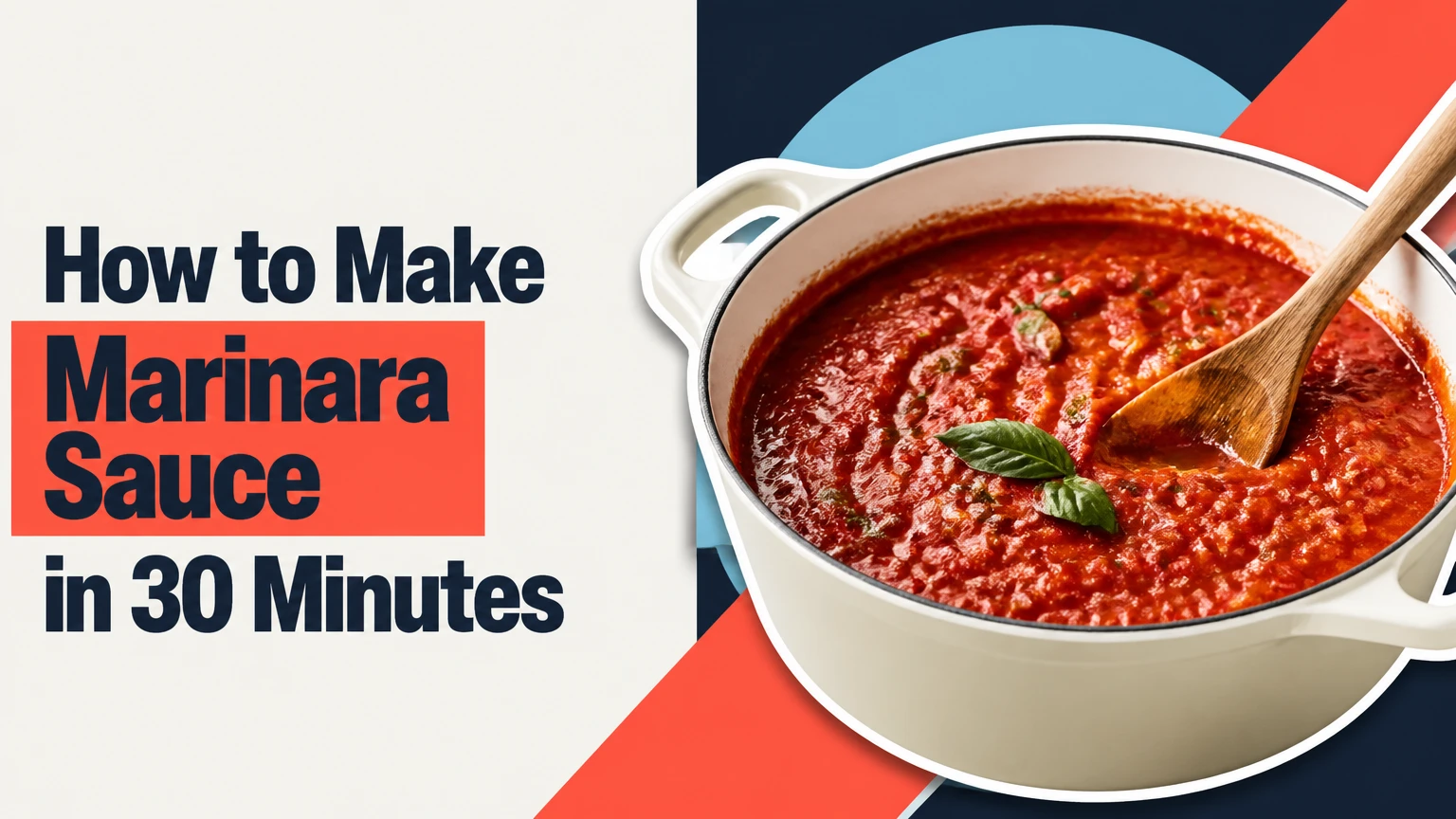
To make marinara sauce, gently infuse extra virgin olive oil with sliced garlic, add crushed whole peeled tomatoes and salt, then simmer uncovered for 20-30 minutes. Finish with fresh basil and adjust the texture before serving. The most important variable is gentle garlic heat, because browned garlic can make the entire sauce bitter.
Key Facts
One 28-ounce can of whole peeled tomatoes produces about 3 cups of marinara sauce.
A standard batch takes 10 minutes to prepare and 20-30 minutes to simmer.
Extra virgin olive oil, garlic, tomatoes, salt, and basil form the classic base.
Uncovered cooking removes water while preserving a fresh tomato flavor.
Typical homemade cost is $4-$8 for approximately four pasta servings.
Refrigerated marinara sauce keeps for 4 days, while frozen sauce keeps best for about 3 months.
What Is Marinara Sauce?
Marinara sauce is a quick-cooked tomato sauce built from tomatoes, olive oil, garlic, and herbs. Traditional Neapolitan versions are usually thinner, brighter, and less sweet than many Italian-American tomato sauces, which often contain onion, oregano, sugar, meat, or a longer cooking time.
The name is associated with Naples and maritime cooking, although the exact origin story is debated. Marinara is not a fixed legal recipe. Cooks vary the garlic, herbs, tomato texture, and cooking time according to region and purpose.
A useful distinction separates marinara from ragù. Marinara contains no required meat and usually reaches the table within 30-45 minutes. Ragù develops flavor from meat, aromatic vegetables, and a longer braise that can last several hours.
How Does Marinara Sauce Develop Flavor?
Marinara sauce develops flavor through three linked processes: garlic releases aromatic compounds into oil, tomato water evaporates during simmering, and heat softens acidity while concentrating natural sugars. Gentle cooking preserves fresh tomato character; aggressive boiling creates splatter and can produce a dull, overly reduced sauce.
Olive oil does not chemically dissolve into tomato water by itself. Stirring disperses small oil droplets through the sauce, creating a temporary emulsion that gives marinara a smoother mouthfeel. A spoonful of pasta water can reinforce that emulsion during final tossing because its starch helps bind water and fat.
How to Make Marinara Sauce
The following recipe makes about 3 cups, enough for 12 ounces of dried pasta or four moderate servings. Use a wide 3-quart saucepan so the sauce reduces evenly, and keep the garlic pale throughout the infusion.
Before You Start
| Item | Standard specification | Typical value |
|---|---|---|
| Yield | Finished sauce | 3 cups |
| Total time | Preparation plus simmering | 30-40 minutes |
| Difficulty | Knife work and temperature control | Beginner |
| Cost | Four pasta servings | $4-$8 |
| Main pan | Wide saucepan | 3-quart |
| Tomato quantity | Whole peeled tomatoes | 28 ounces |
| Oil quantity | Extra virgin olive oil | 3 tablespoons |
| Garlic quantity | Fresh cloves | 3 medium cloves |
Ingredients
- 1 can, 28 ounces, whole peeled tomatoes
- 3 tablespoons extra virgin olive oil
- 3 medium garlic cloves, thinly sliced
- 1/2 teaspoon fine sea salt, plus more to taste
- 4-6 fresh basil leaves, torn
- 1/4 teaspoon red pepper flakes, optional
- 1 teaspoon tomato paste, optional for a thicker sauce
Use tomatoes packed in juice rather than purée when possible. Whole peeled tomatoes let you control the final texture, and their juice supplies the moisture needed for a short simmer.
Step 1: Crush the Tomatoes
Pour the whole peeled tomatoes into a bowl and crush them by hand, or pulse them three to four times with an immersion blender. Remove hard stem cores if the can contains them, but do not discard the tomato juice.
You’ll know it worked when: the mixture contains small tomato pieces suspended in juice, not a completely smooth purée.
Common mistake: crushing tomatoes directly over the pan while the oil heats. Cold tomato juice can cause dangerous splattering when it hits hot oil.
Step 2: Infuse the Oil With Garlic
Place the olive oil and sliced garlic in the cold saucepan. Set the burner to low or medium-low and cook for 2-4 minutes, stirring once or twice, until the garlic becomes fragrant and pale straw-colored.
Add the red pepper flakes during the final 30 seconds if using them. Garlic needs gentle heat because thin slices can move from pale to burnt in less than one minute once the pan becomes hot.
You’ll know it worked when: small bubbles form around the garlic and the oil smells sweetly aromatic rather than toasted.
Common mistake: starting with a hot pan. A cold-start infusion gives the garlic time to flavor the oil before browning begins.
Step 3: Add Tomatoes and Salt
Add the crushed tomatoes and their juice carefully. Stir in 1/2 teaspoon salt, then raise the heat until the sauce reaches a gentle bubble.
The initial tomato addition cools the oil, but the pan may still spit. Pour slowly from the side and keep your face and hands away from the opening.
You’ll know it worked when: the sauce shows occasional bubbles across its surface rather than a rolling boil.
Common mistake: adding all the salt at the beginning without tasting later. Canned tomatoes vary widely in sodium, so final seasoning belongs near the end.
Step 4: Simmer the Sauce Uncovered
Simmer the marinara uncovered over low heat for 20-30 minutes, stirring every 5-7 minutes. Keep the sauce at a slow bubble, and scrape the bottom with a wooden spoon if tomato solids begin to collect.
The wide pan and uncovered lid allow water to evaporate while the tomato pulp softens. A covered pan retains too much water for a quick sauce, although a lid can help briefly if the sauce is splattering.
You’ll know it worked when: the sauce coats a spoon, the oil appears in small orange pools, and the volume has fallen by roughly 10-20 percent.
Common mistake: boiling hard to shorten the cooking time. High heat can scorch the bottom before the watery center reduces.
Step 5: Finish With Basil and Adjust
Turn off the heat and stir in the torn basil. Taste the sauce after 2 minutes, then adjust salt, pepper, acidity, and thickness. Add 1 teaspoon of olive oil for a rounder finish, or loosen the sauce with 1-2 tablespoons of pasta water.
Fresh basil loses its bright aroma during prolonged boiling, so adding it at the end preserves more of its volatile flavor compounds. Remove large basil stems before serving if their texture seems fibrous.
You’ll know it worked when: the sauce tastes tomato-forward, the garlic remains savory, and a spoonful holds its shape briefly before spreading.
Common mistake: correcting acidity with a large amount of sugar. Sweetness can mask sharpness without restoring balance, while a small amount of carrot or butter changes the flavor more naturally.
Which Tomatoes and Herbs Should You Use?
Whole peeled San Marzano-style tomatoes are a strong choice for marinara, but the “DOP” designation identifies a protected production origin and does not guarantee that every can tastes better for every sauce. Tomato variety, harvest quality, salt level, and packing liquid all affect the result.
| Tomato option | Typical price | Texture after 25 minutes | Best use |
|---|---|---|---|
| Whole peeled, 28 ounces | $2-$6 per can | Chunky to rustic | Most flexible marinara |
| Crushed, 28 ounces | $2-$5 per can | Uniform and spoonable | Fast weeknight sauce |
| Passata, 24-28 ounces | $3-$7 per bottle | Smooth and fine | Pizza or smooth pasta |
| Fresh ripe tomatoes, 2 pounds | $4-$10 | Light and variable | Summer sauce |
| San Marzano DOP, 28 ounces | $5-$9 per can | Tender, often less watery | Purist-style batch |
Fresh basil is preferable when available, but dried basil can work in a pantry version. Use 1 teaspoon of dried basil in the simmer and reserve fresh basil, if available, for the finish. Dried oregano creates a more Italian-American profile and should be used sparingly, usually 1/2 teaspoon per 28-ounce can.
Can You Make Marinara Without Fresh Basil?
Yes, marinara sauce works without fresh basil. Omit it, or use 1 teaspoon dried basil added with the tomatoes; parsley, oregano, or a small rosemary sprig changes the profile and should not be treated as an identical substitute.
For a bright finish without basil, add 1 teaspoon chopped flat-leaf parsley or 1 teaspoon extra virgin olive oil. Avoid adding lemon juice unless the sauce tastes flat after cooking, because lemon supplies a different type of acidity from tomatoes.
Which Marinara Style Fits Your Dish?
Classic Neapolitan marinara is the best choice when you want a bright, quick sauce with minimal ingredients. Italian-American sauce suits baked pasta and meatballs, while arrabbiata adds dried chili heat without requiring a different tomato base.
| Style | Core additions | Cooking time | Texture and flavor | Best pairing |
|---|---|---|---|---|
| Classic Neapolitan | Garlic, basil, olive oil | 20-30 minutes | Bright, loose, tomato-led | Spaghetti, linguine |
| Italian-American | Onion, oregano, extra garlic | 35-60 minutes | Fuller, sweeter, thicker | Meatballs, baked ziti |
| Arrabbiata | Dried chilies, garlic, parsley | 20-30 minutes | Hot, sharp, oil-fragrant | Penne, rigatoni |
| Smooth tomato sauce | Passata, olive oil, basil | 15-25 minutes | Uniform and silky | Pizza, gnocchi |
| Vegetable marinara | Carrot, celery, onion | 45-60 minutes | Sweet, rounded, aromatic | Lasagna, polenta |
Marinara is not the best sauce for every application. Its short cooking time does not develop the gelatinous body or deep savory flavor needed for a large braise, and its acidity can overpower delicate fish or mild fresh cheese unless balanced.
How Does Marinara Differ From Pizza Sauce?
Marinara for pasta is usually cooked before serving, while pizza sauce is often applied raw and cooks in a very hot oven. Pizza sauce therefore needs a tighter texture and restrained seasoning, because oven heat reduces it on the dough.
A pasta marinara can contain more liquid and basil. A pizza sauce made from crushed tomatoes or passata generally benefits from draining excess water first, especially when the pizza oven runs below 700°F.
How Much Does Homemade Marinara Cost?
A typical four-serving batch costs $4-$8 before pasta, depending on the tomato brand, olive oil, and whether fresh basil is purchased specifically for the recipe. The same batch can cost closer to $10-$12 when using premium imported tomatoes and high-cost extra virgin olive oil.
| Ingredient | Quantity | Typical US cost | Batch contribution |
|---|---|---|---|
| Whole peeled tomatoes | 28 ounces | $2-$9 | $2-$9 |
| Extra virgin olive oil | 3 tablespoons | $0.35-$1.20 | $0.35-$1.20 |
| Fresh garlic | 3 cloves | $0.15-$0.45 | $0.15-$0.45 |
| Fresh basil | 4-6 leaves | $0.25-$1.00 | $0.25-$1.00 |
| Salt and chili flakes | Small amounts | $0.05-$0.20 | $0.05-$0.20 |
The most economical upgrade is better tomatoes, not a larger quantity of oil. Oil adds aroma and body, but extra oil cannot repair tomatoes that taste metallic, watery, or underripe.
How Do You Fix Common Marinara Problems?
Most marinara problems come from excess heat, excess water, insufficient seasoning, or an acid balance that was judged before the sauce finished reducing. Correct the cause rather than adding several ingredients at once, because simultaneous fixes make the final flavor difficult to control.
| Problem | Likely cause | First correction | Backup correction |
|---|---|---|---|
| Too acidic | Sharp tomatoes or short cooking | Simmer 10 more minutes | Add 1 grated teaspoon carrot |
| Too watery | Covered pan or wet tomatoes | Reduce uncovered 5-15 minutes | Add 1 teaspoon tomato paste |
| Burnt garlic | Oil or pan overheated | Remove garlic and oil if bitter | Restart with fresh oil |
| Too salty | Early over-seasoning | Add unsalted tomatoes | Increase batch with 1/2 can |
| Too sweet | Excess sugar or carrot | Add tomato and 1 teaspoon vinegar | Serve with bitter greens |
| Too thick | Excess reduction | Add pasta water, 1 tablespoon at a time | Add unsalted tomato juice |
How Do You Reduce Acidity Without Making Sauce Sweet?
Reduce perceived acidity by simmering the sauce longer, adding a small grated carrot, or stirring in 1-2 teaspoons of butter at the end. Baking soda can work, but use only a tiny pinch, about 1/16 teaspoon at a time, because it neutralizes acid and can create a flat, soapy taste.
White sugar is not forbidden, but it is a blunt correction. If the tomatoes taste sour because they are underripe or unusually sharp, sugar adds sweetness without adding aroma, body, or savory balance.
What Should You Do If Garlic Burns?
If garlic is dark brown and the oil tastes bitter, discard the garlic and oil and restart the infusion. If only a few slices have browned while the oil remains clean, remove the dark pieces immediately and continue with fresh garlic added later.
Do not attempt to hide burnt garlic with sugar, basil, or extra tomatoes. Bitter compounds disperse through oil quickly, and a sauce containing strongly bitter oil is usually faster to remake than to rescue.
How Should You Store Marinara Sauce?
Cool marinara sauce in a shallow container, refrigerate it within 2 hours, and use it within 4 days. Freeze cooled sauce in measured portions for up to about 3 months for best quality, leaving headspace because frozen liquid expands.
The USDA Food Safety and Inspection Service states, “Never taste food to determine its safety.” Reheat leftovers to 165°F, and discard sauce that has been left at room temperature longer than 2 hours, or longer than 1 hour when the surrounding temperature exceeds 90°F.
| Storage method | Container | Safe quality window | Reheating method |
|---|---|---|---|
| Refrigerator | Covered glass or plastic | 4 days | Saucepan to 165°F |
| Freezer | Flat freezer container | 3 months best quality | Thaw overnight |
| Frozen cubes | Silicone tray, sealed bag | 2-3 months best quality | Directly in saucepan |
| Canned shelf storage | Tested canning process | Recipe-dependent | Follow USDA method |
Do not improvise a shelf-stable canning process for marinara. Tomato acidity varies, and safe preservation requires a tested recipe from the USDA Complete Guide to Home Canning or a university extension service. Refrigeration and freezing are simpler options for an ordinary home batch.
How Should You Serve Marinara Sauce?
Toss marinara with 12 ounces of pasta and reserve at least 1/2 cup of pasta cooking water before draining. Add the pasta to the sauce for 1-2 minutes, then loosen gradually with water until the sauce clings to the noodles rather than pooling underneath them.
| Pasta or dish | Sauce amount | Finishing ingredient | Reason it works |
|---|---|---|---|
| Spaghetti | 2 1/2-3 cups | Basil and olive oil | Long strands carry a loose sauce |
| Penne | 2 1/2-3 cups | Chili flakes | Tubes hold tomato and heat |
| Gnocchi | 2-2 1/2 cups | Parmesan | Soft dumplings need a thicker coating |
| Eggplant Parmesan | 3-4 cups | Low-moisture mozzarella | Sauce supports layered baking |
| Meatballs | 3-4 cups | Parsley and grated cheese | Fuller seasoning matches the meat |
Avoid drowning pasta in sauce. A typical serving uses about 3/4 cup sauce for 3 ounces of dried pasta, although baked dishes require more because some moisture evaporates in the oven.
What Changes for Different Cooks?
Novice cooks should follow the standard recipe and use crushed tomatoes if hand-crushing feels inconvenient. Purists should use whole peeled tomatoes, fresh basil, and no sugar. Advanced cooks can blend tomato varieties, adjust oil-to-water dispersion, and finish the sauce by tossing it with pasta rather than spooning it over.
- For a smooth sauce: Blend briefly after simmering, then strain only if the tomato seeds or skins are objectionable.
- For a larger batch: Double every ingredient in a 5-quart pot, but extend reduction by 5-15 minutes rather than doubling the heat.
- For low-sodium diets: Start with 1/4 teaspoon salt, use no-salt-added tomatoes, and season after reduction.
- For a dairy-free meal: Use olive oil instead of butter and check packaged pasta for egg or dairy ingredients.
- For high-altitude cooking: Expect slower evaporation above 5,000 feet and allow an additional 5-15 minutes, watching the texture rather than the clock.
One practitioner rule matters more than brand loyalty: taste the tomatoes before committing the entire batch. A salty can, metallic can, or unusually acidic can determines the seasoning strategy from the first minute.
Frequently Asked Questions
Can I use tomato sauce instead of whole peeled tomatoes?
Yes, use 28 ounces of plain tomato sauce, but expect a smoother and less textured result. Check the label first because prepared tomato sauce may already contain salt, onion, sugar, or herbs. Begin with 1/4 teaspoon added salt and season only after the marinara has reduced.
Should marinara sauce be covered while cooking?
Marinara sauce should simmer uncovered for most of its cooking time. An uncovered pan lets excess water evaporate within 20-30 minutes, while a lid retains steam and often produces a thin sauce. Cover the pan partially only when splattering becomes a safety problem.
Can I add onion to marinara sauce?
You can add 1/2 small diced onion, about 2 ounces, for a sweeter and more Italian-American profile. Cook the onion in the olive oil for 5-7 minutes before adding garlic, then reduce the garlic quantity slightly if you want onion to remain the dominant aromatic.
Why does my marinara sauce taste bitter?
Bitter marinara usually contains burnt garlic, scorched tomato solids, excessive dried herbs, or too much baking soda. Remove burnt garlic early, avoid hard boiling, and add baking soda only in pinches. If the bitterness comes from the oil or pan fond, restarting is more reliable than masking it.
Can marinara sauce be made ahead?
Yes, marinara can be made 1-3 days ahead and refrigerated in a covered container. The flavor often becomes more integrated overnight, but fresh basil aroma fades, so add a few new torn leaves while reheating rather than relying only on basil cooked into the original batch.
What is the best pasta for marinara?
Spaghetti, linguine, bucatini, penne, and rigatoni all work well. Choose long strands for a loose, oil-rich sauce and ridged tubes for a thicker or chunky marinara. Toss the pasta in the sauce with reserved cooking water for better adhesion.
The Bottom Line
The most dependable method for how to make marinara sauce uses whole peeled tomatoes, a cold-start garlic infusion, moderate salt, and a 20-30 minute uncovered simmer. Finish with fresh basil, correct the texture before serving, and taste after reduction. Gentle heat produces a brighter, more balanced sauce than rapid boiling.