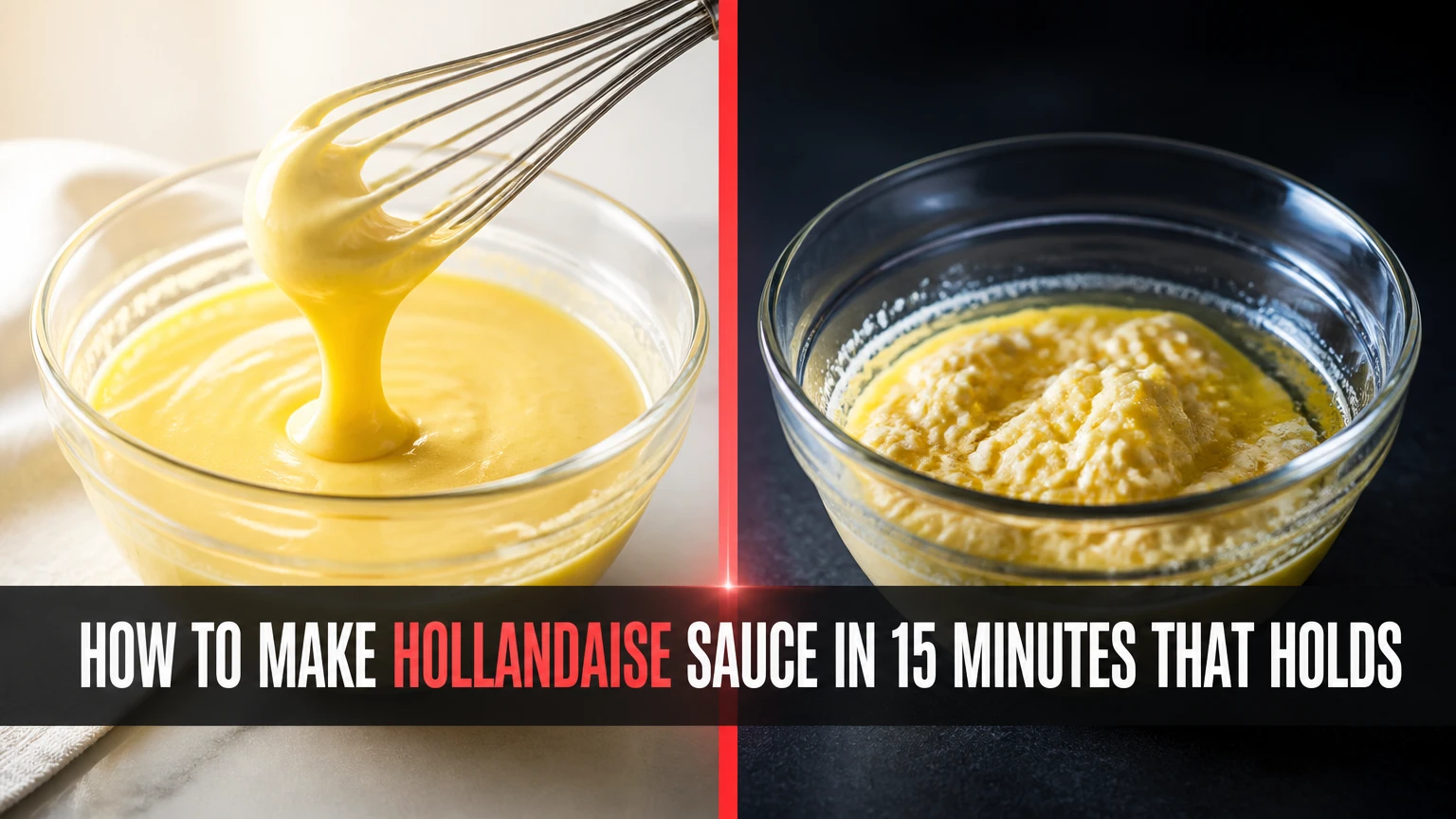
Hollandaise sauce is a warm emulsion of egg yolks, melted butter, lemon juice or another acid, water, and seasoning. Whisk three yolks with acid and water over gentle steam, then add 225 g warm melted butter slowly until thick and glossy; the key success factor is controlling heat while adding fat.
Key Facts at a Glance
- A standard batch uses 3 large egg yolks and 225 g butter for about 4 servings.
- Classic hollandaise takes approximately 10-15 minutes from setup to serving.
- The finished sauce should be warm and fluid, typically around 45-60°C.
- Egg yolk lecithin emulsifies butter droplets into the sauce’s water phase.
- Clarified butter produces a cleaner, lighter sauce; whole butter gives more dairy flavor.
- A broken hollandaise can usually be rescued with warm water or a fresh egg yolk.
What Is Hollandaise Sauce?
Hollandaise sauce is one of the five French mother sauces associated with classical cuisine, alongside béchamel, velouté, espagnole, and tomato sauce. The sauce combines egg yolks, butterfat, acid, and seasoning into a rich topping for eggs, vegetables, fish, and potatoes.
The classic flavor profile is buttery, lightly tangy, and gently peppery. Lemon juice is the most practical acid for home cooking, while professional kitchens may use a reduced mixture of white wine, vinegar, shallot, and peppercorns.
Hollandaise is not a cream sauce. Its body comes from an emulsion and partially thickened egg yolks, not from flour, cream, or cheese. That distinction explains both its luxurious texture and its sensitivity to heat.
Why Does Hollandaise Thicken?
Hollandaise thickens because egg yolk lecithin surrounds microscopic butter droplets and keeps those droplets suspended in a water-based mixture. Whisking creates the droplets, while gentle heat thickens yolk proteins enough to give the emulsion structure.
Butter supplies the fat phase. Lemon juice, water, and the water naturally present in whole butter supply the aqueous phase. Egg yolks connect those phases because lecithin has a water-attracting end and a fat-attracting end.
Temperature determines whether the sauce becomes smooth or scrambled. Diluted yolks can thicken around 65-79°C, while temperatures approaching 80°C increase the risk of curds. The finished sauce should remain warm rather than hot enough to steam aggressively.
A useful practitioner rule is to add butter more slowly during the first 30-60 g. Once the base becomes noticeably thicker and glossy, the emulsion can accept a thin stream more easily.
Ingredients and Tools for Four Servings
The following formula yields approximately 250-300 ml of sauce, enough for four moderate portions over eggs, asparagus, or fish.
Ingredients
| Ingredient | Quantity | Function | Practical specification |
|---|---|---|---|
| Large egg yolks | 3 | Emulsifier and thickener | Approximately 50-60 g total |
| Unsalted butter | 225 g | Fat phase | Clarified or whole butter |
| Lemon juice | 15 ml | Acidity and flavor | Freshly squeezed |
| Cold water | 15 ml | Controls yolk concentration | Add to yolks before heating |
| Fine salt | 1-2 g | Seasoning | Adjust after emulsifying |
| Cayenne pepper | 0.1-0.3 g | Mild heat | Optional |
| White pepper | 0.1 g | Pepper flavor | Optional alternative |
Tools
Use a heatproof stainless-steel or glass bowl, a saucepan, a balloon whisk, a small ladle or pouring jug, and a fine-mesh strainer. The bowl must sit securely over the saucepan without its base touching the simmering water.
Clarified butter is useful but not mandatory. Whole butter works well when its water content is allowed to escape during melting, although the final sauce may taste more distinctly dairy-rich.
Before You Start
| Requirement | Typical value | Why it matters |
|---|---|---|
| Active preparation | 8-10 minutes | Includes whisking and butter addition |
| Total elapsed time | 10-15 minutes | Excludes optional butter clarification |
| Difficulty | Intermediate | Heat control requires attention |
| Batch size | 4 servings | Based on 3 yolks and 225 g butter |
| Ingredient cost | Approximately $3-$7 | Typical United States grocery range |
| Essential equipment | Bowl, saucepan, whisk | A blender is optional |
| Serving temperature | 45-60°C | Fluid without overheating |
Prepare the butter before heating the yolks. Melt 225 g butter over low heat, then keep it warm rather than bubbling violently. If using whole butter, skim foam if desired and leave any watery residue behind when pouring.
For food safety, texture is not a substitute for temperature control. The USDA Food Safety and Inspection Service advises, “Cook eggs until both the yolk and white are firm,” while traditional hollandaise remains soft by design. Use pasteurized eggs when serving pregnant people, older adults, young children, or anyone immunocompromised, and follow local food-safety guidance.
How Do You Make Hollandaise Sauce?
Make classic hollandaise by whisking egg yolks, lemon juice, and water over gentle steam, then incorporating warm melted butter in a controlled stream. The complete method takes about 10-15 minutes, and the sauce is ready when it coats a spoon while remaining fluid and glossy.
Step 1: Melt and Warm the Butter
Melt 225 g unsalted butter in a small saucepan over low heat. Keep the butter warm, approximately 50-60°C, or just above the temperature at which it remains fully liquid.
Clarified butter can be poured more cleanly because its milk solids and much of its water have been removed. Whole butter is acceptable, but avoid pouring the watery sediment from the bottom into the sauce.
You will know the butter is ready when it is liquid and warm without darkening or producing a strong fried-butter smell. Butter that is aggressively boiling can overheat the yolks during incorporation.
The common mistake is preparing the butter too early and allowing it to cool until it begins to thicken. Rewarm it gently before proceeding.
Step 2: Build the Yolk Base
Place 3 egg yolks, 15 ml lemon juice, and 15 ml cold water in the heatproof bowl. Whisk for 30-45 seconds until the mixture looks blended and slightly foamy.
Water dilutes the yolks and gives the proteins room to thicken gradually. Lemon juice contributes acidity, but excessive acid can make the sauce sharp and can weaken its body if added in large amounts.
You will know the base is ready when no streaks of clear white remain and the liquid has a pale yellow color. Do not add the melted butter at this stage.
The common mistake is omitting the water. A yolk mixture with too little water heats unevenly and reaches scrambling temperatures quickly.
Step 3: Heat the Yolks Over Steam
Set the bowl over a saucepan containing 2-3 cm of barely simmering water. The bowl’s base must remain above the water, and the water should produce gentle steam rather than a rolling boil.
Whisk continuously for 2-4 minutes. Lift the bowl from the saucepan every 20-30 seconds if the mixture thickens too quickly, then return it while continuing to whisk.
The yolks are ready for butter when they have increased in volume, look pale, and leave visible whisk tracks for approximately one second. The mixture should resemble a loose custard rather than scrambled eggs.
The common mistake is allowing the bowl to touch the water. Direct contact creates hot spots that can cook the yolks before whisking distributes the heat.
Step 4: Add the Butter Slowly
Remove the bowl from the steam briefly and whisk in the warm butter drop by drop for the first 30-45 g. After the mixture thickens and turns glossy, add the remaining butter in a thin, steady stream while whisking continuously.
Keep the stream narrow enough that each addition disappears before the next substantial amount enters. If the sauce becomes very thick, whisk in 5 ml warm water before continuing.
You will know the emulsion is stable when the sauce holds soft ribbons, looks shiny, and contains no visible pool of butter around its edges. The butter addition usually takes 3-5 minutes.
The common mistake is pouring quickly because the sauce appears stable. A stable early emulsion can still break when a large volume of fat arrives at once.
Step 5: Season and Adjust the Texture
Whisk in 1-2 g fine salt and a small pinch of cayenne or white pepper. Taste the sauce with the food it will accompany, because asparagus, eggs, salmon, and potatoes each change the perceived acidity and salt level.
Adjust a thick sauce with warm water, adding 2.5 ml at a time. Adjust a flat-tasting sauce with a few drops of lemon juice, but avoid adding a full tablespoon unless the batch clearly lacks acidity.
You will know the texture is correct when hollandaise coats the back of a spoon but flows slowly when the spoon tilts. A sauce that sits motionless is too thick for most plating.
The common mistake is correcting thickness with more butter. Extra butter increases richness but usually makes the emulsion heavier and less stable.
Step 6: Serve Immediately or Hold Briefly
Spoon hollandaise over poached eggs, roasted asparagus, grilled fish, steamed broccoli, or crisp potatoes. Serve it warm, ideally within 15-20 minutes of finishing.
To hold the sauce briefly, place the bowl over warm water that is no longer simmering, or keep it in a warm location near 45-55°C. Stir every few minutes and thin it with a teaspoon of warm water if necessary.
You will know the sauce is serviceable when it remains fluid and glossy without a skin forming on top. Discard hollandaise that has remained in unsafe conditions rather than relying on reheating to restore safety.
The common mistake is covering the sauce tightly over active steam. Condensation can drip into the emulsion and dilute it unevenly.
Which Hollandaise Method Should You Use?
The double boiler gives the best control and lightest texture, the blender gives the fastest result, and the direct-pan method suits experienced cooks who can regulate heat without delay. For a first attempt, the blender method is fastest; for learning technique, the bain-marie method is more instructive.
| Method | Active time | Equipment | Texture | Best use |
|---|---|---|---|---|
| Double boiler | 8-12 minutes | Bowl, saucepan, whisk | Light, glossy, adjustable | First traditional batch |
| Blender | 4-6 minutes | Blender or immersion blender | Dense, thick, consistent | Eggs Benedict brunch |
| Direct saucepan | 5-8 minutes | Heavy saucepan, whisk | Rich, compact, velvety | Experienced line cooking |
| Hand immersion blender | 4-6 minutes | Narrow beaker, wand blender | Thick, smooth | Small home batches |
Blender Hollandaise
Add 3 yolks, 15 ml lemon juice, and 1 g salt to a blender. Blend for 5-10 seconds, then pour in 225 g butter heated until fully liquid and very hot, approximately 80-85°C, while blending at high speed.
The hot butter cooks the yolk mixture as it emulsifies, so the method is quick. A narrow container works better with an immersion blender because the blades maintain contact with the developing sauce.
The main limitation is control. A blender can produce a sauce that is thicker than desired, and prolonged blending can warm the emulsion unevenly. Add 5-10 ml warm water after blending if the sauce is too dense.
Direct Saucepan Hollandaise
Place 3 yolks, 15 ml water, and 15 ml acid in a cold heavy saucepan. Whisk over medium-low heat while moving the pan on and off the burner, then add 225 g cold butter in small cubes one piece at a time.
Cold butter moderates the pan temperature as it melts. The method works because the cook controls heat, whisking, and butter addition simultaneously.
This method is unsuitable for distracted cooking. If curds appear, remove the pan immediately and transfer the liquid portion to a clean bowl.
Clarified Butter or Whole Butter?
Clarified butter is the more predictable choice for a clean, stable-feeling hollandaise, while whole butter produces stronger dairy flavor and can make a slightly looser sauce. The better option depends on whether texture control or buttery flavor matters more for the dish.
| Butter choice | Water and solids | Flavor | Typical result | Best pairing |
|---|---|---|---|---|
| Clarified butter | Approximately 0-2% water | Clean, concentrated | Smooth, lighter body | Delicate fish |
| Ghee | Approximately 0-1% water | Toasted, nutty | Rich, stable-feeling | Potatoes, eggs |
| Whole unsalted butter | Approximately 15-18% water | Creamy, milky | Slightly looser sauce | Asparagus, brunch |
| Browned whole butter | Variable after cooking | Hazelnut-like | Darker, heavier flavor | Root vegetables |
Clarified butter is not immune to separation. Removing water reduces splattering and changes the final ratio, but overheating, rapid pouring, or insufficient whisking can still destroy the emulsion.
Whole butter can be preferable when the sauce is served with mild vegetables. Its milk solids contribute flavor that clarified butter does not provide.
How Do You Scale Hollandaise?
Scale hollandaise by using approximately one yolk for every 75 g butter, then adjust the final consistency with water or lemon juice. Small batches emulsify quickly, while large batches require slower heating and a wider bowl to distribute temperature evenly.
| Servings | Egg yolks | Butter | Lemon juice | Water |
|---|---|---|---|---|
| 2 | 2 | 115-125 g | 10 ml | 10 ml |
| 4 | 3 | 225 g | 15 ml | 15 ml |
| 8 | 6 | 450 g | 30 ml | 30 ml |
| 12 | 9 | 675 g | 45 ml | 45 ml |
The ratio is a starting point rather than a rigid formula. Yolks vary in size, butter contains different amounts of water, and the final dish may require a sharper or softer sauce.
For more than eight servings, make two separate batches when possible. A very large bowl of hollandaise heats slowly at the center and cools quickly at the edges, making consistency harder to judge.
What Can You Add to Hollandaise?
Classic hollandaise accepts different acids, herbs, and fats without changing its basic emulsion structure. Additions should be concentrated and relatively low in water so they do not overwhelm the yolk and butter ratio.
| Variation | Main change | Typical quantity for 4 servings | Best food |
|---|---|---|---|
| Béarnaise | Tarragon-vinegar reduction | 30 ml reduction | Steak, roasted beef |
| Maltaise | Blood-orange juice and zest | 15 ml juice, 1 tsp zest | Asparagus, fennel |
| Mousseline | Whipped cream folded in | 60 ml cream | Poached fish |
| Brown-butter hollandaise | Browned butter | 225 g butter | Potatoes, squash |
| Choron-style | Tomato paste or reduction | 15-30 g tomato | Eggs, grilled meat |
For Béarnaise, reduce white wine vinegar or tarragon vinegar with minced shallot, peppercorns, and tarragon until approximately 30 ml remains. Cool the reduction before whisking it with the yolks.
For mousseline, whip 60 ml cold heavy cream to soft peaks and fold it into finished hollandaise immediately before serving. The result is lighter but less suitable for prolonged holding.
Common Mistakes and How to Fix Them
Hollandaise usually fails because the temperature is too high, the butter enters too quickly, or the emulsion becomes too cold. The correct rescue depends on whether the sauce contains cooked curds or only separated fat.
| Symptom | Likely cause | Immediate fix | Prevention |
|---|---|---|---|
| Scrambled curds | Excessive heat | Strain, then whisk liquid into fresh yolk | Use gentle steam |
| Greasy layer | Butter added too fast | Whisk broken sauce into 10 ml warm water | Slow the stream |
| Sauce too thick | Too much fat or evaporation | Add warm water 2.5 ml at a time | Keep water available |
| Sauce too thin | Underheated yolks or excess water | Whisk briefly over steam | Cook base until tracks form |
| Grainy texture | Butter cooled or emulsion destabilized | Rewarm gently and whisk | Keep butter fully liquid |
| Sharp acidity | Excess lemon juice | Add a small amount of unsalted butter or yolk-based sauce | Measure acid first |
Rescue a Broken Hollandaise
Place 10 ml warm water in a clean bowl. Whisk the broken hollandaise into the water one teaspoon at a time until the sauce becomes smooth, then continue adding the remaining sauce slowly.
If the water rescue fails, whisk one fresh egg yolk with 5 ml lemon juice in a clean bowl over gentle steam. Add the broken sauce gradually, treating it as the fat phase.
Do not pour the broken sauce into a fresh yolk all at once. The fresh yolk still needs time to surround the fat droplets.
Rescue Partially Scrambled Hollandaise
Remove the sauce from heat immediately and strain it through a fine-mesh strainer. If the liquid portion remains smooth, whisk it into 10 ml warm water or one fresh yolk in a clean bowl.
A completely scrambled batch is rarely worth serving as hollandaise. Start a new yolk base and incorporate the strained liquid slowly, provided the liquid does not smell scorched or contain extensive cooked egg.
How Should You Hold Hollandaise Safely?
Hold hollandaise for the shortest practical time, ideally no longer than 15-20 minutes, in a warm environment around 45-55°C with frequent stirring. The sauce should not sit at room temperature during a long brunch service.
Traditional hollandaise presents a food-safety tension: the sauce must stay fluid, but the yolks may not become fully firm. The FDA Food Code uses 57°C or higher for hot holding of many time-temperature-controlled foods, while local rules may differ, so commercial kitchens should follow their applicable code.
For home service, make smaller batches closer to serving time. For a large event, use pasteurized eggs and a documented temperature-control plan rather than relying on a thermos, warm countertop, or improvised water bath.
Avoid reheating hollandaise directly over a burner or in a microwave. Gentle whisking over warm steam can restore fluidity, but high heat can scramble the yolks within seconds.
What Should You Serve with Hollandaise?
Hollandaise pairs best with foods that benefit from butter and acidity, including poached eggs, asparagus, salmon, cod, broccoli, artichokes, and roasted potatoes. Use approximately 30-45 ml sauce per main portion, depending on the dish.
Eggs Benedict is the classic application: toasted English muffin, Canadian bacon or ham, poached egg, and hollandaise. Eggs Florentine replaces the meat with spinach, while eggs Royale uses smoked salmon.
For vegetables, use less sauce because asparagus and broccoli already carry fresh, mineral flavors. For fish, add extra lemon and reduce cayenne so the sauce supports rather than masks the protein.
FAQ
Can I Make Hollandaise Without Lemon Juice?
Yes. Replace lemon juice with a cooled white-wine vinegar reduction, tarragon vinegar, or a small amount of orange juice. Use approximately 15-30 ml reduction for three yolks, tasting before adding more because vinegar reductions vary in concentration.
Why Is My Hollandaise Bitter?
Hollandaise can taste bitter when lemon pith, burnt butter solids, excessive cayenne, or an over-reduced vinegar mixture enters the sauce. Strain the acid reduction, use freshly squeezed juice, and add seasoning in small increments after the emulsion forms.
Can I Use Salted Butter?
Salted butter works, but delay additional salt until the sauce is finished. Salt levels vary significantly between brands, and adding the standard 1-2 g salt before tasting can make the final sauce too salty.
Can Hollandaise Be Made the Day Before?
Hollandaise is best made shortly before serving because refrigeration thickens the butter and reheating can scramble the yolks. If advance preparation is unavoidable, chill it promptly, refrigerate it safely, and rewarm gently while whisking, adding warm water to restore texture.
Why Does Hollandaise Taste Too Heavy?
A heavy sauce usually contains too much butter for its yolk and water base, or it has been held until the emulsion becomes dense. Whisk in warm water and lemon juice a few drops at a time, then serve smaller portions of approximately 30 ml.
Is Blender Hollandaise as Good as Classic Hollandaise?
Blender hollandaise can be smooth and reliable, but the texture is usually denser than a hand-whisked bain-marie sauce. Choose the blender for speed and repeatability; choose the classic method when you want a lighter texture and more control over acidity and thickness.
The Bottom Line
To make hollandaise sauce successfully, whisk 3 egg yolks with 15 ml lemon juice and 15 ml water over gentle steam, then add 225 g warm melted butter gradually. Keep the sauce warm but never aggressively hot, adjust the finished texture with warm water, and serve it within minutes for the glossiest result.