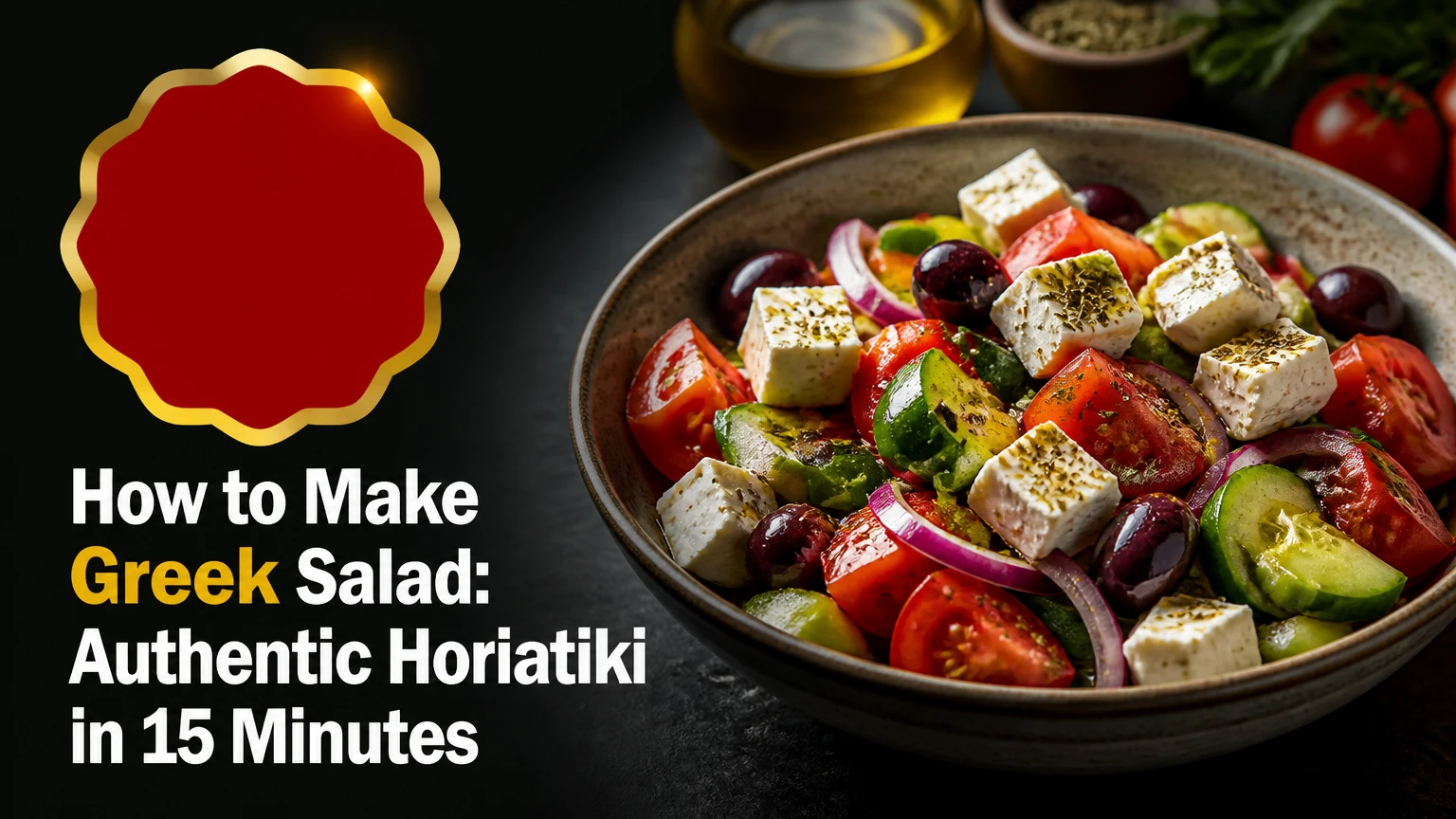
To make Greek salad, combine roughly cut ripe tomatoes, cucumber, red onion, green pepper, Kalamata olives, extra virgin olive oil, red wine vinegar, and dried oregano, then top the mixture with a slab of feta. Rest the salad for 5 minutes so the tomato juices season the oil, but serve it before the vegetables soften.
Key Facts / At a Glance
Authentic Greek salad is called Horiatiki, meaning village salad, and traditionally contains no lettuce.
The recipe takes 10-15 minutes to prepare, plus 5 minutes of resting time.
The quantities below make 4 side servings or 2 substantial main-dish servings.
A traditional serving uses 200 grams of feta, preferably a block preserved in brine.
Greek salad is dressed in the bowl with olive oil, vinegar, salt, and oregano rather than a thick emulsified dressing.
The best texture comes from large rustic cuts and tomatoes served at room temperature.
What Is Authentic Greek Salad?
Authentic Greek salad is a rustic vegetable dish built around ripe tomatoes, cucumber, red onion, green bell pepper, olives, olive oil, oregano, and feta. Horiatiki is assembled in large pieces and usually topped with feta in one slab, while lettuce, croutons, creamy dressing, and shredded cheese belong to later international interpretations.
The dish depends on ingredient quality more than knife work. A firm, fragrant tomato contributes acidity and juice; cucumber supplies coolness and crunch; feta adds salt and lactic tang. Extra virgin olive oil carries the oregano aroma across the vegetables.
Traditional Greek presentations vary by household and region. Some cooks use red wine vinegar, while others rely on tomato acidity and olive oil alone. Lemon juice works, but it creates a brighter, less classic profile than vinegar.
Does Greek salad have lettuce?
Traditional Horiatiki does not contain lettuce. Lettuce appears in many American and restaurant-style Greek salads because it increases volume, provides a leafy base, and holds creamy or emulsified dressing, but omitting it preserves the village-style format.
What makes the salad taste Greek?
The recognizable flavor comes from the combination of ripe tomato juice, brined feta, Kalamata olives, dried oregano, and fruity olive oil. No single ingredient creates the profile. Adding mustard, honey, sugar, or heavy garlic dressing shifts the dish toward a Western vinaigrette.
Greek Salad Ingredients and Exact Quantities
The following quantities make four side servings or two large servings. Use room-temperature tomatoes and feta from brine when available, because refrigeration dulls tomato aroma and dry pre-crumbled cheese has a weaker texture.
| Ingredient | Quantity for 4 sides | Preparation | Practical specification |
|---|---|---|---|
| Ripe tomatoes | 4 large, about 700-800 g | Thick wedges | Vine, beefsteak, or heirloom |
| Cucumber | 1 large, about 300 g | Thick half-moons | English, Persian, or unwaxed field cucumber |
| Red onion | 1 medium, about 120 g | Thin rings | Soak 5 minutes for milder flavor |
| Green bell pepper | 1 medium, about 150 g | Rings or strips | Remove seeds and white ribs |
| Greek feta | 200 g | One slab | Sheep and goat milk, packed in brine |
| Kalamata olives | 10-12 | Whole or halved | Pitted olives improve table safety |
| Extra virgin olive oil | 4 tablespoons, 60 ml | Drizzle | Fruity or moderately peppery |
| Red wine vinegar | 1 tablespoon, 15 ml | Add to vegetables | Increase to 2 tablespoons for sharper flavor |
| Dried oregano | 1 tablespoon | Crush between palms | Greek oregano has a strong herbal aroma |
| Fine sea salt | 1/2 teaspoon initially | Sprinkle over vegetables | Adjust after tasting the feta |
Which tomatoes, cucumber, feta, and olives should you buy?
Choose ripe tomatoes that smell aromatic near the stem and yield slightly under gentle pressure. Use English or Persian cucumbers when possible because their thin skins and smaller seed cavities reduce excess water. Select feta sold as a block in brine, then drain it immediately before serving.
Kalamata olives provide a wine-like, fruity flavor and soft texture. Green olives can replace part of the quantity for contrast, but canned California-style black olives taste milder and less traditionally Mediterranean.
PDO Greek feta is made under European Protected Designation of Origin rules from sheep’s milk or a sheep-and-goat blend in defined Greek regions. Non-PDO feta-style cheese can still work, especially when budget or availability matters, but compare saltiness before adding extra seasoning.
Ingredient substitutions that preserve the structure
| Original ingredient | Best substitute | Quantity | Flavor or texture change |
|---|---|---|---|
| Kalamata olives | Green Castelvetrano olives | 10-12 | Sweeter, firmer, less wine-like |
| Green bell pepper | Yellow bell pepper | 1 medium | Sweeter and less grassy |
| Greek feta | Bulgarian feta | 200 g | Usually saltier and denser |
| Red wine vinegar | Fresh lemon juice | 1 tablespoon | Brighter acidity, less fermented depth |
| English cucumber | Persian cucumbers | 3-4 | Smaller pieces and crisp skin |
| Fresh ripe tomato | Canned tomato, drained | 400 g | Softer texture, suitable only out of season |
Do not replace tomatoes with salsa ingredients such as corn, avocado, or jalapeño if the goal is Horiatiki. Those substitutions may create a good salad, but they change the dish’s identity.
How to Make Greek Salad Step by Step
Greek salad requires no cooking, special equipment, or blended dressing. Set aside 10-15 minutes for preparation, then rest the assembled vegetables for 5 minutes; tomato quality determines more of the result than the exact vinegar measurement.
Before You Start
| Item | Requirement |
|---|---|
| Preparation time | 10-15 minutes |
| Resting time | 5 minutes |
| Total time | 15-20 minutes |
| Difficulty | Easy |
| Equipment | Chef’s knife, cutting board, shallow bowl, measuring spoon |
| Cost, typical | $8-$15 for four side servings |
| Main prerequisite | Ripe tomatoes at room temperature |
| Yield | 4 side servings or 2 main servings |
Step 1: Soften the red onion if needed
Slice the red onion into thin rings, then soak the slices in ice water for 5 minutes if the onion tastes aggressively sharp. Drain thoroughly and pat dry before adding it to the bowl.
You will know the onion is ready when the slices remain crisp but smell less sulfurous. A common mistake is soaking the onion for 20 minutes or longer, which removes too much flavor and leaves the salad watery.
Step 2: Cut the vegetables into rustic pieces
Cut each tomato into six to eight irregular wedges, leaving the seeds and gel attached. Slice the cucumber into 1-centimeter half-moons, cut the pepper into rings or strips, and separate the onion rings.
Large pieces protect the vegetables from collapsing during tossing. Avoid fine dicing, because small cuts release juice rapidly and make the dish resemble a wet chopped relish rather than a composed village salad.
Step 3: Build the vegetable base
Place the tomatoes, cucumber, green pepper, and onion in a wide, shallow serving bowl. Add the olives, keeping several visible around the edges so diners can identify them and remove pits safely if necessary.
A shallow bowl distributes seasoning more evenly than a deep mixing bowl. Do not add the feta yet, because tossing the cheese through the vegetables breaks the block and clouds the tomato juices with dairy.
Step 4: Season with salt, vinegar, and olive oil
Sprinkle the vegetables with 1/2 teaspoon of sea salt, add 1 tablespoon of red wine vinegar, and drizzle in 3 tablespoons of olive oil. Toss gently with two large spoons for 10-15 seconds.
Let the vegetable mixture stand at room temperature for 5 minutes. You will know the seasoning is working when a small pool of reddish, glossy juice forms beneath the tomatoes. The common mistake is salting heavily before tasting, since brined feta and olives will add substantial salt later.
Step 5: Add feta and finish with oregano
Place the 200-gram feta block on top of the vegetables. Drizzle the remaining tablespoon of olive oil over the feta, then crush the dried oregano between your palms and scatter it across the cheese and vegetables.
Serve immediately after the five-minute rest. The salad is ready when the feta remains firm, the cucumber still snaps, and the bottom of the bowl contains seasoned tomato juice rather than a large volume of diluted water.
Why Does the Dressing Work Without Emulsifying?
Greek salad dressing works because salt and acid draw liquid from tomatoes and cucumber, while olive oil carries fat-soluble aromas across the released juice. The result is an intentionally loose, un-emulsified sauce that forms in the bowl, rather than a stable vinaigrette made with mustard or a blender.
Salt begins changing vegetable texture as soon as it contacts cut surfaces. Five minutes is enough to create seasoning liquid without producing a limp salad. A 30-minute rest can improve flavor for some preparations, but it also increases water release.
Oregano is best added near serving. Crushing dried leaves between the palms breaks aromatic structures and distributes the herb over the oil. Adding oregano days before preparation gives a flatter aroma.
The claimed idea that feta “absorbs” the dressing should be understood as surface coating, not deep absorption. Feta is dense and salty; oil, oregano, and tomato juice cling to its exterior while the interior stays creamy and distinct.
Which Greek Salad Style Fits Your Meal?
Horiatiki is the best choice for an authentic side, while lettuce-based Greek salad suits buffets and Cretan Dakos works when bread or rusks must become part of the meal. Seafood versions add capers or grilled shellfish, but they no longer represent the simplest village standard.
| Style | Base ingredients | Cheese or protein | Dressing format | Best use |
|---|---|---|---|---|
| Traditional Horiatiki | Tomato, cucumber, onion, pepper | Feta slab, 200 g | Oil, vinegar, oregano | Greek meal or grilled meat |
| Americanized Greek salad | Romaine, tomato, cucumber | Crumbled feta | Vinaigrette, often garlic-based | Buffet or large luncheon |
| Cretan Dakos | Barley rusks, tomato | Mizithra or feta | Olive oil and tomato juice | Bread-centered light meal |
| Coastal variation | Horiatiki vegetables, capers | Octopus, shrimp, or feta | Oil, vinegar, capers | Seafood lunch |
| Main-course version | Horiatiki vegetables | Chickpeas or grilled chicken | Oil, lemon, oregano | Packed lunch or dinner |
Can you add lettuce to Greek salad?
You can add lettuce for a larger, more filling salad, but the result is an Americanized Greek salad rather than strict Horiatiki. If using romaine, add it immediately before serving and increase the oil and acid by about 25 percent to season the added leaves.
Can Greek salad become a complete meal?
Greek salad becomes a more substantial meal when paired with bread, chickpeas, grilled chicken, tuna, or hard-boiled eggs. A traditional Horiatiki alone supplies vegetables and fat but relatively little protein, with approximately 8-12 grams of protein per side serving depending on the feta quantity.
How Should You Scale, Serve, and Store It?
Prepare Greek salad for immediate service whenever possible. For four side servings, use the listed quantities; for eight servings, double every ingredient but use the vinegar and salt conservatively until tasting because tomato acidity and feta saltiness vary by batch.
| Servings | Tomatoes | Cucumber | Feta | Olive oil | Vinegar |
|---|---|---|---|---|---|
| 2 side servings | 2 large | 1/2 large | 100 g | 2 tbsp | 1/2 tbsp |
| 4 side servings | 4 large | 1 large | 200 g | 4 tbsp | 1 tbsp |
| 8 side servings | 8 large | 2 large | 400 g | 8 tbsp | 2 tbsp |
| 12 side servings | 12 large | 3 large | 600 g | 12 tbsp | 3 tbsp |
Serve Greek salad at cool room temperature, not directly from a cold refrigerator. The tomatoes release more aroma between approximately 18 and 22°C, while the feta remains firm enough to slice or break into large pieces.
For meal prep, store cut cucumber, pepper, onion, and olives in one sealed container, keep tomatoes separately at room temperature for the same day, and store feta in its brine. Add salt, vinegar, oil, and cheese only when eating.
| Storage situation | Maximum practical window | What to do |
|---|---|---|
| Undressed cut vegetables | 24 hours refrigerated | Keep tomatoes separate when possible |
| Dressed Greek salad | 2-4 hours refrigerated | Expect softer cucumber and more liquid |
| Feta in original brine | Follow package date | Keep fully submerged and chilled |
| Assembled salad for transport | 4 hours in a cooler | Carry dressing and feta separately |
| Leftover dressed salad | Next day, within 24 hours | Drain excess liquid before serving |
Greek salad is not ideal for long meal-prep cycles. After 24 hours, the vegetables lose their crispness, the feta becomes coated in diluted juice, and the olive oil tastes less aromatic.
Common Mistakes and How to Fix Them
Why is Greek salad watery?
Greek salad becomes watery when watery vegetables are heavily salted, cut too small, or left dressed for too long. Drain excess liquid, add a fresh tomato wedge and a small splash of olive oil, then adjust vinegar only after tasting.
For future batches, salt lightly, keep cuts at least 1 centimeter thick, and limit the resting period to 5-10 minutes. Salting cucumbers 15 minutes in advance and draining them can help when field cucumbers contain abundant water.
Why does the salad taste flat?
A flat Greek salad usually lacks one of four elements: salt, acid, aromatic oregano, or flavorful olive oil. Add seasoning in small increments, tasting after each adjustment; begin with 1/8 teaspoon salt or 1 teaspoon vinegar rather than correcting aggressively.
Tomatoes with low acidity may need lemon juice, while very salty feta may require no additional salt. The finished juice at the bottom of the bowl should taste balanced on its own.
Why is the onion too strong?
Soak sliced red onion in ice water for 5-10 minutes, then dry it thoroughly. Vinegar soaking also softens the bite, but it begins pickling the onion and can make the salad more acidic than intended.
Thin rings are preferable to minced onion because they provide flavor control. Diners can move or remove a ring, whereas minced pieces spread sharpness throughout every bite.
Why did the feta crumble or disappear?
Feta crumbles when it is tossed through the vegetables, handled while wet, or purchased already broken into small pieces. Place a drained block on top, and let each diner break off portions with a fork.
Pre-crumbled feta often contains anti-caking agents and has more exposed surface area, which can create a drier mouthfeel. It remains acceptable for a buffet dressing or lettuce salad, but a brined block better suits Horiatiki.
Why are the tomatoes bland?
Cold storage suppresses tomato aroma and can produce a mealy texture. Keep ripe tomatoes on the counter, cut them shortly before service, and choose fruit that smells fragrant near the stem.
If supermarket tomatoes are pale or firm, let them ripen at room temperature for one to three days. Do not place unripe tomatoes in direct hot sun, which can soften the exterior unevenly.
Is Greek Salad Healthy?
Greek salad is typically nutrient-dense, high in vegetables, and moderate in calories, but feta, olives, and olive oil make sodium and total fat vary substantially. A typical side serving with one-quarter of the listed ingredients contains about 180-280 calories, 15-24 grams of fat, and 400-800 milligrams of sodium.
Those figures are practical estimates, not laboratory values. Tomato size, olive brine, feta brand, and the amount of oil left in the bowl can change the result considerably.
The salad supplies vitamin C from peppers and tomatoes, potassium from vegetables, and monounsaturated fat from olive oil. It is naturally vegetarian and gluten-free when served without bread or barley rusks. Feta contains dairy, so it is not vegan or dairy-free.
For lower sodium, rinse olives briefly, use less feta, and avoid salting until after tasting. For higher protein, add 120-150 grams of chickpeas or 100-120 grams of grilled chicken per main-course serving.
A useful practitioner rule is to treat olive oil as an ingredient rather than a free-pouring garnish. Four tablespoons contribute roughly 480 calories to the whole bowl, so measuring the oil preserves both flavor balance and portion control.
What Should You Serve With Greek Salad?
Greek salad pairs best with foods that benefit from its acidic tomato juice and briny feta. Serve it with grilled lamb, chicken souvlaki, baked fish, roasted potatoes, warm pita, or crusty bread that can absorb the seasoned liquid.
| Main dish | Portion for one diner | Why it pairs well | Typical total meal time |
|---|---|---|---|
| Chicken souvlaki | 150-180 g cooked | Lean protein balances olive oil | 25-35 minutes |
| Grilled lamb | 120-150 g cooked | Oregano and acid cut richness | 30-40 minutes |
| Baked white fish | 150-180 g cooked | Tomato acidity supports mild fish | 20-30 minutes |
| Chickpeas and pita | 150 g chickpeas plus 1 pita | Vegetarian protein and starch | 15-20 minutes |
| Roasted potatoes | 200 g | Absorbs tomato and oil juices | 40-50 minutes |
Greek salad is less suitable beside dishes with sweet barbecue sauce, creamy pasta, or heavily spiced curry, where its oregano, vinegar, and brine can compete rather than refresh.
Expert Rules for Better Results
Keep the feta visible. A slab gives the diner control over salt and preserves textural contrast. Crumbling the cheese early spreads salt unevenly and makes the bottom of the bowl cloudy.
Use the tomato juice as the sauce. Draining tomatoes before assembly removes the natural liquid that carries olive oil, vinegar, and oregano. Drain only when the fruit is exceptionally watery or the salad must travel.
Measure oil before adding more. A typical 4-serving bowl needs 3-4 tablespoons, not an unmeasured pour. Excess oil masks acidity and leaves the vegetables greasy rather than glossy.
Taste the assembled liquid. The small pool beneath the salad is the most accurate test of seasoning. If that liquid tastes balanced, the vegetables and feta will usually eat well together.
Frequently Asked Questions
Can I make Greek salad the night before?
You can cut most ingredients the night before, but do not fully dress the salad until serving. Refrigerate cucumber, pepper, onion, and olives; keep ripe tomatoes separate if possible, store feta in brine, and add salt, vinegar, oil, and oregano within 5-10 minutes of eating.
Should cucumbers be peeled for Greek salad?
English and Persian cucumbers usually need no peeling because their skins are thin and mild. Partially peel a thick-skinned field cucumber in alternating strips, then remove some seeds if the center is unusually watery.
Can I use lemon instead of red wine vinegar?
Yes. Use 1 tablespoon of fresh lemon juice for the listed four-serving batch, then taste before adding more. Lemon produces sharper, fresher acidity, while red wine vinegar gives Horiatiki a deeper fermented note.
What can I use instead of Kalamata olives?
Use green Castelvetrano, Halkidiki, or another brined olive when Kalamata olives are unavailable. Choose whole or large halved olives rather than finely sliced olives, and adjust salt only after accounting for the replacement olive’s brine.
How long can Greek salad sit at room temperature?
Keep assembled Greek salad at room temperature for about 2 hours, or 1 hour when the surrounding temperature exceeds 32°C. For outdoor meals, place the bowl over ice and keep feta and vegetables chilled until serving.
Is Greek salad keto-friendly?
Traditional Greek salad is generally low in carbohydrates, with most carbohydrates coming from tomatoes, cucumber, onion, and pepper. Check the portion and avoid pita or barley rusks if following a strict ketogenic plan; feta and olive oil add fat without much carbohydrate.
The Bottom Line
The best way to make Greek salad is to use ripe room-temperature tomatoes, large rustic vegetable cuts, brined feta, Kalamata olives, olive oil, oregano, and a restrained amount of vinegar. Rest the dressed vegetables for 5 minutes, place the feta on top, and serve before the tomato juice turns the cucumber soft. That method preserves the defining character of authentic Greek salad, Horiatiki.