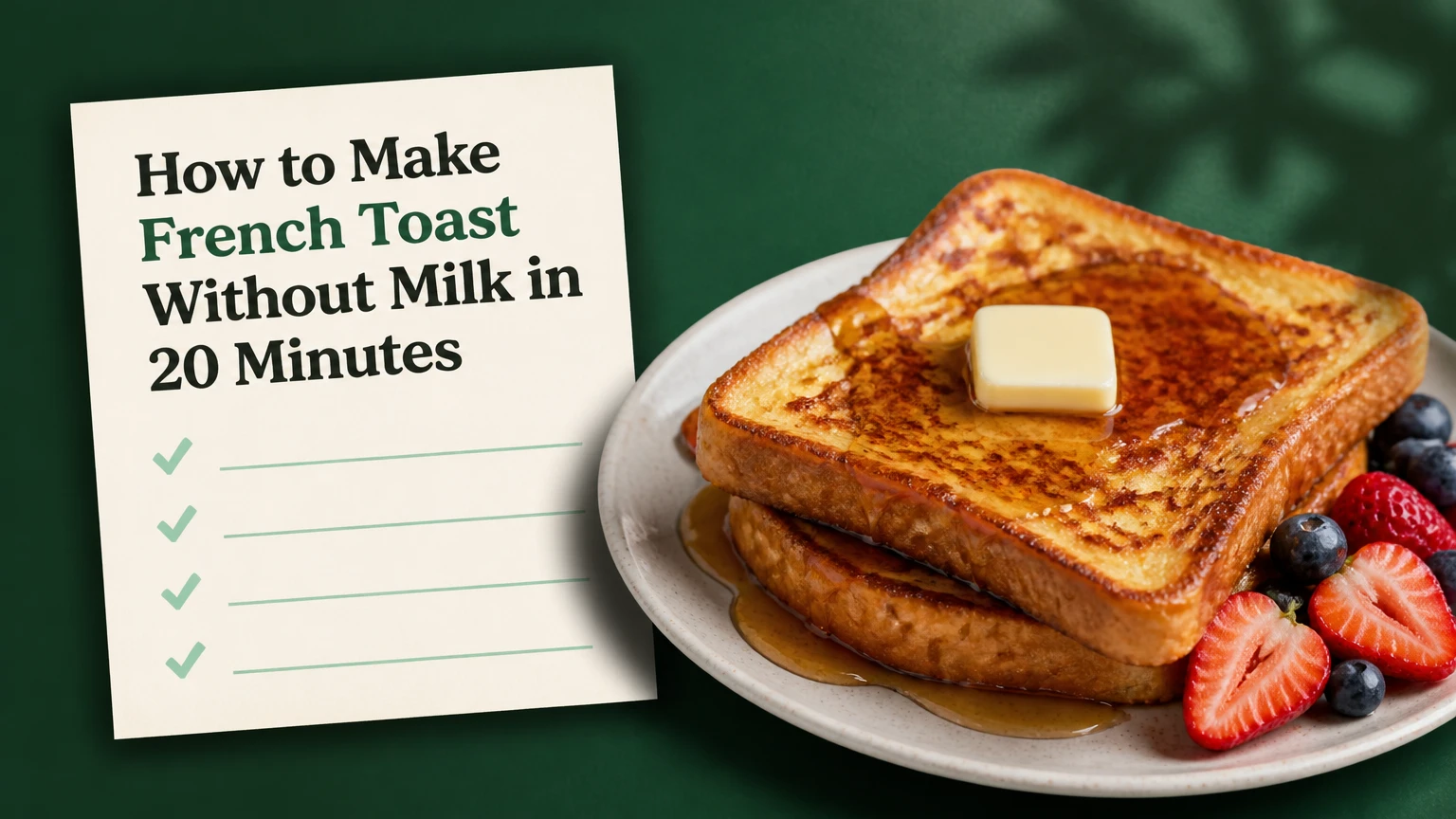
French toast without milk uses eggs, a small amount of water or another liquid, bread, seasoning, and cooking fat to create a crisp outside and tender center. For four slices, whisk 2 large eggs with 1/4 cup liquid, soak thick bread for 15-30 seconds per side, and cook over medium heat for about 3-4 minutes per side.
Key Facts at a Glance
- French toast does not require milk because eggs provide the primary structure and richness.
- Water, oat milk, almond milk, coconut milk, or fruit juice can replace dairy milk.
- The standard ratio for four slices is 2 large eggs to 1/4 cup liquid.
- Thick, slightly stale bread absorbs custard more evenly than fresh sandwich bread.
- Medium heat, approximately 350-375°F at the pan surface, reduces burnt edges and raw centers.
- A cooked egg-based French toast center should reach 160°F, according to USDA egg-safety guidance.
What French Toast Without Milk Is
French toast without milk is bread soaked in an egg-based custard made with a dairy-free liquid, then browned in a skillet. The dish remains French toast, or pain perdu, because the defining process is soaking bread in seasoned egg custard and pan-cooking it, not the presence of dairy milk.
Milk usually adds water, fat, proteins, lactose, and mild sweetness. A replacement liquid mainly needs to thin the eggs enough for the custard to enter the bread crumb. Missing fat can come from coconut oil, dairy-free margarine, butter-free spread, or neutral oil.
The result depends more on bread, soaking time, and pan temperature than on the liquid alone. Brioche and challah produce a rich, custardy center, while sturdy French bread creates a firmer chew and more defined crust.
Is This Recipe Dairy-Free or Vegan?
A French toast recipe without milk is dairy-free only when the cooking fat, bread, and toppings also contain no dairy ingredients. The recipe is not vegan when it contains eggs, although a separate egg-free version can use mashed banana, ground flaxseed, or aquafaba.
Check packaged bread for milk powder, whey, casein, and butter. Check dairy-free margarine labels as well, because some spreads contain milk-derived ingredients despite being marketed for plant-based cooking.
Why Milk Is Not Required
Eggs provide the coagulating proteins that turn liquid custard into a soft interior, while water or plant milk hydrates the bread starches. Heat unfolds the egg proteins and sets the mixture around the crumb, so milk is an optional modifier rather than the structural foundation.
A useful way to think about the custard is concentration. Too little liquid leaves a thick egg coating that can form white patches or cook like scrambled egg. Too much liquid weakens the custard, makes the bread difficult to turn, and increases the risk of a wet center.
For four standard slices, 2 large eggs and 1/4 cup liquid provide a balanced starting point. Use 3 eggs for very thick slices, or reduce the liquid to 3 tablespoons when using thin sandwich bread.
How Does the Custard Chemistry Change?
Dairy milk contributes fat, protein, and lactose, but each contribution is modest in a typical French toast mixture. Oat milk supplies sweetness and body, coconut milk supplies substantial fat, and water supplies hydration without added flavor or browning sugars.
Sugar accelerates browning because it caramelizes and participates in surface browning reactions. Fruit juice can brown rapidly, so reduce heat and wipe excess custard from the bread before it reaches the pan.
Which Liquid Works Best?
Oat milk is the best all-purpose substitute for dairy milk because its mild sweetness and moderate body produce a tender center without overpowering the eggs. Water is the best emergency substitute, almond milk gives a lighter result, coconut milk creates the richest texture, and juice makes a distinctly sweet variation.
Use unsweetened liquids when adding maple syrup or sugar separately. Sweetened plant milk can make the surface darken before the center sets, especially in a thin nonstick pan.
| Liquid | Amount for 2 eggs | Result | Best use |
|---|---|---|---|
| Unsweetened oat milk | 1/4 cup | Tender, lightly sweet crumb | Closest everyday substitute |
| Unsweetened almond milk | 1/4 cup | Light crumb, crisp edges | Lower-richness breakfast |
| Canned coconut milk | 3 tablespoons | Dense, rich custard | Dessert-style French toast |
| Water | 1/4 cup | Crisp, egg-forward texture | Pantry-only version |
| Apple or orange juice | 3 tablespoons | Sweet, aromatic, fast browning | Fruit-based brunch variation |
Can You Make French Toast With Water?
You can make French toast with water, and the best water-based formula uses 2 eggs, 1/4 cup water, 1 teaspoon vanilla, 1/2 teaspoon cinnamon, 1 tablespoon maple syrup, and a pinch of salt for four slices. Add an extra egg yolk when you want more richness without adding milk.
Water has no fat, sugar, or protein, so the finished toast tastes more egg-forward. Vanilla, cinnamon, maple syrup, and a flavorful cooking fat compensate for the neutral liquid.
Use water at room temperature. Very cold water can slightly slow the pan’s recovery after each slice, although the difference is small in a home skillet.
Can You Use Fruit Juice?
Fruit juice works when you want a sweet, fruity French toast, but use only 2-3 tablespoons per 2 eggs because juice contains sugar and acid. Apple juice pairs with cinnamon, while orange juice pairs with vanilla, cardamom, and orange zest.
Juice-based custard needs medium-low heat. The sugar can scorch before the bread warms through, particularly when the pan is cast iron or the slices are thin.
Which Bread Gives the Best Texture?
Day-old brioche, challah, and French bread give the best texture because their drier crumb absorbs custard without collapsing. Fresh sandwich bread works, but it requires a shorter soak and produces a softer, less structured center.
| Bread type | Typical thickness | Soak per side | Cooking result |
|---|---|---|---|
| Brioche | 3/4-1 inch | 20-30 seconds | Rich, soft, custardy |
| Challah | 3/4-1 inch | 20-30 seconds | Tender with firm edges |
| French or sourdough loaf | 1 inch | 25-35 seconds | Chewy center, crisp crust |
| Standard sandwich bread | 1/2 inch | 8-12 seconds | Soft, quick-cooking |
| Gluten-free bread | 1/2-3/4 inch | 10-20 seconds | Fragile, best handled carefully |
Bread that is one or two days old is preferable, but fresh bread can be dried in a 300°F oven for 8-10 minutes. Cool the slices completely before soaking.
Avoid bread with large open holes when using a thin custard. Large holes can trap liquid, causing the outside to brown while the interior stays wet.
How to Make French Toast Without Milk
The complete method takes approximately 20 minutes, including 5 minutes of preparation and 12-16 minutes of cooking. The main success factor is matching the soak time to the bread’s thickness and dryness.
Before You Start
| Item | Quantity or specification |
|---|---|
| Thick bread | 4 slices, 3/4-1 inch thick |
| Large eggs | 2 |
| Dairy-free liquid | 1/4 cup, or 3 tablespoons for juice |
| Vanilla extract | 1 teaspoon |
| Ground cinnamon | 1/2 teaspoon |
| Maple syrup or sugar | 1 tablespoon |
| Fine salt | 1/16 teaspoon |
| Cooking fat | 1 tablespoon |
| Equipment | Wide bowl, whisk, 10-12-inch skillet, spatula |
Typical total cost is $1.50-$4 for four servings, depending on the bread and liquid. The recipe has an easy skill level, but bread handling and heat control determine the final texture.
Step 1: Whisk the Egg Custard
Whisk 2 eggs, 1/4 cup oat milk or water, 1 teaspoon vanilla, 1/2 teaspoon cinnamon, 1 tablespoon maple syrup, and salt in a wide, shallow bowl. Whisk for 30-45 seconds, until the whites disappear into the yolks and no clear strands remain.
Mixing the cinnamon into the sugar or maple syrup first can reduce floating spice clumps. Stir the custard again between slices because ground cinnamon tends to settle.
You will know it worked when the liquid looks evenly colored and no separate egg white remains. The common mistake is under-whisking, which creates pale, rubbery egg patches on the cooked bread.
Step 2: Heat the Skillet
Place a 10-12-inch nonstick or well-seasoned cast-iron skillet over medium heat for 2-3 minutes. Add 1 tablespoon dairy-free margarine, coconut oil, avocado oil, or neutral vegetable oil, and spread it across the cooking surface.
A drop of custard should begin to sizzle gently when the pan is ready. Violent sizzling indicates excessive heat, while no sound means the bread may absorb fat and stick.
The practical target is approximately 350-375°F on the pan surface. Home stovetops vary, so visual browning is more useful than relying on a burner number alone.
Step 3: Soak the Bread
Place one slice in the custard for 15-30 seconds per side, then lift it and let excess liquid drip back into the bowl for 2 seconds. Put the slice directly into the hot pan.
Use 8-12 seconds per side for fresh sandwich bread and 25-35 seconds for dry, thick French bread. The slice should feel heavier and flexible, but it should not tear when lifted.
You will know the soak is correct when the surface is moist and the center has gained weight without becoming floppy. The common mistake is soaking every bread type for the same duration.
Step 4: Cook the First Side
Cook the soaked slice for 3-4 minutes over medium heat, without moving it during the first 2 minutes. Add a few drops of oil around the edges if the pan looks dry.
Lift one corner after 3 minutes. The cooked surface should be golden brown with a dry-looking edge, not pale and wet or dark brown and bitter.
Thick slices may need 4-5 minutes on the first side over medium-low heat. A lower, steadier temperature allows the egg inside to set before the crust burns.
Step 5: Flip and Finish
Turn the toast with a broad spatula and cook the second side for 3-4 minutes. Avoid pressing firmly, because squeezing the bread forces the custard out and produces a dense center.
The toast is ready when both sides are evenly browned and the center feels set but springy. For food safety, USDA guidance recommends cooking egg dishes to 160°F; an instant-read thermometer inserted into the center can verify the temperature.
The common mistake is flipping repeatedly. One deliberate flip preserves the crust and reduces tearing.
Step 6: Rest and Serve
Transfer the cooked toast to a plate or wire rack and rest it for 1 minute before serving. A wire rack preserves the underside’s crispness better than stacking slices on a plate.
Top with maple syrup, berries, sliced banana, powdered sugar, toasted nuts, or dairy-free yogurt. Add syrup immediately before eating because prolonged contact softens the crust.
Common Mistakes and How to Fix Them
| Problem | Likely cause | Immediate fix | Prevention |
|---|---|---|---|
| Soggy center | Excessive soaking or high heat | Cook at medium-low for 2-3 extra minutes | Use drier bread and shorter soaking |
| Burnt outside | Pan above 375°F or sugary liquid | Wipe pan, reduce heat, replace oil | Use medium heat and less sweetener |
| Scrambled egg patches | Custard was poorly mixed | Scrape off loose egg and lower heat | Whisk until completely homogeneous |
| Torn bread | Fresh bread or excessive soaking | Use a wide spatula and chill briefly | Dry bread and shorten soak |
| Cinnamon clumps | Spice settled or floated | Stir before each dip | Mix cinnamon with sugar first |
| Sticking | Insufficient fat or weakly preheated pan | Loosen edges after crust forms | Preheat pan and coat the surface |
Why Does French Toast Become Soggy?
Soggy French toast usually results from too much custard entering fresh bread, not from the absence of milk. Fresh bread has more moisture and less structural strength, so it absorbs liquid quickly and collapses before the egg proteins set.
Reduce the soak to 8-12 seconds per side, use medium-low heat, and cook for an additional 1-2 minutes. If the slices are already saturated, finish them in a 300°F oven for 5-8 minutes.
Why Does the Outside Burn Before the Center Cooks?
Burning occurs when surface sugars and fats brown faster than the interior custard reaches its setting temperature. Sweetened oat milk, maple syrup, and fruit juice increase the risk because their sugars darken quickly.
Lower the burner to medium-low and extend cooking time. For slices thicker than 1 inch, cook them in a covered skillet for the first 2 minutes, then uncover to restore surface crispness.
How Do You Prevent Eggy French Toast?
Eggy French toast comes from an overly concentrated custard, too little liquid, or insufficient seasoning. Keep the baseline near 2 eggs to 1/4 cup liquid for four slices, then add vanilla, cinnamon, and salt to balance the egg flavor.
Do not add four eggs to four slices unless you also increase the liquid and bread quantity. Extra yolk adds richness, but extra egg white can create a firmer, more noticeable egg texture.
Situational Variations
Different dietary and pantry situations require changes to the binder, liquid, or cooking fat. The most reliable adjustment is to preserve enough moisture for absorption while avoiding a custard that overwhelms the bread.
Budget Pantry Version
Use 2 eggs, 1/4 cup water, 1 tablespoon sugar, 1 teaspoon vanilla, cinnamon, salt, and vegetable oil. This version typically costs less than $1.50 for four slices when basic pantry ingredients are available.
Add 1 extra egg yolk when using dense bread or when you want a richer result. Do not add extra egg white without additional liquid because the toast can become rubbery.
Dairy-Free Version
Use oat milk, almond milk, coconut milk, or water, and cook with coconut oil, avocado oil, or verified dairy-free margarine. Confirm that the bread contains no whey, casein, milk solids, or butter.
Oat milk offers the most neutral substitution. Coconut milk is unsuitable for diners who dislike coconut flavor or need to avoid coconut allergens.
Vegan Version Without Eggs or Dairy
For four slices, whisk 1 tablespoon ground flaxseed with 3 tablespoons water and rest the mixture for 5 minutes. Add 1/2 cup oat milk, 1 tablespoon maple syrup, vanilla, cinnamon, and salt, then soak the bread briefly and cook in dairy-free fat.
Vegan French toast is softer and less egg-custardy because flax gel does not coagulate like eggs. Use sturdy bread, soak for 10-15 seconds per side, and cook at medium-low heat until the coating is visibly dry.
Aquafaba can replace some of the liquid, but it provides less structure than eggs. Mashed banana works as a binder and sweetener, although it produces a noticeable banana flavor and browns quickly.
Gluten-Free Version
Choose sturdy gluten-free bread, preferably slices at least 3/4 inch thick. Reduce the soak to 10-20 seconds per side because many gluten-free loaves weaken quickly when wet.
A wide spatula is more important than a nonstick coating when handling fragile slices. Let the first side form a complete crust before attempting to turn it.
Time, Cost, and Scaling
The four-slice recipe takes 5-8 minutes to prepare and 12-16 minutes to cook in a single skillet. Cooking eight slices in batches usually takes 25-35 minutes because crowding the pan lowers its temperature and prevents even browning.
| Servings | Bread | Eggs | Liquid | Cooking fat |
|---|---|---|---|---|
| 1-2 slices | 1-2 slices | 1 large egg | 2 tablespoons | 1-2 teaspoons |
| 4 slices | 4 slices | 2 large eggs | 1/4 cup | 1 tablespoon |
| 6 slices | 6 slices | 3 large eggs | 6 tablespoons | 1 1/2 tablespoons |
| 8 slices | 8 slices | 4 large eggs | 1/2 cup | 2 tablespoons |
For batch cooking, keep finished slices on a wire rack in a 200°F oven for up to 20 minutes. Avoid covering them tightly because trapped steam softens the crust.
Can You Store and Reheat French Toast?
Cooked French toast keeps in the refrigerator for up to 3-4 days in a sealed container, provided it is chilled promptly. USDA food-safety guidance places perishable leftovers in the refrigerator within 2 hours, or within 1 hour when ambient temperatures exceed 90°F.
Reheat slices in a toaster, toaster oven, or 375°F oven for 5-8 minutes. A microwave heats the center quickly but leaves the exterior soft.
To freeze French toast, cool it completely, place parchment between slices, and freeze in a sealed bag for up to 2 months for best texture. Reheat from frozen in a toaster oven at 375°F for approximately 10-14 minutes.
The Bottom Line
To make French toast without milk, whisk 2 eggs with 1/4 cup water or plant milk, season the custard, briefly soak four thick slices of day-old bread, and cook them in dairy-free fat over medium heat for 3-4 minutes per side. Oat milk gives the most balanced result, while water works well with extra yolk and stronger seasoning.
Bread dryness and pan temperature matter more than the specific milk substitute. Keep the surface near 350-375°F, shorten the soak for fresh bread, lower the heat when sugar or juice is present, and confirm a 160°F center when food-safety verification matters.
Frequently Asked Questions
Can I Use Half-and-Half Alternatives in French Toast?
You can use plant-based cream or barista-style oat milk, but reduce the amount to 3 tablespoons for 2 eggs because thicker liquids coat the bread more heavily. Coconut cream creates a dense dessert-like result, while barista oat milk gives richness without a strong coconut flavor.
What Can I Use Instead of Vanilla Extract?
Use 1/4 teaspoon almond extract, 1 teaspoon orange zest, 1/2 teaspoon ground cardamom, or an additional 1/4 teaspoon cinnamon. Almond extract is potent, so larger amounts can overpower the eggs and bread.
Can I Make French Toast Without Butter?
You can cook French toast without butter using coconut oil, avocado oil, canola oil, sunflower oil, or verified dairy-free margarine. Use 1 tablespoon fat for a 10-12-inch skillet and replenish between batches if the surface becomes dry.
Should French Toast Be Made With Stale Bread?
Slightly stale bread is preferable because the drier crumb absorbs custard while retaining its shape. Fresh bread can still work when dried at 300°F for 8-10 minutes or soaked for only 8-12 seconds per side.
Can I Prepare the Custard Ahead of Time?
You can whisk the custard up to 24 hours ahead and refrigerate it in a covered container. Stir it before use, keep it below 40°F, and discard the mixture if it remains at room temperature for more than 2 hours.
Why Does My Milk-Free French Toast Taste Bland?
Bland French toast usually lacks salt, vanilla, sugar, or adequate browning rather than lacking dairy milk. For four slices, use 1 tablespoon maple syrup or sugar, 1 teaspoon vanilla, 1/2 teaspoon cinnamon, and a small pinch of salt, then cook until both surfaces are deeply golden.