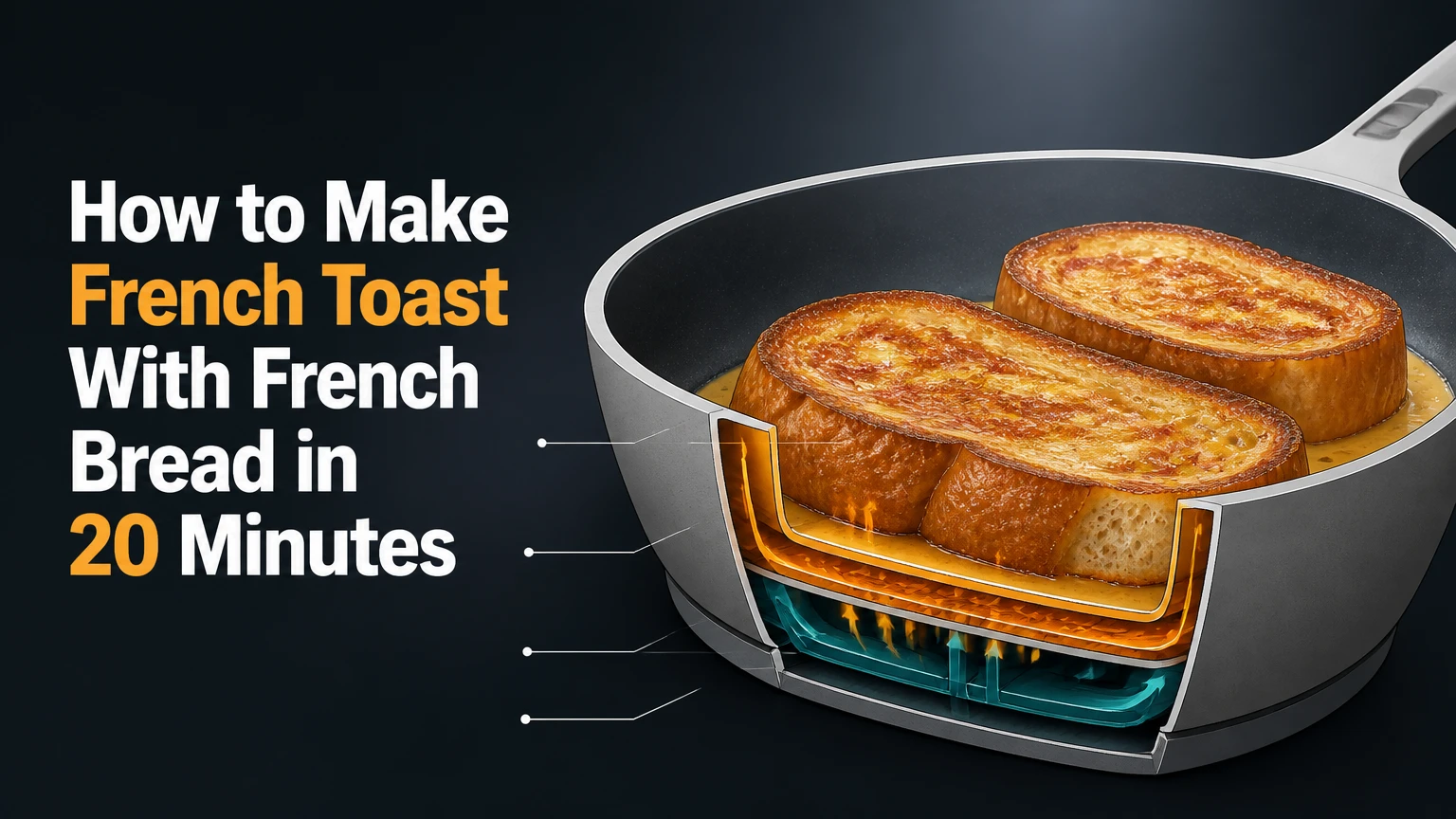
To make French toast with French bread, slice slightly stale baguette or boule into 1-inch pieces, soak each side in an egg-and-milk custard for 15-30 seconds, and cook in butter over medium-low heat for 3-4 minutes per side. The result should have a browned crust, a set custardy center, and a chewy edge without collapsing.
Key Facts at a Glance
Use French bread slices 0.75-1 inch thick, or approximately 2-2.5 cm.
The dependable custard ratio is 1 large egg for every 60 ml, or 1/4 cup, of milk.
Slightly stale bread absorbs custard more evenly than fresh, soft bread.
Soak baguette for about 15-20 seconds per side and thicker boule for 20-30 seconds per side.
Cook over medium-low heat, approximately 350°F or 175°C, for 3-4 minutes per side.
A four-serving batch typically takes 15-20 minutes and uses 2-3 tablespoons of butter.
Before You Start
French toast with French bread requires a dry, porous loaf, a shallow soaking dish, and a pan that can hold steady medium-low heat. The most important success factor is bread moisture: a stale or deliberately dried slice absorbs custard while retaining enough structure to flip cleanly.
Ingredients for Four Servings
| Ingredient | Quantity | Practical specification |
|---|---|---|
| French bread | 1 loaf, 8-12 slices | Baguette or boule, sliced 0.75-1 inch thick |
| Large eggs | 4 | About 1 egg per 1/4 cup milk |
| Whole milk | 1 cup, 240 ml | Half-and-half works for a richer center |
| Sugar | 2 tablespoons | Granulated for clean sweetness, brown for caramel notes |
| Vanilla extract | 1 teaspoon | Pure or imitation vanilla |
| Ground cinnamon | 1 teaspoon | Whisk immediately before dipping |
| Fine salt | 1/8 teaspoon | Balances sweetness and egg flavor |
| Unsalted butter | 2-3 tablespoons | Add more between batches if the pan dries |
Equipment and Setup
Use a wide, shallow bowl or baking dish so the bread lies flat rather than stacking. A nonstick skillet gives the easiest release, while cast iron retains heat well but requires closer temperature control because its surface can become too hot between batches.
You also need a whisk, flat spatula, baking sheet, and wire rack. The rack keeps cooked slices above steam, which preserves the crust more effectively than stacking them on a plate.
| Preparation factor | Recommended value | Why it matters |
|---|---|---|
| Preparation time | 5-8 minutes | Slicing and mixing custard |
| Cooking time | 10-15 minutes | Two or more skillet batches |
| Total time | 15-20 minutes | Four-serving batch |
| Skill level | Beginner | Requires heat and timing control |
| Typical ingredient cost | $3-$8 | Varies by bread, dairy, and toppings |
| Yield | 4 servings | Approximately 2 slices per person |
Which French Bread Works Best?
A day-old baguette provides the crispest crust and a light, airy center, while a day-old boule gives thicker, softer slices with more custard capacity. French bread should be firm enough to lift after soaking; very fresh bread is the least reliable choice because its interior already contains substantial moisture.
| Bread type | Slice shape | Typical soak | Result |
|---|---|---|---|
| Baguette | Diagonal 1-inch pieces | 15-20 seconds per side | Crisp edge, airy center |
| Boulé or round loaf | 1-inch slabs | 20-30 seconds per side | Soft, custardy interior |
| Dense country French loaf | Straight 0.75-inch slices | 25-35 seconds per side | Chewy and substantial |
| Fresh supermarket French loaf | 1-inch slices | 10-15 seconds per side | Higher risk of collapse |
| Frozen then thawed loaf | 1-inch slices | 20-30 seconds per side | Works if dried before soaking |
Fresh bread can still work. Arrange slices on a baking sheet and dry them at 300°F, or 150°C, for 8-10 minutes, then cool them completely before adding custard. Warm slices absorb liquid too rapidly at the surface and can produce an uneven, wet middle.
Step 1: Dry and Slice the Bread
Cut French bread into 0.75-1-inch slices, then dry fresh slices at 300°F for 8-10 minutes if necessary. Diagonal baguette slices create more surface area and cook quickly, whereas straight-cut boule slices provide a thicker center that needs a longer soak and gentler cooking.
Slice Thickness Guide
| Slice thickness | Best bread | Soak time per side | Main risk |
|---|---|---|---|
| 0.5 inch | Dense baguette | 10-15 seconds | Dry center |
| 0.75 inch | Baguette | 15-20 seconds | Balanced result |
| 1 inch | Baguette or boule | 20-30 seconds | Requires steady heat |
| 1.25 inches | Thick boule | 30-45 seconds | Raw center if pan is hot |
| 1.5 inches | Stuffed or casserole slice | 45-60 seconds | Difficult skillet cooking |
You will know the bread is ready when the surface feels dry and the slice remains rigid when lifted. A properly dried slice should not crack, crumble, or feel damp inside.
Common mistake: Drying bread until it becomes hard throughout. Excessively dry bread needs more soaking but can remain tough in the center. Day-old bread is usually preferable to bread that has been baked until brittle.
Step 2: Make the Custard
Whisk 4 eggs until the yolks and whites are fully blended, then add 1 cup of whole milk, 2 tablespoons of sugar, 1 teaspoon of vanilla, 1 teaspoon of cinnamon, and a pinch of salt. A smooth custard distributes egg protein, milk, sugar, and seasoning evenly across every slice.
The standard ratio is 1 large egg per 1/4 cup of milk. Whole milk supplies a balanced texture, while half-and-half increases richness but browns faster because the mixture contains more milk fat and solids.
Why the Custard Ratio Matters
Egg proteins set during cooking and create the tender interior. Too many eggs produce a firm, egg-forward texture, while too much milk produces a weak custard that leaves the bread wet.
Cinnamon does not dissolve in milk. Whisk the mixture again before dipping each batch, or combine cinnamon with the sugar first to reduce floating clumps.
You will know the custard is ready when no visible streaks of egg white remain and the sugar has dispersed. The mixture should pour like thin cream, not resemble a thick batter.
Common mistake: Adding cinnamon directly to still milk and assuming it will stay suspended. Stir before each dipping cycle, particularly after the custard sits for several minutes.
Step 3: Soak Without Sogging
Place two or three slices in the shallow dish and soak them for 15-30 seconds per side, depending on thickness and dryness. Turn the slices once, press gently for better contact, and remove them when the bread feels heavier but still holds its shape.
Baguette slices usually need 15-20 seconds per side. One-inch boule slices often need 20-30 seconds, while dense or very dry bread may need an additional 10 seconds. Do not soak the entire loaf at once because the first slices will continue absorbing liquid while later slices wait.
You will know the soak is sufficient when the outer crumb looks saturated and the slice bends slightly without tearing. The crust may remain firm; that is desirable because it helps the slice survive transfer and flipping.
Common mistake: Leaving bread submerged for several minutes. Long soaking is suitable for an overnight casserole, not for standard skillet French toast. Individual slices can become fragile before the pan is ready.
Step 4: Heat the Pan Correctly
Preheat a skillet over medium-low heat, then melt 1 tablespoon of unsalted butter until it foams without smoking. The cooking surface should be approximately 350°F, or 175°C, because moderate heat allows the egg custard to set before the sugars and milk solids burn.
Add soaked bread only after the butter has spread across the pan. Leave space around each slice so steam can escape and the crust can brown instead of steaming.
Pan and Heat Comparison
| Cooking surface | Preheat setting | Batch capacity | Best use |
|---|---|---|---|
| 10-inch nonstick skillet | Medium-low, 350°F | 2-3 slices | Easiest first batch |
| 12-inch cast-iron skillet | Low-medium, 325-350°F | 3-4 slices | Strong browning |
| Electric griddle | 350°F | 6-8 slices | Family breakfast |
| Sheet pan and oven | 375°F | 8-12 slices | Crowd cooking |
| Induction skillet | Power level 4-5 of 10 | 2-4 slices | Precise heat adjustment |
You will know the pan is ready when butter foams for several seconds and the first slice sizzles quietly on contact. Loud sputtering indicates excess moisture or excessive heat; no sound at all indicates that the surface may be too cool.
Common mistake: Starting on high heat to accelerate browning. The exterior can burn before the custard reaches a food-safe, set texture. Lower the heat immediately if the butter browns in under 30 seconds.
Step 5: Cook Until the Center Sets
Place soaked slices in the buttered pan and cook undisturbed for 3-4 minutes on the first side, then flip and cook for another 3 minutes. The finished French toast should be deep golden brown outside and springy in the center, with no visible liquid custard at the cut edge.
Cooking time varies with thickness, pan material, and starting temperature. A 0.75-inch baguette slice may finish in 3 minutes per side, while a 1-inch boule slice may need 4 minutes per side over slightly lower heat.
FoodSafety.gov advises, “Cook eggs until both the yolk and white are firm.” For French toast with a thick custardy center, an instant-read thermometer should register approximately 160°F, or 71°C, at the center, consistent with the USDA safe minimum for egg dishes.
You will know it is done when the center springs back lightly under a fingertip and the underside is evenly browned. A wet, squishy middle needs additional low-temperature cooking.
Common mistake: Pressing the bread repeatedly with a spatula. Pressure drives custard out of the crumb and makes the interior denser. Flip once unless the slice needs a brief final adjustment.
Transfer cooked slices to a wire rack over a baking sheet. Keep them in a 200°F, or 90°C, oven while finishing the batch, but avoid holding them there for more than 20-30 minutes because prolonged heat dries the center.
Why Does French Bread Make Good French Toast?
French bread works well because its dry, porous crumb absorbs custard while its crust supplies structural support during flipping. Three kitchen mechanisms control the result: capillary action draws liquid into air pockets, egg proteins coagulate as they heat, and surface browning develops through Maillard reactions and sugar caramelization.
Stale bread contains less free water than fresh bread, leaving room for milk and egg to enter the crumb. Heat then transforms the absorbed liquid into a soft, set interior, while the exposed surface dries and browns in butter.
The chemistry has a practical limit. Browning cannot rescue bread that is saturated through the center, and a high pan temperature can brown the surface before the egg proteins set internally. Moderate heat is therefore a texture-control tool, not merely a way to prevent burning.
Which Cooking Method Should You Use?
Use a skillet for the best browned crust, an oven casserole for hands-off service, and a griddle when cooking more than six slices. The skillet method remains the best default for two to four servings because it offers direct control over browning and soak depth.
| Method | Temperature | Time | Capacity | Texture trade-off |
|---|---|---|---|---|
| Skillet | 350°F | 6-8 minutes per batch | 2-4 slices | Crispest buttered crust |
| Electric griddle | 350°F | 6-8 minutes | 6-8 slices | Consistent, less pan crowding |
| Oven casserole | 350°F | 35-45 minutes | 8-12 slices | Soft top, limited seared crust |
| Sheet-pan bake | 375°F | 18-25 minutes | 8-12 slices | More surface browning than casserole |
| Stuffed thick slices | 325-350°F | 8-12 minutes | 2-3 slices | Rich center, higher burning risk |
For a casserole, arrange bread in a greased baking dish, pour custard over it, refrigerate for 4-12 hours, and bake at 350°F for 35-45 minutes. The overnight method suits entertaining, but it does not reproduce the crisp edge of individually pan-fried slices.
Common Mistakes and How to Fix Them
Why is the outside burnt but the inside raw?
The pan is too hot or the slices are too thick. Reduce the heat to low, transfer the browned slices to a 350°F oven for 5-7 minutes, and check the center with an instant-read thermometer.
Why is the French toast soggy?
Fresh bread, excessive soaking, crowded cookware, or too much milk can create a wet slice. Use dried bread, follow the 1 egg to 1/4 cup milk ratio, drain excess custard briefly, and leave space between slices.
Why does it taste like fried eggs?
An egg-heavy custard or poorly blended whites creates an omelet-like flavor. Use 4 eggs with 1 cup of milk, add vanilla and sugar, and whisk until the mixture has a uniform pale-yellow color.
Why is the center dry?
The bread may be too dense, the slices too thin, or the pan temperature too low for the chosen soak time. Use thicker slices, add 10-15 seconds per side to the soak, or switch from dense country bread to a lighter baguette.
Why is one side darker than the other?
Butter solids collect unevenly, or the pan temperature changes between batches. Wipe out burnt butter, add 1-2 teaspoons of fresh butter, and adjust the burner before adding the next slices.
Why does the custard form cinnamon patches?
Ground cinnamon floats and adheres unevenly. Whisk the custard immediately before each batch, or mix cinnamon with sugar before adding the milk.
Variations for Different Situations
For one or two servings
Use 2 eggs, 1/2 cup milk, 1 tablespoon sugar, 1/2 teaspoon vanilla, 1/2 teaspoon cinnamon, and a pinch of salt. This produces four slices, which is enough for two moderate servings or one large serving.
For a dairy-free version
Replace whole milk with unsweetened oat milk, soy milk, or almond milk at a 1:1 volume ratio. Soy milk gives the most body, oat milk browns readily, and almond milk produces a lighter custard.
For a richer weekend version
Replace half the milk with half-and-half, use brown sugar, and add 1/8 teaspoon of nutmeg or 1 teaspoon of orange zest. Richer custard browns faster, so reduce the pan slightly below medium-low if the surface colors before 3 minutes.
For a stuffed version
Use 1.5-inch boule slices, cut a pocket through the side, and add 1-2 tablespoons of cream cheese, fruit preserves, or chocolate-hazelnut spread. Seal the opening as much as possible, soak for 30-45 seconds per side, and cook at low heat for 4-5 minutes per side.
Stuffed French toast is not ideal for rushed weekday cooking. The filling increases thickness and makes the center slower to heat, so surface color must not determine doneness.
How Much Time and Money Does It Take?
A four-serving skillet batch typically takes 15-20 minutes and costs approximately $3-$8 in United States grocery prices, excluding optional toppings. Bread, eggs, and milk determine most of the cost; vanilla, berries, and pure maple syrup can substantially increase the total.
| Batch size | Bread | Eggs and milk | Typical total time | Typical ingredient cost |
|---|---|---|---|---|
| 1 serving | 2 slices | 1 egg, 1/4 cup milk | 10-12 minutes | $1.00-$2.50 |
| 2 servings | 4 slices | 2 eggs, 1/2 cup milk | 12-16 minutes | $2.00-$4.00 |
| 4 servings | 8 slices | 4 eggs, 1 cup milk | 15-20 minutes | $3.00-$8.00 |
| 8 servings | 16 slices | 8 eggs, 2 cups milk | 25-35 minutes | $6.00-$15.00 |
Food prices vary substantially by country and store. In Bangladesh, a comparable family batch may cost roughly Tk. 350-Tk. 600 when prepared with standard bread, eggs, milk, sugar, and butter, while premium dairy and imported vanilla increase the total.
Make-Ahead, Storage, and Reheating
Cooked French toast keeps in the refrigerator for up to 3 days when cooled quickly and stored in a sealed container. Separate slices with parchment so condensation does not transfer moisture from one piece to another.
Reheat slices in a 375°F oven or toaster oven for 5-8 minutes, turning once. An air fryer at 350°F for 3-5 minutes restores the crust more effectively than a microwave, which softens the bread through steam.
For freezing, cool slices completely, freeze them in a single layer, then transfer them to a freezer bag for up to 2 months. Reheat from frozen at 375°F for 10-15 minutes. Do not leave egg-soaked bread at room temperature for more than 2 hours, or 1 hour when the surrounding temperature exceeds 90°F.
Serving and Topping Balance
Serve French toast immediately with toppings that add contrast rather than saturating the crust. Pure maple syrup, powdered sugar, berries, toasted nuts, yogurt, and lightly salted butter each contribute a distinct texture or flavor.
Add syrup at the table instead of pouring it over the entire batch in advance. A wet topping can soften the browned surface within minutes, especially when slices are held on a plate rather than a wire rack.
FAQ
Can I use a baguette that is only one day old?
Yes, provided the baguette feels dry on the outside and firm in the crumb. If the interior still feels soft and moist, dry 1-inch slices at 300°F for 8-10 minutes, cool them, and use the normal 15-20-second soak per side.
Can I use low-fat or skim milk?
Yes, but the custard will be lighter and less creamy. Whole milk is the most balanced option, while half-and-half produces a richer center. If using skim milk, keep the 1 egg to 1/4 cup milk ratio and avoid extending the soak unnecessarily.
Can I make French toast without eggs?
For an egg-free version, whisk 1 cup of unsweetened soy milk with 2 tablespoons of cornstarch, 1 tablespoon of sugar, vanilla, cinnamon, and salt. Dip briefly and cook over medium heat. The result will brown less and set more softly than an egg custard.
Should I use butter or oil?
Butter provides the best flavor and browning, but its milk solids can burn during repeated batches. For steadier high-volume cooking, use 1 teaspoon of neutral oil with 1 teaspoon of butter, or wipe the pan and refresh the butter between batches.
Can I soak French bread overnight?
Overnight soaking works best when the bread is arranged in a casserole and baked as a unified dish. Individual baguette slices can become too fragile after many hours, so skillet French toast should usually be soaked immediately before cooking.
What should French toast with French bread taste like?
The finished slice should taste lightly sweet, aromatic with vanilla and cinnamon, and distinctly buttery, with a crisp browned exterior and a moist but set center. A strong fried-egg flavor indicates too much egg, while a cold liquid center indicates insufficient cooking.
The Bottom Line
The most reliable way to make French toast with French bread is to use day-old 0.75-1-inch slices, whisk a custard at a ratio of 1 egg to 1/4 cup milk, soak each side for 15-30 seconds, and cook at approximately 350°F for 3-4 minutes per side. Moderate heat, controlled soaking, and a wire rack produce the crisp crust and set center that French bread handles particularly well.