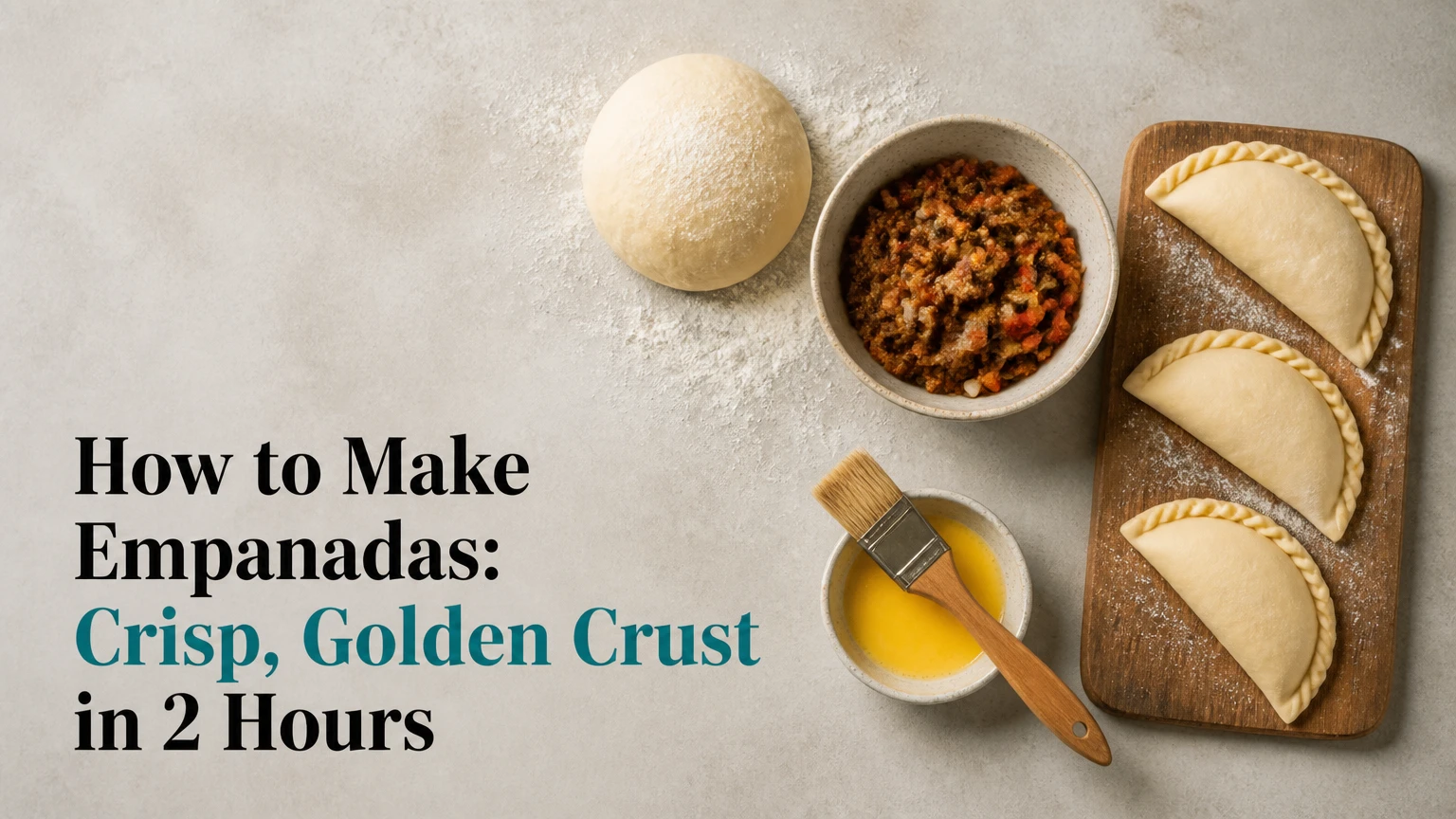
Empanadas are filled pastry turnovers made by enclosing a seasoned filling in dough, sealing the edges, and baking or frying the packets until crisp. To make reliable homemade empanadas, prepare a tender dough, cook and completely chill a fairly dry filling, portion it carefully, seal out trapped air, and cook at the correct temperature.
Key Facts at a Glance
- A typical homemade batch yields 12 empanadas from 3 cups of flour and 12 five-inch dough rounds.
- Empanada dough rolls most reliably at approximately 1/8 inch, or 3 millimeters, thick.
- Two level tablespoons of chilled filling suit one five-inch dough disc.
- Baked empanadas need approximately 20-25 minutes at 400°F (204°C).
- Fried empanadas need oil held between 350°F and 375°F (177°C and 190°C).
- Raw assembled empanadas keep in the refrigerator for up to 24 hours and freeze well for about 3 months.
What Are Empanadas?
Empanadas are enclosed pastries whose name comes from the Spanish verb empanar, meaning to wrap or coat in bread. The dough forms a sealed cooking chamber: heat crisps the exterior while steam warms the filling and carries its aroma into the pastry.
The word covers many distinct foods rather than one standardized recipe. A five-inch Argentine beef turnover, a fried Colombian cornmeal pocket, and a large Galician tuna pie all belong to the empanada family, but their doughs, fillings, and cooking methods differ substantially.
The most useful home distinction is dough type. Wheat pastry produces a flexible, flaky shell suited to beef, chicken, cheese, and fruit. Precooked cornmeal dough produces a sturdier gluten-free shell, especially common in Colombia and Venezuela.
What Do You Need Before You Start?
A standard batch takes about 1 hour 45 minutes to 2 hours 30 minutes, including dough rest and filling chill time. The active work is closer to 60-75 minutes, while the filling and dough can cool or rest without attention.
| Requirement | Typical amount or setting | Practical purpose |
|---|---|---|
| Yield | 12 empanadas | Five-inch rounds, 2 tablespoons filling each |
| Active preparation | 60-75 minutes | Mixing, cooking, rolling, and sealing |
| Dough rest | 30-60 minutes | Relaxes gluten and prevents shrinkage |
| Filling chill | 30-45 minutes | Protects pastry fat and improves sealing |
| Equipment | 2 baking sheets, skillet, rolling pin | Supports batch preparation |
| Optional tools | 5-inch cutter, thermometer, pastry brush | Improves uniformity and temperature control |
| Typical home cost | $0.75-$1.75 each | Depends on meat, cheese, and purchased wrappers |
Use a digital scale if available, especially for flour. A cup of flour can vary by more than 20 grams depending on how it is packed, and that difference can make pastry either dry or sticky.
Step 1: Make the Wheat Empanada Dough
Make the dough with 3 cups all-purpose flour, 1 teaspoon salt, 6 tablespoons chilled unsalted butter or lard, 1 large egg, and 1/2 to 2/3 cup ice water. Cut the cold fat into the flour until coarse crumbs form, then add the egg beaten with 1/2 cup water and add more water only as needed.
Dough ingredients and functions
| Ingredient | Quantity | Function |
|---|---|---|
| All-purpose flour | 3 cups, about 360 g | Forms the pastry structure |
| Fine salt | 1 teaspoon | Seasons dough and limits blandness |
| Unsalted butter or lard | 6 tablespoons, about 85 g | Adds tenderness and flakiness |
| Large egg | 1 | Adds richness and binding |
| Ice water | 1/2-2/3 cup, 120-160 ml | Hydrates flour without warming fat |
Whisk the flour and salt in a bowl. Rub or cut in the chilled fat until the largest pieces are about pea-sized. Small visible fat pieces are useful because they create tender layers; a completely smooth paste produces a more cookie-like crust.
Beat the egg with 1/2 cup ice water and stir it into the flour using a fork. Stop when shaggy clumps form. Add water one tablespoon at a time if dry flour remains, because excess water encourages toughness and shrinkage.
Turn the dough onto a lightly floured surface and knead for only 1-2 minutes. Wrap it tightly and refrigerate for 30-60 minutes. You will know the dough is ready when it feels cohesive but still cool, and a pressed indentation returns slowly. The common mistake is pouring in all 2/3 cup water automatically.
Step 2: Cook a Dry, Seasoned Filling
Cook the filling before rolling the dough, then refrigerate it until completely cold. A practical beef filling uses 1 pound ground beef, 2 finely chopped onions, 2 minced garlic cloves, 1 tablespoon cumin, 1 tablespoon paprika, salt, pepper, and optional olives, raisins, potatoes, or chopped hard-boiled egg.
Heat 1 tablespoon oil or lard in a skillet over medium heat. Cook the onions for 8-10 minutes until soft and translucent, then add garlic and spices for 30-60 seconds. Add the beef, break it into small pieces, and cook until browned throughout.
Ground beef should reach 160°F (71°C). The United States Department of Agriculture Food Safety and Inspection Service states, “The only way to tell if food is safely cooked is to use a food thermometer.” Drain excess liquid, taste the filling, and spread it in a shallow container so it cools faster.
Refrigerate the filling for at least 30 minutes, or until it is cold to the touch. Warm filling melts butter or lard in the pastry, which causes greasy seams, weak bottoms, and leakage. Filling should be moist enough to eat comfortably but dry enough that no liquid pools when a spoonful rests for 10 seconds.
Step 3: Roll and Cut the Discos
Roll the chilled dough to approximately 1/8 inch, or 3 millimeters, thick, then cut 12 rounds measuring 4-5 inches across. Keep unused dough covered while working, because exposed pastry develops a dry surface that will not seal cleanly.
Divide the dough into two pieces before rolling. Roll from the center outward and rotate the dough frequently, using minimal flour. Too much bench flour prevents the edges from adhering; brush away excess flour before filling.
Gather scraps only once if possible. Repeated rerolling develops gluten and makes the final rounds spring back. If the dough resists or contracts, refrigerate it for 10 minutes rather than forcing it thinner.
The correct disc should bend without cracking and should not look translucent. A five-inch round usually accepts about 2 tablespoons of filling, while a four-inch round takes closer to 1 tablespoon.
Step 4: Fill and Seal Each Empanada
Place 2 level tablespoons of cold filling in the center of each dough round, leaving at least a 1/2-inch border. Fold the disc into a half-moon, press out visible air, and seal the edge firmly before crimping with a fork or making a repulgue.
Moisten the rim with a fingertip dipped in water only if the dough feels dry. Too much water makes the edge slippery rather than adhesive. Press from the filling outward, pushing air toward the open side instead of trapping a bubble above the filling.
A fork crimp is the most dependable beginner method. Press the tines 1/4 inch into the border without cutting through the dough. For a traditional repulgue, pinch a corner, fold it inward, and repeat around the curve at roughly 1/2-inch intervals.
Set finished empanadas on parchment and refrigerate them for 15-20 minutes before cooking. That short chill firms the fat and strengthens the seam. The main mistake is overfilling, which gives steam and expansion no room inside the pocket.
Step 5: Bake the Empanadas
Bake empanadas at 400°F (204°C) for 20-25 minutes after brushing them with egg wash. Arrange them 1 inch apart on a parchment-lined sheet, brush with one beaten egg mixed with 1 tablespoon water, and rotate the sheet if the oven browns unevenly.
Poke one small vent in the top of each pastry with a toothpick if the filling is particularly moist. The opening releases expanding steam, although a well-drained filling and a firm seal remain more important than venting.
Baked empanadas are ready when the bottoms feel firm and the top is evenly golden. Cool them for 5-10 minutes before serving, because the filling remains substantially hotter than the crust after removal from the oven.
Baking is the better method for large batches, delicate decorative edges, and reheated leftovers. The trade-off is a drier exterior than frying, especially when the dough contains too little fat or the oven runs hot.
Step 6: Fry the Empanadas
Fry empanadas in neutral oil at 350°F-375°F (177°C-190°C) for about 2-3 minutes per side. Use enough oil to submerge the turnovers, lower them carefully with tongs, and cook only a few at a time so the temperature does not collapse.
A thermometer matters because cool oil creates greasy pastry while overheated oil darkens the shell before the filling is hot. Let the oil return to approximately 365°F between batches, then drain fried empanadas on a rack rather than stacking them on paper towels.
Fried empanadas have the crispest, most blistered shell and cook faster than baked ones. They are less convenient for meal preparation because the crust softens as it cools and the method requires active hot-oil handling.
Never add wet or icy empanadas to oil. Moisture can cause dangerous splattering. Keep a lid nearby for an oil flare-up, turn off the heat, and never pour water onto burning oil.
Which Cooking Method Should You Choose?
Baking suits batch cooking and reheating, frying produces the crispest immediate result, and air frying offers a smaller oil load with a somewhat drier shell. The best choice depends on whether the priority is texture, quantity, convenience, or storage.
| Method | Temperature | Cooking time | Best use |
|---|---|---|---|
| Conventional oven | 400°F (204°C) | 20-25 minutes | 12-24 empanada batches |
| Deep frying | 350°F-375°F (177°C-190°C) | 2-3 minutes per side | Maximum crispness |
| Air fryer, fresh | 360°F (182°C) | 10-15 minutes | Small batches with less oil |
| Air fryer, frozen | 360°F (182°C) | 12-18 minutes | Weeknight meal preparation |
| Convection oven | 375°F (191°C) | 18-22 minutes | Faster, more even browning |
Brush air-fried empanadas lightly with oil and leave space between them. Air fryers vary by basket size and heating pattern, so begin checking at 10 minutes. Air frying is not equivalent to deep frying: the surface browns well, but the shell usually lacks the same bubbles and richness.
Which Empanada Style Fits Your Filling?
Wheat pastry works with Argentine, Chilean, Caribbean, and Spanish-inspired fillings, while precooked cornmeal creates the gluten-free structure associated with Colombian and Venezuelan fried empanadas. Regional identity comes from the combination of dough, filling, shape, and cooking method.
| Style | Dough | Typical filling | Cooking format |
|---|---|---|---|
| Argentine | Wheat flour with butter, lard, or beef fat | Beef, onion, olive, egg, raisin | Baked or fried, 4-5 inches |
| Chilean | Wheat flour with shortening and sometimes milk | Pino, olive, egg, raisin | Large baked turnover |
| Colombian | Precooked yellow cornmeal | Beef or chicken, potato, hogao | Deep fried, 4-5 inches |
| Venezuelan | Precooked cornmeal | Beef, chicken, cheese, black beans | Deep fried, 4-6 inches |
| Puerto Rican | Wheat flour with achiote | Picadillo, olives, capers, sofrito | Deep fried |
| Galician | Yeasted wheat dough | Tuna or cod, onion, pepper, saffron | Large baked pie |
For a vegetarian batch, replace beef with 2 cups cooked lentils, 1 cup diced mushrooms, or 2 cups roasted squash. Reduce excess water before filling, then add cheese only after the mixture has cooled.
For sweet empanadas, use the same wheat pastry with apple-cinnamon, guava and cream cheese, dulce de leche, or pumpkin filling. Sweet fillings must be thick and cool; runny jam is a frequent cause of burst seams.
For gluten-free Colombian-style empanadas, combine precooked corn flour with warm water and salt according to the package, rest the dough for 10 minutes, and press rounds between plastic sheets. Wheat dough techniques do not transfer directly because cornmeal has no gluten network.
How Should You Store and Reheat Empanadas?
Refrigerate raw assembled empanadas for up to 24 hours, or freeze them in a single layer before transferring them to a sealed bag for approximately 3 months. Bake frozen wheat empanadas at 375°F (191°C) for about 30 minutes, adding time if the centers remain cold.
| Storage state | Container or method | Typical limit | Reheating or cooking |
|---|---|---|---|
| Raw refrigerated | Covered tray | 24 hours | Bake or fry from cold |
| Raw frozen | Tray-freeze, then freezer bag | 3 months | Bake at 375°F for about 30 minutes |
| Cooked refrigerated | Airtight container | 3-4 days | Oven at Oven 375°F for 8-12 minutes |
| Cooked frozen | Wrapped individually | 1-2 months | Oven at 375°F for 18-25 minutes |
| Room temperature | Covered serving tray | 2 hours | Refrigerate or discard |
For the best reheated crust, use a 375°F oven or toaster oven rather than a microwave. Microwave heating softens the pastry because steam condenses inside the shell, although 30-60 seconds in the microwave followed by 3-5 minutes in a hot oven can warm a cold center efficiently.
The USDA advises refrigerating perishable foods within two hours, or within one hour when ambient temperatures exceed 90°F (32°C). Cool cooked empanadas in a single layer before covering them so condensation does not saturate the bottoms.
Why Do Empanadas Burst or Turn Soggy?
Empanadas burst when filling moisture, trapped air, weak seams, or excessive portion size overwhelms the pastry. Soggy bottoms usually result from hot filling, underbaking, condensation, or a baking sheet that prevents the base from crisping.
| Problem | Likely cause | Specific fix |
|---|---|---|
| Seam opens | Overfilling or floury rim | Use 2 tablespoons, brush off flour, press firmly |
| Shell bursts | Wet filling or trapped air | Drain filling, press air out, add a tiny vent |
| Tough dough | Overmixing or excess water | Knead 1-2 minutes, rest 30-60 minutes |
| Dough shrinks | Warm or under-rested gluten | Chill 10 minutes, roll gently |
| Soggy bottom | Hot filling or condensation | Chill filling, use parchment, cool uncovered |
| Burned exterior | Oil or oven too hot | Fry near 365°F, verify oven temperature |
| Greasy fried shell | Oil below 350°F | Fry smaller batches and restore heat |
A practitioner rule is to judge filling moisture with a spoon, not by appearance in the skillet. If liquid gathers around the spoon within several seconds, continue cooking or drain it before assembly.
Another useful rule is to seal the pastry twice. First press the edge with your fingers, then crimp it with a fork or repulgue. Crimping alone can decorate a seam without compressing its inner layers.
If a raw empanada develops a tear, patch it with a small piece of dough moistened at the edges. Do not stretch the tear closed, because thin stressed dough usually splits again in the oven.
Can You Use Store-Bought Wrappers?
Store-bought frozen empanada discs are the fastest dependable option for beginners and large batches. Thaw them according to package directions, keep them covered, and use approximately 1-2 tablespoons of filling per disc.
Purchased wrappers are useful when uniform sizing matters or when the filling requires most of the preparation time. They are less customizable than homemade dough, and some brands are designed specifically for frying rather than baking, so follow the package method when it conflicts with a general temperature.
Do not thaw wrappers directly on a hot counter for hours. Separate them while pliable, fill them promptly, and return unused discs to the refrigerator. A wrapper that becomes warm and sticky is harder to seal and more likely to tear.
How Much Do Homemade Empanadas Cost?
A typical homemade batch costs approximately $10-$21 for 12 wheat empanadas, or about $0.85-$1.75 each, depending mainly on meat, cheese, and purchased wrappers. Lentil, potato, and cabbage fillings reduce the cost, while hand-cut beef and specialty cheese increase it.
| Filling and dough choice | Batch cost, typical | Yield | Approximate cost each |
|---|---|---|---|
| Ground beef, homemade dough | $14-$21 | 12 | $1.17-$1.75 |
| Lentil and potato, homemade dough | $9-$13 | 12 | $0.75-$1.08 |
| Chicken and cheese, homemade dough | $13-$19 | 12 | $1.08-$1.58 |
| Purchased wrappers, beef filling | $16-$24 | 12 | $1.33-$2.00 |
| Cornmeal potato filling | $8-$14 | 12 | $0.67-$1.17 |
Prices vary by location and package size, so these are typical household ranges rather than fixed retail figures. The largest savings come from preparing dough and filling in batches, not from reducing the filling portion below what the wrapper can support.
FAQ
Can I Make Empanadas the Day Before?
Yes. Assemble raw empanadas, place them on a parchment-lined tray, cover them, and refrigerate them for up to 24 hours. Brush with egg wash immediately before baking. For longer storage, freeze the unbaked pastries flat first, then transfer them to a freezer bag.
How Do I Stop Filling From Leaking?
Use completely chilled filling, leave a 1/2-inch border, remove trapped air, and press the seam firmly before crimping. Filling that contains visible liquid should be cooked longer or drained. Two level tablespoons is a safer starting portion than a rounded spoonful.
Are Empanadas Better Baked or Fried?
Fried empanadas have the crispest shell and fastest cooking time, while baked empanadas suit larger batches, lower oil use, and reheating. Choose baking for meal preparation and frying for immediate serving. Air frying offers a middle ground but produces less blistering than deep frying.
Can I Make Empanadas Without Eggs?
Yes. Replace the egg in the dough with 2 tablespoons additional ice water, adding it gradually, and seal the edges with water. For browning, brush the surface with milk, cream, or oil. Egg-free pastry may brown less deeply but can remain tender when handled lightly.
Why Is My Empanada Dough Cracking?
Cracking usually means the dough is too dry, too cold, or overworked. Let it sit at room temperature for 5-10 minutes, then press small cracks together with damp fingers. If the entire batch cracks, knead in water one teaspoon at a time rather than flooding the dough.
How Many Empanadas Does One Batch Make?
The listed dough formula makes approximately 12 five-inch empanadas or 16 smaller four-inch turnovers. The final yield depends on rolling thickness and scrap loss. Portion filling by volume or weight so every pastry cooks at the same rate.
The Bottom Line
To make empanadas successfully, prepare a lightly worked dough, cook a well-seasoned filling until its excess moisture is gone, chill both components, and use no more than 2 tablespoons of filling per five-inch disc. Bake at 400°F for 20-25 minutes or fry near 365°F until golden. Homemade empanadas reward careful temperature and moisture control more than complicated shaping.