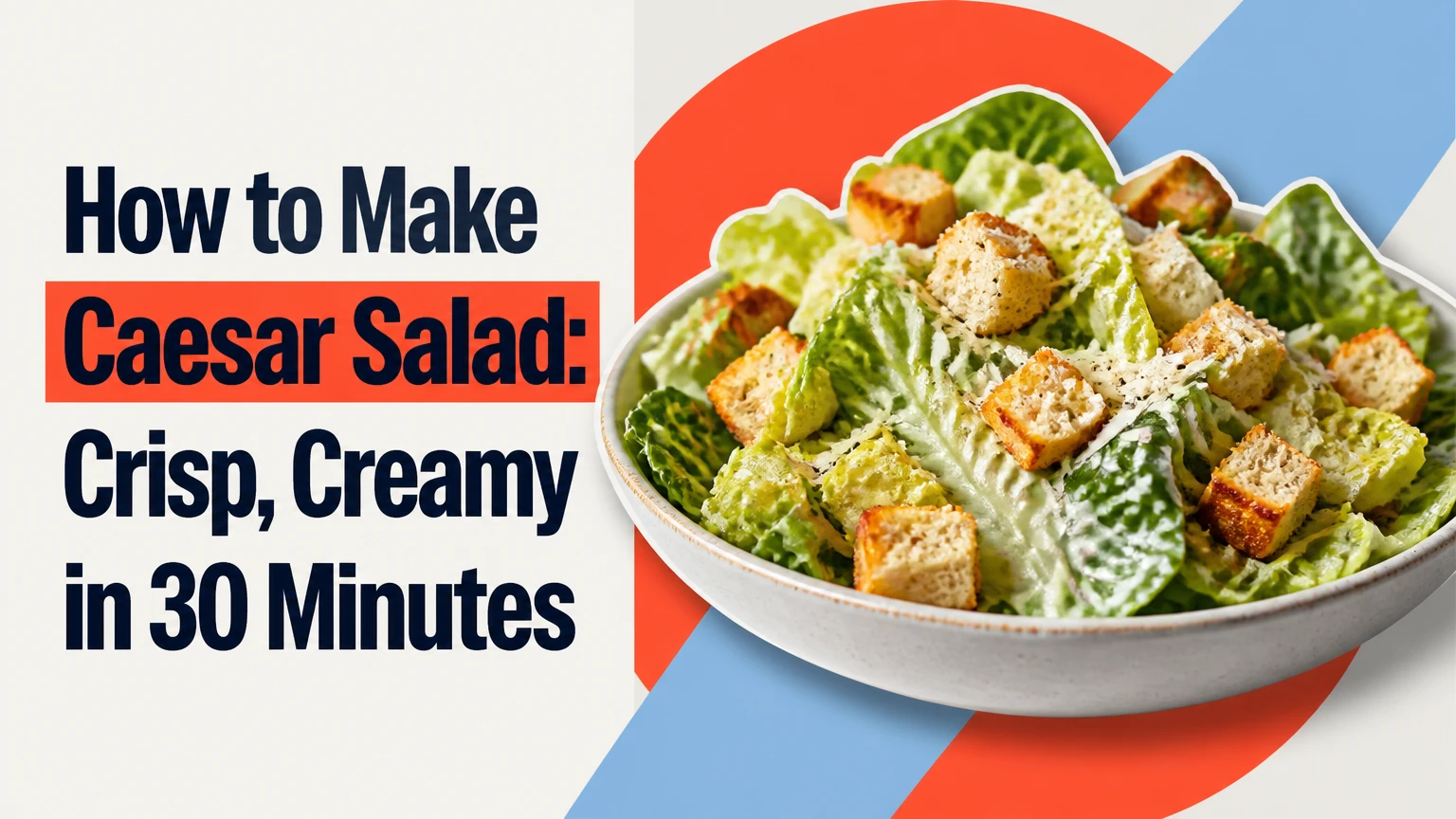
To make Caesar salad, toss chilled, thoroughly dried romaine with a garlic, anchovy, lemon, Parmesan, and egg-based dressing, then add crisp croutons immediately before serving. The complete recipe takes about 30 minutes, makes four main-course or six side servings, and succeeds or fails mainly on dry lettuce, gradual oil incorporation, and restrained salting.
Key Facts at a Glance
A standard Caesar salad uses romaine lettuce, croutons, Parmesan, and a savory emulsion dressing.
Four side servings require about 2 large romaine hearts, 40-50 g croutons, and 180-220 g dressing.
Homemade preparation typically takes 25-35 minutes, including 10-12 minutes for oven-baked croutons.
Thoroughly dried lettuce keeps dressing on the leaves instead of diluting it at the bottom of the bowl.
Anchovies create savory depth without making the salad taste strongly fishy when blended into the dressing.
Refrigerate leftover dressing and undressed components separately; dressed romaine becomes soft within hours.
What Makes a Caesar Salad?
Caesar salad is a composed salad of crisp romaine, toasted bread, aged Parmesan, and a tangy savory dressing emulsified with egg yolk or mayonnaise. Garlic, lemon juice, anchovies or Worcestershire sauce, black pepper, and oil create its characteristic salty, acidic, creamy flavor.
The salad is commonly associated with Caesar Cardini, an Italian immigrant who operated restaurants in Tijuana, Mexico. Food historians generally place its creation in 1924, although the exact first recipe and the role of Cardini’s brother Alex remain debated. The earliest versions used whole romaine leaves, which diners picked up by hand, and did not necessarily include anchovies as separate fillets.
Modern restaurant Caesar salad usually differs from the early preparation in four ways: chopped romaine replaces whole leaves, anchovies are added directly, raw egg yolk or mayonnaise thickens the dressing, and croutons provide a more pronounced crunch. The result is a salad where every component has a defined job rather than a bowl of lettuce with a heavy sauce.
Why Does the Dressing Taste So Savory?
Parmesan and anchovies supply glutamates and other savory compounds, while lemon juice and Worcestershire sauce sharpen the flavor. Garlic contributes aroma, egg yolk binds water and oil, and olive or neutral oil provides body.
Anchovy fillets do not make a Caesar dressing taste overtly fishy when they are mashed into a paste and dispersed through the acid and fat. One or two fillets per serving batch creates depth; adding six large fillets to a small dressing can overwhelm the lettuce.
What Ingredients and Tools Do You Need?
The following quantities make four generous side servings or two large meal salads. Use romaine hearts with firm ribs and unblemished leaves, because loose spring greens lack the structural strength needed for a creamy dressing.
| Component | Quantity for 4 side servings | Practical specification |
|---|---|---|
| Romaine lettuce | 2 large hearts, 350-450 g whole | 250-300 g trimmed leaves |
| Day-old bread | 120-150 g | Sourdough, baguette, or rustic white bread |
| Anchovy fillets | 4 oil-packed fillets, 15-20 g | Substitute 2 tsp anchovy paste |
| Garlic | 1 small clove, 3-4 g | Grated or mashed into a paste |
| Egg yolk | 1 large, about 18 g | Use pasteurized egg for a lower-risk option |
| Lemon juice | 30 ml, 2 tbsp | Freshly squeezed |
| Dijon mustard | 5 ml, 1 tsp | Helps flavor and stabilize the emulsion |
| Neutral oil | 90 ml, 6 tbsp | Canola, grapeseed, or avocado oil |
| Extra-virgin olive oil | 30 ml, 2 tbsp | Use a mild, not aggressively bitter, oil |
| Parmesan | 45-55 g | Finely grated for dressing, shaved for topping |
| Black pepper | 1/2 tsp or to taste | Freshly ground |
| Fine salt | 1/8-1/4 tsp initially | Adjust only after tasting the anchovy and cheese |
You need a rimmed baking sheet, mixing bowl, whisk, chef’s knife, cutting board, microplane or fine grater, measuring spoons, and salad spinner. A food processor is optional, but hand whisking gives better control when making a small quantity.
How Much Time and Money Does Caesar Salad Take?
A typical homemade batch costs approximately $8-$16 for four side servings, or $2-$4 per serving, depending on Parmesan, anchovy, bread, and romaine prices. The range excludes reusable pantry staples such as oil, salt, and pepper when those are already available.
| Stage | Typical duration | Temperature or condition | Output checkpoint |
|---|---|---|---|
| Ingredient preparation | 8-10 minutes | Room temperature dressing ingredients | Garlic and anchovies finely mashed |
| Crouton baking | 10-12 minutes | 375°F or 190°C | Dry, golden centers and edges |
| Lettuce washing and drying | 5-8 minutes | Cold water, then refrigerator | No visible water on leaves |
| Dressing emulsification | 4-6 minutes | Gradual oil addition | Thick, glossy, spoon-coating dressing |
| Assembly | 2-3 minutes | Chilled greens, cool croutons | Leaves evenly coated, not pooled |
| Total elapsed time | 25-35 minutes | Serve immediately | Crisp salad with crunchy bread |
A restaurant Caesar commonly costs $12-$22 per serving in the United States because labor, rent, protein additions, and service contribute more than the raw ingredients. Homemade Caesar salad is therefore inexpensive, but premium Parmigiano-Reggiano can raise the batch cost by several dollars.
How to Make Caesar Salad, Step by Step
Follow four stages: bake the croutons, dry and chill the romaine, emulsify the dressing, and toss immediately before eating. Plan 25-35 minutes, keep the lettuce cold, and add oil slowly during the first part of whisking.
Before You Start
| Preparation factor | Recommendation |
|---|---|
| Servings | 4 side salads or 2 large salads |
| Active time | 15-20 minutes |
| Total time | 25-35 minutes |
| Difficulty | Moderate, mainly because of the emulsion |
| Oven setting | 375°F or 190°C |
| Equipment | Baking sheet, whisk, bowl, spinner, grater |
| Main prerequisite | Completely dry romaine and cool croutons |
| Typical cost | $8-$16 per batch |
Step 1: Bake Crisp Croutons
Heat the oven to 375°F or 190°C. Tear 120-150 g of day-old bread into irregular 2.5 cm pieces, because rough torn surfaces create more crevices for dressing than uniformly sliced cubes.
Toss the bread with 3 tbsp olive oil, 1/4 tsp salt, and 1 tbsp finely grated Parmesan. Spread the pieces in one layer on a rimmed baking sheet, leaving small gaps so steam can escape. Bake for 10-12 minutes, turning once after 6 minutes.
You will know the croutons are ready when the outside is deep golden and the center feels dry rather than bendable. Cool them completely for at least 10 minutes before assembly. Warm croutons soften lettuce and can make a properly emulsified dressing appear thinner.
Common mistake: Overcrowding the baking sheet steams the bread. Use two sheets if the pieces touch, or bake in a second batch.
Step 2: Wash, Cut, and Chill the Romaine
Separate the romaine leaves, rinse them under cold water, and spin them until no water collects in the spinner. Pat large ribs with a clean towel, then tear or cut the leaves into 4-6 cm pieces.
Refrigerate the dry lettuce for at least 15 minutes. Cold, firm leaves resist wilting and provide enough surface texture for the dressing to cling. The finished salad is best around 39-45°F, or 4-7°C, although a thermometer is unnecessary for ordinary home service.
You will know the lettuce is ready when a handful feels crisp and leaves leave no wet film on your fingers. Moisture is the enemy here. Water dilutes the dressing and encourages it to slide from the leaf surface.
Common mistake: Washing chopped lettuce in advance and storing it wet creates bruised edges and a watery bowl. Dry whole leaves first, then cut them.
Step 3: Emulsify the Caesar Dressing
Mash 4 anchovy fillets and 1 small garlic clove into a smooth paste. In a bowl, whisk 1 egg yolk, 2 tbsp lemon juice, and 1 tsp Dijon mustard for 30 seconds, then add the anchovy-garlic paste.
Drizzle in 90 ml neutral oil one teaspoon at a time while whisking constantly. After the mixture becomes visibly thick, add the remaining neutral oil and 30 ml mild extra-virgin olive oil in a thin stream. Whisk in 45-55 g finely grated Parmesan and 1/2 tsp black pepper. Taste before adding salt.
You will know the emulsion worked when the dressing looks glossy, coats a spoon, and falls in a slow ribbon rather than separating into an oily layer. The target consistency is thicker than vinaigrette but loose enough to spread across several leaves.
Common mistake: Adding the first quarter of the oil too quickly causes separation. Slow down until the dressing thickens, then increase the flow.
Step 4: Toss and Serve Immediately
Place the chilled romaine in a large bowl and add about 150 g dressing, reserving the rest for adjustment. Toss with clean hands or salad tongs for 20-30 seconds, lifting from the bottom so the dressing distributes across the ribs and leaf surfaces.
Add two-thirds of the cooled croutons and toss five more times. Transfer the salad to plates, then finish with the remaining croutons, 10-15 g shaved Parmesan, and a final grind of black pepper.
You will know the salad is correctly dressed when the leaves look lightly glossy rather than wet, and no pool of dressing remains at the bottom. Add more dressing one tablespoon at a time; removing excess sauce is difficult.
Common mistake: Dressing the entire bowl several minutes before dinner makes the romaine lose its snap. Keep components separate until everyone is ready.
Which Dressing Method Should You Choose?
Raw-yolk dressing gives the most traditional creamy texture, mayonnaise provides the easiest and most consistent shortcut, and a vegan version replaces egg, anchovy, and dairy with plant-based umami. Choose the method according to food-safety needs, dietary restrictions, and whether you value freshness over speed.
| Dressing style | Thickener and umami | Time | Best use | Main limitation |
|---|---|---|---|---|
| Modern classic | Egg yolk, anchovy, Parmesan | 5-7 min | Fresh dinner salad | Raw egg consideration |
| Mayonnaise shortcut | 120 g mayonnaise, Parmesan, lemon | 3-5 min | Beginner or picnic preparation | Heavier mouthfeel |
| Coddled-egg style | Egg warmed in hot water for 1 min | 7-9 min | Traditional presentation | Less convenient |
| Vegetarian | Miso, capers, Parmesan | 5-7 min | No-fish diets | Different marine savoriness |
| Vegan | Vegan mayonnaise, white miso, capers, nutritional yeast | 4-6 min | Egg-free and dairy-free meals | Requires specialty substitutes |
How Do You Make Caesar Dressing Without Raw Egg?
Use 120 g mayonnaise in place of the egg yolk and oil, then whisk it with 30 ml lemon juice, 1 grated garlic clove, 1 tsp Dijon, 1-2 tsp Worcestershire sauce, and 35-45 g grated Parmesan. Thin with 1-2 tbsp water until the sauce coats lettuce without clumping.
Commercial mayonnaise already contains an emulsified oil-and-egg base, so the dressing does not require gradual oil incorporation. This version is useful for pregnancy, immunocompromised diners, children, or cooks who want a five-minute preparation, although mayonnaise still contains egg unless a vegan product is selected.
The Food and Drug Administration advises, “Cook eggs until both the yolk and white are firm,” for the lowest-risk preparation. Pasteurized eggs provide another option for a raw-yolk dressing, but follow the package instructions and keep the finished salad refrigerated.
How Do You Make Vegetarian or Vegan Caesar Salad?
For vegetarian Caesar salad, replace anchovies with 1 tsp white miso or 1 tbsp finely chopped capers while retaining Parmesan and egg. For vegan Caesar salad, combine 120 g vegan mayonnaise, 1 tbsp lemon juice, 1 tsp white miso, 1 tsp caper brine, 1 grated garlic clove, and 2 tbsp nutritional yeast.
Miso supplies fermented savoriness, caper brine supplies salt and acidity, and nutritional yeast contributes a cheese-like note. The substitutions reproduce the salad’s balance of fat, acid, salt, and umami, but they do not reproduce the exact flavor of anchovy and aged dairy.
How Should You Scale Caesar Salad?
Scale the salad by weight rather than by bowl volume: use roughly 4 parts trimmed romaine to 1 part dressing and 5 parts romaine to 1 part croutons. These are practical starting ratios, not rigid culinary laws, because dense romaine leaves need more sauce than delicate inner leaves.
| Servings | Trimmed romaine | Dressing | Croutons | Parmesan topping |
|---|---|---|---|---|
| 2 side servings | 125-150 g | 60-75 g | 25-30 g | 10 g |
| 4 side servings | 250-300 g | 140-180 g | 40-50 g | 15 g |
| 6 side servings | 375-450 g | 210-260 g | 60-75 g | 20 g |
| 8 side servings | 500-600 g | 280-350 g | 80-100 g | 25-30 g |
Start with less dressing than the table suggests if the romaine is unusually small or tender. Add more only after tossing, because Parmesan and anchovies intensify as the dressing spreads across the greens.
For a main course, plan 150-200 g trimmed romaine, 100-150 g cooked chicken or shrimp, 60-90 g croutons, and 90-120 g dressing per person. Protein additions increase satiety but do not justify doubling the sauce.
What Are the Best Protein and Bread Variations?
Grilled chicken is the most practical protein addition because its mild flavor supports the anchovy-Parmesan dressing; use 120-150 g cooked chicken per main-course serving. Shrimp work well with extra lemon, while salmon creates a richer meal and benefits from a lighter dressing application.
| Variation | Added quantity per person | Preparation | Dressing adjustment |
|---|---|---|---|
| Chicken Caesar | 120-150 g cooked breast | Grill to 165°F internal temperature | Add 1 tbsp dressing |
| Shrimp Caesar | 100-130 g peeled shrimp | Sauté 2-3 min per side | Add 1 tsp lemon |
| Salmon Caesar | 120-150 g cooked salmon | Roast or pan-sear | Use 15% less dressing |
| Gluten-free Caesar | 40-50 g gluten-free croutons | Bake until fully dry | Verify Worcestershire label |
| Low-carb Caesar | 20-25 g roasted seeds | Toast pumpkin seeds 5-7 min | Keep romaine and dressing amounts |
Gluten-free diners should check the bread, Worcestershire sauce, mustard, mayonnaise, and packaged Parmesan for cross-contact or wheat-derived ingredients. A salad can contain no obvious pasta or flour and still receive gluten from croutons or bottled condiments.
How Do You Fix Common Caesar Salad Problems?
Most Caesar salad failures come from uncontrolled water, oil, temperature, or salt. Correct the specific component rather than adding more of everything, because additional Parmesan can make a salty dressing worse and additional oil can make a split emulsion heavier.
| Problem | Likely cause | Immediate fix | Prevention |
|---|---|---|---|
| Dressing separates | Oil added too fast | Whisk 1 tsp water, then slowly add broken dressing | Add oil by teaspoon at first |
| Dressing tastes salty | Anchovy and Parmesan added before tasting | Whisk in 1-2 tbsp mayonnaise or plain yogurt | Delay salt until the end |
| Salad is watery | Wet romaine or excessive lemon | Drain, add dry lettuce, use less dressing | Spin and towel-dry leaves |
| Croutons are soft | Warm bread or early assembly | Rebake at 375°F for 4-6 min | Cool fully and add last |
| Dressing tastes bitter | Harsh olive oil or excess garlic | Add 1 tsp water and 1-2 tsp Parmesan | Blend mild oil with neutral oil |
| Romaine is wilted | Salad dressed too early | Add fresh dry romaine if available | Toss within 2 minutes of service |
How Do You Rescue a Split Dressing?
Place 1 tsp warm water or 1 fresh egg yolk in a clean bowl and whisk it briefly. Add the split dressing one teaspoon at a time, whisking continuously until the mixture becomes glossy, then incorporate the remainder in a thin stream.
The repair works because the new yolk or water phase gives the oil droplets another stable environment. If the dressing remains loose, refrigerate it for 10 minutes and whisk again; do not immediately add more oil.
How Do You Prevent Bitter Caesar Dressing?
Use a mild extra-virgin olive oil blended with neutral oil, and avoid aggressive high-speed blending for several minutes. A practical home ratio is 75% neutral oil to 25% olive oil, especially when the olive oil tastes peppery or intensely bitter on its own.
Raw garlic also becomes harsh when its quantity is excessive. One small clove for four servings gives aroma without dominating the anchovy and lemon; roast or blanch the garlic if a softer flavor is preferred.
How Should You Store and Prepare Caesar Salad Ahead?
Store dry romaine, cooled croutons, and dressing in separate airtight containers for up to 2 days for best texture, although homemade mayonnaise-style dressing can remain refrigerated for about 3-4 days when handled safely. Never store a fully dressed Caesar salad if crispness matters.
Keep romaine between 34°F and 40°F in a refrigerator, wrapped loosely in paper towels to absorb condensation. Store croutons at room temperature in a sealed container for 2-3 days, not in the refrigerator where humidity softens them.
Make-ahead assembly should happen in this order: take the dressing from the refrigerator and stir it smooth, cut the chilled lettuce, taste the sauce, then toss immediately before serving. If the dressing thickens overnight, loosen it with 1 tsp water at a time.
What Is the Most Reliable Technique?
The most reliable Caesar salad technique is to control moisture and emulsification separately: dry and chill the romaine, cool the croutons fully, and add oil gradually to the egg-and-acid base. Those three controls matter more than using a wooden bowl, premium equipment, or a particular brand of Parmesan.
A home cook should also taste in stages. Anchovies, Parmesan, and Worcestershire all contain substantial salt, so salting the dressing before those ingredients are incorporated creates a predictable over-seasoning error.
Caesar salad is not ideal for long buffet service, prolonged outdoor heat, or early meal preparation. For those situations, serve the dressing in a separate container and let diners toss individual portions.
Frequently Asked Questions
Can You Make Caesar Salad Without Anchovies?
Yes, but the dressing needs another source of savory depth. Replace four anchovy fillets with 1-2 tsp Worcestershire sauce, 1 tsp white miso, or 1 tbsp finely chopped capers, depending on whether the salad is pescatarian, vegetarian, or vegan. The flavor will be less marine and slightly different from a classic modern Caesar.
Should Caesar Salad Have Chicken?
Chicken is optional, not part of the foundational Caesar salad. Add 120-150 g cooked chicken per main-course serving when the salad needs to function as a full meal, but keep the romaine, crouton, Parmesan, and dressing proportions close to the base recipe.
Can You Make Caesar Salad Without a Blender?
Yes. A whisk and a sturdy bowl are sufficient for four servings, and hand whisking gives better control over the first oil additions. A blender is useful for a larger batch, but prolonged high-speed processing can make assertive olive oil taste bitter and can overwork garlic.
Why Is My Caesar Dressing Too Thick?
A thick Caesar dressing usually contains too much Parmesan, too little acid, or chilled mayonnaise and egg. Whisk in cold water one teaspoon at a time until the dressing coats a leaf in a thin film; avoid adding oil, which increases thickness.
Is Caesar Salad Healthy?
Caesar salad can fit a balanced meal, but dressing and croutons contribute concentrated calories, sodium, and fat. A typical side portion with 60-75 g dressing and 40-50 g croutons is more energy-dense than plain dressed greens, while chicken, beans, or shrimp can add protein.
Can You Use Bagged Romaine?
Yes, provided the leaves are crisp, cold, and dry. Bagged romaine saves preparation time but often carries excess moisture, so spin it or blot it before dressing and remove leaves with brown edges or a slippery texture.
The Bottom Line
To make Caesar salad successfully, bake 40-50 g of crisp croutons, chill and thoroughly dry 250-300 g romaine, whisk a gradual oil emulsion with anchovy, garlic, lemon, egg yolk, Dijon, and Parmesan, then toss immediately before serving. The exact keyword process, how to make Caesar salad, becomes simple when moisture, temperature, and salt are controlled.