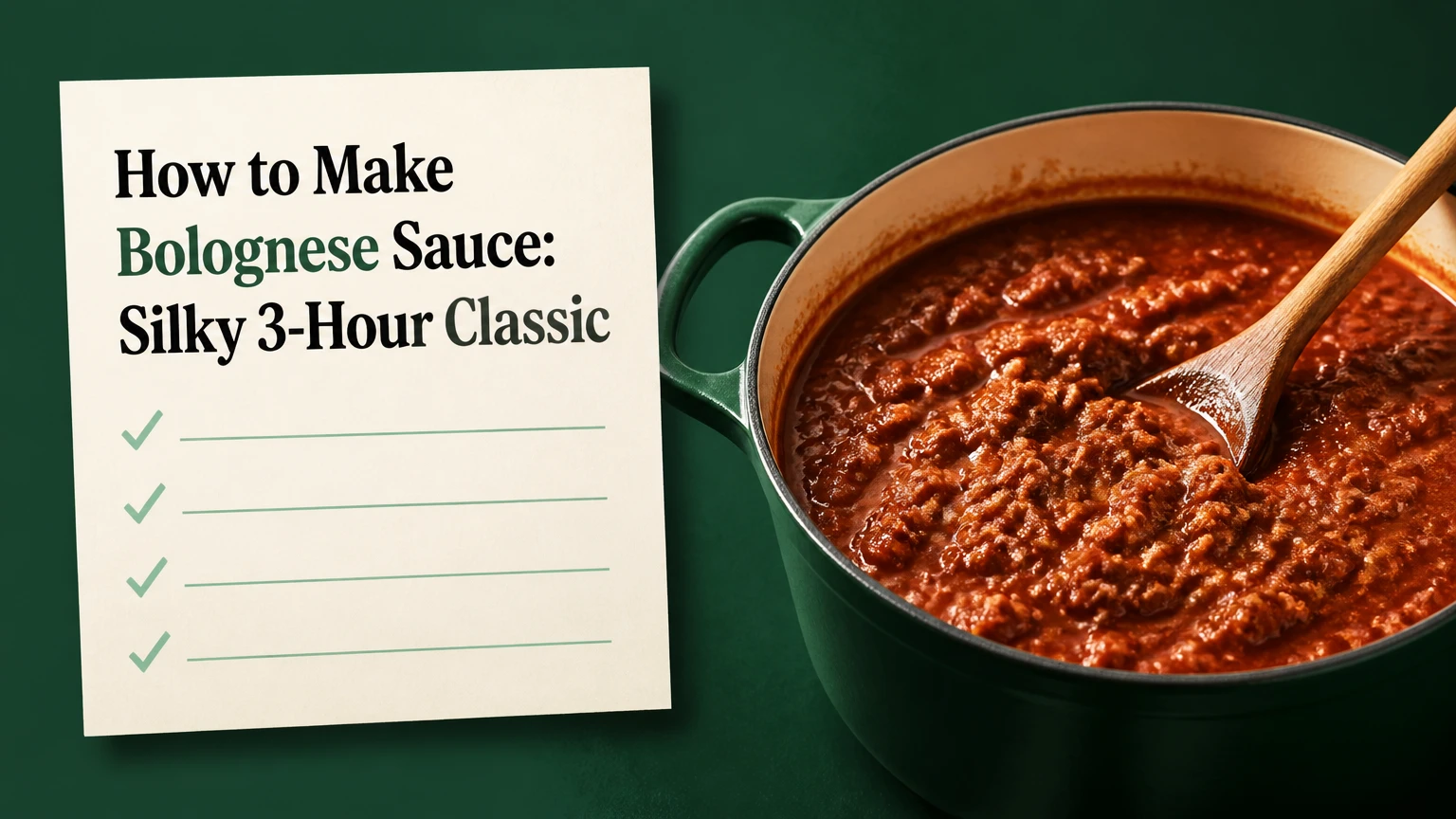
Bolognese sauce, or ragù alla bolognese, is made by gently cooking browned meat, pancetta, soffritto, wine, restrained tomato, broth, and milk until thick and silky. For the traditional flavor, allow 3-4 hours, keep the heat below a boil, and serve the finished ragù with tagliatelle, pappardelle, or lasagna rather than relying on thin spaghetti.
Key Facts at a Glance
A traditional batch uses about 600 g of meat and 200 g of finely diced onion, carrot, and celery.
Ragù alla bolognese usually contains less tomato than Italian-American meat sauce.
The sauce needs 2.5-4 hours of gentle simmering for tender meat and concentrated flavor.
Milk added during the final 30-45 minutes softens acidity and helps bind fat into the sauce.
Tagliatelle and pappardelle hold thick ragù more effectively than standard dried spaghetti.
A finished portion generally contains 125-150 g of sauce before pasta is added.
What Is Traditional Bolognese Sauce?
Traditional Bolognese sauce is a meat ragù from Bologna, in Italy’s Emilia-Romagna region, built around soffritto, beef, pork, wine, tomato, broth, and milk. The registered recipe of the Accademia Italiana della Cucina describes a slow, restrained preparation rather than a bright tomato sauce loaded with garlic and dried herbs.
The sauce is thick enough to cling to pasta. Tomato provides acidity, color, and balance, but the meat remains the central ingredient. Italian-American versions often reverse those proportions by using crushed tomatoes as the dominant volume and adding garlic, basil, oregano, or a larger quantity of red wine.
The Bologna tradition is also tied to fresh egg pasta. Tagliatelle alla bolognese is the classic pairing because its broad, slightly rough surface catches the reduced meat sauce. Lasagna verdi uses a related ragù with green spinach pasta and béchamel.
How Does Bolognese Differ From Meat Sauce?
Bolognese is a specific style of meat ragù, while “meat sauce” is a broad category that may include any ground meat cooked with tomato, onion, herbs, and stock. The most useful distinction is the balance of ingredients, cooking time, and intended pasta.
| Feature | Ragù alla bolognese | Italian-American meat sauce | Quick weekday ragù | Ragù bianco |
|---|---|---|---|---|
| Meat | 400 g beef plus 200 g pork | 500 g beef | 500 g turkey or beef | 500 g pork, chicken, or sausage |
| Tomato | 200-300 g passata | 700-800 g crushed tomato | 400-500 g crushed tomato | 0 g |
| Dairy | 150-250 ml whole milk | Usually 0 ml | Optional 30 ml cream | 100-150 ml cream |
| Cooking time | 3-4 hours | 60-120 minutes | 30-45 minutes | 90-180 minutes |
| Typical pasta | Tagliatelle, lasagna | Spaghetti, shells | Penne, spaghetti | Pappardelle, rigatoni |
What Ingredients Do You Need?
A balanced traditional batch requires 600 g total meat, 200 g soffritto vegetables, 200-300 g tomato, 150-250 ml milk, and enough wine or broth to create a concentrated sauce without making it soupy. Use meat with approximately 20% fat because very lean mince becomes dry during extended cooking.
Traditional Ingredient Formula
The following quantities produce approximately six portions of sauce. Weigh the vegetables after trimming, and use a wide, heavy pot that allows evaporation.
| Ingredient | Quantity for 6 portions | Practical specification |
|---|---|---|
| Ground beef | 400 g | Chuck, shoulder, skirt, or flank with 15-20% fat |
| Ground pork or pancetta | 200 g | Pork shoulder, belly, or finely chopped pancetta |
| Yellow onion | 100 g | Fine dice, approximately 3 mm |
| Carrot | 60 g | Fine dice, peeled |
| Celery | 40 g | Fine dice, leaves removed |
| Olive oil or butter | 15-25 g | Use only enough to start the soffritto |
| Dry wine | 150 ml | White for a lighter profile, red for deeper flavor |
| Tomato passata | 250 g | Plain passata without sugar or herbs |
| Beef or chicken broth | 350-500 ml | Unsalted or lightly salted |
| Whole milk | 200 ml | Add in stages near the end |
| Salt | 10-14 g, adjusted | Add gradually as the sauce reduces |
| Black pepper | 1-2 g | Add near the end |
The classic formula does not require garlic, oregano, basil, or chili. Those ingredients are valid in other meat sauces, but they shift the profile away from the delicate meat, dairy, and soffritto character associated with Bolognese.
Which Meat Works Best?
Ground beef shoulder or chuck provides a reliable balance of fat, connective tissue, and beef flavor. Pork belly or pancetta adds rendered fat and savory depth, while ground pork shoulder contributes softness without the intense saltiness of cured pork.
Coarse-ground meat gives a more substantial texture than finely emulsified supermarket mince. Ask a butcher for one coarse pass, or pulse trimmed meat briefly in a food processor until pieces measure about 5-8 mm.
How to Make Bolognese Sauce
Make Bolognese sauce in seven stages: render pork, soften soffritto, brown the beef, reduce wine, add tomato and broth, simmer gently, and finish with milk. The active work takes about 35-45 minutes, while the full stovetop process takes 3-4 hours; thorough browning and a bare simmer determine the final quality.
Before You Start
| Requirement | Typical specification |
|---|---|
| Active preparation | 35-45 minutes |
| Total stovetop time | 3-4 hours |
| Difficulty | Moderate, with simple techniques |
| Equipment | 5-6 litre Dutch oven or heavy saucepan |
| Utensils | Chef’s knife, cutting board, wooden spoon, ladle |
| Yield | 1.1-1.4 kg finished sauce |
| Typical batch cost | $18-$35, depending on meat and wine |
| Pasta for 6 | 500-600 g fresh or dried pasta |
Use a pot at least 28 cm wide if possible. A narrow saucepan traps steam, slows browning, and produces a looser sauce. Take the meat from the refrigerator 15-20 minutes before cooking so a very cold mass does not sharply lower the pan temperature.
Step 1: Render the Pork
Place the pancetta or ground pork in a cold Dutch oven, then set the burner to medium. Cook for 5-8 minutes, stirring occasionally, until the pork releases fat and develops pale golden edges.
Add 1 tablespoon of oil only if the pork is lean and the pot remains dry. The success checkpoint is a thin, even fat layer across the bottom with no dark, burnt fragments. A common mistake is starting with high heat, which browns the pork before its fat renders and can make the finished sauce greasy.
Step 2: Cook the Soffritto
Add the onion, carrot, and celery to the rendered fat. Cook for 8-12 minutes over medium-low heat, stirring every 1-2 minutes, until the vegetables are soft, translucent, and sweet-smelling.
Traditional soffritto should soften rather than char. The vegetables should compress visibly and leave the spoon moving through the mixture without resistance. If the onion browns heavily before the carrot softens, lower the heat and add 1 tablespoon of water.
Step 3: Brown the Beef
Increase the heat to medium-high and add the ground beef in two portions. Break each portion into coarse pieces, but do not constantly stir; allow contact with the pot for 2-3 minutes before turning.
Cook for 10-15 minutes, until the liquid released by the beef has evaporated and the meat begins to sizzle in the fat. Browned meat should show deep tan or brown edges rather than a uniform gray color. A crowded pot steams the beef, so use two batches when the meat covers the base by more than one layer.
Step 4: Deglaze With Wine
Pour in 150 ml dry wine after the meat has browned. Scrape the base of the pot with a wooden spoon, then simmer for 5-8 minutes until the wine has almost completely evaporated.
Dry white wine is common in traditional formulas because it adds acidity without dominating the meat. Dry red wine gives a darker, more assertive sauce. The correct checkpoint is a moist coating on the meat with no visible pool of wine; adding tomato before reducing the wine leaves a raw, sharp flavor.
Step 5: Add Tomato and Broth
Stir in 250 g passata and 350 ml broth. Bring the mixture to a gentle simmer, then reduce the burner immediately to low.
The liquid should come about halfway up the meat, not cover it completely. Scrape the sides and base once, then taste for salt only after the first hour because broth, pancetta, and evaporation can significantly increase salinity.
Step 6: Simmer Gently
Leave the pot partially covered and cook for 2.5-3.5 hours, stirring every 25-30 minutes. Maintain a temperature that produces one or two small bubbles every few seconds; a rolling boil forces out moisture and can toughen the meat.
Add 50-100 ml broth whenever the base looks dry or catches during stirring. The sauce is ready when the meat is tender, the liquid has reduced into a thick coating, and a spoon drawn across the bottom leaves a path that closes slowly. The final hour often produces more flavor concentration than the first because water loss intensifies the browned meat, tomato, and stock.
Step 7: Add Milk and Adjust
Pour 200 ml whole milk into the pot over the final 30-45 minutes, adding it in three or four stages. Stir after each addition and allow the sauce to return to a gentle simmer before adding more.
Milk softens tomato acidity, rounds the wine, and helps integrate rendered fat. Whole milk gives a silkier result than skim milk because its fat and milk solids contribute body. Season with salt and pepper only after the milk has incorporated and the sauce reaches its final thickness.
Why Does Slow Cooking Improve the Sauce?
Slow cooking improves Bolognese because heat gradually converts collagen and connective tissue into gelatin while evaporation concentrates dissolved flavor compounds. The process also gives fat time to coat meat particles and allows milk proteins to moderate acidity without scorching.
The Maillard reaction occurs mainly during the browning stage, not during the simmer. Browning creates roasted savory compounds, while simmering performs tenderization and concentration. These stages cannot be fully substituted by simply boiling ground meat in tomato sauce.
A practical rule is to spend more attention on the first 30 minutes than on the last 3 hours. Weak browning cannot be repaired by longer cooking, but a properly browned base can become excellent with modest ingredients.
When Should You Add Milk, Tomato, and Salt?
Add wine after browning and reduce it before tomato. Add milk during the last 30-45 minutes, then correct salt at the end. Early salt seasoning is acceptable in small amounts, but final salt must wait until reduction is complete.
Some registered and family recipes add milk earlier, before or alongside the tomato. Both approaches can work. Adding milk late gives a clearer control point for cooks because the sauce’s acidity and final concentration are easier to judge.
Do not substitute sweetened plant milk. Unsweetened oat milk can add body, but almond milk contributes little fat and may leave a faint nutty taste. For dairy-free cooking, use unsweetened oat milk or omit the milk and finish with pasta water and olive oil.
How Much Sauce and Pasta Do You Need?
Plan on 125-150 g finished ragù and 80-100 g dry pasta per adult. Fresh egg pasta weighs more because it contains water, so 100-120 g fresh tagliatelle per person is a typical serving.
| Diners | Total meat | Total soffritto | Finished sauce target | Dry pasta |
|---|---|---|---|---|
| 2 | 200 g | 65-70 g | 350-450 g | 160-200 g |
| 4 | 400 g | 130-135 g | 700-900 g | 320-400 g |
| 6 | 600 g | 200 g | 1.1-1.4 kg | 500-600 g |
| 8 | 800 g | 265-270 g | 1.5-1.8 kg | 640-800 g |
Cook pasta in well-salted water until 1-2 minutes short of the package’s al dente time. Toss the drained pasta with ragù in a wide pan, adding 2-4 tablespoons of pasta water if the sauce needs loosening. Thick Bolognese should coat the pasta rather than form a separate layer at the bottom.
Which Pasta Is Best?
Tagliatelle is the strongest traditional choice because its broad surface holds dense meat particles and emulsified fat. Pappardelle works similarly, while lasagna uses the sauce as one layer among pasta, béchamel, and cheese.
Spaghetti is not wrong as a home-cooking choice, but its smooth, narrow shape does not carry thick ragù as effectively. Rigatoni and shells are practical alternatives when fresh egg pasta is unavailable.
Which Bolognese Version Fits Your Situation?
The traditional stovetop version is best when flavor and texture matter more than speed. A 45-minute version suits a weeknight, while a slow cooker helps with unattended cooking but cannot reproduce the same reduction unless the sauce is finished uncovered on the stove.
| Version | Time | Main ingredients | Best use | Main limitation |
|---|---|---|---|---|
| Traditional stovetop | 3-4 hours | Beef, pork, milk, passata | Weekend meal, lasagna | Requires periodic stirring |
| Weekday ragù | 40-50 minutes | Beef or turkey, tomato paste, stock | Quick dinner | Less tender and layered |
| Slow cooker | 6-8 hours | Browned meat, tomato, broth | Unattended cooking | Limited evaporation |
| Pressure cooker | 55-75 minutes | Beef, pork, wine, tomato | Faster deep flavor | Smaller reduction window |
| Ragù bianco | 2-3 hours | Pork, sausage, mushrooms, no tomato | Earthy white sauce | Richness needs acid control |
| Vegetarian ragù | 45-90 minutes | Lentils, mushrooms, walnuts, tomato | Meat-free meal | Different texture and protein |
How Do You Make a 45-Minute Version?
Brown 500 g ground beef with 150 g finely diced soffritto, add 40 g tomato paste, 400 g passata, and 250 ml stock, then simmer uncovered for 25-30 minutes. Finish with 100 ml milk or 50 ml cream and adjust the seasoning.
Use a wide skillet to maximize evaporation. This version tastes more tomato-forward because the meat has less time to release gelatin and the vegetables have less time to dissolve into the sauce. It is a useful weekday substitute, not an identical replacement for long-cooked ragù.
Can You Use a Slow Cooker?
Brown the pork, soffritto, and beef on the stove first, then transfer them to a slow cooker with wine, tomato, and only 250 ml broth. Cook on low for 6-8 hours, leaving the lid closed during the main cook.
Finish the sauce uncovered in a saucepan for 15-25 minutes if it looks thin. Add milk during the final 30 minutes in the slow cooker, or stir it in during the stovetop reduction. Slow cookers retain moisture, so using the full stovetop broth quantity often produces watery ragù.
What Are the Most Common Problems?
Most Bolognese failures come from excess water, excessive heat, or incorrect seasoning timing. Diagnose the sauce by texture and smell before adding ingredients, because a random splash of cream or sugar can conceal rather than correct the underlying problem.
| Problem | Likely cause | Immediate fix | Prevention |
|---|---|---|---|
| Watery sauce | Covered pot or excess broth | Reduce uncovered 15-30 minutes | Add broth gradually |
| Oily surface | Excess fat or insufficient emulsification | Skim fat, then stir in pasta water | Use 15-20% fat meat |
| Tough meat | Boiling or lean mince | Add broth and simmer gently 30-60 minutes | Maintain one or two bubbles |
| Sharp acidity | Undercooked wine or tomato | Reduce longer, add milk | Evaporate wine fully |
| Gray meat | Crowded pan or low heat | Continue uncovered browning | Brown in two batches |
| Burnt base | High heat or dry pot | Transfer without scraping burnt bits | Stir every 25-30 minutes |
How Do You Fix Watery Bolognese?
Remove the lid and simmer the sauce over medium-low heat for 15-30 minutes, stirring often. The correct endpoint is a sauce that clings to a spoon and leaves a visible track when dragged across the pot base.
Do not add flour as a first fix. Flour can produce a pasty texture and masks the concentrated meat flavor. If the sauce is already salty, dilute it with unsalted broth or a small quantity of unsalted tomato before reducing again.
How Do You Fix Oily Bolognese?
Spoon off visible fat while the sauce is warm, then stir in 2-4 tablespoons of starchy pasta water immediately before serving. Pasta water contains starch that helps disperse small fat droplets through the sauce.
A slight glossy surface is normal and desirable. A separate centimeter-thick oil layer usually indicates fatty meat, too little reduction, or insufficient stirring during the final stage. Do not replace all the rendered fat with water, because fat carries many of the browned meat aromas.
How Do You Fix Bitter or Burnt Sauce?
Move the unburnt sauce to a clean pot without scraping the dark base. Add a small amount of unsalted broth, milk, or passata, then simmer gently and reassess.
Sugar is not a reliable correction for burnt flavors. A pinch can balance sharp tomato, but sweetness will not remove charred bitterness. If the entire batch smells acrid, discard it rather than serving a sauce with concentrated burnt compounds.
How Should You Store and Reheat It?
Cool Bolognese in a shallow container and refrigerate it within two hours of cooking. The United States Department of Agriculture recommends using refrigerated leftovers within 3-4 days and reheating them to 165°F, or 74°C.
Freeze ragù in 250-400 g portions for up to 3 months for the best texture. Thaw overnight in the refrigerator, then reheat in a saucepan over medium-low heat with 1-3 tablespoons of water or broth per portion.
| Storage method | Container | Practical limit | Reheating method |
|---|---|---|---|
| Refrigerator | Shallow sealed container | 3-4 days | Saucepan, 74°C center |
| Freezer | Flat freezer bag or airtight tub | 3 months | Thaw overnight, then simmer |
| Frozen portion | 300 g serving container | 8-12 weeks best quality | Low heat with 30 ml broth |
| Cooked pasta with sauce | Sealed meal container | 1-2 days best texture | Microwave or skillet with water |
How Can You Adapt Bolognese?
Adaptations work best when they preserve the sauce’s core structure: browned savory ingredients, softened aromatics, controlled liquid, and enough fat or starch for a cohesive texture. Substitutions that remove both meat and dairy require a separate source of umami and body.
- Ground turkey: Add 1 tablespoon olive oil and 20 g finely chopped mushrooms because turkey contains less fat and can dry out during a long simmer.
- Pork-free: Use 600 g beef with 25 g butter or olive oil, then monitor the sauce because beef alone may taste leaner.
- Vegetarian: Brown 250 g mushrooms, use 150 g cooked lentils and 50 g walnuts, and reduce the cooking time to 45-60 minutes.
- Dairy-free: Replace milk with 150 ml unsweetened oat milk, or omit it and use pasta water for emulsification.
- Alcohol-free: Replace wine with 100 ml broth plus 1 tablespoon red-wine vinegar added near the end.
- Gluten-free: Pair the ragù with certified gluten-free tagliatelle, polenta, rice, or potatoes.
Frequently Asked Questions
Can you make Bolognese the day before?
Yes. Refrigerated ragù often tastes more integrated after 12-24 hours because the fat, gelatin, and reduced liquid settle into a cohesive texture. Cool it promptly in a shallow container, refrigerate it within two hours, and reheat gently with a small splash of broth.
Does authentic Bolognese contain garlic?
The registered traditional style does not require garlic, and many classic preparations omit it. Garlic is acceptable in personal or regional adaptations, but its sharp sulfurous flavor can dominate the softer notes of milk, pork, and soffritto.
Is Bolognese better with red or white wine?
Dry white wine gives the cleanest, lighter acidity associated with many traditional formulas, while dry red wine creates a darker and more assertive sauce. Choose white wine for tagliatelle and red wine when pairing the ragù with robust pasta or a stronger cheese.
Can you use tomato paste instead of passata?
Yes. Use 40-60 g double-concentrated tomato paste for six portions, fry it with the browned meat for 1-2 minutes, and dilute it with broth. Tomato paste produces a darker, more concentrated flavor than 250 g passata, so add liquid gradually.
Why is Bolognese served with tagliatelle instead of spaghetti?
Tagliatelle has a broad, porous surface that catches meat, fat, and reduced sauce more effectively. Spaghetti remains a common international pairing, but its narrow, smooth strands allow thick ragù to slide toward the plate.
Can you leave Bolognese simmering overnight?
Do not leave a pot unattended overnight on a stovetop. Cook the sauce until tender, cool it safely, refrigerate it, and reheat the next day. A slow cooker can run unattended only when its manufacturer permits that use and the appliance remains on a stable, heat-safe surface.
The Bottom Line
To make Bolognese sauce with traditional depth, brown 600 g of beef and pork thoroughly, soften 200 g of soffritto, reduce 150 ml wine completely, and simmer the mixture with restrained tomato and broth for 3-4 hours. Add whole milk during the final 30-45 minutes, then toss the finished ragù with tagliatelle and pasta water. The decisive techniques are patient browning, low heat, gradual reduction, and final seasoning after evaporation. Properly made, how to make Bolognese sauce becomes less about adding more tomato and more about developing a thick, tender, balanced meat ragù.