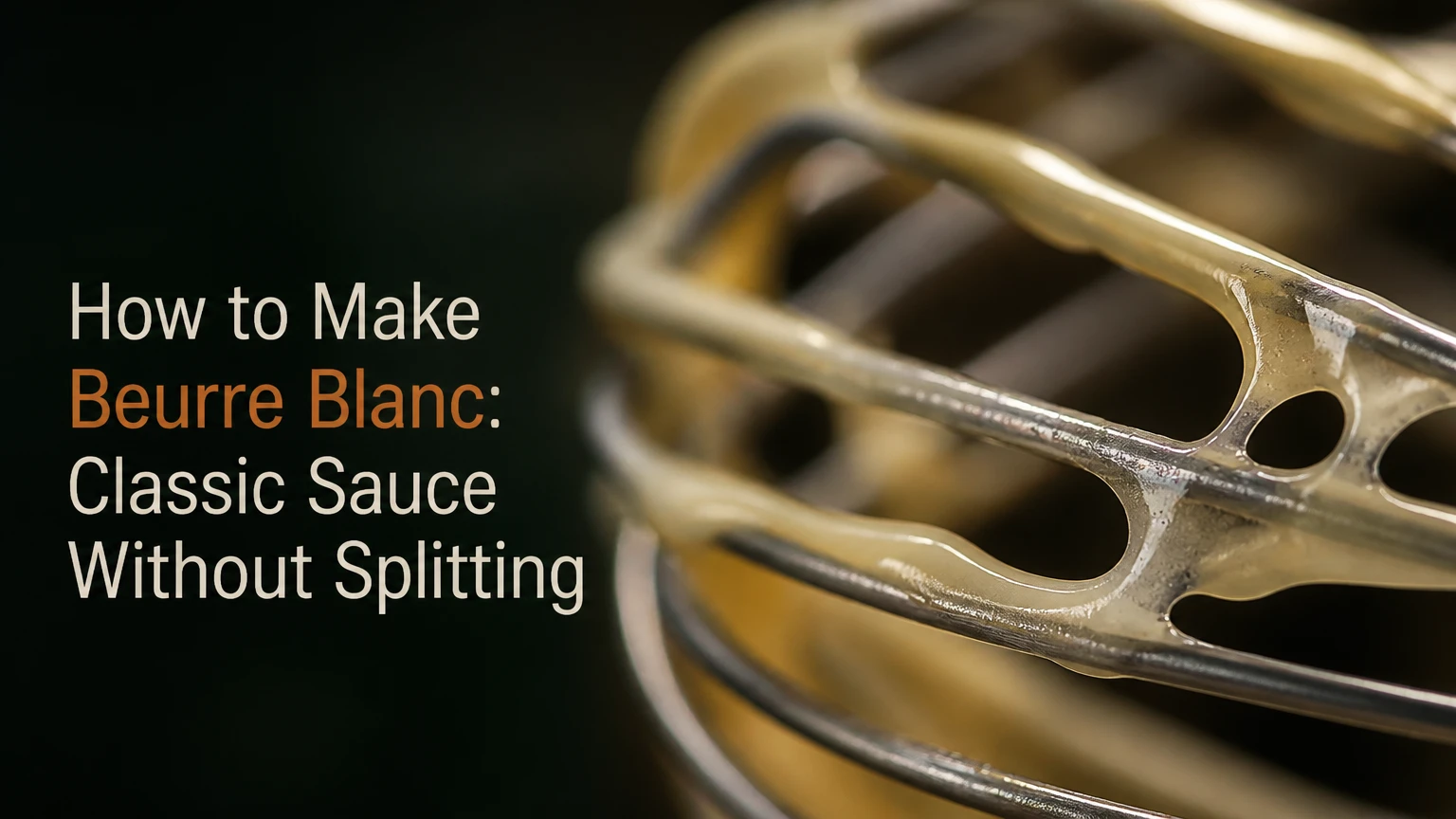
Beurre blanc is a warm French butter sauce made by reducing shallots, dry white wine, and vinegar, then whisking in cold unsalted butter until the mixture becomes glossy, opaque, and velvety. The full process takes about 20-30 minutes, and temperature control matters more than advanced knife skills.
Key Facts at a Glance
- Beurre blanc usually yields about 240 milliliters, or 1 cup, from 225 grams of butter.
- A practical serving size is 30-60 milliliters per person, depending on the main dish.
- The reduction should finish at approximately 1-2 tablespoons before butter is added.
- Cold butter added gradually creates a temporary fat-in-water emulsion.
- The sauce is easiest to hold around 43-54°C, or 110-130°F.
- A traditional beurre blanc contains butter, wine, vinegar, shallots, and salt; cream is optional.
What Is Beurre Blanc?
Beurre blanc is a warm emulsified sauce from France, traditionally associated with the Loire Valley and the Nantes area. The name means “white butter,” describing the sauce’s pale color and butter-based texture rather than a separate type of butter.
Classic beurre blanc combines sharp acidity with rich milkfat. Chefs commonly spoon it over poached or roasted fish, scallops, shrimp, asparagus, green beans, potatoes, chicken, and mild shellfish because the sauce adds richness without the heavier body of a cream sauce.
The sauce is temporary rather than permanently stable. Beurre blanc can remain smooth during a meal, but extended high heat, aggressive boiling, or prolonged refrigeration changes its structure. That limitation is part of the technique.
What does beurre blanc taste like?
Beurre blanc tastes buttery, tangy, lightly sweet from cooked shallots, and faintly wine-like. The finished sauce should taste bright before it tastes heavy, because the reduction supplies enough acidity to balance approximately 225 grams of butter.
A harsh sauce usually has an over-reduced or scorched base. A greasy sauce usually has lost its emulsion. A pale, smooth sauce with a clean acidic finish indicates a properly balanced reduction.
Before You Start
The following setup is sized for four to six servings and gives a manageable first batch. A 20-centimeter saucepan works better than a wide skillet because a narrow base preserves enough reduction liquid to support the butter emulsion.
| Requirement | Classic specification | Practical note |
|---|---|---|
| Total time | 20-30 minutes | Includes 10-15 minutes for reduction |
| Yield | 225-240 ml | About 1 cup after straining |
| Butter | 225 g, unsalted | Cut into 1-1.5 cm cubes |
| Wine | 60 ml, dry white | Sauvignon Blanc, Muscadet, or unoaked Chardonnay |
| Vinegar | 60 ml | Champagne or white wine vinegar |
| Shallots | 2 tablespoons, minced | About 25-30 g |
| Optional cream | 15 ml | Add before butter for stability |
| Equipment | 20 cm saucepan, whisk, strainer | A heatproof bowl helps with rescue |
Use unsalted butter when possible. Salted butter varies in salt concentration, and beurre blanc already contains a concentrated acidic reduction, so unsalted butter gives you more control at the finish.
Prepare every butter cube before turning on the stove. The emulsion stage moves quickly once the reduction reaches its endpoint.
Which Wine and Vinegar Should You Use?
Dry, high-acid white wine and mild wine vinegar produce the most balanced beurre blanc. Sauvignon Blanc, Muscadet, dry Pinot Grigio, and unoaked Chardonnay are reliable choices; sweet wine, heavily oaked wine, and strongly flavored vinegar can dominate the sauce.
| Liquid choice | Typical acidity or profile | Result in beurre blanc | Best use |
|---|---|---|---|
| Muscadet | High acidity, low oak | Clean, mineral finish | Oysters, white fish |
| Sauvignon Blanc | Medium-high acidity | Herbal, crisp reduction | Salmon, shrimp, vegetables |
| Unoaked Chardonnay | Medium acidity | Rounder, softer flavor | Chicken, scallops |
| Champagne vinegar | Mild, aromatic acidity | Refined, delicate sharpness | Sole, asparagus |
| White wine vinegar | Direct, pronounced acidity | Brighter and sharper | General-purpose batch |
| Lemon juice | Fresh citric acidity | More obvious citrus flavor | Grilled fish, shrimp |
Choose a wine you would drink, but do not use an expensive bottle solely for the sauce. Cooking wine with added salt or a flat, sweet wine can create an unbalanced reduction.
For an alcohol-free version, replace the wine with 60 milliliters of water or unsalted fish stock and retain 45-60 milliliters of vinegar. The result will lack wine’s fruit and aroma, so add the vinegar gradually and taste before the butter stage.
How Does Beurre Blanc Stay Emulsified?
Beurre blanc stays emulsified when butterfat is dispersed into a small water-based reduction while the pan remains warm rather than hot. Whisking breaks the fat into small droplets, while butter’s milk proteins and phospholipids help keep those droplets suspended.
Butter contains approximately 80-82% milkfat, 16-18% water, and 1-2% milk solids, although exact composition varies by product and national standard. The reduction provides the water phase. Cold butter slows melting long enough for whisking to distribute the fat instead of allowing a separate oil layer to form.
A practical working range is approximately 43-57°C, or 110-135°F. The sauce is most comfortable for service around 43-54°C. Above roughly 60°C, or 140°F, the emulsion becomes increasingly vulnerable to separation; below about 40°C, the butter begins to firm and the sauce thickens unevenly.
Professional kitchens often use the phrase “mounting with butter” for this process. The phrase describes adding butter gradually to a liquid base while whisking, not simply melting butter into a pan.
How to Make Beurre Blanc
Follow these six steps for a traditional sauce. The reduction endpoint and the low-temperature butter stage determine the result more than the exact brand of vinegar.
Step 1: Reduce the Shallots, Wine, and Vinegar
Combine 2 tablespoons minced shallots, 60 milliliters dry white wine, and 60 milliliters vinegar in a small saucepan. Bring the mixture to a steady simmer over medium heat, then reduce it until only 1-2 tablespoons of liquid remain, which normally takes 10-15 minutes.
The shallots should look moist and lightly glazed, not submerged. Do not let the pan become completely dry, because the remaining water phase is needed to emulsify the butter.
You will know the reduction is ready when a spoon dragged across the pan briefly exposes the bottom and the liquid smells concentrated but not burnt. If the mixture smells sharply vinegary, add 1-2 teaspoons of water before mounting the butter.
Common mistake: using high heat to shorten the reduction. A violent boil can scorch shallots and produce bitter acidity before enough water evaporates.
Step 2: Prepare the Pan for Butter
Lower the heat to its lowest setting, or remove the saucepan from the burner for 30-60 seconds. Add 1 tablespoon of heavy cream at this point if you want a cream-stabilized version, then simmer it for about 10 seconds.
The reduction must be hot enough to melt butter gradually, but not hot enough to boil. A bubbling pan is too active for the emulsion stage.
You will know the pan is ready when the reduction is steaming lightly without large bubbles. On induction or gas, moving the saucepan on and off the heat is more reliable than leaving it over a fixed low flame.
Common mistake: adding butter while the reduction is still boiling. The first butter cubes can melt into oil before the whisk creates a stable dispersion.
Step 3: Whisk in the First Butter Cubes
Add two or three cold butter cubes, totaling approximately 15-20 grams, and whisk continuously. Keep the saucepan off the heat for the first 20-30 seconds if the reduction is very hot.
The first butter should produce a cloudy, slightly thickened liquid rather than a visible yellow oil ring. Once the cubes are nearly incorporated, add the next small portion.
You will know the emulsion has started when the liquid becomes opaque and the whisk leaves a brief trail. That initial structure makes the remaining butter easier to incorporate.
Common mistake: using softened butter. Soft butter melts rapidly and gives the water phase less time to surround the fat droplets.
Step 4: Add the Remaining Cold Butter Gradually
Add one or two cubes at a time, whisking until each addition is almost fully incorporated before adding more. Keep the pan between low heat and no heat, and rotate the saucepan or lift it from the burner whenever the sauce begins to steam heavily.
The full butter stage usually takes 5-8 minutes. Do not chase a completely liquid appearance during the process, because the sauce should thicken as the butterfat disperses.
You will know the sauce is progressing correctly when it becomes uniformly pale, glossy, and thick enough to coat the back of a spoon. A thin yellow line around the edge means the pan is too hot or the additions are too large.
Common mistake: adding half the butter at once. A small reduction cannot absorb a large sudden load of fat, especially when the butter melts faster than it can be whisked.
Step 5: Season and Strain the Sauce
Remove the saucepan from heat when the last butter is incorporated. Taste the beurre blanc, then season with kosher salt and a small amount of white pepper; strain through a fine-mesh sieve if you want a smooth sauce without shallot pieces.
Seasoning should happen at the end because reduction concentrates salt and acidity. If the sauce tastes too sharp, whisk in 1-2 teaspoons of warm water. If it tastes flat, add a few drops of vinegar or lemon juice rather than a large splash.
You will know the sauce is finished when it coats a spoon, falls in a slow ribbon, and remains opaque for at least 30 seconds in the serving vessel. Serve promptly.
Common mistake: boiling the finished sauce to keep it hot. Boiling drives the emulsion toward separation.
Step 6: Serve at the Right Temperature
Spoon beurre blanc over the plated food rather than pouring it onto a very hot pan. Serve it at approximately 43-54°C, or 110-130°F, for the smoothest texture.
A warm ceramic bowl or insulated container can keep the sauce comfortable for 15-20 minutes. Stir gently before serving if the surface begins to thicken.
Traditional or Cream-Stabilized?
The traditional method gives the cleanest butter-and-acid flavor, while a cream-stabilized method gives home cooks a wider margin for error. Add 1 tablespoon of heavy cream to the finished reduction and simmer briefly before whisking in butter.
| Criterion | Traditional method | Cream-stabilized method | Practical winner |
|---|---|---|---|
| Butter flavor | Direct and pronounced | Slightly rounder | Traditional |
| Split resistance | Moderate | High | Cream-stabilized |
| Acidity | Sharper, clearer | Softer and muted | Traditional |
| Holding time | About 10-20 minutes | About 20-30 minutes | Cream-stabilized |
| Ingredients | Butter, wine, vinegar, shallot | Same plus 15 ml cream | Traditional |
| Best user | Experienced cook | First-time maker | Depends on skill |
Cream is not required for authentic beurre blanc. It is a practical stabilizer that adds water, milk proteins, and a little viscosity, but too much cream changes the sauce toward a cream sauce.
For a dinner party, use cream if the sauce must wait several minutes between cooking and plating. For a small meal served immediately, the traditional method gives a more focused flavor.
How Should You Scale the Recipe?
Scale the butter and liquid together, but do not multiply the reduction time mechanically. Reduce the liquid to the same 1-2 tablespoon endpoint for a four-person batch, then use a larger base and confirm the volume visually for larger quantities.
| Servings | Butter | Wine | Vinegar | Finished sauce |
|---|---|---|---|---|
| 2 | 115 g | 30 ml | 30 ml | 120 ml |
| 4 | 225 g | 60 ml | 60 ml | 225-240 ml |
| 6 | 340 g | 90 ml | 90 ml | 340-360 ml |
| 8 | 450 g | 120 ml | 120 ml | 450-480 ml |
The ratio is approximately 1 gram of butter for each 1 milliliter of combined wine and vinegar in the starting reduction. That is a useful baseline, not a rigid formula, because evaporation varies with pan width and burner strength.
For eight or more servings, use a wide sauté pan only during the reduction, then transfer the concentrated base to a smaller saucepan for mounting. Very large batches are harder to emulsify by hand and are less suitable for a home kitchen.
Which Foods Pair With Beurre Blanc?
Beurre blanc pairs best with foods that are lean, lightly seasoned, or naturally sweet. White fish, salmon, scallops, prawns, asparagus, peas, new potatoes, chicken breast, and roasted fennel all provide enough structure for the sauce without competing with its acidity.
| Food | Cooking method | Sauce amount per person | Useful variation |
|---|---|---|---|
| Cod or sole | Poached or pan-seared | 45 ml | Chive or lemon |
| Salmon | Roasted or seared | 30-45 ml | Dill or beurre rouge |
| Scallops | Hard sear | 30 ml | Champagne vinegar |
| Shrimp | Grilled or sautéed | 30-45 ml | Citrus |
| Asparagus | Steamed or grilled | 30 ml | Tarragon |
| Chicken breast | Pan-roasted | 45-60 ml | Extra shallot |
| New potatoes | Boiled | 30 ml | Chervil or parsley |
Beurre blanc is less suitable for strongly spiced dishes, fatty braised meats, or foods with an aggressive tomato base. Those dishes can overwhelm the sauce’s delicate acidity.
Beurre Blanc Compared With Similar Sauces
Beurre blanc differs from hollandaise because beurre blanc begins with a wine-and-vinegar reduction and emulsifies butter without egg yolks. Hollandaise uses egg yolks as the primary emulsifier and usually includes lemon juice, making it more custard-like and vulnerable to curdling if overheated.
| Sauce | Emulsifying base | Main acid | Typical texture | Common pairing |
|---|---|---|---|---|
| Beurre blanc | Butter milk solids and whisking | Wine and vinegar | Fluid, glossy | Fish, scallops |
| Hollandaise | Egg yolks | Lemon juice | Thick, spoonable | Eggs, asparagus |
| Béarnaise | Egg yolks and herbs | Vinegar and wine | Thick, aromatic | Steak |
| Velouté | Flour and stock | Usually none | Pourable, opaque | Poultry, fish |
| Brown butter | No stable emulsion | None | Liquid, nutty fat | Pasta, squash |
Brown butter is not a substitute when you need acidity and a creamy, opaque sauce. It is faster and more heat-tolerant, but its nutty milk solids produce a fundamentally different flavor.
Why Did the Sauce Split?
A split beurre blanc usually results from excessive heat, excessive butter added too quickly, or insufficient water in the reduction. The separated sauce shows a yellow oil layer, translucent liquid, or greasy droplets instead of a uniform pale coating.
Use the appearance to choose the rescue method:
- Remove the pan from heat immediately.
- Whisk in 1 teaspoon of cold water.
- If the sauce remains oily, place 1 tablespoon of water in a clean saucepan and bring it to a gentle simmer.
- Slowly whisk the broken sauce into that water, one teaspoon at a time.
- Stop adding sauce when the mixture becomes opaque, then incorporate the remainder gradually.
A teaspoon of cold cream can rescue a mildly broken sauce, especially when the original batch included cream. Ice can cool an overheated sauce, but an ice cube also adds water unpredictably and can dilute a small batch, so measured cold water is easier to control.
Why is the sauce thin or translucent?
A thin beurre blanc usually contains too much liquid, insufficient butter, or butter added before the first portion formed an emulsion. Continue whisking off heat and add cold butter one cube at a time; do not boil the sauce to force thickening.
If the sauce is thin but smooth, reduce it slightly in a separate pan before combining, or whisk in a small amount of additional butter off heat. If it is thin and oily, treat it as a broken emulsion and rebuild it with a tablespoon of water.
Why does beurre blanc taste bitter?
Bitterness usually comes from scorched shallots, burnt reduction, or heavily reduced low-quality wine. Sugar can mask harshness, but it cannot repair burnt flavors.
For a mildly harsh sauce, whisk in 1-2 teaspoons of water and a small pinch of sugar, then retaste. For a visibly dark or smoky reduction, start again, because the bitter compounds will remain concentrated in the butter sauce.
Can You Hold or Reheat Beurre Blanc?
Beurre blanc is best served immediately, but it can be held for approximately 15-20 minutes in a warm, not hot, container. Reheating over direct heat is risky because the sauce can exceed its stable temperature range before the center becomes warm.
To hold it, place the saucepan over barely warm water or in a thermos that has been warmed with hot water and dried. Stir every few minutes, and keep the sauce below approximately 57°C, or 135°F.
To reheat a chilled sauce, place 1 tablespoon of water in a clean saucepan over low heat and whisk in the cold sauce gradually. A microwave is difficult to control and often creates hot spots, so it is a poor choice for beurre blanc.
Refrigerated leftovers typically keep for 1-2 days in a sealed container. The texture may not return perfectly after chilling, and freezing usually produces a separated, grainy result.
What Are the Best Variations?
Beurre blanc variations work best when the base structure remains intact: reduce the acidic liquid, mount the butter gradually, then add delicate flavorings at the end.
| Variation | Change to the base | Flavor profile | Best pairing |
|---|---|---|---|
| Beurre rouge | Red wine and red wine vinegar | Fruitier, deeper | Salmon, duck |
| Citrus beurre blanc | Replace 30 ml vinegar with lemon or lime | Bright, aromatic | Shrimp, chicken |
| Herbed beurre blanc | Add 1-2 teaspoons fresh herbs | Green, fresh | Vegetables, sole |
| Mustard beurre blanc | Add 1 teaspoon Dijon mustard | Tangy, savory | Pork, salmon |
| Truffle beurre blanc | Add 1 teaspoon truffle butter | Earthy, intense | Scallops, mushrooms |
| Saffron beurre blanc | Steep a pinch of saffron in reduction | Floral, savory | Shellfish, halibut |
Add fresh herbs after removing the pan from heat. Boiling dill, chives, tarragon, or chervil strips away their fresher aromas.
For citrus beurre blanc, add zest during the reduction and juice near the end. Citrus juice tastes brighter when it avoids prolonged boiling.
What Are the Best Alternatives?
A dairy-free beurre blanc cannot reproduce classic beurre blanc exactly because butter’s milkfat and milk solids create the traditional texture. Olive oil, plant butter, or blended cashew cream can produce a related acidic sauce, but each changes the flavor and stability.
For dairy-free cooking, reduce 60 milliliters of white wine with 30 milliliters of vinegar, then whisk in 120-150 milliliters of mild extra-virgin olive oil or a neutral plant butter. Emulsify with a stick blender if necessary.
For a lower-fat option, use a fish or vegetable reduction thickened lightly with cornstarch, then finish with 15-30 grams of butter. It will resemble a glossy pan sauce more than a classic beurre blanc.
Do not replace all butter with margarine without checking its water and salt content. Some margarines contain less fat and more water, producing a loose sauce with a noticeably different finish.
Practical Rules That Prevent Most Failures
- Keep the reduction moist: completely dry shallots cannot support the first butter addition.
- Use cold cubes: 1-1.5 centimeter pieces melt slowly enough for controlled incorporation.
- Control heat by moving the pan: a burner’s lowest setting can still be too hot in a thin saucepan.
- Make smaller batches for practice: 225 grams of butter is easier to emulsify than 450 grams.
- Season last: the reduction’s acidity and salt concentration change during evaporation.
- Keep a tablespoon of water nearby: water is the most useful rescue ingredient for a broken sauce.
A counterintuitive point matters here: colder butter is helpful, but an ice-cold pan is not. The reduction must provide enough warmth to melt each cube gradually, so the target is cold butter entering a warm base.
Another useful kitchen rule is to strain before service only when texture requires it. Shallots carry flavor, and removing them can make the sauce taste less aromatic even though the mouthfeel becomes smoother.
Frequently Asked Questions
Can I make beurre blanc without shallots?
Yes. Replace the shallots with 1 tablespoon finely minced scallion whites, 1 teaspoon minced leek, or omit them entirely. Shallots contribute sweetness and aroma, but the sauce still emulsifies when the acidic reduction contains wine, vinegar, and enough residual liquid.
Can I use lemon juice instead of vinegar?
Yes, but add lemon juice carefully because its flavor is more recognizable than white wine vinegar. Replace half the vinegar with lemon juice during the reduction, then add a few drops of fresh juice at the end if the finished sauce needs more brightness.
How much beurre blanc should I serve per person?
Serve approximately 30 milliliters per person for fish with another sauce or garnish, and 45-60 milliliters for a plain fillet or vegetables. A 225-gram butter batch produces roughly 240 milliliters, enough for four generous portions or six moderate portions.
Is beurre blanc gluten-free?
Traditional beurre blanc is gluten-free when the wine, vinegar, butter, and stock contain no added gluten ingredients. Check commercial stock, flavored vinegars, and plant-butter labels, because packaged products can introduce wheat-based thickeners or flavor carriers.
Can I use salted butter?
Salted butter works, but unsalted butter gives better control because the reduction concentrates as water evaporates. If using salted butter, delay seasoning until the sauce is finished and add salt only after tasting the complete emulsion.
Why did my butter sauce become grainy?
Graininess usually indicates overheating, chilled butter added to an overly cold base, or a sauce that partially separated and then cooled. Rewarm it gently with 1 tablespoon water in a clean pan, whisking continuously, and avoid boiling.
The Bottom Line
To make beurre blanc, reduce equal parts dry white wine and wine vinegar with minced shallots until 1-2 tablespoons remain, then whisk in 225 grams of cold cubed butter over low or residual heat. The sauce succeeds when the reduction stays moist, the butter enters gradually, and the finished emulsion remains warm rather than hot. Serve the beurre blanc immediately with fish, shellfish, vegetables, or poultry.