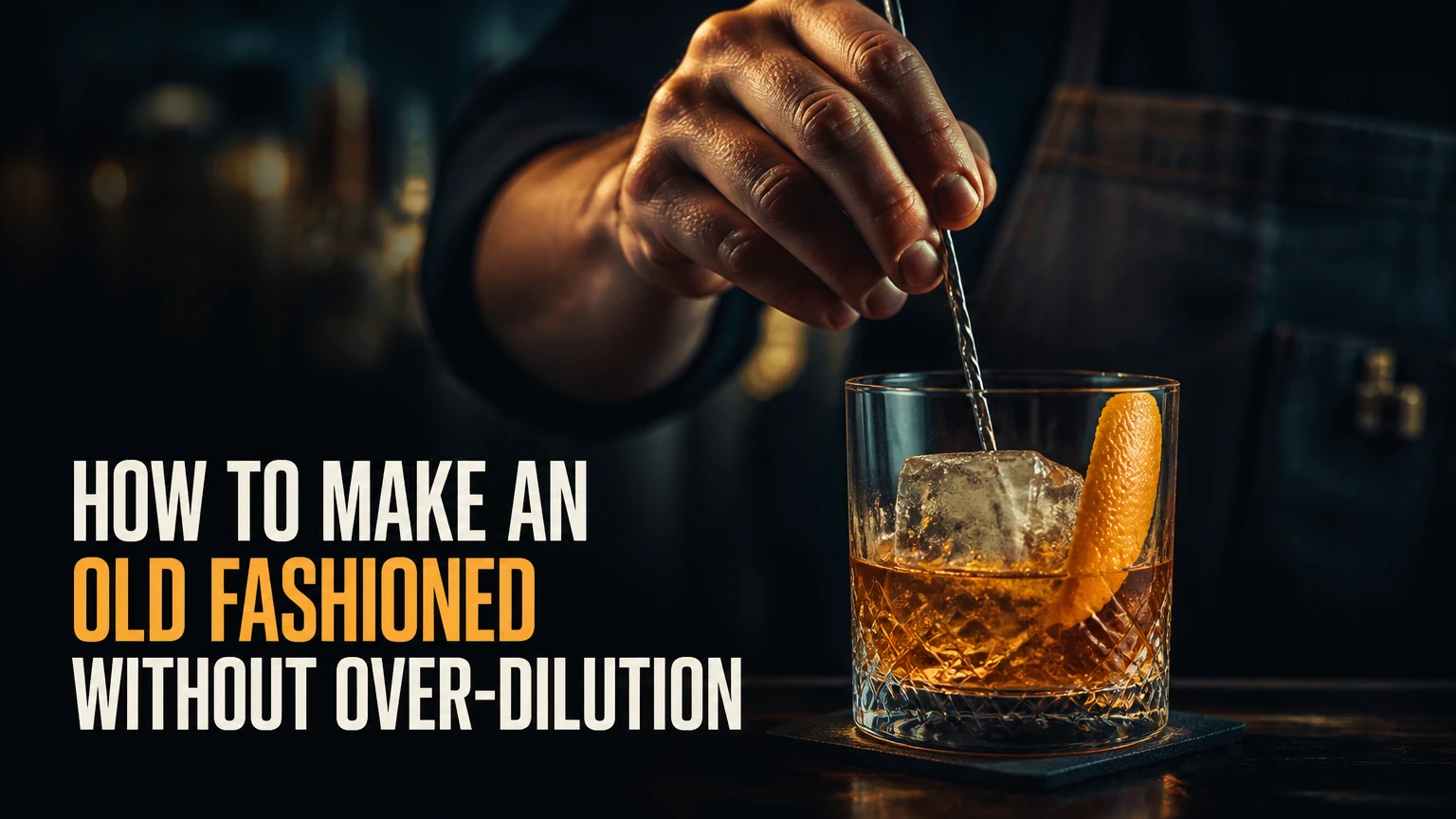
An Old Fashioned requires 2 ounces of bourbon or rye, 1 teaspoon of simple syrup, and 2 dashes of Angostura bitters. Stir those ingredients with ice for 20-30 seconds, strain over one large cube, and express an orange peel over the surface. The complete process takes about 3 minutes.
Key Facts
A standard Old Fashioned contains 2 ounces of whiskey, 1 teaspoon of syrup, and 2-3 dashes of bitters.
Bourbon produces a sweeter profile, while rye creates a drier, spicier cocktail.
Stirring with ice for 20-30 seconds usually provides practical chilling and dilution.
One large cube melts more slowly than small refrigerator ice and preserves the drink longer.
A typical home-made Old Fashioned costs $1.50-$4.00 per serving, excluding the bottle and equipment.
A 2-ounce pour of 80-101 proof whiskey usually produces a drink around 30%-35% ABV after dilution.
What Is an Old Fashioned?
An Old Fashioned is a spirit-forward cocktail made from whiskey, sugar, water supplied by dilution, bitters, and a citrus garnish. The drink contains no fruit juice or carbonated mixer, so sweetness and dilution must be measured carefully enough to soften the whiskey without hiding its oak, grain, and spice.
The recipe follows the old definition of a cocktail. In How to Mix Drinks, or The Bon-Vivant’s Companion (1862), bartender Jerry Thomas wrote: “A cocktail is a stimulating liquor, composed of spirits of any kind, sugar, water, and bitters.” That formula explains why modern Old Fashioneds can use bourbon, rye, brandy, aged rum, or other spirits while retaining the same structure.
The name originally described a customer’s request for a cocktail made in the old style, rather than a single universally fixed recipe. Fruit muddling, soda water, cherries, and orange slices became regional or later variations, especially in Wisconsin. They are valid drinks, but they are not required for the classic whiskey version.
How Does an Old Fashioned Work?
An Old Fashioned balances four forces: alcohol, sweetness, bitterness, and dilution. Sugar reduces the perception of alcohol heat, bitters connect sweet and woody flavors with spice, and water released by melting ice lowers the drink’s intensity while opening aromatic compounds.
Citrus peel affects aroma more than acidity. When the peel is squeezed skin-side down over the drink, volatile orange oils land on the surface and reach the nose before the first sip. An orange wheel or juice changes the recipe by adding pulp, acidity, and additional water.
The drink continues changing in the glass. A well-made Old Fashioned may taste firmer during the first minute, rounder after 5 minutes, and softer after 10-15 minutes, depending on cube size, room temperature, glass shape, and how often the drink is sipped.
Before You Start
| Requirement | Typical specification | Why it matters |
|---|---|---|
| Preparation time | 2-3 minutes | Includes measuring, stirring, straining, and garnish |
| Difficulty | Beginner | Accurate measuring is more important than advanced technique |
| Home cost | $1.50-$4.00 per drink | Depends on whiskey, bitters, syrup, and garnish |
| Whiskey quantity | 2 oz, or 60 ml | Creates the standard spirit-forward serving |
| Bitters quantity | 2-3 dashes | Adds spice and aromatic depth without dominating |
| Serving glass | 8-10 oz rocks glass | Leaves room for whiskey and one large cube |
You need a jigger, barspoon, mixing glass, strainer, rocks glass, ice, a peeler or paring knife, whiskey, bitters, and sweetener. A heavy pint glass can replace a mixing glass, and a clean spoon can replace a barspoon in an emergency.
Prepare 1:1 simple syrup by combining equal volumes of white sugar and water, stirring until dissolved, then cooling the mixture. Refrigerated syrup in a clean sealed container typically keeps for about 2 weeks. A 2:1 rich syrup lasts longer, often 3-4 weeks under refrigeration, but its stronger sweetness requires a smaller pour.
How to Make an Old Fashioned
Use the stirred method for the most consistent result. The recipe below makes one drink and assumes an 80-101 proof bourbon or rye.
Step 1: Chill the Serving Glass
Place an 8-10 ounce rocks glass in the freezer for 5-10 minutes, or fill it with ice and cold water while you mix. If you use temporary ice, discard the water and ice before straining the cocktail.
A cold glass slows the warming of the finished drink. It also prevents the serving cube from melting rapidly as soon as the whiskey touches it.
You will know it worked when: the glass feels cold on its exterior and contains no leftover meltwater.
Common mistake: Leaving water from the chilling ice in the glass dilutes the cocktail before the intended serving cube can do its job.
Step 2: Combine the Sweetener and Bitters
Add 1 teaspoon, or 5 ml, of 1:1 simple syrup to a mixing glass. Add 2 dashes of Angostura aromatic bitters; use 3 dashes for a sweeter bourbon or a stronger spice profile.
For a sugar-cube method, put one standard white sugar cube in the rocks glass with the bitters and 1 teaspoon of water. Stir or gently muddle until the cube breaks down. A cube is traditional, but syrup gives more predictable sweetness.
You will know it worked when: the syrup and bitters form one evenly colored liquid before the whiskey is added.
Common mistake: Treating a dash as a fixed milliliter measurement. Dash bottles vary, so count consistent squeezes from the same bottle.
Step 3: Measure and Add the Whiskey
Pour 2 ounces, or 60 ml, of bourbon or rye into the mixing glass. Use a jigger rather than estimating from the bottle, because an extra half-ounce changes both strength and balance substantially.
Choose bourbon for vanilla, caramel, corn sweetness, and softer oak. Choose rye for pepper, baking spice, herbal notes, and a drier finish. Whiskey at 90-101 proof generally retains flavor after dilution without making the drink excessively hot.
You will know it worked when: the liquid level is close to 2 ounces and the bitters remain integrated rather than floating in a separate layer.
Common mistake: Using a delicate, low-proof whiskey with excessive dilution. The drink can taste thin because the sugar and water overwhelm its lighter flavors.
Step 4: Add Ice and Stir
Fill the mixing glass about three-quarters full with solid ice. Stir smoothly for 20-30 seconds, using the spoon against the inside wall rather than churning the ice aggressively.
The goal is simultaneous chilling and dilution. A typical stirred cocktail receives roughly 15-25% water by volume, although the actual result varies with ice temperature, cube shape, stirring speed, and glass temperature.
You will know it worked when: the mixing glass feels frosty, the spoon moves smoothly, and the whiskey tastes chilled without a sharp, undiluted alcohol edge.
Common mistake: Stirring by the clock alone. A warm room, small cubes, or a hot mixing glass can require a different duration, so taste and temperature are better checkpoints than rotations alone.
Step 5: Strain Over Fresh Ice
Remove the temporary ice from the rocks glass and place one large cube, ideally about 2 by 2 inches, inside. Strain the cocktail over the cube using a julep or Hawthorne strainer.
Fresh serving ice prevents cloudy meltwater from the mixing stage from entering the drink. Large, dense ice also exposes less surface area than several small cubes, so the cocktail changes more slowly while you drink it.
You will know it worked when: the drink is clear, cold, and free of small ice chips.
Common mistake: Stirring and serving over the same small ice. That ice has already melted quickly and can make the final drink watery.
Step 6: Express an Orange Peel
Cut an orange peel approximately 2 inches long and 1 inch wide, avoiding excessive white pith. Hold it skin-side down over the drink, squeeze once to release the oils, rub the peel around the rim, and place it in the glass.
Orange is the standard modern garnish because its oils complement caramel, oak, vanilla, and baking spice. A lemon peel creates a sharper aromatic profile, while a grapefruit peel works better with smoky mezcal or bitter herbal variations.
You will know it worked when: the surface smells distinctly citrusy before you taste the drink.
Common mistake: Dropping in an orange wheel or muddling fruit. Those techniques add juice, pulp, and bitterness from pith, changing a clean whiskey cocktail into a fruit-forward drink.
Which Whiskey Makes the Best Old Fashioned?
Bourbon is the easiest starting point for a mellow Old Fashioned, while rye is better for drinkers who prefer spice and a drier finish. Proof matters as much as category: an 86-101 proof whiskey usually offers enough flavor to withstand chilling and dilution.
| Whiskey choice | Typical proof | Flavor contribution | Best use |
|---|---|---|---|
| Maker’s Mark bourbon | 90 proof | Vanilla, caramel, soft wheat | Beginner-friendly sweet drink |
| Buffalo Trace bourbon | 90 proof | Oak, brown sugar, baking spice | Balanced standard recipe |
| Wild Turkey 101 bourbon | 101 proof | Robust oak, cinnamon, pepper | Drinks that need extra structure |
| Rittenhouse rye | 100 proof | Rye spice, cocoa, pepper | Classic drier profile |
| Bulleit Rye | 95 proof | Mint, pepper, grain spice | Bold, high-rye variation |
| Aged dark rum | 80-100 proof | Molasses, tropical fruit, oak | Rum Old Fashioned |
Avoid using a heavily peat-smoked Scotch as a direct substitute unless smoke is the intended flavor. Peat can dominate Angostura and orange oils, so a split base or a single drop of smoky spirit usually gives better control.
High-proof whiskey is not automatically superior. A 120-proof pour can remain hot after ordinary stirring, while a softer 80-proof whiskey may lose definition. For most home preparation, 90-105 proof is a practical range.
Which Sweetener Should You Use?
Use 1 teaspoon of 1:1 simple syrup when consistency and speed matter. Use a sugar cube when you want the historical presentation and do not mind dissolving it thoroughly; use 1/2 teaspoon of 2:1 rich demerara syrup when you want deeper molasses and caramel notes.
| Sweetener | Starting amount | Flavor | Adjustment |
|---|---|---|---|
| White simple syrup, 1:1 | 1 tsp, 5 ml | Clean, neutral sweetness | Add 1/4 tsp for a sweeter drink |
| Demerara syrup, 2:1 | 1/2-3/4 tsp, 2.5-3.75 ml | Molasses, caramel, dark sugar | Use 1 tsp with high-proof rye |
| White sugar cube | 1 cube plus 1 tsp water | Traditional, neutral | Muddle until no crystals remain |
| Maple syrup | 1/2-1 tsp | Wood, caramel, toasted sugar | Pair with rye or apple brandy |
| Honey syrup, 1:1 | 1 tsp | Floral, rounded sweetness | Pair with bourbon or aged rum |
Sweetness perception changes with temperature. A cocktail that tastes perfectly balanced warm may seem less sweet once chilled, so judge the final drink after stirring rather than adjusting the syrup in the bottle.
How Much Bitters Should You Add?
Start with 2 dashes of Angostura bitters for 2 ounces of whiskey, then increase to 3 dashes if the whiskey is especially sweet or the drink needs more spice. Add 1 dash of orange bitters only when you want a brighter, more layered citrus aroma.
Angostura contributes clove, cinnamon, gentian, and dried-herb notes. Orange bitters supply a lighter top note, but they are optional and should not replace the aromatic backbone of Angostura in a classic recipe.
Chocolate, black walnut, and mole bitters can work in variations, particularly with rye, aged rum, or mezcal. Use one flavored dash alongside 1-2 dashes of Angostura rather than replacing all the bitters immediately.
What Ice and Glassware Work Best?
A rocks glass and one large, dense cube provide the slowest practical dilution for a single Old Fashioned. During mixing, use several cold solid cubes because their combined surface area chills the cocktail faster than one large serving block.
Clear ice is visually attractive but not mandatory. Cloudiness comes from trapped air and minerals, while drink quality depends more on ice temperature, cube size, and the time the cocktail spends in contact with it.
| Ice format | Approximate size | Best stage | Practical result |
|---|---|---|---|
| Large clear cube | 2 x 2 inches | Serving | Slow, steady dilution for 10-15 minutes |
| Standard freezer cube | 1 inch | Mixing | Fast chilling, faster melt |
| Cracked ice | 1/2-1 inch pieces | Mixing only | Rapid dilution and cold temperature |
| Ice sphere | 2 inches diameter | Serving | Slow melt, smaller contact area |
| Pebble ice | 1/2 inch or less | Avoid for classic style | Rapid dilution and short drink life |
A large cube does not prevent dilution. It delays it. The cocktail still needs enough water during stirring to taste balanced from the first sip.
Should You Stir or Build the Drink in the Glass?
Stirring in a mixing glass produces the most consistent temperature, dilution, and texture, while building in the rocks glass is faster and requires less equipment. Choose the stirred method for a polished result and the built method for casual service or a traditional sugar-cube presentation.
| Criterion | Stirred method | Built-in-glass method |
|---|---|---|
| Preparation time | 2-3 minutes | 2-4 minutes |
| Equipment | Mixing glass, strainer, spoon | Rocks glass, spoon or muddler |
| Sweetener | 5 ml syrup | 1 cube plus 5 ml water |
| Dilution control | High, taste during stirring | Moderate, develops during drinking |
| First-sip consistency | Smooth and uniform | May contain undissolved sugar |
| Best setting | Dinner service, repeated drinks | Home, casual single serving |
The built method is not wrong. It simply asks the drinker to accept more variation. If sugar crystals remain at the bottom, later sips become sweeter than the first.
How Do You Fix Common Problems?
Most Old Fashioned problems can be corrected with small measured adjustments rather than a complete remake. Add water to a hot drink, add whiskey to a watery drink, and add a controlled amount of sweetener only after tasting the chilled cocktail.
| Problem | Likely cause | Correction |
|---|---|---|
| Too hot or harsh | Under-stirring or high-proof whiskey | Stir 10 seconds longer, then retaste |
| Too watery | Small ice or excessive stirring | Add 1/4-1/2 oz whiskey and 1 dash bitters |
| Too sweet | Excess syrup or sugary whiskey | Add 1/4 oz whiskey and 1 dash bitters |
| Too bitter | 4 or more bitters dashes | Add 1/4 tsp syrup and 1 tsp water |
| Sugar at bottom | Cube not dissolved | Stir with 1 tsp warm water before adding whiskey |
| Flat aroma | No fresh peel or stale bitters | Express a fresh peel and replace old bitters |
Do not solve every problem with extra bitters. Bitters increase aromatic bitterness, but they do not reliably remove sweetness or reduce alcohol heat.
An expert rule of thumb is to make the smallest correction possible. A quarter-ounce of whiskey or a quarter-teaspoon of syrup can rescue a drink; doubling an ingredient usually creates a second problem.
Which Variations Are Worth Trying?
The best variation keeps the original architecture while changing one major variable. Replace the base spirit, sweetener, or bitters, but avoid changing all three at once if you want to understand the result.
| Variation | Base | Sweetener | Bitters and garnish |
|---|---|---|---|
| Rye Old Fashioned | 2 oz rye | Demerara, 1/2 tsp | Angostura, orange peel |
| Rum Old Fashioned | 2 oz aged rum | 1/2 tsp demerara | Angostura, lime or orange peel |
| Brandy Old Fashioned | 2 oz brandy | 1 tsp simple syrup | Angostura, orange peel |
| Oaxaca Old Fashioned | 1 1/2 oz reposado tequila, 1/2 oz mezcal | 1/2 tsp agave syrup | Angostura, grapefruit peel |
| Maple Old Fashioned | 2 oz bourbon or rye | 1/2 tsp maple syrup | Angostura, orange peel |
The Wisconsin Old Fashioned is a distinct regional style. It commonly uses brandy, muddled orange and cherry, sugar, bitters, and a soda-water top, so it should not be judged against the clean whiskey recipe by the same standards.
Can You Make a Lower-Proof Version?
A lower-proof Old Fashioned can use 1 1/2 ounces of whiskey plus 1/2 ounce of chilled water, keeping the same 1 teaspoon syrup and 2 dashes bitters. The result is lighter but still spirit-led, provided the whiskey has enough flavor.
For an alcohol-free version, use a nonalcoholic whiskey alternative, 2 dashes of alcohol-free bitters, 1 teaspoon demerara syrup, and 1/2 ounce chilled water. Product strength varies widely, so taste after stirring and adjust sweetness rather than copying the alcoholic recipe mechanically.
How Can You Batch Old Fashioneds?
For eight drinks, combine 16 ounces of whiskey, 1 1/3 ounces of 1:1 simple syrup, and 16 dashes of Angostura bitters. Add 4 ounces of filtered water before chilling, then refrigerate the batch for at least 1 hour and pour 2 1/2 ounces per serving over fresh ice.
The added water replaces the dilution normally created by stirring. Keep the orange peels separate and express one over each glass immediately before service, because citrus oils lose aroma faster than the whiskey mixture.
Do not batch with ice inside the bottle or pitcher. Ice continues melting unpredictably, and the final drinks may become watery before guests are served.
How Much Does an Old Fashioned Cost?
A typical home Old Fashioned costs $1.50-$4.00 when the whiskey, bitters, syrup, ice, and orange garnish are purchased in normal retail quantities. The first shopping trip costs more because a bottle of whiskey and bitters provide multiple servings.
| Cost component | Typical retail price | Approximate drink cost |
|---|---|---|
| 750 ml whiskey bottle | $25-$60 | $2.00-$4.80 for 2 oz |
| 1 oz bitters bottle | $8-$15 | $0.10-$0.25 for 2-3 dashes |
| Sugar and water | $2-$5 | $0.05-$0.15 |
| One orange | $1-$2 | $0.10-$0.25 |
| Large-format ice | $3-$8 per bag | $0.25-$0.75 |
| Total typical home drink | Varies by whiskey | $1.50-$4.00 |
A 750 ml bottle contains approximately 12.7 standard 2-ounce pours. At a bar, a classic Old Fashioned commonly costs $12-$22, with premium whiskey, large-format ice, and smoked presentations pushing the price higher.
What Should You Serve With an Old Fashioned?
An Old Fashioned pairs best with salty, roasted, smoky, or rich foods that can withstand whiskey’s oak and bitters. Serve it with grilled steak, smoked nuts, aged cheddar, pork belly, dark chocolate, or desserts containing caramel and toasted sugar.
Avoid pairing a very sweet bourbon Old Fashioned with an equally sweet fruit dessert. The combined sweetness can erase the drink’s spice and make the finish feel heavy. Rye, with its drier pepper profile, works better with rich meat and strongly seasoned snacks.
An Old Fashioned is not a refreshing highball. It is a slow, concentrated drink, so it works better before dinner or alongside small rich portions than with a large meal requiring repeated refills.
Frequently Asked Questions
Can I Make an Old Fashioned Without a Mixing Glass?
Yes. Add the syrup and bitters to a rocks glass, stir, add 2 ounces of whiskey, and fill the glass with ice. Stir for 20-30 seconds, then add a large cube if the original ice has melted substantially. This method is convenient, but undissolved sugar and uneven dilution are more likely.
Is an Old Fashioned Made With Bourbon or Rye?
An Old Fashioned can use either bourbon or rye. Bourbon gives the drink a sweeter profile with vanilla and caramel, while rye adds pepper, baking spice, and a drier finish. Bourbon is the more approachable starting point; rye is often better for drinkers who find bourbon-based versions too soft.
Should an Old Fashioned Have a Cherry?
A cherry is optional and is not required in the classic whiskey formula. If you use one, choose a quality cocktail cherry such as Luxardo and add it as a garnish without muddling it into the drink. Neon maraschino cherries and crushed fruit create a sweeter, cloudier regional variation.
Why Does My Old Fashioned Taste Too Strong?
A strong-tasting Old Fashioned usually needs more dilution, a lower-proof whiskey, or slightly more sweetener. Stir the drink for another 10 seconds, wait 30 seconds, and taste again. If the alcohol still dominates, add 1 teaspoon of cold water rather than pouring in a large amount at once.
Can I Use an Orange Slice Instead of an Orange Peel?
You can, but an orange slice contributes juice, pulp, and water rather than only aromatic oils. Use a peel for a clean, spirit-forward Old Fashioned. Use a slice when you intentionally want a fruitier, sweeter style, such as a Wisconsin brandy Old Fashioned.
How Long Does an Old Fashioned Last After Mixing?
An Old Fashioned is best immediately after stirring and remains enjoyable for roughly 10-15 minutes over a large cube. A bottled, pre-diluted batch can stay refrigerated for about 1-2 days, although its orange aroma will fade unless the peel is expressed only at serving time.
The Bottom Line
To make an Old Fashioned, combine 2 ounces of bourbon or rye with 1 teaspoon of simple syrup and 2 dashes of Angostura bitters. Stir with ice for 20-30 seconds, strain over one large cube, and express an orange peel over the surface. Choose bourbon for sweetness, rye for spice, and adjust dilution before changing the recipe.
The best how to make an old fashioned method is the one that produces a cold, balanced drink without undissolved sugar or excess water. Measure the whiskey, control the ice, and taste after stirring. Those three decisions matter more than expensive equipment or elaborate garnish.