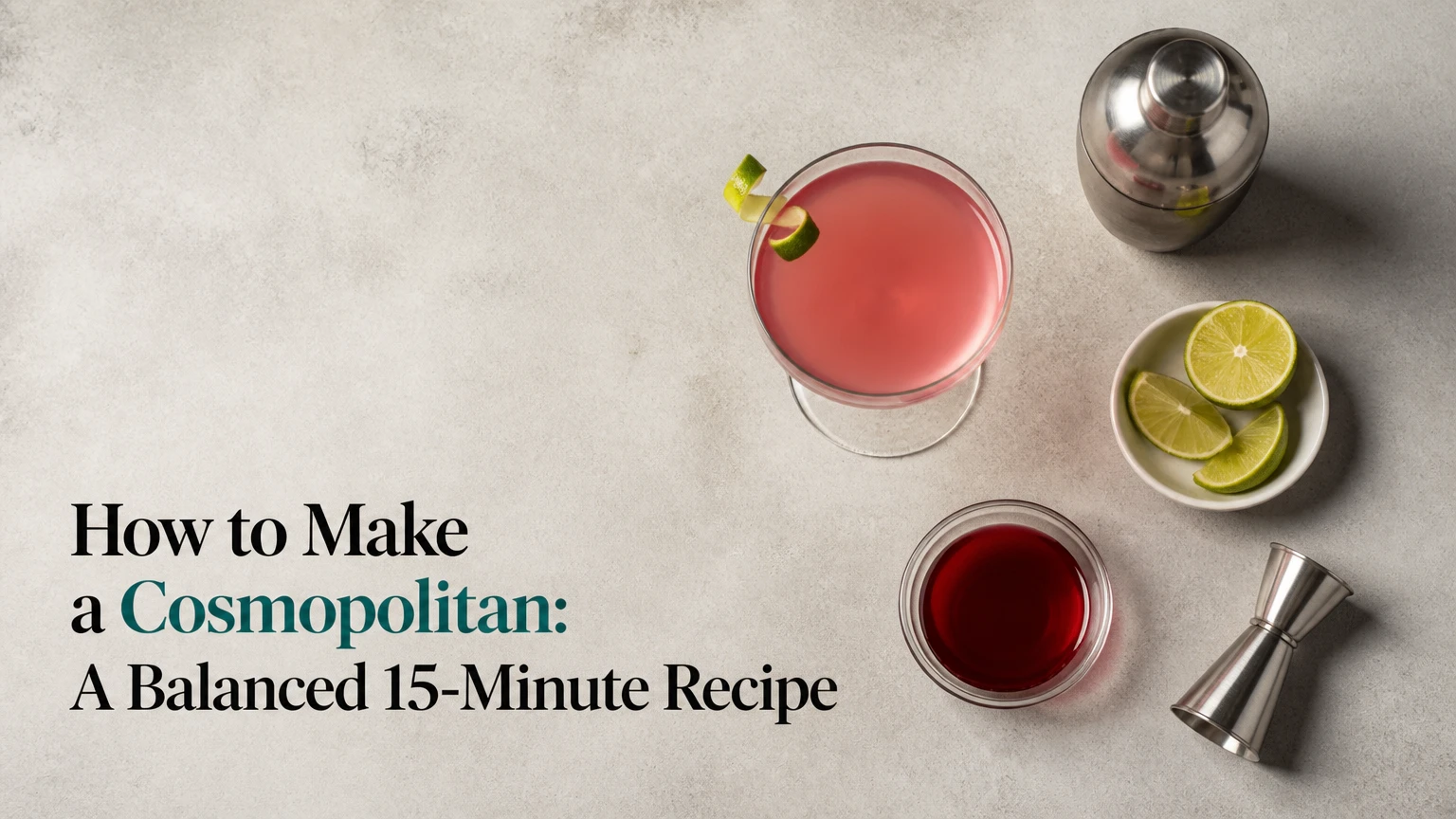
To make a Cosmopolitan, shake 45 ml citrus vodka, 22.5 ml triple sec, 22.5 ml fresh lime juice, and 15 ml cranberry juice cocktail with ice for 12-15 seconds. Double-strain the cold drink into a chilled coupe or Martini glass, then garnish with an expressed orange peel for a crisp, lightly tart, blush-pink cocktail.
Key Facts at a Glance
- A standard Cosmopolitan uses 45 ml citrus vodka, 22.5 ml triple sec, 22.5 ml lime juice, and 15 ml cranberry juice cocktail.
- Fresh lime juice controls the drink’s acidity; bottled lime cordial usually makes the cocktail sweeter and less fresh.
- The Cosmopolitan should be pale, translucent pink rather than opaque red or neon pink.
- Hard shaking with solid ice chills and dilutes the drink simultaneously, usually in 12-15 seconds.
- A chilled coupe or Martini glass holds the drink without ice, so glass chilling must happen before straining.
- A typical home preparation takes 10-15 minutes and costs approximately $3-$8 per drink, excluding reusable equipment.
What Is a Cosmopolitan?
The Cosmopolitan is a vodka-based modern classic built from citrus vodka, orange liqueur, fresh lime juice, and cranberry juice cocktail. The finished drink belongs broadly to the Sour family and resembles a Daisy because it combines a spirit, citrus acid, and a sweetened liqueur, with cranberry providing color and a restrained tart fruit note.
The drink became strongly associated with New York cocktail culture and 1990s popular culture, although its exact origin is disputed. Cheryl Cook is often credited with an early South Beach version, while bartender Dale DeGroff helped popularize a polished version using citrus vodka, Cointreau, fresh lime, and a small cranberry addition.
A good Cosmopolitan is not a cranberry vodka drink served in a stemmed glass. Cranberry should tint the cocktail and contribute tartness without overwhelming the lime and orange aroma. The target flavor is cold, clean, citrus-forward, lightly sweet, and dry enough to invite another sip.
What Do You Need Before You Start?
A Cosmopolitan requires a shaker, a jigger, ice, a strainer, and a chilled stemmed glass. The recipe takes about 2-3 minutes to assemble and another 5-10 minutes to chill the glass, while a jigger provides more reliable balance than free-pouring.
| Requirement | Recommended specification | Typical home cost or time |
|---|---|---|
| Cocktail shaker | Boston or three-piece cobbler shaker, 500-750 ml | $15-$45 |
| Measuring tool | Double-sided jigger with 15 ml and 30 ml marks | $5-$20 |
| Strainer | Hawthorne strainer, plus fine-mesh strainer if available | $8-$25 |
| Serving glass | 150-220 ml coupe or Martini glass | $8-$30 each |
| Ice | 150-250 g dense cubes per drink | 12-15 seconds shaking |
| Citrus preparation | One fresh lime usually yields 20-30 ml juice | 2-3 minutes |
Chill the glass in a freezer for 5-10 minutes, or fill it with ice and cold water while preparing the drink. Do not leave a thin glass in a freezer for hours, because rapid temperature changes can crack fragile glassware.
Which Ingredients Make the Best Cosmopolitan?
The most dependable combination is citrus vodka, Cointreau or another clean triple sec, freshly squeezed lime juice, and cranberry juice cocktail. Citrus vodka supplies a subtle lemon or orange note, while the orange liqueur contributes both sweetness and aromatic orange peel character.
| Ingredient | Standard amount | Suitable examples | Function |
|---|---|---|---|
| Citrus vodka | 45 ml, 1.5 oz | Absolut Citron, Ketel One Citroen, plain vodka | Alcohol base and citrus aroma |
| Triple sec | 22.5 ml, 0.75 oz | Cointreau, Combier, DeKuyper | Orange sweetness and peel aroma |
| Fresh lime juice | 22.5 ml, 0.75 oz | Juice from 1-2 fresh limes | Acidity and freshness |
| Cranberry juice cocktail | 15 ml, 0.5 oz | Ocean Spray or equivalent | Blush color and tart fruit flavor |
| Orange peel | 1 small strip | Navel or Valencia orange | Volatile citrus oils |
Cranberry juice cocktail is usually sweetened and therefore fits the classic formula more easily than unsweetened cranberry juice. Pure cranberry juice is intensely acidic and astringent; if you use it, reduce the quantity to 7.5-15 ml and add 5-7.5 ml of 1:1 simple syrup.
How Does the Cosmopolitan Recipe Work?
The Cosmopolitan works when sweetness, acidity, alcohol, dilution, and aroma remain in proportion. Triple sec and cranberry cocktail supply most of the sugar, lime supplies the sharp acid, vodka provides structure, and shaking adds approximately 15-25 percent dilution in a typical home preparation.
The exact dilution varies with ice size, shaker design, room temperature, and shaking force. Large, cold cubes usually melt more slowly than small wet cubes, but they still transfer enough water during a vigorous shake to soften the alcohol and integrate the lime.
The International Bartenders Association’s published Cosmopolitan recipe uses 40 ml vodka citron, 15 ml Cointreau, 15 ml fresh lime juice, and 30 ml cranberry juice, demonstrating that there is no single universal ratio. The lower-cranberry formula below produces a paler, drier drink that many home bartenders find more balanced.
Core Cosmopolitan Recipe
Use the following formula for one approximately 105 ml pre-dilution drink, which becomes roughly 125-135 ml after shaking and straining.
| Component | Metric measure | US measure | Preparation note |
|---|---|---|---|
| Citrus vodka | 45 ml | 1.5 oz | Keep refrigerated or store at room temperature |
| Triple sec | 22.5 ml | 0.75 oz | Cointreau gives a clean orange profile |
| Fresh lime juice | 22.5 ml | 0.75 oz | Strain seeds and pulp if needed |
| Cranberry cocktail | 15 ml | 0.5 oz | Use a small pour for pale pink color |
| Ice | 150-250 g | 1.5-2 cups | Use solid, dry cubes |
| Orange peel | 1 strip | 1 strip | Express oils over the surface |
A 45 ml pour of 40 percent ABV vodka contributes 18 ml of pure alcohol. Triple sec may range from 20-40 percent ABV, so the finished Cosmopolitan commonly lands near 20-25 percent ABV after dilution, depending on the brands and final volume.
How to Make a Cosmopolitan Step by Step
Step 1: Chill the Serving Glass
Fill a coupe or Martini glass with ice and cold water, or place the empty glass in a freezer for 5-10 minutes. A cold glass prevents the strained cocktail from warming quickly because the Cosmopolitan is served up, without ice.
Success checkpoint: The bowl or stemmed glass feels cold immediately before straining.
Common mistake: Chilling the glass with warm tap water leaves residual heat and melts the first ice that contacts it.
Step 2: Measure Every Ingredient
Add 45 ml citrus vodka, 22.5 ml triple sec, 22.5 ml fresh lime juice, and 15 ml cranberry juice cocktail to the shaker. Measure each liquid with a jigger, because an extra 10 ml of cranberry can turn the drink dark and an extra 10 ml of triple sec can make it noticeably sweet.
Success checkpoint: The liquid ratio is recorded or measured before ice enters the shaker.
Common mistake: Measuring “by eye” creates inconsistent drinks, especially when the glass markings are inaccurate.
Step 3: Add Solid Ice
Fill the shaker with dense ice cubes until the liquid is surrounded by ice, leaving enough room for the shaker to move. Large cubes typically give more predictable dilution than crushed ice, which can create a watery drink before the center becomes properly cold.
Success checkpoint: The shaker contains enough ice to keep the liquid moving across cold surfaces throughout the shake.
Common mistake: Using half-melted ice from a warm glass or an ice bucket adds water before the cocktail has chilled.
Step 4: Shake Hard for 12-15 Seconds
Seal the shaker and shake vigorously for 12-15 seconds. A strong horizontal shake chills the drink, blends the citrus and liqueur, and introduces a small amount of aeration that makes the texture feel less sharp.
Success checkpoint: The shaker exterior is very cold and often frosted, and the metal becomes uncomfortable to hold continuously.
Common mistake: Shaking for only 3-5 seconds leaves the Cosmopolitan warm, concentrated, and alcohol-forward.
Step 5: Strain Into the Chilled Glass
Remove the ice water from the serving glass, then strain the cocktail through a Hawthorne strainer. Double-strain through a fine-mesh strainer when the lime contains pulp or when small ice fragments would distract from the drink’s smooth appearance.
Success checkpoint: The cocktail reaches the glass cold, clear enough to show a translucent pink tone, and free of floating pulp.
Common mistake: Letting the cocktail sit in the shaker after shaking allows continued melting and makes dilution unpredictable.
Step 6: Express an Orange Peel
Cut a strip of orange peel approximately 5 cm long, avoiding most of the white pith. Hold the peel over the drink with the colored side facing the surface, squeeze once to release its oils, and rub the rim lightly before dropping or discarding the peel.
Success checkpoint: The first aroma is fresh orange peel rather than raw alcohol.
Common mistake: Adding a thick, pith-heavy peel contributes bitterness without releasing much aromatic oil.
Flaming the peel is optional. A lit match or lighter can briefly warm the expressed oils, but keep the flame away from the alcohol and never pour or spray flammable liquid near it. Expressed, unflamed peel gives most drinkers the same essential aroma with less risk.
Which Cranberry Juice and Orange Liqueur Should You Choose?
Cranberry juice cocktail is the easiest choice for a classic Cosmopolitan because its built-in sweetness suits the relatively small 15 ml measure. Unsweetened cranberry juice offers more control but requires syrup and usually produces a sharper, more austere drink.
| Choice | Sugar control | Flavor result | Best use |
|---|---|---|---|
| Cranberry juice cocktail | Low, already sweetened | Rounder, fruitier, pale pink | Classic home recipe |
| 100% cranberry juice | High, very tart | Dry, acidic, more tannic | Low-sugar customization |
| Cranberry drink blend | Medium, brand-dependent | Sweeter and less concentrated | Budget or supermarket availability |
| White cranberry juice | Medium, mild color | Softer fruit, nearly clear | White Cosmopolitan variation |
Cointreau is a reliable premium triple sec because its orange aroma is clear and its sweetness is predictable. Grand Marnier can work, but its cognac base adds weight and may shift the flavor toward a richer, less crisp profile. A basic triple sec is usable when it is clean, though very inexpensive brands can taste solvent-like.
Citrus Vodka Versus Plain Vodka
Citrus vodka is traditional in many modern Cosmopolitan recipes, but plain vodka is a valid substitute when fresh lime and orange liqueur provide enough aromatic lift. The difference becomes more noticeable with neutral or inexpensive triple sec, where citrus vodka helps prevent the drink from tasting flat.
| Base spirit | Typical ABV | Citrus character | Result |
|---|---|---|---|
| Citrus vodka | 40% | Light lemon or orange | Most recognizable classic profile |
| Plain vodka | 40% | Neutral | Cleaner, sharper, less aromatic |
| Lemon vodka | 35-40% | Strong lemon | Brighter but potentially one-dimensional |
| Citrus gin | 40-47% | Juniper plus citrus | Botanical variation, no longer a classic Cosmo |
A premium vodka cannot repair poor proportions. Fresh lime, accurate measurements, sufficient chilling, and appropriate dilution affect the final drink more than moving from a mid-shelf to an ultra-premium bottle.
What Are the Main Cosmopolitan Variations?
The classic formula is the best starting point, but ingredient substitutions can target different sweetness, color, cost, or alcohol preferences. Keep the lime measurement stable when changing the cranberry component, then adjust syrup in 2.5 ml increments.
| Variation | Formula | Color and taste | Main trade-off |
|---|---|---|---|
| Classic blush | 45 vodka, 22.5 triple sec, 22.5 lime, 15 cranberry | Pale pink, crisp, balanced | Requires fresh lime |
| White Cosmopolitan | 45 vodka, 22.5 elderflower liqueur, 22.5 lime, 30 white cranberry | Nearly clear, floral, tart | Loses classic cranberry character |
| Dry cranberry version | 45 vodka, 22.5 Cointreau, 22.5 lime, 10 pure cranberry, 5 syrup | Sharper, less sweet | More sensitive to cranberry acidity |
| Luxury orange version | 45 citrus vodka, 22.5 Grand Marnier, 22.5 lime, 15 cranberry | Richer orange and deeper fruit | Less clean and more expensive |
| Lower-alcohol version | 30 vodka, 15 triple sec, 22.5 lime, 15 cranberry | Lighter, still tart | Smaller drink and less spirit body |
Can You Make a Cosmopolitan Without Alcohol?
Yes, an alcohol-free Cosmopolitan-style drink can use 45 ml nonalcoholic vodka alternative, 20 ml orange syrup or nonalcoholic orange aperitif, 22.5 ml lime juice, and 15 ml cranberry cocktail. Shake with ice and strain, but expect less body because ethanol normally carries aroma and supplies warmth.
For a zero-proof version, avoid simply replacing vodka with extra cranberry juice. That substitution creates a sweet, dark drink with little structural support. A small amount of soda water added after straining can lighten the drink, although carbonation changes the classic texture.
Why Does a Cosmopolitan Taste Wrong?
Most flawed Cosmopolitans fail because of ratio, temperature, dilution, or ingredient freshness rather than because of the chosen glass or vodka brand. The fastest diagnosis is visual and sensory: inspect the color, taste the lime and sweetness, then assess whether the alcohol feels hot or diluted.
| Problem | Likely cause | Correction | Future control |
|---|---|---|---|
| Neon pink or dark red | More than 20-30 ml cranberry | Add 10-15 ml vodka and 5 ml lime, then re-shake | Keep cranberry at 15 ml |
| Cloying sweetness | Too much triple sec or sweet cordial | Add 5 ml fresh lime and re-taste | Use a jigger and fresh lime |
| Medicinal flavor | Cheap orange liqueur or lime cordial | Rebuild with Cointreau or fresh lime | Avoid artificial lime cordial |
| Hot, weakly integrated alcohol | Under-shaking or warm ingredients | Shake again with fresh ice for 10 seconds | Chill the glass and ingredients |
| Watery texture | Crushed or melting ice | Rebuild with less ice melt and fresh ingredients | Use dense cubes |
| Flat citrus aroma | Old lime juice or no garnish | Add fresh lime and express orange peel | Juice limes immediately before service |
| Cloudy pulp-heavy drink | Unstrained lime pulp | Fine-strain into the glass | Use a Hawthorne and mesh strainer |
A pale pink appearance is a useful measurement check, but color alone cannot prove balance. Some cranberry brands are more concentrated or darker than others, so taste and volume measurements matter more than matching a photograph.
How Do You Fix an Overly Sweet Cosmopolitan?
Add 2.5-5 ml fresh lime juice at a time, shake with ice for 5 seconds, and taste after each adjustment. If the drink is both sweet and too concentrated, add 10-15 ml vodka rather than adding excessive lime, because too much acid creates a harsh, thin finish.
Do not correct sweetness with salt unless you understand the effect. A tiny saline solution addition can suppress bitterness in some cocktails, but it cannot replace missing acidity or undo a large triple sec pour.
How Do You Fix a Cosmopolitan That Is Too Tart?
Add 2.5-5 ml simple syrup or 5-10 ml cranberry cocktail, then shake briefly with fresh ice. Pure cranberry juice and particularly acidic limes can require more sugar than the base formula, while sweetened cranberry cocktail may require none.
Lime acidity varies substantially by fruit, ripeness, and storage. Taste the juice before assembling several drinks, especially when preparing a large batch.
How Much Does a Cosmopolitan Cost?
A typical home Cosmopolitan costs about $3-$8 using mid-shelf spirits, while a premium bar version commonly costs $14-$25 before taxes and service charges. The largest cost variable is the bottle price, because each drink uses 45 ml vodka and 22.5 ml orange liqueur.
| Preparation level | Vodka and liqueur cost | Fresh ingredients | Typical total |
|---|---|---|---|
| Budget home | $1.50-$2.50 | $0.50-$1.00 | $2-$4 |
| Mid-shelf home | $2.50-$5.00 | $0.75-$1.50 | $3.25-$6.50 |
| Premium home | $5.00-$9.00 | $1.00-$2.00 | $6-$11 |
| Cocktail bar | $7-$15 | $1-$3 | $14-$25 |
A 750 ml bottle yields approximately 16 standard 45 ml vodka pours, while a 375 ml bottle of Cointreau or triple sec yields approximately 16 pours of 22.5 ml. Fresh limes and cranberry cocktail add relatively little cost but strongly affect the final result.
Can You Batch Cosmopolitans for a Party?
Yes, batch the vodka, triple sec, cranberry, and lime together, then refrigerate the mixture and add measured water for dilution before service. For best flavor, prepare the batch no more than 4-8 hours ahead, because fresh lime loses aromatic brightness during storage.
The following batch includes approximately 20 percent dilution, which replaces the water normally supplied by shaking. Stir the batch thoroughly, keep it below 4°C, and pour into chilled glasses. A brief shake with ice is still preferable when time allows.
| Servings | Vodka | Triple sec | Lime juice | Cranberry | Added water |
|---|---|---|---|---|---|
| 6 | 270 ml | 135 ml | 135 ml | 90 ml | 125-150 ml |
| 12 | 540 ml | 270 ml | 270 ml | 180 ml | 250-300 ml |
| 20 | 900 ml | 450 ml | 450 ml | 300 ml | 420-500 ml |
For service, use 125-135 ml per glass and garnish each drink separately. Do not carbonate the batch, freeze it in glass bottles, or leave it at room temperature for several hours. Citrus pulp can settle, so stir gently before each pour.
What Glass Should Hold a Cosmopolitan?
A coupe or V-shaped Martini glass with 150-220 ml capacity is appropriate for a Cosmopolitan served up. A coupe is less likely to spill during transport, while a narrow Martini bowl emphasizes presentation but warms more quickly because more surface area is exposed.
A rocks glass is unsuitable for the classic presentation unless the drink is deliberately served over fresh ice. Ice changes the dilution curve and makes the drink closer to a longer, slower-sipping variation rather than a traditional Cosmo.
The Bottom Line
To make a Cosmopolitan with reliable balance, measure 45 ml citrus vodka, 22.5 ml triple sec, 22.5 ml fresh lime juice, and 15 ml cranberry juice cocktail. Shake the mixture hard with solid ice for 12-15 seconds, strain it into a chilled coupe, and finish with expressed orange peel.
The strongest quality controls are fresh lime, restrained cranberry, accurate measurement, and sufficient chilling. Premium spirits can refine the aroma, but they cannot rescue a drink that is too sweet, too warm, or badly diluted.
Frequently Asked Questions
Can I use lemon juice instead of lime juice?
You can use lemon juice, but the drink will taste softer and less characteristic because lemon has a different aromatic profile and often a rounder perceived acidity. Use 20-22.5 ml lemon juice, taste before serving, and expect a paler citrus impression rather than the familiar Cosmopolitan finish.
Should a Cosmopolitan be served with ice?
A classic Cosmopolitan is served up, meaning it is strained into a chilled glass without ice. Serving it over one large cube is acceptable for slower consumption, but the melting ice will progressively dilute the drink and alter the intended temperature and texture.
How long does fresh lime juice last?
Fresh lime juice is brightest immediately after juicing and generally performs best within 24 hours when refrigerated in a sealed container. Juice stored for several days may remain safe if properly chilled, but its aroma becomes flatter and its acidity can taste less lively.
What vodka is best for a Cosmopolitan?
Citrus vodka is the traditional choice because it reinforces the orange and lime aromas, while a clean plain vodka produces a sharper, more neutral drink. Mid-shelf vodka is sufficient when the lime is fresh and the triple sec is balanced; premium vodka offers diminishing returns.
How many calories are in a Cosmopolitan?
A typical Cosmopolitan contains approximately 150-220 calories, depending on the vodka proof, triple sec brand, and cranberry cocktail sugar level. Alcohol supplies most of the calories, while sweetened orange liqueur and cranberry juice contribute the remainder. Nutrition labels vary by product, so brand-specific calculation is more accurate.