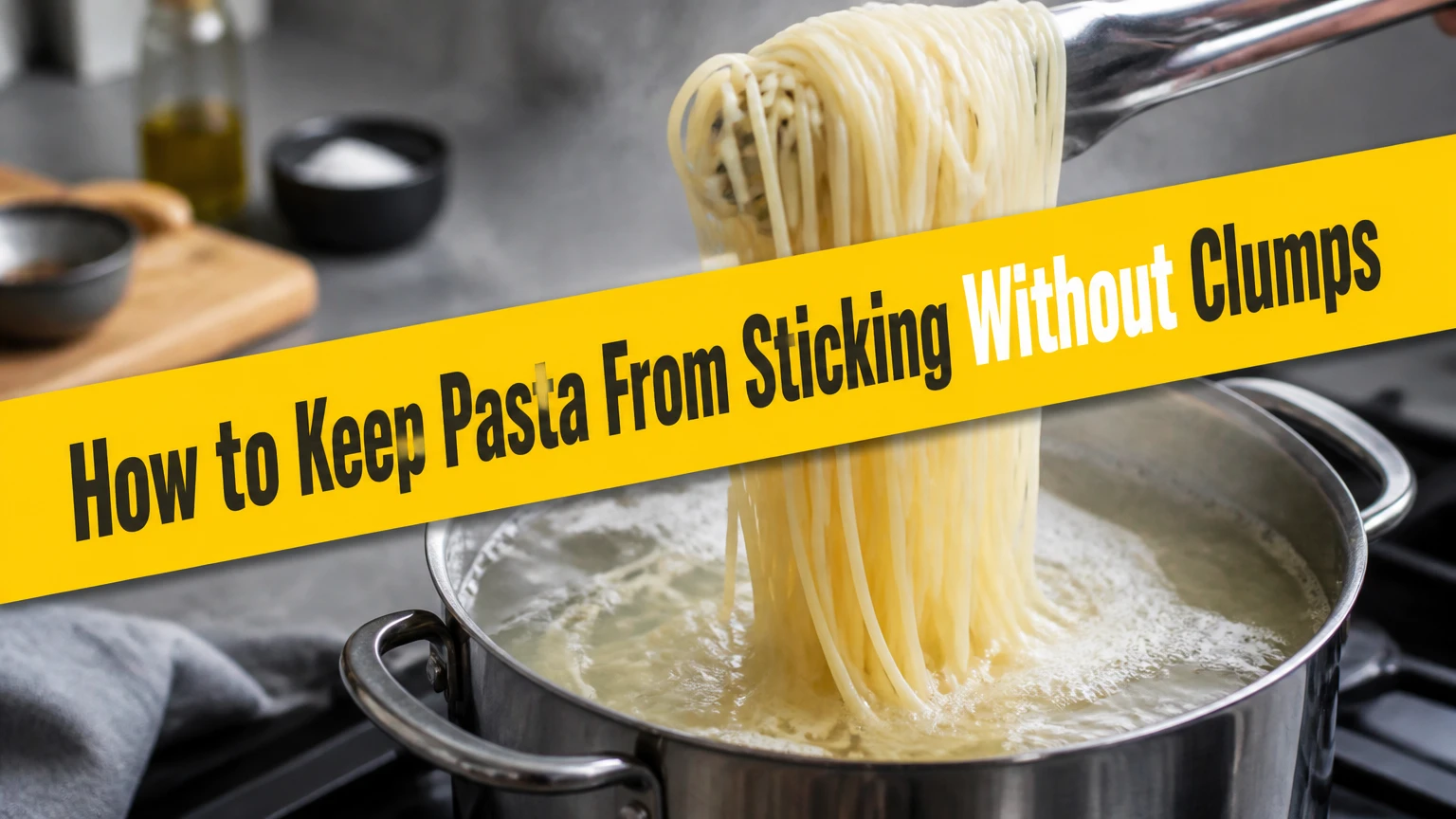
To keep pasta from sticking, cook it in adequately salted water, separate the pieces during the first 60-90 seconds, stir periodically, and transfer it directly into sauce after draining. For pasta that must be held, toss it with a small amount of oil or rinse it according to its final use, because oil and water reduce sauce adhesion.
Key facts at a glance
The highest-risk sticking period is the first 1-2 minutes after dry pasta enters the water.
A practical starting point is 3-4 liters of water for 450 grams of dried pasta, with less water possible in a wide pot when you stir reliably.
Oil in the boiling water does not prevent pasta from sticking because cooking oil floats separately from the pasta water.
Hot pasta should move directly from the pot into sauce; pasta for a cold salad can be rinsed and lightly oiled.
Reserve 120-240 milliliters of pasta water before draining to loosen sauce and rehydrate clumps.
Fresh pasta, gluten-free pasta, and rice noodles need shorter cooking times and more attentive handling than standard dried durum-wheat pasta.
Why Does Pasta Stick Together?
Pasta sticks when hydrated surface starch becomes concentrated between neighboring pieces and forms an adhesive film as the pasta cools or sits undisturbed. Heat releases starch from the outer layer, while insufficient movement, crowded cookware, draining, and delayed saucing allow that film to bind adjacent strands or shapes.
Pasta contains starch granules made mainly of amylose and amylopectin. During cooking, those granules absorb water and swell in a process called gelatinization. Some starch remains on the pasta surface and some disperses into the water, which is why properly cooked pasta leaves cloudy, starchy cooking liquid.
Surface starch is useful when finishing pasta with sauce. The same starch becomes a problem when bare pieces touch for long enough to cool. Long strands form contact points along their length, while penne, shells, and fusilli can trap starch-rich water inside their hollows and ridges.
The practical lesson is more important than the chemistry: separate pasta while the exterior is softening, keep the pieces hydrated, and give them a destination after draining. Pasta does not need to boil violently for its entire cooking time, but it must not sit in a motionless, crowded mass.
How Much Water Prevents Pasta From Sticking?
Use about 3-4 liters of water for 450 grams of dried pasta as a reliable household starting point. The traditional 4-6 quart range also works, but a large water volume is a dilution aid rather than a guarantee, and a smaller volume can succeed when the pot is wide and the pasta is stirred promptly.
The cooking vessel matters. A narrow pot lets long strands overlap before they soften, whereas a wide pot gives spaghetti and linguine more room to separate. Short shapes are less likely to form a single tangle, but excessive pasta still lowers the water temperature and concentrates surface starch.
Use these quantities as practical targets:
| Dried pasta amount | Water starting point | Salt range | Suitable pot |
|---|---|---|---|
| 115 g, 4 oz | 1-1.5 L | 4-6 g | 3-4 L saucepan |
| 225 g, 8 oz | 1.5-2.5 L | 7-10 g | 4-5 L pot |
| 450 g, 1 lb | 3-4 L | 14-20 g | 6-8 L pot |
| 900 g, 2 lb | 5-7 L | 28-40 g | 10-12 L stockpot |
Salt primarily seasons the pasta. Claims that ordinary salting reliably prevents sticking by restricting starch swelling overstate its effect; salt concentration and cooking temperature vary too widely in home kitchens for that to be the main control. Add salt after the water boils so it dissolves promptly, using less when a medically restricted diet or a highly salty sauce requires it.
Can You Cook Pasta in Less Water?
Yes. A half-volume method can work for 225-450 grams of pasta if the pot is wide, the pasta is submerged quickly, and you stir frequently. Less water produces more concentrated cooking liquid, which can help emulsify a sauce, but it leaves less thermal and dilution margin when the pot is crowded.
Less water is a poor choice for a large batch of long pasta, fragile fresh pasta, or a cook who cannot stir during the first few minutes. The objective is adequate water around each piece, not a magic gallon-per-pound rule.
How to Keep Pasta From Sticking: The Step-by-Step Method
The most reliable method takes roughly 10-15 minutes for typical dried pasta, including boiling time, and requires a pot, colander, tongs or a wooden spoon, salt, sauce, and a heatproof measuring cup. Early separation determines success more than adding oil, using an unusually large pot, or maintaining a rolling boil after the pasta has softened.
Step 1: Prepare the Pot and Sauce
Place the pot on the largest suitable burner and start heating the water before opening the pasta package. Warm the sauce in a separate skillet during the final minutes of cooking so drained pasta never waits in a cold colander.
Set out tongs, a spoon, a heatproof cup for pasta water, and the serving bowl. This setup removes the most common delay: searching for equipment while cooked pasta loses moisture.
You will know it worked when: the sauce is hot and the transfer tools are ready before the pasta reaches al dente.
Common mistake: cooking pasta first and beginning the sauce afterward. That creates an unavoidable holding period.
Step 2: Bring the Water to a Full Boil
Bring the measured water to a boil before adding dried pasta. A full boil helps the water recover heat after the pasta enters, but vigorous bubbling is not a substitute for stirring, especially during the first minute.
Add the salt once the water boils. For 450 grams of pasta, 14-20 grams of salt is a practical range, although the exact amount should match the sauce and dietary needs.
You will know it worked when: bubbles continue around the pasta shortly after it enters the pot and the water does not become tepid.
Common mistake: adding pasta to lukewarm water and leaving it untouched while the pot heats. Slow hydration gives neighboring pieces more time to form a starchy bond.
Step 3: Add Pasta and Stir Immediately
Add the pasta in one batch, then stir from the bottom and around the sides for 60-90 seconds. Use tongs for spaghetti and a wooden spoon or heatproof spatula for penne, shells, and other short shapes.
Long strands should be fanned into the water rather than dropped as a tight bundle. If the strands are too long for the pot, wait 20-30 seconds for the submerged portion to soften, then bend the remainder under the water and stir.
You will know it worked when: no strands remain fused in a bundle and the pieces move independently when lifted.
Common mistake: stirring only the surface. Pasta often sticks first at the bottom, where pieces contact the hottest metal and one another.
Step 4: Stir at Shape-Specific Intervals
Stir again after another 60 seconds, then every 2-3 minutes until the pasta is nearly done. Long strands need more frequent lifting because their contact area is large; short shapes need enough agitation to prevent bottom settling.
Use the package time as a starting point, but taste one piece 1-2 minutes before the stated finish. Pasta intended for a skillet sauce can be drained slightly firm because it will continue cooking during the final toss.
| Pasta type | First stirring period | Later stirring | Typical finishing point |
|---|---|---|---|
| Spaghetti or linguine | Continuous for 60-90 seconds | Every 1-2 minutes | 1 minute before package time |
| Penne or rigatoni | 60 seconds | Every 2-3 minutes | Al dente in the center |
| Shells or orecchiette | 60-90 seconds | Every 2 minutes | Tender with slight resistance |
| Fresh tagliatelle | 30-45 seconds | One gentle stir | Usually 1-3 minutes total |
| Gluten-free corn or rice pasta | 60-90 seconds | Every 1-2 minutes | Package time, then taste |
You will know it worked when: pasta pieces separate when stirred and no layer has settled into a dense mat on the bottom.
Common mistake: stirring aggressively after fresh pasta has softened. Fragile noodles can tear, release excess starch, and become gummy.
Step 5: Reserve Water and Drain Efficiently
Before draining, reserve 120-240 milliliters of cooking water for a 450-gram batch. Use a measuring cup, ladle, or carefully scoop from the pot, then drain without shaking the pasta dry for an extended period.
Do not leave pasta in the colander while you finish the sauce. A colander is a drainage tool, not a holding vessel. The exterior cools and dries quickly, while the remaining surface starch becomes tackier.
You will know it worked when: the pasta remains moist, separate, and hot as it leaves the pot.
Common mistake: draining all the water and then discovering that a thick sauce needs loosening. Pasta water is difficult to recreate once discarded.
Step 6: Transfer Pasta Directly Into Sauce
Move pasta into the hot sauce within about 30-60 seconds of draining. Tongs let you transfer long shapes with some cooking water attached; a spider strainer works well for short pasta.
Toss over medium heat for 30-90 seconds, adding pasta water 15-30 milliliters at a time until the sauce coats the noodles without becoming watery. The water contributes moisture and starch, while movement distributes fat, cheese, or tomato solids across the pasta.
You will know it worked when: sauce clings in a thin, continuous coating and the pasta separates whenever you lift it.
Common mistake: adding a large amount of pasta water at once. Incremental additions preserve control and prevent a diluted sauce.
Which Anti-Sticking Method Fits Your Meal?
Direct saucing is the best default for hot pasta, while oiling and rinsing are holding techniques with specific trade-offs. The correct choice depends on whether the pasta must carry sauce, cool for storage, or remain separate for service.
| Final use | Best method | Quantity or time | Sauce consequence |
|---|---|---|---|
| Hot marinara or meat sauce | Direct transfer and toss | 30-90 seconds | Maximizes coating |
| Carbonara or cheese sauce | Toss off heat with pasta water | 60-120 mL water | Supports emulsion |
| Cold pasta salad | Rinse, drain, then oil lightly | 1-2 tsp oil per 450 g | Reduces dressing adhesion |
| Meal-prep pasta | Cool quickly and oil lightly | 1 tsp oil per 450 g | Keeps portions separate |
| Buffet pasta with sauce | Par-cook, cool, reheat | 2-3 minutes under package time | Requires hot-water refresh |
| Soba or rice noodles | Rinse under cold water | 15-30 seconds | Removes surface starch |
Should You Add Oil to Pasta Water?
No. Oil floating on the water surface has little sustained contact with submerged pasta, so it is an inefficient anti-sticking method. After draining, residual oil can coat the pasta and make tomato, cheese, or meat sauce slide away.
Oil becomes useful after cooking when pasta will be held without sauce. Use approximately 1-2 teaspoons of olive or neutral oil per 450 grams, toss thoroughly, and cool the pasta in a shallow layer rather than leaving it in a hot heap.
Should You Rinse Pasta After Cooking?
Rinse standard wheat pasta only when you need to stop cooking, remove surface starch, or serve it cold. Cold water removes the starchy coating that helps sauce cling, so rinsing is usually counterproductive for hot Italian-style dishes.
Rinsing is appropriate for pasta salad, soba, rice noodles, and some gluten-free noodles. Use cold running water for 15-30 seconds, then drain thoroughly. A brief rinse of 5-10 seconds can cool meal-prep pasta, but it removes less starch and may leave pieces more adhesive if they are not oiled.
How Do Fresh and Gluten-Free Pasta Differ?
Fresh pasta cooks quickly and requires gentler handling, while gluten-free pasta often releases more surface starch and can break if overcooked. Both types benefit from immediate separation, but neither should be treated exactly like a thick dried durum-wheat shape.
Fresh tagliatelle or fettuccine may cook in 1-3 minutes, so the first stir must happen immediately and the draining equipment must be ready. Fresh filled pasta such as ravioli should be moved with a spider or slotted spoon rather than vigorously stirred, because agitation can split the seams.
Gluten-free pasta made from corn, rice, quinoa, or legumes varies substantially by brand. Follow the package time, begin tasting 1-2 minutes early, and use gentle but regular stirring. If the cooking water becomes very cloudy or thick, the pasta is releasing significant starch and needs prompt draining rather than extended boiling.
What Are the Best Fixes for Clumped Pasta?
Clumped pasta can often be recovered with hot water and movement before the starch film dries. Do not pull a cold, dry clump apart forcefully, because strands can tear and remain bonded at multiple points.
| Problem | Immediate fix | Recovery time | Avoid |
|---|---|---|---|
| Strands clump in the pot | Add a splash of boiling water and separate with tongs | 15-30 seconds | Turning off heat immediately |
| Pasta clumps in the colander | Return it to the pot with 30-60 mL hot water | 30-60 seconds | Pulling it apart dry |
| Sauced pasta thickens | Add 15-30 mL pasta water and toss | 30-60 seconds | Adding cold water |
| Chilled pasta sticks in storage | Rinse briefly or loosen with warm water | 15-30 seconds | Microwaving a dry brick |
| Pasta is gummy and broken | Stop cooking and drain; use a thin sauce | Immediate | Boiling it longer |
For a drained clump, return the pasta to the warm pot, add a few tablespoons of reserved water or warm sauce, and toss gently. Heat rehydrates the exterior; movement breaks contact points. If the pasta has become severely overcooked, separation may improve but its texture cannot be fully restored.
Why Does Sauce Slide Off Pasta?
Sauce slides off when the pasta surface has been coated with oil, stripped of starch by rinsing, or overcooked until its exterior becomes soft and slick. A sauce that is too thin or insufficiently reduced also fails to cling, even when the pasta was cooked correctly.
Finish the pasta in the sauce rather than rinsing it. Add a small amount of reserved water and toss until the sauce thickens around the noodles. For butter, cheese, or cream sauces, off-heat tossing helps prevent separation; for tomato sauces, medium heat can reduce excess liquid while the pasta finishes.
One practitioner rule is especially useful: if sauce pools at the bottom of the bowl, stop adding water. If sauce looks dry and leaves bare patches on the pasta, add 15 milliliters of pasta water and toss for 20-30 seconds before deciding whether more is needed.
How Should You Hold Pasta for Meal Prep or a Buffet?
Cook pasta slightly underdone, cool it quickly, and store it separately from sauce when the meal will be eaten later. For 450 grams of pasta, a typical holding method uses 1 teaspoon of oil after cooling, while buffet service requires a reheat step to restore moisture and texture.
For meal prep, cook to approximately 1-2 minutes short of the package instruction, drain, and rinse briefly if you need to stop carryover cooking. Toss with a small amount of oil, spread in a shallow container, and refrigerate promptly.
The United States Department of Agriculture advises refrigerating perishable cooked foods within 2 hours, or within 1 hour when the ambient temperature exceeds 90°F (32°C). USDA guidance also places common refrigerated leftovers in a 3-4 day window, provided they were cooled and stored correctly.
For a buffet, par-cook pasta for roughly 2-3 minutes less than the final target, cool it, then refresh portions in boiling water for about 30-60 seconds before saucing. Holding cooked pasta dry in a chafing dish encourages both sticking and surface drying.
Common Mistakes That Make Pasta Sticky
The following errors create most household clumping problems, even when the pasta brand and shape are suitable.
- Adding oil to the cooking water: Oil floats, provides little contact with the pasta, and can later interfere with sauce adhesion.
- Using a small, crowded pot: Crowding lowers the temperature and concentrates starch around neighboring pieces.
- Skipping the first stir: The first 60-90 seconds determine whether softened surfaces remain separate.
- Leaving pasta in the colander: Heat loss and surface drying allow starch-rich contact points to set.
- Rinsing pasta meant for hot sauce: Rinsing removes the surface starch that helps sauce emulsify and cling.
- Overcooking: A damaged, swollen exterior releases more starch and produces a soft, gummy coating.
A large pot is useful, but it cannot compensate for delayed stirring. Conversely, a smaller pot can produce separate pasta when the batch is modest, the pasta is submerged promptly, and the cook maintains movement.
How Much Does It Cost to Prevent Sticking?
Preventing sticky pasta costs approximately $0 beyond ordinary ingredients and cookware. A household typically needs a pot costing $20-$60, a heatproof spoon or tongs costing $5-$20, and 1-2 teaspoons of oil only for pasta that will be held.
The most economical improvement is procedural: stir early, reserve water, and sauce immediately. Buying a larger pot may improve long-strand handling, but purchasing premium pasta or specialized equipment is not necessary to prevent ordinary sticking.
The limitation is worth stating clearly: no method guarantees perfect separation after prolonged holding. Pasta continues absorbing moisture, sauces change viscosity, and refrigeration alters texture. The goal is to match the post-cooking treatment to the final dish, not to force every batch into the same technique.
Frequently Asked Questions
Does adding butter keep pasta from sticking?
Butter can reduce sticking after draining, but it is best reserved for plain pasta, reheating, or dishes where a buttery coating is intended. Butter on pasta that will receive tomato or cheese sauce can reduce adhesion, just like oil. Directly tossing hot pasta with the finished sauce is usually more effective.
Does salt stop pasta from sticking?
Salt mainly improves flavor and has a much smaller anti-sticking effect than stirring, adequate water, and immediate saucing. Salt the water according to the sauce and dietary requirements, but do not rely on salt to separate crowded or neglected pasta.
Can I make pasta ahead without it sticking?
Yes. Cook the pasta slightly underdone, cool it quickly, toss it with about 1 teaspoon of oil per 450 grams, and store it separately from the sauce. Refrigerate within the USDA two-hour window and use the pasta within 3-4 days for best quality and safety.
Why does my spaghetti stick even with plenty of water?
Spaghetti can stick despite abundant water when it enters as a tight bundle, remains undisturbed during the first minute, or sits in the colander after draining. Fan the strands into boiling water, stir for 60-90 seconds, and transfer them directly to hot sauce.
Is rinsing pasta better than oiling it?
Rinsing removes surface starch, while oiling adds a barrier, so neither method is ideal for hot sauce. For cold pasta salad, rinse and use a light oil coating; for meal prep, either brief rinsing or oiling can work, but the pasta should be cooled and stored separately from sauce.
How do restaurants keep pasta from sticking?
Restaurants commonly cook pasta close to service, transfer it directly into sauce, and finish it with cooking water. For advance preparation, kitchens portion par-cooked pasta, cool it quickly, oil it lightly when needed, and refresh each portion briefly in boiling water before saucing.
The Bottom Line
The most dependable way to keep pasta from sticking is to separate it during the first 60-90 seconds, stir every few minutes, drain efficiently, and toss it directly with hot sauce. Use oil only for pasta that must remain separate, and use cold-water rinsing for cold salads, soba, and rice noodles. Matching the method to the final dish prevents both clumps and sauce that slides off.