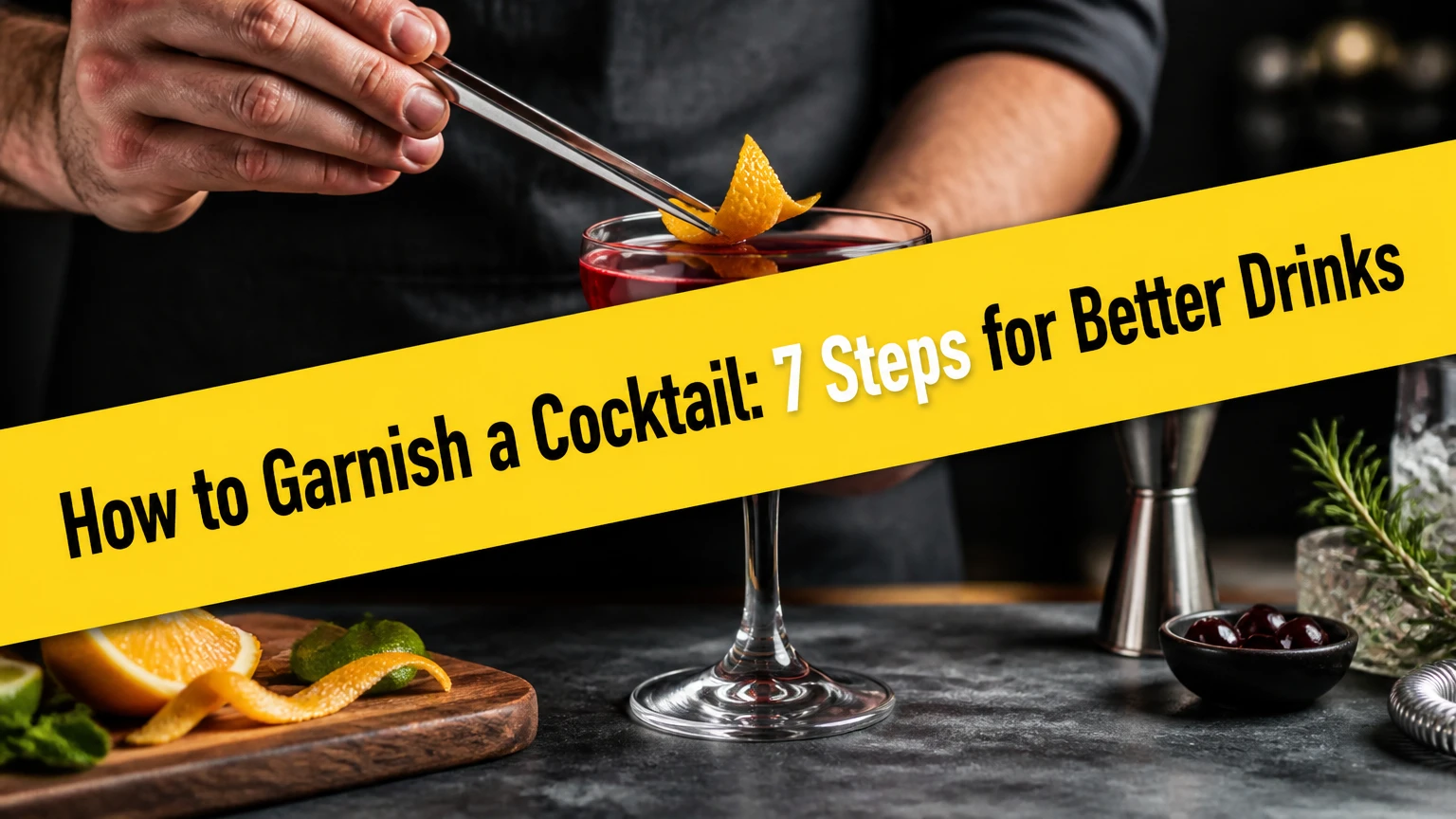
A cocktail garnish is a fresh, dried, edible, or aromatic element added to improve a drink’s appearance, aroma, texture, or flavor. To garnish a cocktail, prepare clean ingredients, cut them precisely, express citrus oils when appropriate, rim or skewer components before serving, and place one functional garnish with one aromatic accent.
Key Facts / At a Glance
A citrus twist usually measures 2-3 inches long and about 1/16 inch thick.
Citrus wheels and half-moons typically measure 1/8-1/4 inch thick.
Express a citrus peel with the colored skin facing the drink, not the white pith.
A partial salt or sugar rim gives better flavor control than a fully coated rim.
Fresh herbs provide stronger aroma than dehydrated fruit but usually last only 1-3 days.
One structural garnish plus one aromatic accent is a practical limit for most cocktails.
What Does a Cocktail Garnish Do?
A cocktail garnish changes how the drink looks, smells, feels, or tastes at the moment of service. Lemon oils reach the nose before a Martini does, a salted rim changes the first sip of a Margarita, and a pickled onion adds acidity and salinity to a Gibson.
The best garnish has a job. A lime wedge supplies optional juice, an orange peel releases aroma, an olive adds savory flavor, and a mint sprig creates a fresh nose. A decorative element such as an edible flower may contribute appearance without improving the drink’s balance.
A garnish should support the cocktail’s dominant ingredients. Orange suits whiskey, rum, and bitter aperitifs; lemon suits gin and sparkling drinks; lime suits agave spirits and tropical formulas. Flavor pairing is more reliable than color matching.
The Four Garnish Functions
| Function | Typical garnish | Primary effect | Suitable examples |
|---|---|---|---|
| Aromatic | Lemon peel, mint, rosemary | Releases volatile oils near the nose | Martini, Mojito, Old Fashioned |
| Flavor-bearing | Olive, cherry, cucumber | Adds taste during or after sipping | Dirty Martini, Manhattan, Gimlet |
| Structural | Citrus wedge, wheel, skewer | Attaches, supports, or provides juice | Margarita, Negroni, Bloody Mary |
| Decorative | Edible flower, dehydrated wheel | Adds visual character | Spritz, mocktail, Collins |
What Should You Prepare Before Garnishing?
Prepare the garnish station before mixing the drink. You need clean produce, a sharp paring knife or Y-peeler, a cutting board reserved for food, a small tray, cocktail picks, a clean cloth, and a waste bowl.
A sharp blade produces a smoother cut with less crushing. A dull knife tears citrus membranes and bruises herbs, while a channel knife creates narrow citrus strips that work well in classic presentations.
Tools and Materials
| Item | Typical quantity | Best use | Replacement |
|---|---|---|---|
| Y-peeler | 1 | Long citrus ribbons | Sharp vegetable peeler |
| Paring knife | 1, 2.5-4 inch blade | Wheels, wedges, trimming pith | Small chef’s knife |
| Cutting board | 1, 8 x 12 inch minimum | Clean produce preparation | Sanitized plate |
| Cocktail picks | 4-12 | Olives, onions, cherries | Bamboo toothpicks |
| Fine salt or sugar | 1-2 tablespoons | Glass rims | Tajín, cocoa, crushed spices |
| Small tray | 1 | Holding prepared garnishes | Saucer lined with parchment |
The U.S. Food and Drug Administration advises washing produce under running water and not using soap, detergent, or commercial produce wash. Wash hands before preparation, then dry ingredients thoroughly because surface water weakens rims and makes herbs deteriorate faster.
How to Garnish a Cocktail in Seven Steps
A standard cocktail garnish takes about 30-90 seconds once the ingredients are prepared. The seven-step method works for citrus, herbs, rims, skewers, and simple dried fruit; the cut, aroma, and placement should change according to the drink.
Step 1: Match the Garnish to the Cocktail
Choose the garnish after identifying the drink’s main spirit, strongest aromatic, acidity, sweetness, and serving glass. A lemon twist fits a dry gin Martini, while an orange peel fits an Old Fashioned because the peel’s oils complement whiskey and bitters.
Avoid using a garnish solely because its color matches the drink. A grapefruit wheel can overpower a delicate vodka highball, and rosemary can dominate a light sparkling cocktail.
You’ll know it worked when: the garnish reinforces the drink’s aroma or gives the guest a useful flavor option.
Common mistake: choosing a sweet garnish for a dry, savory drink without a balancing reason.
Step 2: Wash, Dry, and Inspect the Ingredients
Rinse citrus, fruit, and herbs under cool running water, inspect for bruising or mold, and dry each item completely with a clean towel. Do not wash herbs hours in advance unless you can dry and refrigerate them properly.
For commercial service, keep ready-to-eat garnishes away from raw meat, seafood, and unwashed produce. The FDA Food Code uses 41°F or 5°C as the cold-holding benchmark for many perishable foods, so refrigerated fruit and herbs should remain cold until service.
You’ll know it worked when: the ingredient has no visible soil, standing water, damaged areas, or unpleasant odor.
Common mistake: storing wet herbs in a sealed container, which accelerates decay.
Step 3: Cut the Shape and Control the Thickness
Use a sharp knife to cut wheels and wedges at 1/8-1/4 inch thick, or use a Y-peeler for a 2-3 inch citrus twist. Keep the colored zest layer intact and remove excess white pith when the peel will sit in the drink for more than a few minutes.
A twist for a stirred drink should be wide enough to hold without tearing, generally 1/2-1 inch wide. Cut a small slit through the center of a wheel or wedge if the garnish must sit securely on a rim.
You’ll know it worked when: the cut edge is clean, the garnish holds its shape, and the thickness is consistent.
Common mistake: leaving a thick strip of pith on a peel. Pith bitterness becomes more noticeable as the drink warms.
Step 4: Express Citrus Oils Over the Drink
Hold the citrus peel with the colored skin facing downward, 2-4 inches above the cocktail, and pinch or bend it sharply once. The released oils should land on the surface and around the rim; rub the peel around the rim only when the recipe calls for a stronger citrus aroma.
For a flaming orange peel, use a lighter or match only with proper distance from the liquid, hands, hair, paper, and flammable alcohol vapors. The flame is optional, not a requirement for a good Old Fashioned.
You’ll know it worked when: the drink smells distinctly of citrus before the first sip and the peel shows a slight sheen.
Common mistake: expressing the peel with the pith facing down, which releases less aromatic oil and more bitter moisture.
Step 5: Prepare a Controlled Salt or Sugar Rim
Moisten only the outside edge of the glass with a lime wedge, then roll the rim through a shallow layer of salt or sugar at roughly a 45-degree angle. A half rim or quarter rim gives the drinker control and keeps seasoning from falling into every sip.
Rim the glass before adding ice and liquid. For a Margarita, use kosher salt, fine sea salt, or a chile-lime blend; for a dessert cocktail, use superfine sugar, cocoa, or finely crushed spice.
You’ll know it worked when: the coating adheres in a narrow, even band and no liquid drips down the glass.
Common mistake: dipping the entire rim into wet juice. Excess moisture causes clumps and sends loose salt into the cocktail.
Step 6: Skewer Loose Garnishes Correctly
Thread olives, cocktail onions, cherries, cornichons, or berries onto a clean 3-4 inch pick. One or three pieces is a common service convention because odd numbers look balanced, but the drink’s scale matters more than the number.
Pierce firm ingredients through their center without splitting them. Place the pick across the rim, rest it on the ice, or position it inside the drink according to the glass and recipe.
You’ll know it worked when: the garnish stays secure while the guest lifts the glass or removes the pick.
Common mistake: using a pick too short for the glass, which causes the garnish to slide into the drink.
Step 7: Place the Garnish at Service
Add the garnish immediately before serving so aromas remain concentrated and delicate ingredients stay crisp. Rest a citrus wheel on the rim, float a dehydrated wheel, insert a herb sprig beside the ice, or place a pick where it will not obstruct drinking.
A garnish should not block the straw, cover the drink’s surface completely, or make the glass difficult to hold. Keep the finished cocktail visually open.
You’ll know it worked when: the guest can drink comfortably, identify the garnish, and smell it during the first sip.
Common mistake: adding a heavy fruit skewer to a delicate coupe, where it unbalances the glass.
Which Garnish Fits Each Cocktail?
The most suitable garnish depends on the cocktail’s base spirit, acidity, sweetness, bitterness, and glassware. The table below gives conventional pairings, but the garnish should remain proportional to the drink.
| Cocktail | Primary garnish | Preparation specification | Why it works |
|---|---|---|---|
| Martini | Lemon twist or green olive | 2-3 inch twist or 1-3 olives | Citrus lifts gin; olive adds salinity |
| Old Fashioned | Orange peel | 2 x 1/2 inch peel, expressed | Orange oils soften whiskey and bitters |
| Margarita | Lime wheel and salt rim | 1/8-1/4 inch wheel, half rim | Lime matches agave; salt moderates acidity |
| Manhattan | Brandied cherry | 1 cherry on a 3-4 inch pick | Adds dark fruit sweetness |
| Negroni | Orange peel or half-moon | 2 inch peel or 1/4 inch half-moon | Orange complements bitter botanicals |
| Mojito | Mint sprig and lime wedge | 1 large sprig, 1 wedge | Mint supplies aroma; lime offers acidity |
| Daiquiri | Lime wheel | 1/8 inch wheel | Clean, restrained citrus presentation |
| Tom Collins | Lemon wheel or cherry | 1/8-1/4 inch wheel | Echoes lemon and adds color |
| Nonalcoholic spritz | Orange half-moon or herb | 1/4 inch half-moon | Adds aroma without extra sweetness |
A Martini garnish also changes the drink’s perceived flavor. A lemon twist emphasizes dryness and citrus aroma, while an olive introduces salt and savory notes. Neither is universally correct.
Fresh or Dehydrated Garnishes: Which Is Better?
Fresh garnishes provide the strongest aroma and most immediate flavor, while dehydrated garnishes offer predictable shape, low daily waste, and longer storage. Fresh citrus and herbs suit aromatic drinks; dehydrated fruit suits high-volume service, batching, and drinks where a slow visual presentation matters more than fresh juice.
| Attribute | Fresh garnish | Dehydrated garnish |
|---|---|---|
| Typical preparation time | 5-30 seconds per serving | 6-12 hours per batch |
| Useful storage period | 1-3 days for cut fruit and herbs | 1-8 weeks when fully dry and sealed |
| Aroma strength | High at service | Moderate, often requires rehydration |
| Waste profile | Peels and bruised pieces daily | Low after batch production |
| Equipment | Knife, peeler, board | Oven or dehydrator, rack, airtight container |
| Best applications | Martini, Old Fashioned, Mojito | Spritz, punch, high-volume service |
To dehydrate citrus, slice it evenly at about 1/8 inch, arrange pieces without overlap, and dry at 130-140°F, or 55-60°C, until brittle. Exact time varies with fruit water content and equipment, so texture is a better endpoint than the clock.
Dehydrated fruit is not a universal upgrade. It contributes less fresh aroma, cannot supply juice, and can taste leathery when under-dried. Store completely cooled pieces in an airtight container with a dry environment, and discard pieces showing moisture, mold, or off odors.
How Much Time and Money Does a Garnish Take?
A simple cocktail garnish usually costs about $0.05-$0.50 per serving at home, while premium cherries, edible flowers, and specialty products can cost $0.75-$2 or more. Preparation takes 5-30 seconds for fresh cuts and several hours for dehydrated fruit, although dehydrating runs as a batch process.
These are typical U.S. retail estimates, not universal prices. The AI Overview’s Tk figures are location-specific and should not be treated as global costs; ingredient prices vary by country, season, retailer, and purchase volume.
| Garnish type | Typical prep time | Typical cost per serving | Practical specification |
|---|---|---|---|
| Lemon or lime twist | 10-20 seconds | $0.05-$0.20 | 2-3 inches long, minimal pith |
| Citrus wheel or wedge | 15-30 seconds | $0.05-$0.20 | 1/8-1/4 inch thick |
| Fresh herb sprig | 5-10 seconds | $0.10-$0.35 | 1 large mint or rosemary sprig |
| Olive or onion pick | 10-20 seconds | $0.15-$0.60 | 1 or 3 pieces on a 3-4 inch pick |
| Salt or sugar rim | 20-40 seconds | $0.02-$0.15 | Outer half rim, shallow coating |
| Dehydrated citrus | 6-12 hours per batch | $0.15-$0.50 | 130-140°F until brittle |
| Premium cherry or flower | 5-15 seconds | $0.75-$2.00+ | One drained cherry or flower |
What Are the Most Common Garnish Problems?
Most garnish failures come from poor moisture control, excessive pith, weak attachment, or a mismatch between garnish intensity and drink structure. Each problem has a practical recovery method.
Bitter Citrus Peel
Trim thick pith from a long twist with a paring knife, but do not remove the colored zest. If the finished drink already tastes bitter, remove the peel rather than adding more sugar automatically.
Bruised or Soggy Herbs
Revive wilted mint or basil in ice water for 10-15 minutes, then dry it thoroughly. Handle herbs by the stem and clap or “slap” a mint sprig once between clean hands only when you are serving it, because repeated bruising darkens leaves.
Rim Crumble
Use less moisture and a shallower layer of salt. A clean, dry glass rim with a narrow outer coating is easier to control than a thick full rim.
Over-Garnishing
Limit most drinks to one structural or flavor-bearing garnish plus one aromatic accent. Multiple fruits, flowers, herbs, and powders compete for attention and can make the cocktail difficult to drink.
Garnish Falling Into the Glass
Cut a small slit into a wheel or wedge, use a longer pick, or place the item inside the ice rather than balancing it on a thin rim. Heavy skewers belong on rocks glasses and sturdy highballs.
Fruit Spoiling Quickly
Refrigerate cut fruit in a shallow airtight container lined with a dry paper towel, and prepare only a one- to three-day supply. Never use fruit with mold, fermentation odors, sliminess, or leaking juice.
How Should You Adapt Garnishes for Different Situations?
A good garnish method changes with service volume, equipment, dietary needs, and the drink’s presentation. The garnish must remain safe, stable, and easy to consume in the actual setting.
For Home Bartenders
Prepare only the quantity needed for the evening, usually one citrus fruit for 4-8 twists or wheels depending on size. A Y-peeler, paring knife, reusable metal picks, and one small tray cover nearly every common home cocktail.
A vegetable peeler can replace a channel knife, and a saucer can replace a professional garnish tray. Home bartenders should master clean citrus cuts before attempting flames, smoke, or elaborate edible structures.
For High-Volume Bars
Batch dehydrated wheels, pre-portion olives, and use labeled containers for each service station. Prepare a two-hour working quantity of delicate herbs rather than exposing the entire day’s supply to room temperature.
Speed should not eliminate inspection. A dehydrated wheel may reduce waste, but it cannot replace the fresh citrus aroma required by a Martini or the optional juice expected with some Margaritas.
For Nonalcoholic Cocktails
Use the same pairing logic for mocktails, shrubs, sparkling water, and zero-proof spirits. Cucumber ribbons, citrus wheels, mint, basil, and edible flowers can provide aroma and visual structure without adding alcohol or excessive sugar.
Avoid using an oversized garnish to compensate for a weak drink. A balanced nonalcoholic cocktail needs correct acidity, sweetness, dilution, and carbonation before decoration.
For Guests With Dietary or Allergy Concerns
Confirm that flowers are specifically sold as edible and have not been treated with ornamental pesticides. Use separate picks and tools when cross-contact with allergens is possible, and avoid unknown decorative plants.
FoodSafety.gov consistently treats cut fresh produce as perishable food requiring careful handling. Garnishes are small, but they still enter or touch the drink and should receive the same hygiene attention as other ready-to-eat ingredients.
Expert Rules for Better Cocktail Garnishes
Aroma usually matters more than decoration. A correctly expressed lemon peel can change the first impression of a Martini more effectively than an elaborate skewer because volatile oils reach the nose before the liquid reaches the palate.
Garnish size should follow glass scale. A 3-inch peel suits a rocks glass, but the same peel can overwhelm a Nick & Nora glass. The garnish should remain visible without becoming the largest object in the presentation.
The drink’s temperature changes the garnish decision. Cold, diluted cocktails benefit from aromatic oils and herbs because low temperature suppresses perceived aroma. A strongly flavored garnish can be unnecessary in a warm or high-sugar drink.
Rim only what the drinker needs. A full salt rim forces seasoning into every sip, while a half rim lets the guest alternate between salted and unsalted tastes. This is a service decision, not merely a decorative preference.
FAQ
Should a cocktail garnish be added before or after shaking?
Add the garnish after shaking, straining, and final ice placement. Citrus peels, herbs, fruit, and flowers lose aroma or structure when shaken, while a rim must be prepared before liquid enters the glass. Place the finished garnish immediately before service for the cleanest appearance.
Can I use lemon instead of lime for a cocktail garnish?
You can substitute lemon for lime when the drink’s flavor remains balanced, but the result will be less tropical and often less sharp. Lemon suits gin, whiskey, vodka, and sparkling cocktails; lime generally fits tequila, rum, mezcal, and drinks built around tropical acidity.
How do I store cut cocktail garnishes overnight?
Store cut citrus and fruit in an airtight container in the refrigerator with a dry paper towel beneath the pieces. Keep herbs cool and lightly protected from crushing. Use cut fruit within 1-3 days, and discard any ingredient with mold, slime, fermentation odor, or unusual discoloration.
Are edible flowers safe to put on cocktails?
Only use flowers labeled for culinary or edible use from a known supplier. Ornamental flowers may contain pesticides or treatments that are not intended for consumption. Remove nonedible stems, avoid unknown wild plants, and keep flowers refrigerated according to the supplier’s instructions.
How can I garnish a cocktail without special tools?
Use a small sharp knife, a vegetable peeler, a clean cutting board, a saucer, and wooden toothpicks. A knife can make wedges and wheels, a peeler can make citrus ribbons, and a saucer can hold salt or sugar for a controlled partial rim.
What is the easiest cocktail garnish for beginners?
A citrus wheel is the easiest starting garnish because it requires only a sharp knife and consistent thickness. Cut a lemon, lime, or orange into 1/8-1/4 inch rounds, make one slit from the edge to the center, and rest the piece on the glass rim.
The Bottom Line
To garnish a cocktail well, match the garnish to the drink’s flavor, prepare clean and dry ingredients, cut consistently, express citrus oils correctly, control the rim, and place the final element without obstructing the guest. Start with one functional garnish and one aromatic accent, then add complexity only when it improves the drinking experience.