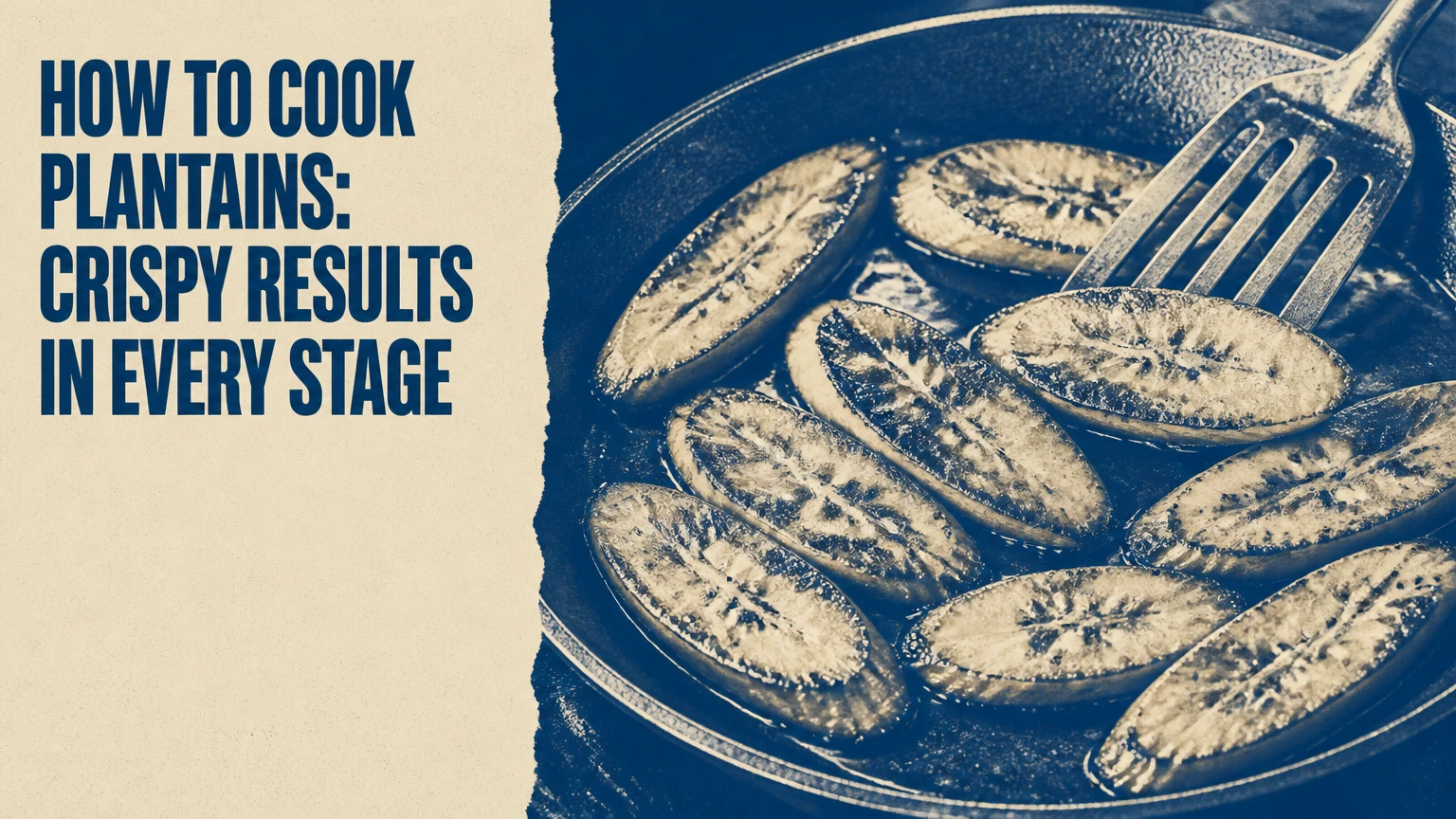
To cook plantains, match the method to ripeness: fry green plantains twice for crisp savory tostones, pan-fry yellow or black plantains for caramelized maduros, or bake and boil them for lower-fat sides. The decisive factors are peel color, moderate heat for ripe fruit, and cooking until the center is fully tender.
Key facts at a glance
Green plantains are starchy and best for tostones, boiling, mashing, and plantain chips.
Yellow plantains with black spots are sweet enough for maduros but firm enough to slice cleanly.
Mostly black plantains are safe when the flesh smells sweet and has no mold, but they cook quickly.
Tostones require two frying stages: about 325°F for softening and 375°F for crisping.
A medium plantain usually yields 12-16 rounds or 2-3 side-dish servings.
Plantains must be cooked before eating because their raw flesh is dense, starchy, and difficult to digest.
What Are Plantains?
Plantains are cooking bananas from the Musa genus with firmer flesh, more starch, and less sweetness than dessert bananas at comparable green ripeness. Their thick peel changes from green to yellow and then black as starch converts into sugar, so the same fruit can produce a potato-like side dish or a soft caramelized dessert.
Plantains are not vegetables botanically, although green plantains function like a starchy vegetable in the kitchen. Green fruit has a dense structure and mild astringency; ripe fruit becomes softer, sweeter, and more fragile. A dessert banana can sometimes replace a ripe plantain in a baked dish, but it will usually collapse sooner and taste more sugary.
The peel color gives the most useful information, but color alone is not enough. Press the fruit gently: green plantains should feel hard, yellow plantains should have limited give, and very ripe plantains should feel soft without leaking liquid or showing fuzzy growth.
Which ripeness should you buy?
Choose green plantains for savory dishes and crisp textures, yellow plantains for a balanced sweet side, and black plantains for the softest, sweetest preparation. A yellow peel with several black spots is the most forgiving stage for first-time cooks because the flesh remains sliceable while the sugars brown readily.
| Ripeness | Typical peel and flesh | Flavor and texture | Best applications |
|---|---|---|---|
| Green | Solid green peel, firm cream-colored flesh | Neutral, dense, potato-like | Tostones, boiling, chips, mash |
| Yellow | Yellow peel, occasional black spots, firm flesh | Mildly sweet, pliable, lightly fruity | Pan-frying, baking, roasting |
| Black | Mostly black peel, soft golden flesh | Intensely sweet, tender, custardy | Baking, shallow frying, desserts |
| Spoiled | Fuzzy mold, sour odor, leaking flesh | Fermented, slimy, unsafe to salvage | Discard |
How Does Plantain Ripeness Change Cooking?
Plantain ripeness changes cooking through starch conversion and moisture loss. Heat gelatinizes the starch in green plantains, making the flesh tender, while heat browns the sugars in ripe plantains, creating a darker crust and a sweeter flavor.
Green plantains need enough cooking time to soften their dense center before high heat can make them crisp. That is why traditional tostones use a first fry, a pressing step, and a second fry. The first fry cooks the interior; the second fry removes surface moisture and develops the crisp shell.
Yellow and black plantains need gentler heat. Their sugars brown before the center becomes tender if the pan is too hot, producing a bitter exterior around a firm middle. The Maillard reaction contributes roasted flavor where amino acids and sugars meet, while caramelization directly darkens the plantain’s natural sugars.
Oil temperature matters more than a precise brand or pan. A crowded skillet loses heat, whereas a shallow batch in properly heated oil cooks more evenly and absorbs less oil.
How to Cook Plantains in Four Reliable Ways
The best method depends on the texture you want. Use twice-frying for crisp savory rounds, pan-frying for caramelized slices, baking for a lower-fat side, and boiling for a soft starch that can be mashed.
Before you start
| Requirement | Typical amount or setting | Why it matters |
|---|---|---|
| Plantains | 2 medium fruits, 8-10 ounces each | Yields about 4 side servings |
| Neutral oil for frying | 2-3 cups for a 10-inch skillet | Provides 1.5-2 inches of depth |
| Salt | 1/2 teaspoon, plus finishing salt | Seasons the cooked flesh |
| Heavy skillet | 10-12 inches wide | Holds slices in one layer |
| Instant-read thermometer | Target 325°F and 375°F | Prevents pale or burnt frying |
| Total active time | 10-20 minutes | Varies by method and batch size |
Use a cutting board reserved for produce, a sharp paring knife, tongs, paper towels or a wire rack, and a flat-bottomed cup for smashing. Never pour water into hot oil, and keep a lid or baking sheet nearby to cover a flare-up without moving the pan.
Step 1: Peel and cut the plantains
Cut off both ends, score the peel lengthwise along three or four ridges, and pry the peel away in strips with the knife tip or your thumb. Green plantain peel adheres tightly, so do not try to pull it like a banana peel.
For tostones, cut green plantains into 1-inch rounds. For maduros, cut ripe plantains diagonally into 1/2-inch slices. For baking, use 1/2-inch rounds or split the fruit lengthwise after peeling.
You will know the preparation worked when the pieces have clean edges and similar thickness. Uneven pieces cook at different rates. A sticky film on your hands is normal; rub your hands and knife with a little cooking oil, then wash them with soap.
Step 2: Fry green plantains until tender
Heat 1.5-2 inches of neutral oil in a deep, heavy skillet to 325°F. Add green plantain rounds in a single layer and fry for 3-4 minutes per side, turning once, until pale yellow and fork-tender but not brown.
Work in batches of six to eight rounds if necessary. Overloading the pan can reduce the oil temperature below 300°F, which produces greasy pieces and delays softening.
You will know the first fry is complete when a fork enters the center with moderate resistance and the surface remains light. If the centers are hard, continue frying for 1-2 minutes. If the outsides brown early, lower the heat and check the oil temperature.
Step 3: Smash the warm plantains
Transfer the fried rounds to a rack or paper towels and press each one while hot. Use a tostonera, tortilla press, or flat-bottomed cup to create discs about 1/4-inch thick.
Press straight down rather than twisting. Twisting can tear the partially cooked starch and create ragged pieces that break apart in the second fry. A small square of parchment between the cup and plantain reduces sticking.
You will know the discs are ready when they hold together and show an even thickness from edge to center. Smash them immediately; cooled rounds become rigid and tend to crack.
Step 4: Fry tostones until crisp
Raise the oil to 375°F and return the smashed discs in small batches. Fry for 1-2 minutes per side until golden brown, crisp at the edges, and firm when lifted with tongs.
Drain tostones on a wire rack rather than stacking them. Steam trapped between stacked pieces softens the crust within minutes. Season with fine salt while the surface still has a trace of oil.
The finished interior should be fluffy and dense rather than wet. A pale, flexible tostone needs another 30-60 seconds. A dark brown tostone has likely spent too long in hot oil and may taste bitter.
Step 5: Pan-fry ripe plantains
Heat 2 tablespoons of neutral oil or butter in a skillet over medium heat. Arrange 1/2-inch yellow or black plantain slices in one layer and cook for 3-4 minutes per side, lowering the heat to medium-low if the underside darkens before the center softens.
Ripe plantains contain enough sugar to brown quickly. Turn them with a thin spatula once the first side is deep golden brown, and avoid repeated flipping because soft slices can break.
You will know maduros are done when both sides are caramel brown and the center yields easily when pressed. If the outside is dark but the center remains firm, add 1 tablespoon of water, cover the skillet for 60-90 seconds, then uncover and finish over low heat.
Step 6: Bake plantains with less oil
Heat the oven to 400°F and line a baking sheet with parchment. Toss 1/2-inch slices or lengthwise halves with about 1 tablespoon of oil per two plantains, arrange them without touching, and bake for 15 minutes.
Flip the pieces and bake for another 10-15 minutes. Convection ovens often finish 3-5 minutes sooner, so check the centers at the 20-minute mark.
Baked plantains are ready when the edges are browned and the center is soft throughout. Baking creates a tender, lightly browned surface, not the brittle crust of a deep-fried tostone. That limitation matters when choosing the method for a party platter.
Step 7: Boil plantains for mash or a soft side
Leave the peel on when possible, cut each plantain into three or four chunks, and simmer the pieces in salted water for 15-20 minutes. Drain, peel while warm, and serve whole or mash the flesh with butter, olive oil, warm water, or milk.
Boiling green plantains produces a mild, dense starch suited to mangú, fufu-style mash, or a side dish with stewed meat. Yellow plantains become softer and sweeter but can turn watery if left in the pot after the centers are tender.
The doneness checkpoint is simple: a fork should pass through the thickest center without a hard core. Drain promptly. Excess water weakens the mash and dulls the flavor.
Which Plantain Cooking Method Should You Choose?
Choose tostones for maximum crispness, maduros for speed and sweetness, baking for lower oil use, and boiling for mash. The comparison below uses typical home-kitchen times for two medium plantains and assumes one uncrowded batch.
| Method | Ripeness | Temperature | Typical time | Result |
|---|---|---|---|---|
| Tostones | Green | 325°F, then 375°F oil | 20-25 minutes | Crisp outside, fluffy center |
| Maduros | Yellow or black | Medium, about 300-350°F pan surface | 8-12 minutes | Soft, sweet, caramelized |
| Baking | Yellow or black | 400°F oven | 25-30 minutes | Tender, lightly browned |
| Boiling | Green or yellow | Simmering water, about 200°F | 15-20 minutes | Soft, dense, mashable |
| Air frying | Green or ripe | 375-400°F circulating air | 14-24 minutes | Crisp edges, less oil |
Are plantains healthier baked or boiled?
Baked and boiled plantains generally use less added fat than fried plantains, but the fruit itself remains a carbohydrate-rich food in every method. USDA FoodData Central entries for raw plantain provide the appropriate nutrient baseline, while added oil, butter, cheese, and sauces determine much of the final calorie difference.
Boiled green plantain is useful when you want a plain starch for a meal. Baked ripe plantain works better when you want sweetness without several cups of frying oil. Neither method automatically makes a large serving low-calorie, so portion size still matters.
Can you cook plantains in an air fryer?
Air-fried plantains work best when pieces are lightly oiled and spaced apart. Cook green rounds at 375°F for about 10 minutes, flatten them, then cook at 400°F for another 5-7 minutes; cook ripe 1/2-inch slices at 380°F for 10-14 minutes, turning halfway.
An air fryer cannot reproduce the exact surface texture of oil-fried tostones because its heat transfer and moisture removal differ from immersion frying. It is useful for small portions, reheating, and reducing oil, but overcrowding leaves the centers soft and the edges uneven.
How Do You Prevent Common Plantain Problems?
Most plantain failures come from incorrect heat, excessive thickness, or delayed handling. Adjust the method according to the failure: lower heat for burnt ripe fruit, extend the first fry for hard green centers, and vent cooked pieces on a rack to prevent sogginess.
| Problem | Likely cause | Immediate fix | Prevention |
|---|---|---|---|
| Tostones break while pressing | Rounds cooled or were undercooked | Fry another 1-2 minutes, then press hot | Smash within 2 minutes of first fry |
| Ripe slices burn outside | Pan too hot or slices too thin | Add 1 tablespoon water and cover briefly | Use medium-low heat and 1/2-inch slices |
| Fried pieces taste greasy | Oil below 325°F or crowded pan | Drain on a rack and re-crisp briefly | Fry six to eight pieces per batch |
| Boiled flesh turns watery | Overcooking or poor draining | Return mash to low heat for 1-2 minutes | Drain as soon as fork-tender |
| Center stays hard | Pieces are thick or heat is too high | Cover with 1 tablespoon water for 1-2 minutes | Lower heat and use even cuts |
| Plantains stick to the pan | Sugars burned onto a dry surface | Loosen with a thin spatula while warm | Use enough oil and avoid high heat |
A practitioner rule is to treat oil temperature as a recovery variable, not a one-time setting. After adding cold plantain pieces, wait for the oil to return near its target before adding more; otherwise, the recipe’s stated time becomes unreliable.
Another useful rule is to choose the ripest fruit for speed only when the pieces can remain intact. Very black plantains caramelize quickly but may split during slicing, so baking halves is often safer than making thin pan-fried rounds.
Do not eat plantains with fuzzy mold, a sour fermented smell, leaking liquid, or slimy flesh. Black skin alone is not spoilage. Cut open a very dark plantain and inspect the flesh; small dry brown marks can be trimmed, but mold extending into the flesh warrants discarding the entire fruit.
How Should You Store, Freeze, and Reheat Plantains?
Store unripe plantains at room temperature until they reach the desired color, then refrigerate ripe fruit for roughly 3-5 days. Freeze peeled slices in an airtight bag for up to about 3 months, separating pieces so they can be cooked without thawing into a solid block.
| State | Storage location | Typical usable period | Best handling |
|---|---|---|---|
| Green, unpeeled | Cool counter, 60-70°F | 7-10 days, often longer | Inspect daily as color changes |
| Yellow or black, unpeeled | Refrigerator | 3-5 days | Keep peel on until preparation |
| Peeled raw slices | Freezer at 0°F | Up to 3 months | Freeze in one layer first |
| Cooked plantains | Refrigerator below 40°F | 3-4 days | Cool promptly in a shallow container |
| Frozen cooked tostones | Freezer at 0°F | About 2-3 months | Re-crisp directly from frozen |
Reheat tostones in a 400°F oven or air fryer for 5-8 minutes. Reheat maduros in a covered skillet over low heat with 1 teaspoon of water, or use a microwave for 30-60 seconds when crispness is unimportant.
Avoid refrigerating green plantains too early. Cold storage can interrupt normal ripening and leave the flesh firm and unevenly sweet.
What Should You Serve With Plantains?
Serve savory green plantains with black beans, shredded beef, roasted chicken, ceviche, eggs, or garlic-cilantro mojo. Pair sweet maduros with salty cheese, rice and beans, grilled pork, jerk-seasoned chicken, or a breakfast plate with eggs.
A simple garlic mojo combines minced garlic, lime juice, olive oil, salt, and chopped cilantro. Add the acid after frying rather than before, because wet sauce rapidly softens a crisp tostone.
For a balanced plate, use one serving of plantain as the starch and add a protein, beans, and a vegetable. The sweet-savory contrast is especially effective with salty queso fresco or a spicy bean stew.
How much does cooking plantains usually cost?
A typical two-plantain side costs about $1.20-$2.40 for the fruit in a Western supermarket, plus approximately $0.10-$0.40 for oil, salt, and seasonings. Prices vary by region, season, and whether the store sells plantains individually or by weight.
Deep frying consumes more oil initially, although strained neutral oil can sometimes be reused if it remains clean and has not overheated. Baking costs less in added fat but requires a preheated oven, which can matter when cooking only one serving.
Frequently Asked Questions
Do you have to soak green plantains before cooking?
No, green plantains do not require soaking for tostones, boiling, or baking. Some cooks soak pressed tostones briefly in salted water or garlic-seasoned water before the second fry, but the pieces must be dried thoroughly because water contacting hot oil causes dangerous splattering.
Why are my plantains hard after frying?
Hard fried plantains usually had an undercooked first stage, slices thicker than the recipe specified, or oil that was too hot. For green tostones, return the rounds to 325°F oil until a fork reaches the center, then press and complete the second fry at 375°F.
Can you eat plantains raw when they are yellow?
Yellow plantains are technically edible raw, but they remain firmer, starchier, and less pleasant than dessert bananas. Cooking improves their texture and flavor by softening the flesh and browning the sugars, so yellow plantains are normally pan-fried, baked, roasted, or boiled.
How do you know when a black plantain has gone bad?
A black plantain is usually usable when the interior smells sweet, feels soft but not slimy, and has no fuzzy mold. Discard it if the flesh smells sour or alcoholic, leaks liquid, feels slippery, or contains mold that penetrates beyond a small surface blemish.
Can bananas replace plantains in a recipe?
Firm cooking bananas can replace ripe plantains in some baked preparations, but ordinary dessert bananas are a poor substitute for green plantains. Dessert bananas contain more sugar and less dense starch, so they disintegrate during boiling and cannot produce the same sturdy, fluffy center in tostones.
How do you keep cooked plantains crispy?
Keep cooked plantains in a single layer on a wire rack, leave them uncovered, and serve them promptly. For longer holding, use a 200°F oven for up to about 20 minutes; do not cover crisp tostones with foil because trapped steam softens the crust.
The Bottom Line
Cook green plantains as twice-fried tostones when you want a crisp savory side, yellow or black plantains as pan-fried maduros when you want fast caramelization, and ripe fruit in the oven when you want less added oil. For the most reliable results, cut evenly, control heat, and cook each piece until the center is tender. That is the practical key to how to cook plantains successfully.