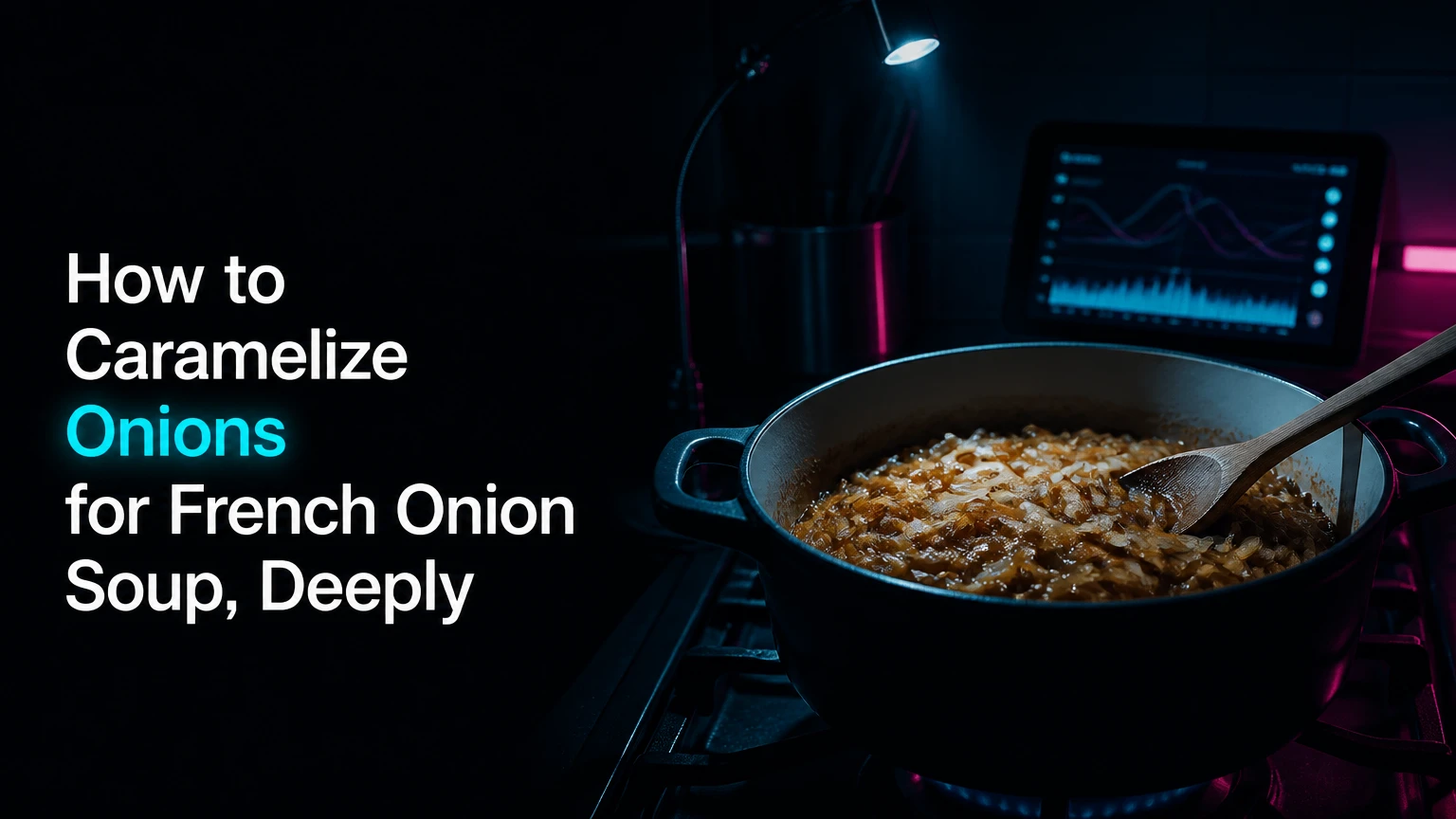
To caramelize onions for French onion soup, cook 3 pounds of thinly sliced yellow onions in a wide, heavy pan with 2 tablespoons of butter, 1 tablespoon of oil, and 1 teaspoon of salt for 45-60 minutes. Stir more often as the onions darken, then deglaze the mahogany fond with 1/2 cup of wine, stock, or water.
Key Facts at a Glance
Three pounds of raw onions typically produce 1 1/2-2 cups of deeply caramelized onions.
Yellow onions provide the best balance of sweetness, sulfurous savoriness, and affordability for soup.
A wide 12-inch pan reduces evaporation time because onions spread across more heated surface area.
French onion soup onions should reach a deep chestnut or mahogany brown, not merely translucent or golden.
Typical stovetop cooking takes 45-60 minutes, although a crowded pan or low-output burner can require 75-90 minutes.
Burnt black onions cannot be repaired by adding stock; remove them before bitterness spreads.
What Caramelization Does to Onions
Caramelizing onions means slowly removing water and browning concentrated onion sugars and flavor compounds. The process also includes Maillard browning, although onions contain much less protein than meat, so their soup flavor comes primarily from sugar concentration, sulfur chemistry, and browned pan residue.
Raw onions contain a large amount of water. During the first 15-25 minutes, that water escapes as steam, the onion cells soften, and the pan temperature remains close to the boiling point of water. Browning accelerates only after enough moisture has evaporated.
The commonly repeated 320°F threshold is not a precise cooking target. Different sugars caramelize across different temperatures, and a wet onion pan can remain below that temperature for much of the process. For French onion soup, color, aroma, texture, and absence of bitter black spots are more useful than an infrared thermometer reading.
Why patience matters
Slow cooking gives onion slices time to collapse before their exposed sugars burn. High heat can produce brown edges quickly, but the interior remains harsh and watery, while the pan develops bitter scorched particles rather than sweet, savory fond.
A practical rule is simple: if the onions are browning before they are soft, the heat is too high. If the onions are soft but remain pale after 35 minutes, the pan may be too crowded or the burner may be too weak.
Before You Start
| Item | Recommended specification | Typical amount or time |
|---|---|---|
| Yellow onions | Fresh, firm, medium-sized | 3 pounds, about 6-8 onions |
| Pan | Wide, heavy-bottomed, 12- to 14-inch diameter | 1 pan |
| Butter | Unsalted or salted dairy butter | 2 tablespoons |
| Neutral oil | Canola, grapeseed, or avocado oil | 1 tablespoon |
| Salt | Fine sea salt or table salt | 1 teaspoon |
| Deglazing liquid | Dry white wine, sherry, stock, or water | 1/2 cup |
| Cooking time | Medium, then medium-low heat | 45-60 minutes |
The pan should hold the raw onions in a layer no deeper than about 2 1/2 inches. A 12-inch skillet works for 2-3 pounds; 5 pounds requires a 14-inch pan or two skillets. A Dutch oven can hold more onions, but its narrow base usually extends the evaporation phase.
Prepare a wooden spoon, a sharp chef’s knife, a cutting board, measuring spoons, and a heatproof bowl. The total cost is typically low: onions commonly cost roughly $1-$3 per pound in United States supermarkets, while the fat and deglazing liquid add about $1-$3 per batch.
How to Caramelize Onions for French Onion Soup
Step 1: Slice the onions pole to pole
Trim the stem and root ends, halve each onion from root to stem, peel it, and place the cut side down. Slice lengthwise into 1/8- to 1/4-inch strips, keeping the slices as uniform as possible.
Lengthwise slicing preserves more structure during prolonged cooking. Crosswise slices soften faster and can create shorter strands, which are acceptable if you prefer a softer soup but can become stringy or mushy when cooked past the target.
You’ll know it worked when: the slices are similar in thickness and remain long enough to form recognizable strands.
Common mistake: cutting thick wedges alongside paper-thin strips. Thin pieces burn while thick pieces are still firm.
Step 2: Heat the fat and add salt
Place the wide pan over medium heat. Add 2 tablespoons of butter and 1 tablespoon of neutral oil; when the butter foam subsides, add the onions and 1 teaspoon of salt.
Butter contributes dairy aroma and browned milk solids, while neutral oil raises the mixture’s tolerance for prolonged heating. The oil does not prevent burning, but it makes the butter less likely to scorch during the long cooking period.
Salt seasons the onions and helps draw out moisture. Salt does not magically force water from the cells, so its main practical benefits are earlier seasoning and slightly faster softening.
You’ll know it worked when: every slice is glossy and the butter coats the pan without smoking.
Common mistake: adding the onions to smoking fat. Lower the heat, discard any blackened butter, and begin again with clean fat.
Step 3: Sweat the onions until translucent
Cook the onions over medium heat for 10-15 minutes, stirring every 2-3 minutes. Keep the pan uncovered so steam escapes, and scrape the bottom whenever soft onions begin to stick.
The volume will collapse substantially during this phase. The slices first look rigid and piled high, then become glossy, limp, and translucent as their cell walls break down.
Do not add sugar at this stage. Granulated sugar can make the surface brown before the onion’s sharp sulfur compounds and excess water have mellowed, producing a sweeter but less complex soup base.
You’ll know it worked when: the onions have reduced by roughly one-third, released visible moisture, and show no dark brown edges.
Common mistake: covering the pan. A lid traps steam and delays the concentration required for browning.
Step 4: Brown gradually over medium-low heat
Reduce the burner to medium-low once the onions are soft and the pan contains little free liquid. Continue cooking for 25-35 minutes, stirring every 3-5 minutes.
The onions will pass through pale yellow, blond, amber, and finally chestnut brown. Letting the onions sit undisturbed for several minutes creates contact with the pan, but each stir should move the entire layer so no section remains against a hot spot.
If the pan becomes dry before the onions are deeply colored, add 1 tablespoon of water. Water temporarily dissolves the developing fond and cools the surface; it does not stop caramelization because it evaporates again.
You’ll know it worked when: the onions are soft enough to press flat with a spoon, smell sweet and savory, and color evenly from edge to center.
Common mistake: stirring constantly. Continuous movement prevents fond formation and can extend the cooking time by 10-20 minutes.
Step 5: Build and dissolve the fond
During the final 10-15 minutes, stir every 1-2 minutes. Watch the bottom closely as a sticky brown film forms, because the difference between useful fond and burnt residue can develop within two minutes on a thin pan.
The onions are ready for soup when they are deep chestnut to mahogany brown, jammy but still strand-like, and reduced to approximately one-quarter of their original volume. A few dark brown pieces are desirable; black flakes with a bitter smell are not.
Add 1/2 cup of dry white wine, dry sherry, beef stock, or water. Scrape firmly with a wooden spoon while the liquid simmers, dissolving the fond into the onions.
You’ll know it worked when: the pan bottom feels smooth after scraping and the liquid turns brown rather than gray or black.
Common mistake: deglazing with too little liquid. One or two tablespoons may dissolve a small fond, but 1/2 cup gives enough volume to capture residue without evaporating instantly.
Which Onions and Fat Work Best?
Yellow onions are the most dependable choice for French onion soup because they balance sweetness with savory sulfur compounds. Sweet onions caramelize readily but can produce a one-dimensional broth, while red onions add color and fruitiness that can turn gray-purple during long cooking.
| Onion choice | Sugar and flavor | Cooked texture | Best use |
|---|---|---|---|
| Yellow onion | Balanced sweetness and savory sharpness | Soft strands with strong body | 100% traditional soup base |
| White onion | Sharper raw flavor, clean sweetness | Soft, slightly lighter-colored strands | Broth-forward soups |
| Sweet onion | High perceived sweetness, mild sulfur | Very soft and jammy | 25-50% blend with yellow onion |
| Red onion | Pungent, fruity, deeper color | Soft strands with muted purple tones | 10-20% accent in a mixed batch |
| Shallot | Concentrated sweetness and perfume | Fine, delicate strands | 10-15% blended with yellow onion |
Use 80-100% yellow onions for a savory classic. A useful blend is 2 1/2 pounds yellow onions plus 1/2 pound sweet onions. Adding more than half sweet onions can make the finished soup taste sugary, especially with sweet wine or a highly reduced stock.
Should you use butter, oil, or both?
Use butter and neutral oil together for the most rounded result. Butter supplies flavor, while oil reduces the chance that milk solids will scorch during a 45-60 minute cook.
| Fat | Amount for 3 pounds onions | Flavor effect | Main limitation |
|---|---|---|---|
| Unsalted butter | 3 tablespoons | Rich dairy and nutty milk solids | Can brown or burn quickly |
| Neutral oil | 3 tablespoons | Clean, restrained flavor | Less aromatic depth |
| Butter plus oil | 2 tablespoons plus 1 tablespoon | Balanced richness and heat tolerance | Requires measuring two fats |
| Beef tallow | 2-3 tablespoons | Deep beefy savoriness | Can dominate a lighter broth |
| Olive oil | 3 tablespoons | Fruity, peppery notes | Strong varieties may compete with cheese |
French cooks differ on whether butter alone is traditional, but the practical choice depends on pan control and desired flavor. Clarified butter also works because its milk solids have been removed, though it lacks the toasted dairy character of regular butter.
Which Pan Produces the Best Fond?
A wide stainless-steel or enameled cast-iron pan usually produces the clearest fond for French onion soup. Stainless steel offers visual feedback because browned residue is easy to see, while enameled cast iron stores heat and reduces burner hot spots.
| Pan type | Best size for 3 pounds | Fond visibility | Typical cooking result |
|---|---|---|---|
| Stainless-steel skillet | 12-14 inches | Excellent, silver surface shows browning | Fast evaporation and precise scraping |
| Enameled Dutch oven | 5 1/2-7 quarts | Good, steady heat | Even cooking, usually 60-90 minutes |
| Bare cast-iron skillet | 12 inches | Moderate, dark surface hides residue | Strong heat retention, higher scorching risk |
| Nonstick skillet | 12 inches | Poor, fond development is limited | Gentle cooking, less browned flavor |
| Slow cooker insert | 5-7 quarts | Poor, almost no pan fond | Soft onions with minimal surface browning |
Avoid a small saucepan for 3 pounds of onions. The deep pile traps moisture, and the onions steam for too long before browning. A broad pan is often more important than a powerful burner because evaporation depends heavily on exposed surface area.
How Dark Should Soup Onions Become?
French onion soup onions should be deep chestnut or mahogany brown, soft enough to spread, and aromatic without any burnt bitterness. Pale golden onions are edible and sweet, but they usually produce a thinner, less savory soup after broth is added.
| Stage | Approximate time | Appearance | Soup consequence |
|---|---|---|---|
| Sweated | 0-15 minutes | Glossy, translucent, pale | Sharp flavor remains |
| Blond | 20-30 minutes | Light yellow to gold | Sweet but relatively mild |
| Amber | 30-45 minutes | Golden brown, soft | Balanced flavor and lighter broth |
| Chestnut | 45-60 minutes | Deep brown, jammy | Full classic soup flavor |
| Burnt | Any stage | Black spots, acrid aroma | Bitter broth, difficult to recover |
Color varies with onion variety, pan material, lighting, and batch size. Taste one strand near the end. Properly cooked onions taste concentrated and savory-sweet, not simply sugary.
How Much Onion Do You Need?
Use 3 pounds of raw onions for approximately 4-6 servings of French onion soup. The finished quantity depends on onion water content, slice thickness, cooking temperature, and how far the onions are reduced.
| Raw onions | Approximate onion count | Cooked yield | Soup quantity |
|---|---|---|---|
| 1 pound | 2-3 medium onions | 1/2-2/3 cup | 1-2 servings |
| 2 pounds | 4-6 medium onions | 1-1 1/3 cups | 3-4 servings |
| 3 pounds | 6-8 medium onions | 1 1/2-2 cups | 4-6 servings |
| 4 pounds | 8-11 medium onions | 2-2 2/3 cups | 6-8 servings |
| 5 pounds | 10-14 medium onions | 2 1/2-3 1/3 cups | 8-10 servings |
A 75-80% reduction by weight is a reasonable kitchen estimate, not a fixed law. Very juicy onions lose more water, while a lower final temperature leaves a larger but less concentrated yield.
For soup, use approximately 1 pound of raw onions per quart of finished broth. More onions create a dense, sweet base; fewer onions produce a lighter broth where stock and wine become more prominent.
Can You Speed Up the Process?
You can shorten the process modestly with a wider pan, smaller batch, or oven finish, but fast methods usually sacrifice fond, strand structure, or flavor complexity. Baking soda accelerates softening and browning, yet too much creates mushy onions and an alkaline taste.
Baking soda raises pH, which speeds Maillard browning and weakens vegetable structure. If using it, add no more than a small pinch, approximately 1/16 teaspoon per pound of onions, after the onions have softened. The 1/4-teaspoon-per-pound recommendation is excessive for most home batches.
| Method | Typical time | Texture | Fond quality | Best situation |
|---|---|---|---|---|
| Stovetop skillet | 45-60 minutes | Strand-like and jammy | Strong | Best overall flavor |
| Wide sauté pan | 35-50 minutes | Slightly firmer | Strong | Small 1-2 pound batch |
| Oven at 350°F | 2-3 hours | Very soft | Moderate | Low-attention cooking |
| Slow cooker on low | 8-12 hours | Soft and wet | Weak | Overnight meal preparation |
| Baking soda addition | 30-45 minutes | Very soft if overused | Moderate | Time-sensitive cooking |
A slow cooker can prepare the onions, but the moist environment does not create the same browned fond as a skillet. Finish the onions in a wide pan for 10-15 minutes if you want a darker flavor, and reduce any excess liquid before adding broth.
What Should You Do If the Onions Burn?
If a few small pieces are dark but the batch smells sweet, transfer the unburnt onions to a clean pan and leave the scorched residue behind. If the entire batch smells acrid or tastes bitter, discard it because broth, sugar, and cheese cannot reliably mask burnt sulfur compounds.
| Problem | Likely cause | Immediate fix | Prevention |
|---|---|---|---|
| Black edges | Heat too high | Add 1 tablespoon water and reduce heat | Use medium-low after softening |
| Pale onions after 45 minutes | Pan too crowded | Continue uncovered or split batch | Use a 12-14-inch skillet |
| Watery onions | Lid used or low heat | Cook uncovered until liquid evaporates | Avoid covering the pan |
| Uneven color | Irregular slicing or hot spots | Stir thoroughly and lower heat | Cut uniform strips |
| Mushy onions | Baking soda or excess liquid | Drain only if soup is not started | Skip soda or use a tiny pinch |
| Bitter fond | Scorched sugars | Move onions to clean pan | Deglaze before residue blackens |
Never scrape black residue into the soup. Brown fond tastes roasted and savory; black residue tastes bitter because sugars and proteins have progressed beyond useful browning.
Variations for Different Kitchens
Can you caramelize onions in the oven?
Yes. Cook salted onions with butter and oil in a covered Dutch oven at 350°F for 45 minutes, then uncover and stir every 20-30 minutes for another 75-120 minutes. The oven surrounds the pot with heat, reducing burner hot spots, but evaporation is slower than in a skillet.
The oven method suits large batches and cooks who cannot monitor a stovetop continuously. Transfer the softened onions to a skillet for the final 10 minutes if the Dutch oven has not developed enough fond.
Can you use a slow cooker?
Yes, but slow-cooker onions are best treated as a convenience base rather than a full substitute for stovetop caramelization. Add sliced onions, fat, and salt to a 5- to 7-quart cooker, cook on low for 8-12 hours, then reduce the liquid in a skillet.
Slow-cooked onions are exceptionally soft and may contain more liquid. They work well for meal prep, but the finished soup will usually have less roasted depth unless the onions receive a final high-contact reduction in a pan.
Can you make them ahead?
Caramelized onions keep for 4 days in a refrigerator at 40°F or below when cooled promptly and stored in a shallow airtight container. Freeze them in 1/2- or 1-cup portions for up to 3 months, then thaw them in the refrigerator or directly in a saucepan.
For food safety, refrigerate cooked onions within 2 hours, or within 1 hour when ambient temperatures exceed 90°F, following the United States Department of Agriculture’s general guidance for perishable cooked food. Reheat onions until steaming before adding them to hot broth.
Expert Rules for Better French Onion Soup
First, deglaze twice if the pan develops fond early. Add 2 tablespoons of water, scrape, let the liquid evaporate, and repeat; this builds layered browned flavor without letting one thick patch scorch.
Second, keep the final onions less sweet than dessert onions. French onion soup needs contrast from salty broth, wine acidity, toasted bread, and Gruyère or Comté. Adding sugar often removes that balance rather than improving it.
Third, taste after deglazing, before adding stock. The onions should already taste rounded and intensely savory at this point. If they taste harsh, continue cooking; if they taste bitter, remove the batch from the scorched pan immediately.
Frequently Asked Questions
Do you need to add sugar to French onion soup onions?
No, added sugar is unnecessary for properly cooked onions. Yellow onions contain enough natural sugars to brown during prolonged cooking, and sugar added early can encourage surface scorching before the onions soften. Add sugar only for a deliberate sweet-savory variation, and limit it to 1/2 teaspoon per pound.
Why do caramelized onions become watery again?
Caramelized onions can release more liquid when salt, wine, or stock is added, or when hot onions cool in a sealed container. Return them to a wide pan and cook uncovered until the excess moisture evaporates. Watery onions are not ruined unless they also contain black, bitter residue.
Is red wine suitable for deglazing?
Red wine is suitable, but dry white wine or dry sherry usually produces a cleaner French onion soup. Red wine adds tannin and darker fruit flavors that can dominate delicate chicken stock. If using red wine, choose a dry, low-tannin style and limit the quantity to 1/4-1/2 cup.
Should French onion soup use beef stock?
Beef stock is traditional for a darker, meatier soup, but chicken stock, vegetable stock, or a blend can work. A strong homemade beef stock may need dilution, while boxed stock often needs additional salt and acidity. Choose unsalted or low-sodium stock when possible so the onions remain adjustable.
Why do onions make my soup taste sweet instead of savory?
Sweetness usually comes from stopping at a light golden stage, using only sweet onions, or reducing the broth too aggressively. Cook yellow onions to chestnut brown, add a dry acidic deglazing liquid, and balance the finished soup with salt and a measured amount of stock.
Can you caramelize frozen sliced onions?
Frozen onions can be cooked, but they release more water and usually take longer to brown. Add them directly to a wide pan over medium heat, evaporate the liquid completely, then continue over medium-low heat. Frozen onions produce a softer texture and less even fond than freshly sliced onions.
The Bottom Line
To caramelize onions for French onion soup, use 3 pounds of yellow onions, slice them pole to pole, cook them uncovered in a wide pan, and allow 45-60 minutes for deep chestnut browning. Stir every few minutes at first, every 1-2 minutes at the end, and deglaze the clean brown fond before adding broth. The exact keyword remains simple: how to caramelize onions for french onion soup comes down to moisture control, moderate heat, and stopping at mahogany rather than black.