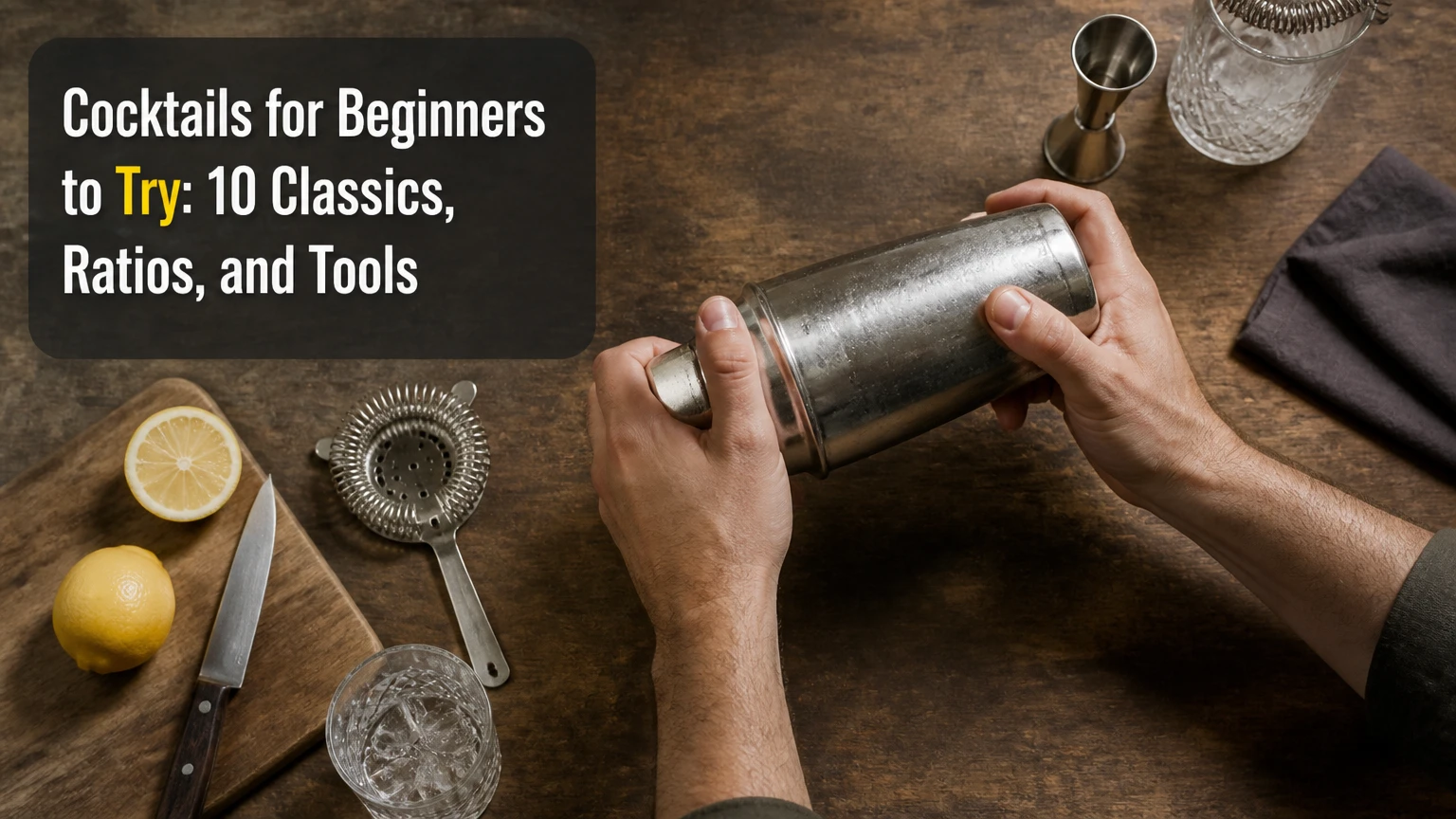
The best cocktails for beginners to try are the Daiquiri, Moscow Mule, Gin and Tonic, Whiskey Sour, Aperol Spritz, Old Fashioned, Negroni, Tom Collins, Margarita, and Espresso Martini. They teach the core skills of mixing: measuring, building over ice, shaking, stirring, balancing sweet and sour, and controlling dilution.
Key Facts at a Glance
- A cocktail balances alcohol, sweetness, acidity, bitterness, dilution, temperature, and texture.
- A Daiquiri is the clearest first lesson in the sour formula: rum, lime juice, and simple syrup.
- Highballs such as a Moscow Mule and Gin and Tonic require no shaker and usually take 1-2 minutes.
- Fresh citrus, dense ice, and a jigger improve a beginner cocktail more than expensive liquor does.
- A standard 1.5-ounce pour of 40% spirits contains about 0.6 fluid ounces of pure alcohol, the amount NIAAA uses to define one US standard drink.
- A $30-$50 starter kit can cover measuring, shaking, stirring, and straining.
Which Cocktails for Beginners to Try First?
For most new home bartenders, start with a Moscow Mule, Daiquiri, or Gin and Tonic, depending on how much alcohol flavor you enjoy. The Moscow Mule is the easiest build, the Daiquiri teaches balance, and the Gin and Tonic introduces botanical flavor without requiring a shaker.
A useful beginner sequence moves from forgiving drinks to precise ones. Build a highball first, shake a sour second, stir an Old Fashioned third, and taste a bitter Negroni last. That progression develops technique while gradually increasing the prominence of the base spirit.
Quick comparison of the first ten drinks
| Cocktail | Core ingredients | Method | Typical time | Beginner profile |
|---|---|---|---|---|
| Moscow Mule | 2 oz vodka, 0.5 oz lime, 4 oz ginger beer | Build | 2 minutes | Spicy, refreshing, low alcohol bite |
| Gin and Tonic | 2 oz gin, 4-6 oz tonic, lime | Build | 1 minute | Bitter, botanical, adjustable |
| Daiquiri | 2 oz white rum, 1 oz lime, 0.75 oz syrup | Shake | 3 minutes | Tart, clean, balanced |
| Whiskey Sour | 2 oz bourbon, 0.75 oz lemon, 0.75 oz syrup | Shake | 3 minutes | Tart, rich, rounded |
| Aperol Spritz | 3 oz Prosecco, 2 oz Aperol, 1 oz soda | Build | 2 minutes | Bubbly, lightly bitter |
| Tom Collins | 2 oz gin, 1 oz lemon, 0.75 oz syrup, soda | Shake and build | 4 minutes | Lemon-forward, long, fizzy |
| Margarita | 2 oz tequila, 1 oz lime, 0.75 oz orange liqueur | Shake | 3 minutes | Tart, citrusy, assertive |
| Old Fashioned | 2 oz bourbon, 0.25 oz syrup, bitters | Stir | 4 minutes | Strong, sweet, aromatic |
| Negroni | 1 oz gin, 1 oz Campari, 1 oz sweet vermouth | Stir | 4 minutes | Bitter, herbal, spirit-forward |
| Espresso Martini | 1.5 oz vodka, 1 oz coffee liqueur, 1 oz espresso | Shake | 5 minutes | Roasted, rich, dessert-like |
Ingredient measurements use US fluid ounces. A jigger with 0.75-ounce and 1.5-ounce sides reduces the errors that make an otherwise sound recipe taste unbalanced.
What Makes a Cocktail Beginner-Friendly?
A beginner-friendly cocktail has a short ingredient list, a forgiving flavor structure, accessible equipment, and a clear way to correct mistakes. Drinks with citrus, sugar, soda, ginger beer, or sparkling wine often hide harsh alcohol more effectively than spirit-forward recipes.
Difficulty is not the same as ingredient count. A three-ingredient Negroni can be harder for a new palate than a five-ingredient Tom Collins because Campari, gin, and vermouth remain prominent. The best first drink therefore depends on taste preference, alcohol tolerance, and whether the drinker wants to practice technique.
The four useful cocktail families
| Family | Formula | Representative drink | Main skill |
|---|---|---|---|
| Sour | Spirit + citrus + sweetener | Daiquiri | Balance and shaking |
| Highball | Spirit + carbonated mixer | Gin and Tonic | Measuring and dilution |
| Spirit-forward | Spirit + sugar, bitters, or fortified wine | Old Fashioned | Stirring and aroma |
| Spritz or fizz | Modifier + sparkling ingredient | Aperol Spritz | Gentle building and carbonation |
Ten Cocktails for Beginners to Try
The recipes below use practical home-bar proportions rather than rigid claims that one ratio fits every palate. Ice size, citrus acidity, spirit proof, and sweetness vary, so taste is the final quality check.
1. Moscow Mule: Best No-Shaker Starting Point
The Moscow Mule is the easiest first cocktail for someone who wants a cold, flavorful drink without buying a shaker. Vodka supplies a neutral base, while ginger beer contributes sweetness, spice, carbonation, and most of the drink’s character.
Recipe
- 2 ounces vodka
- 0.5 ounce fresh lime juice
- 4 ounces chilled ginger beer
- Lime wedge for garnish
Fill a highball or mule mug with ice. Add vodka and lime juice, top with ginger beer, and stir twice from the bottom upward. Use ginger beer rather than ginger ale if you want stronger spice and less sugary softness.
Choose it if: you like ginger, lime, and fizzy drinks.
Skip it if: you dislike carbonation or want to taste the base spirit clearly.
2. Gin and Tonic: Best One-Minute Cocktail
A Gin and Tonic takes about one minute and needs no shaker, making it the lowest-friction introduction to mixed drinks. Start with a 1:2 ratio of gin to tonic, then adjust toward 1:3 for a lighter drink or use a more aromatic gin when tonic is less bitter.
Recipe
- 2 ounces London dry gin
- 4-6 ounces chilled tonic water
- Lime wedge or lemon peel
Fill a tall glass with solid ice. Add gin, pour tonic slowly down a bar spoon or the side of the glass, and stir once. Excessive stirring releases carbonation and leaves the drink flat.
Tonic water contains quinine and sugar, so brands differ substantially. A dry tonic gives a sharper result; a sweeter tonic makes juniper and alcohol less prominent.
Choose it if: you enjoy bitter, herbal, or citrus flavors.
Skip it if: tonic tastes medicinal to you.
3. Daiquiri: Best Lesson in Balance
The Daiquiri is the best first shaken cocktail because its three-part structure makes every adjustment obvious. A classic Daiquiri combines white rum, fresh lime juice, and sugar syrup, with a practical starting ratio of 2:1:0.75 rather than assuming the sour formula must always be exactly 2:1:1.
Recipe
- 2 ounces white rum
- 1 ounce fresh lime juice
- 0.75 ounce simple syrup
- Ice
Add the ingredients to a shaker, fill it with ice, and shake hard for 10-15 seconds. Strain into a chilled coupe or small cocktail glass. A good Daiquiri tastes cold, bright, and rounded, not like undiluted rum with lime added.
The often-cited 2:1:1 sour ratio means two parts spirit, one part citrus, and one part sweetener. Many modern Daiquiris reduce the syrup to 0.5-0.75 ounce because commercial sugar syrups and ripe limes vary.
Choose it if: you want to learn how sweet and sour interact.
Skip it if: you strongly dislike tart drinks.
4. Whiskey Sour: Best Rich Sour
The Whiskey Sour gives bourbon beginners a softer entry than drinking whiskey neat. Lemon provides acidity, syrup rounds the edges, and bourbon adds vanilla, oak, caramel, and spice.
Recipe
- 2 ounces bourbon
- 0.75 ounce fresh lemon juice
- 0.75 ounce simple syrup
- Optional: 0.75 ounce egg white
- Angostura bitters for garnish
Shake the liquid ingredients with ice for 10-15 seconds, then strain over fresh ice in a rocks glass. If using egg white, shake once without ice for about 10 seconds, add ice, and shake again; use pasteurized egg white if food safety is a concern.
Egg white changes texture, not the essential flavor. It creates a denser foam and can make the drink seem less sharp, but it is unnecessary for a successful first Whiskey Sour.
Choose it if: you like lemon desserts or bourbon.
Skip it if: you want a light, low-alcohol drink.
5. Aperol Spritz: Best Light, Bubbly Choice
The Aperol Spritz is a low-intensity aperitivo built from 3 parts Prosecco, 2 parts Aperol, and 1 part soda. Its orange flavor, moderate bitterness, and carbonation make it approachable for people who do not enjoy strong spirits.
Recipe
- 3 ounces Prosecco
- 2 ounces Aperol
- 1 ounce club soda
- Orange slice
Add ice to a large wine glass. Pour in Prosecco, Aperol, and soda in that order, then stir gently once. Do not shake sparkling wine, and serve immediately because carbonation fades quickly.
Aperol Spritz is lower in alcohol than a drink containing 2 ounces of full-strength spirits, but it is still alcoholic. The exact strength depends on the Prosecco and the amount of soda.
Choose it if: you prefer orange, bubbles, and mild bitterness.
Skip it if: you dislike bitter aperitifs or sparkling wine.
6. Tom Collins: Best Long Sour
The Tom Collins combines gin, lemon, simple syrup, and soda in a tall, refreshing format. It teaches shaking and carbonation in one drink, although the soda is added after shaking to protect its bubbles.
Recipe
- 2 ounces gin
- 1 ounce fresh lemon juice
- 0.75 ounce simple syrup
- 2-3 ounces chilled club soda
- Lemon wheel
Shake gin, lemon, syrup, and ice for 10-15 seconds. Strain into an ice-filled Collins glass, top with soda, and lift the drink once with a bar spoon. The final cocktail should taste lemony and cool rather than syrupy.
7. Margarita: Best Tequila Introduction
A classic Margarita uses tequila, lime juice, and orange liqueur. The drink is more precise than a sugary restaurant version, so it teaches how citrus acidity, agave flavor, and orange sweetness interact.
Recipe
- 2 ounces blanco tequila
- 1 ounce fresh lime juice
- 0.75 ounce orange liqueur
- Optional half-salt rim
Shake with ice for 10-15 seconds and strain over fresh ice or into a chilled glass. Salt only half the rim so the drinker can compare salted and unsalted sips.
Use blanco tequila labeled 100% agave. Mixto tequila can taste rougher, especially in a short cocktail with little sugar.
8. Old Fashioned: Best Stirred Introduction
The Old Fashioned is a strong, slow-sipping cocktail that combines whiskey, sugar, water from dilution, and aromatic bitters. It is not the best first drink for someone who wants alcohol hidden, but it is an excellent first stirred drink.
Recipe
- 2 ounces bourbon or rye
- 0.25 ounce rich simple syrup, or one small sugar cube
- 2-3 dashes Angostura bitters
- Orange peel
Add whiskey, syrup, bitters, and ice to a mixing glass. Stir smoothly for 20-30 seconds, then strain over one large cube in a rocks glass. Express the orange peel over the surface and place it in the drink.
Rye creates a drier, spicier Old Fashioned. Bourbon produces a rounder, sweeter profile. The drink should be cold and slightly diluted, never warm and burning.
9. Negroni: Best Bitter Progression Drink
The Negroni uses equal parts gin, Campari, and sweet vermouth, producing a bitter, herbal, wine-like cocktail with substantial alcohol. Beginners often appreciate it more after trying a Spritz or Gin and Tonic first.
Recipe
- 1 ounce gin
- 1 ounce Campari
- 1 ounce sweet vermouth
- Orange peel
Stir all ingredients with ice for 20-30 seconds and strain over fresh ice or serve up. Refrigerate sweet vermouth after opening because it is fortified wine, not shelf-stable liquor; use it within roughly one to three months for the freshest flavor.
Choose it if: you actively enjoy bitterness and herbal flavors.
Skip it if: sweet citrus or ginger drinks are your usual preference.
10. Espresso Martini: Best Coffee and Dessert Option
An Espresso Martini combines vodka, coffee liqueur, and fresh espresso for a cold, foamy drink with roasted bitterness. It is approachable for coffee drinkers, but caffeine and alcohol can mask perceived strength without reducing actual alcohol content.
Recipe
- 1.5 ounces vodka
- 1 ounce coffee liqueur
- 1 ounce fresh espresso, cooled briefly
- Optional 0.25 ounce syrup
Shake hard with ice for 10-15 seconds and double-strain into a chilled coupe. Fresh espresso helps create the characteristic crema-like foam, while syrup is optional because coffee liqueur varies in sweetness.
How Should a Beginner Shake, Stir, or Build a Drink?
Shaking suits cocktails containing citrus, dairy, or egg white because vigorous movement combines ingredients and adds aeration. Stirring suits clear, spirit-only cocktails because it chills and dilutes them without clouding the liquid, while building suits drinks whose main ingredient is soda, tonic, ginger beer, or sparkling wine.
Shaking a sour
- Measure every ingredient with a jigger.
- Pour liquids into the shaker.
- Fill the shaker about two-thirds to three-quarters full with hard ice.
- Seal it firmly and shake for 10-15 seconds.
- Strain immediately into the serving glass.
You will know the drink is ready when the shaker is very cold and condensation covers its exterior. The common mistake is using too little ice, which creates fast melting, weak chilling, and inconsistent dilution.
Stirring a spirit-forward drink
- Add measured ingredients to a mixing glass.
- Add enough ice to cover the liquid.
- Stir around the inside wall for 20-30 seconds.
- Strain through a Julep or Hawthorne strainer.
- Serve over fresh ice or in a chilled glass.
A 30-45 second stir may be appropriate for a larger drink or smaller ice, but time is only a proxy. Taste and temperature matter more than performing a fixed number of rotations.
Building a highball or spritz
Add ice first, then the alcoholic ingredient, then the carbonated mixer. Stir once or twice, because aggressive mixing drives off carbonation and makes a long drink taste flat.
What Does a Beginner Need to Buy?
A basic home cocktail setup costs approximately $30-$50 for tools, excluding alcohol, and can make every drink in this guide. A jigger, shaker, strainer, bar spoon, citrus press, and reliable ice matter more than specialized glassware.
| Tool | Typical price | Quantity needed | Main use |
|---|---|---|---|
| Two-sided jigger | $6-$12 | 1 | Measure 0.75, 1, and 2 oz pours |
| Boston shaker | $12-$25 | 1 | Shake sours and coffee cocktails |
| Hawthorne strainer | $7-$12 | 1 | Strain shaken drinks |
| Bar spoon | $5-$10 | 1 | Stir and gently combine drinks |
| Citrus press | $8-$18 | 1 | Juice one lime or lemon quickly |
| Mixing glass | $10-$25 | 1 | Stir Old Fashioneds and Negronis |
A cocktail shaker is optional for highballs. A clean jam jar can shake a sour in an emergency, but its seal, capacity, and glass strength are less reliable than bar equipment.
Minimal bottle and ingredient plan
Buy one bottle at a time rather than building a full bar. A practical first purchase is white rum for Daiquiris, followed by bourbon, gin, vodka, or tequila according to your preferred flavor.
| Starter item | Typical US cost | Drinks supported | Storage guidance |
|---|---|---|---|
| White rum, 750 ml | $20-$35 | Daiquiri, Mojito variation | Room temperature, tightly closed |
| Bourbon, 750 ml | $25-$45 | Whiskey Sour, Old Fashioned | Room temperature, upright |
| London dry gin, 750 ml | $20-$35 | Gin and Tonic, Tom Collins, Negroni | Room temperature, tightly closed |
| Aperol, 750 ml | $25-$35 | Aperol Spritz | Room temperature before opening |
| Sweet vermouth, 750 ml | $10-$20 | Negroni, Manhattan variation | Refrigerate after opening |
| Fresh citrus | $1-$2 per fruit | Daiquiri, sour, Mule | Juice shortly before mixing |
| Ginger beer, 4-pack | $5-$8 | Moscow Mule | Refrigerate after opening |
Prices vary by state, retailer, tax, and bottle size. Fresh citrus usually provides more useful flavor improvement than upgrading from a mid-shelf to premium base spirit.
How Do Ratio, Ice, and Dilution Change the Result?
A cocktail’s ratio determines its flavor direction, while ice controls temperature and dilution. The common 2:1:1 sour formula is a starting point, not a law, because lemon and lime acidity, syrup concentration, and spirit proof differ from kitchen to kitchen.
| Drink structure | Starting ratio | Expected result | Adjustment for beginners |
|---|---|---|---|
| Daiquiri sour | 2 rum : 1 lime : 0.75 syrup | Bright and moderately tart | Add 0.25 oz syrup if too sharp |
| Whiskey Sour | 2 bourbon : 0.75 lemon : 0.75 syrup | Rich and rounded | Reduce syrup to 0.5 oz for drier taste |
| Gin and Tonic | 1 gin : 2-3 tonic | Botanical and bitter | Use 3 parts tonic for a lighter drink |
| Old Fashioned | 8 whiskey : 1 syrup : bitters | Strong and aromatic | Stir longer for more dilution |
| Spritz | 3 Prosecco : 2 Aperol : 1 soda | Bubbly and low intensity | Add soda for a lighter serving |
Large, solid ice melts more slowly than small, wet cubes, but a stirred drink still needs sufficient dilution. For a sour, 10-15 seconds of vigorous shaking with a full load of ice is a practical home benchmark.
What Are the Most Common Beginner Mistakes?
The most common beginner errors are inaccurate measuring, stale citrus, under-icing, warm glassware, and poor handling of carbonation. Each error changes a specific variable, so the correction should target that variable rather than adding random ingredients.
- Free-pouring: A half-ounce error in syrup or citrus can noticeably change a short cocktail. Use a jigger until the recipe becomes familiar.
- Using bottled lemon or lime juice: Pasteurized juice often lacks the fresh aroma and volatile oils of recently squeezed fruit. Squeeze citrus the same day whenever possible.
- Under-icing: Two or three cubes in a shaker melt quickly and produce warm, weak liquid. Fill the shaker adequately and use fresh ice for serving.
- Over-shaking carbonated drinks: Never shake tonic, soda, ginger beer, or sparkling wine. Add those ingredients after the shaking step.
- Ignoring vermouth storage: Open sweet vermouth develops stale, oxidized flavors at room temperature. Refrigerate it and replace it when the aroma becomes dull.
- Adding garnish without purpose: Citrus peel adds aromatic oils, while a lime wedge adds acidity if squeezed. A garnish should change aroma or taste, not merely decorate the glass.
How Can You Fix a Cocktail That Tastes Wrong?
A drink that tastes too sour needs small additions of sweetener, while a drink that tastes too sweet needs measured acid or dilution. A hot, burning cocktail usually needs more chilling and dilution; a weak cocktail needs less mixer or a fresh, correctly measured build.
| Problem | Likely cause | First correction | Avoid |
|---|---|---|---|
| Too sour | Excess lemon or lime | Add 0.125-0.25 oz syrup | Adding more spirit immediately |
| Too sweet | Excess syrup or liqueur | Add 0.125 oz citrus | Pouring in large amounts of acid |
| Too strong or hot | Insufficient dilution | Stir or shake with fresh ice 5-10 seconds | Adding water without measuring |
| Too weak | Excess soda, tonic, or ice melt | Add 0.25 oz base spirit | Adding more sugar |
| Flat | Carbonation lost | Add fresh chilled soda or tonic | Shaking carbonated ingredients |
| Bitter | Too much Campari or tonic | Add dilution and a little sweetness | Removing bitterness with salt alone |
| Cloudy and heavy | Over-shaking a clear drink | Stir the next batch | Filtering repeatedly |
Taste before making a second correction. A 0.125-ounce adjustment is often enough in a single-serving cocktail.
Which First Cocktail Fits Your Taste?
Choose the Moscow Mule or Aperol Spritz if alcohol flavor is your main concern, the Daiquiri or Margarita if you like tart fruit, and the Old Fashioned or Negroni if you want the base spirit to remain obvious. Coffee drinkers usually find the Espresso Martini more familiar than a gin-based cocktail.
| Preference or situation | First choice | Why it fits | Next drink |
|---|---|---|---|
| Sweet and fizzy | Moscow Mule | Ginger beer covers vodka’s bite | Aperol Spritz |
| Tart and fresh | Daiquiri | Three ingredients reveal balance | Margarita |
| Whiskey and dessert flavors | Whiskey Sour | Lemon softens bourbon | Old Fashioned |
| Bitter and herbal | Aperol Spritz | Mild bitterness before Campari | Negroni |
| Coffee after dinner | Espresso Martini | Roasted flavor dominates | Old Fashioned |
| No shaker available | Gin and Tonic | One-glass build | Moscow Mule |
| Lower-intensity serving | Aperol Spritz | Sparkling wine and soda extend the drink | Tom Collins |
| No alcohol | Lime ginger cooler | Ginger and citrus retain structure | Alcohol-free Collins |
What Are Good Alcohol-Free Alternatives?
An alcohol-free cocktail should preserve balance rather than simply remove the spirit from an alcoholic recipe. A lime ginger cooler, alcohol-free Collins, or bitter-orange spritz can provide acidity, sweetness, bitterness, dilution, and carbonation without ethanol.
Lime ginger cooler
Combine 1 ounce fresh lime juice, 0.5 ounce simple syrup, 4 ounces ginger beer, and 1 ounce soda over ice. Add mint or a lime wheel if available. The drink has the same sour, sweet, spicy, and fizzy architecture as a Mule, but contains no vodka.
Alcohol-free Collins
Shake 1 ounce lemon juice and 0.5 ounce syrup with ice, strain into a tall ice-filled glass, and top with 3 ounces soda. Add an alcohol-free gin alternative if desired, but check its label because products differ in sugar, botanicals, and serving strength.
How Much Alcohol Is in a Beginner Cocktail?
A cocktail containing 2 ounces of 40% spirit has more alcohol than a standard 1.5-ounce pour of the same spirit. NIAAA defines one US standard drink as 0.6 fluid ounces of pure alcohol, equivalent to 1.5 ounces of 40% distilled spirits, 5 ounces of 12% wine, or 12 ounces of 5% beer.
A 2-ounce pour of 40% vodka contains about 0.8 fluid ounces of pure alcohol before dilution. Ice and mixers increase volume but do not remove alcohol, and sweetness or caffeine can make strength harder to perceive.
Measure pours, drink slowly, eat food, and follow local drinking-age and driving laws. Choose an alcohol-free alternative when alcohol is unsafe or unwanted.
A Four-Drink Learning Path for New Mixers
Follow a four-drink sequence to build skills without buying every bottle at once. Begin with the Gin and Tonic, move to the Daiquiri, practice the Old Fashioned, and finish with the Negroni when bitter flavors become more familiar.
- Gin and Tonic: Learn accurate pouring, ice management, and gentle carbonation handling.
- Daiquiri: Learn the sour structure, hard shaking, fresh citrus, and straining.
- Old Fashioned: Learn stirring, dilution, bitters, and expressing citrus oils.
- Negroni: Learn how fortified wine and bitterness change a spirit-forward drink.
The sequence is more valuable than collecting equipment. A beginner who repeats four balanced recipes will usually improve faster than one who makes ten unrelated drinks once.
FAQ
Can I make beginner cocktails without a cocktail shaker?
Yes, highballs and spritzes require no shaker, and a clean jam jar can temporarily replace one for shaken drinks. Build a Gin and Tonic, Moscow Mule, or Aperol Spritz directly in the serving glass. A proper shaker becomes worthwhile when you regularly make Daiquiris, Sours, Margaritas, or Espresso Martinis.
What is the easiest cocktail to make at home?
The Gin and Tonic is usually the easiest cocktail because it requires two measured liquids, ice, and one gentle stir. The Moscow Mule is nearly as simple but requires fresh lime and ginger beer. Both drinks take approximately 1-2 minutes and can be made without a strainer.
Should beginners use vodka because it has little flavor?
Vodka is useful when a mixer should dominate, as in a Moscow Mule or Espresso Martini, but neutral flavor does not automatically make a drink better. Gin, rum, bourbon, and tequila teach more about how spirits affect balance. Choose vodka for a neutral base, not as a universal first bottle.
How long does fresh citrus juice last?
Fresh lemon and lime juice tastes best shortly after squeezing, when its aroma remains bright. Refrigerated juice in a sealed container is typically usable for about 24-48 hours, although quality declines sooner. For the clearest flavor, squeeze only the amount needed for the current cocktail session.
Which beginner cocktail is lowest in alcohol?
Aperol Spritz is generally lower in alcohol than a cocktail built with 2 ounces of full-strength spirits because it uses a smaller amount of bitter aperitif, sparkling wine, and soda. Actual strength varies with brands, proportions, and serving size, so lower intensity does not mean alcohol-free.
What should I mix first if I dislike bitter flavors?
Start with a Moscow Mule, Daiquiri, or Whiskey Sour rather than a Negroni or strongly bitter Gin and Tonic. Ginger beer, citrus, and syrup provide familiar flavor anchors. After those drinks, try an Aperol Spritz, whose bitterness is milder than Campari’s.
The Bottom Line
The best cocktails for beginners to try are the Moscow Mule for simplicity, Daiquiri for learning balance, Gin and Tonic for a one-minute build, and Whiskey Sour for a rich shaken drink. Add an Old Fashioned when you are ready for stirring, then try a Negroni if bitter, herbal flavors appeal to you. Fresh citrus, full ice, and measured pours matter more than premium bottles.