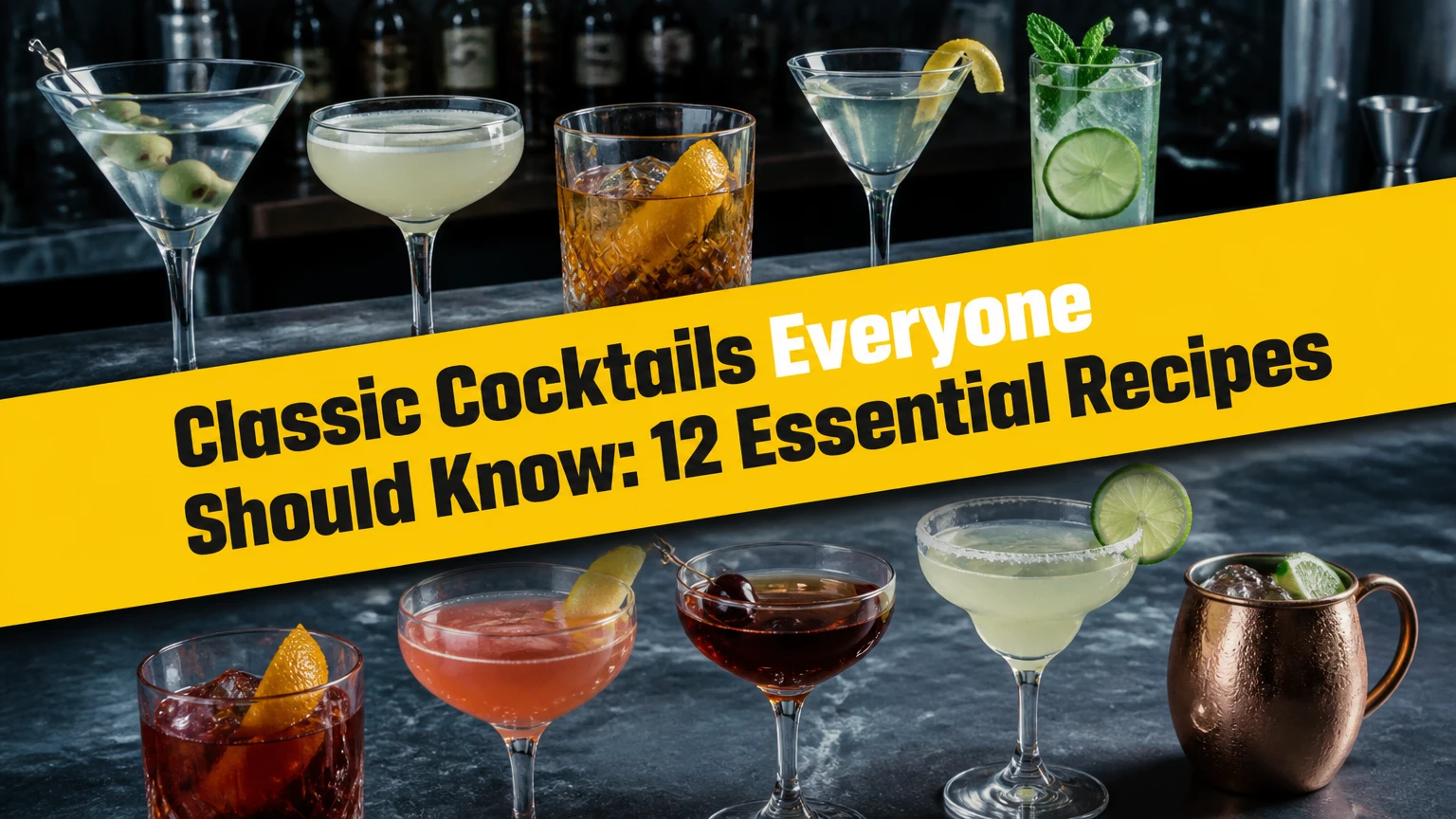
Classic cocktails everyone should know include the Old Fashioned, Martini, Daiquiri, Negroni, Margarita, Manhattan, Whiskey Sour, Tom Collins, Sidecar, Mojito, Moscow Mule, and French 75. These drinks teach the main families of mixology: spirit-forward, sour, bitter, tall, sparkling, and refreshing cocktails, using repeatable ratios and techniques.
Key Facts at a Glance
A classic cocktail is a durable recipe with historical recognition, repeatable construction, and influence on later drinks.
The Old Fashioned uses spirit, sugar, water, and bitters; Jerry Thomas defined a cocktail in 1862 using those four elements.
Stir spirit-only drinks for approximately 20-30 seconds; shake citrus-based drinks for approximately 10-15 seconds.
Fresh lemon or lime juice usually gives a brighter result than bottled juice, while sweet vermouth must be refrigerated after opening.
A 2-ounce spirit pour typically produces a 16-24 percent alcohol-by-volume drink after normal dilution, although recipes vary.
The best first cocktail depends on taste: choose a Daiquiri for tartness, a Whiskey Sour for softness, or a Tom Collins for length and refreshment.
What Counts as a Classic Cocktail?
A classic cocktail is a historically established mixed drink whose recipe, name, and preparation have remained recognizable across generations. The category usually includes drinks created from the mid-1800s through the mid-1900s, but no single cutoff determines whether a cocktail qualifies.
Historical influence matters as much as age. The Margarita is younger than the Old Fashioned, yet its international recognition and stable structure make it a modern classic. The Espresso Martini, created by Dick Bradsell in London in the 1980s, is often called a modern classic rather than a traditional classic.
Jerry Thomas wrote in How to Mix Drinks in 1862, “A cocktail is a stimulating liquor, composed of spirits of any kind, sugar, water, and bitters.” The definition describes the Old Fashioned especially well, but it does not cover every enduring drink. Sours, highballs, cobblers, punches, and sparkling cocktails follow different structures.
Why are classic cocktails worth learning?
Classic cocktails are worth learning because each one teaches a transferable technique, ratio, or flavor relationship. A Daiquiri teaches the sour template, a Martini teaches dilution and vermouth management, and a Negroni teaches equal-parts construction and bitterness.
The recipes also provide benchmarks. If a bartender can make a balanced Daiquiri, Manhattan, and Old Fashioned, problems with sweetness, dilution, temperature, or spirit selection become easier to diagnose in less established drinks.
Which Classic Cocktails Should Everyone Know?
The most useful foundation contains 12 drinks rather than five because the expanded set covers the major cocktail families and the base spirits most commonly found in a home bar. The first five are essential benchmarks, while the remaining seven broaden technique and ingredient knowledge.
| Cocktail | Family | Base spirit | Method | Typical serve |
|---|---|---|---|---|
| Old Fashioned | Spirit-forward | Bourbon or rye | Stir | Rocks, large cube |
| Martini | Spirit-forward | Gin or vodka | Stir | Chilled stemmed glass |
| Daiquiri | Sour | White rum | Shake | Chilled coupe |
| Negroni | Bitter aperitif | Gin | Stir | Rocks, large cube |
| Margarita | Sour | Blanco tequila | Shake | Rocks, fresh ice |
| Manhattan | Spirit-forward | Rye or bourbon | Stir | Coupe or Nick and Nora |
| Whiskey Sour | Sour | Bourbon | Shake | Rocks or coupe |
| Tom Collins | Tall sour | Gin | Shake, top with soda | Collins glass |
| Sidecar | Citrus sour | Cognac | Shake | Coupe |
| Mojito | Refreshing highball | White rum | Build and churn | Highball, crushed ice |
| Moscow Mule | Highball | Vodka | Build, top with ginger beer | Copper mug or highball |
| French 75 | Sparkling sour | Gin | Shake, top with Champagne | Flute or coupe |
What Are the Core Cocktail Ratios?
There is no universal “golden ratio” for classic cocktails. The commonly repeated 2:1:1 formula works as a starting point for some sours, but the actual balance depends on acid strength, sugar concentration, spirit proof, liqueur sweetness, ice dilution, and serving size.
| Cocktail structure | Practical starting ratio | Example | Main balancing force |
|---|---|---|---|
| Old Fashioned | 2 oz spirit, 0.25 oz sweetener | 2 oz rye, 0.25 oz syrup | Bitters and water |
| Classic sour | 2 oz spirit, 1 oz citrus, 0.75 oz sweetener | Daiquiri | Acid and sugar |
| Equal-parts aperitif | 1:1:1 | Negroni | Bitterness and vermouth |
| Manhattan | 2 oz spirit, 1 oz vermouth, bitters | Rye Manhattan | Fortified wine |
| Highball | 2 oz spirit, 3-5 oz mixer | Tom Collins | Carbonation and length |
| Sparkling sour | 1 oz spirit, 0.5 oz citrus, 0.5 oz sweetener, 2 oz wine | French 75 | Acid and bubbles |
Measure ingredients with a jigger rather than counting free-poured seconds. A 0.25-ounce error in a short drink can change the balance more than a small difference in bottle quality.
How do dilution and temperature change a drink?
Dilution lowers perceived alcohol heat and integrates ingredients, while temperature suppresses some sweetness and bitterness. Typical stirred drinks gain about 15-25 percent of their final volume from melted ice; shaken sours often gain about 20-30 percent because agitation transfers heat more quickly.
Ice quality controls consistency. Dense, large cubes melt more slowly in a serving glass, while wet, cracked ice dilutes rapidly during mixing. A drink that tastes harsh after correct measurements usually needs more controlled dilution, not more sugar.
Shaking also adds aeration. Citrus drinks become lighter and slightly opaque, while stirring leaves spirit-forward cocktails clearer and silkier. The familiar rule is useful, but texture and ingredients matter more than dogma.
1. Old Fashioned: The Essential Whiskey Template
The Old Fashioned combines 2 ounces of bourbon or rye, 0.25 ounce of rich simple syrup or 1 teaspoon of sugar, and 2-3 dashes of aromatic bitters. Stir the mixture with ice for 20-30 seconds, then strain over one large cube and express an orange peel over the surface.
Add the syrup and bitters to a mixing glass, then pour in the whiskey. Stirring the sugar directly into a cube with a splash of water can work, but syrup dissolves more evenly and reduces gritty texture.
Bourbon produces a rounder drink with vanilla and caramel notes. Rye gives a drier, spicier result. Orange peel contributes aromatic oil, whereas an orange wedge or muddled fruit adds juice and sweetness that are not part of the leanest classic style.
Typical home cost: $1.50-$3.50 per drink.
Best for: whiskey drinkers and slow sipping.
Avoid when: the guest wants citrus, carbonation, or a low-alcohol drink.
2. Martini: The Dilution and Vermouth Test
A balanced Dry Martini starts with 2.5 ounces of gin and 0.5 ounce of dry vermouth, stirred with ice for about 20-30 seconds and strained into a chilled glass. A lemon twist emphasizes citrus botanicals, while an olive adds salt and savory weight.
“Dry” should describe the amount of vermouth, not the absence of vermouth. A 5:1 ratio remains dry but tastes more complete than an 8:1 pour, especially when the vermouth is fresh. A wet Martini may use a 2:1 or 3:1 ratio.
Keep opened vermouth refrigerated and replace it when it smells flat, oxidized, or sour. A practical home window is four to eight weeks, although the exact life depends on storage, bottle fill level, and the vermouth itself.
Typical home cost: $2.50-$5.00 per drink.
Best for: spirit-forward drinkers who notice texture and aroma.
Avoid when: the drinker dislikes herbal flavors or strong alcohol.
3. Daiquiri: The Benchmark Classic Sour
The classic Daiquiri uses 2 ounces of white rum, 1 ounce of fresh lime juice, and 0.75 ounce of simple syrup. Shake with ice for 10-15 seconds and strain into a chilled coupe; the drink is served up, not as a frozen slush.
Lime acidity varies by fruit and season, so the 2:1:0.75 ratio is a starting point rather than an immutable law. Add syrup in 0.125-ounce increments when the lime is unusually sharp.
The Hemingway Daiquiri adds grapefruit juice and maraschino liqueur, producing a drier, more aromatic drink. Aged rum creates a richer Daiquiri, but the white-rum version is the clearest test of fresh juice, dilution, and sweet-sour balance.
Typical home cost: $1.25-$2.75 per drink.
Best for: beginners who enjoy tart, refreshing flavors.
Avoid when: fresh lime is unavailable.
4. Negroni: The Equal-Parts Aperitif
The classic Negroni contains 1 ounce each of gin, Campari, and sweet vermouth. Stir the ingredients with ice for 20-30 seconds, strain over a large cube, and garnish with an expressed orange peel.
Campari supplies bitterness, sweet vermouth supplies spice and sweetness, and gin contributes botanical structure. The drink is not designed to hide bitterness, so it may be more approachable before a meal than as a first cocktail for someone accustomed to sweet drinks.
The Boulevardier replaces gin with bourbon or rye and feels warmer and heavier. The Negroni Sbagliato replaces gin with sparkling wine, reducing spirit intensity while preserving the bitter-vermouth core.
Typical home cost: $2.75-$5.00 per drink.
Best for: drinkers who enjoy bitter aperitifs.
Avoid when: bitterness is unpleasant or the vermouth is old.
5. Margarita: Tequila, Citrus, and Orange Liqueur
A classic Margarita combines 2 ounces of blanco tequila, 1 ounce of fresh lime juice, and 0.75 ounce of Cointreau or another quality orange liqueur. Shake with ice for 10-15 seconds and strain over fresh ice in a salt-rimmed rocks glass.
Salt is optional but functional. It reduces perceived bitterness and makes the lime taste fuller; apply it to half the rim when people have different preferences.
Tommy’s Margarita uses tequila, lime, and agave syrup instead of orange liqueur. The result emphasizes roasted agave and gives the bartender more direct control over sweetness. Sour mix is convenient, but it commonly introduces excess sugar and muted citrus.
Typical home cost: $2.50-$4.50 per drink.
Best for: guests who prefer bright, tart drinks.
Avoid when: the only available citrus is bottled and old.
6. Manhattan: The Whiskey and Vermouth Counterpart
A Manhattan uses 2 ounces of rye or bourbon, 1 ounce of sweet vermouth, and 2 dashes of Angostura bitters. Stir with ice and strain into a chilled coupe, then garnish with a brandied cherry.
Rye creates a spicier, leaner Manhattan, while bourbon adds vanilla and a softer finish. The vermouth is a major ingredient rather than a minor modifier, so refrigeration and freshness matter as much here as they do in a Martini.
The Manhattan is a useful progression after the Old Fashioned because it teaches how fortified wine changes a drink without adding citrus or carbonation.
7. Whiskey Sour: A Softer Introduction to Whiskey
The standard Whiskey Sour combines 2 ounces of bourbon, 0.75 ounce of fresh lemon juice, and 0.75 ounce of simple syrup. Shake with ice and strain over fresh ice; add 0.5 ounce of egg white for a richer texture and a stable foam.
Without egg white, the cocktail is sharper and more transparent. With egg white, use a dry shake first, then shake again with ice, and avoid serving the drink to anyone with an egg allergy.
The Whiskey Sour is more forgiving than an Old Fashioned because lemon and sugar soften the whiskey. It is a strong first choice for someone who wants to explore brown spirits without drinking them neat.
8. Tom Collins: The Tall Gin Sour
A Tom Collins uses 2 ounces of London Dry gin, 1 ounce of lemon juice, and 0.75 ounce of simple syrup, shaken with ice and strained into a Collins glass. Fill with fresh ice and top with approximately 2 ounces of chilled soda water.
Carbonation changes the perception of strength by extending the drink and lifting its aroma. Add soda after shaking, never inside the sealed shaker, because trapped pressure can create a dangerous release.
The Tom Collins suits warm weather and longer sessions better than a Martini. Its weakness is dilution from too much soda or small, rapidly melting ice.
9. Sidecar: Cognac’s Classic Citrus Sour
The Sidecar combines 2 ounces of Cognac, 0.75 ounce of orange liqueur, and 0.75 ounce of fresh lemon juice. Shake with ice and strain into a chilled coupe, with an optional half sugar rim.
Cognac provides dried-fruit and oak notes, while orange liqueur rounds the lemon. A full sugar rim can make the drink taste sweet before the liquid reaches the palate, so half-rimming offers better control.
The Sidecar is a useful alternative to a Margarita when a drinker wants citrus without tequila’s vegetal or peppery notes.
10. Mojito: Mint, Lime, and Controlled Carbonation
A Mojito combines 2 ounces of white rum, 0.75 ounce of lime juice, 0.5-0.75 ounce of simple syrup, mint leaves, and soda water. Press the mint gently with syrup and lime, add rum and crushed ice, churn, then top with soda.
Hard muddling tears mint leaves and releases bitter chlorophyll. The correct technique extracts aroma without turning the drink vegetal.
Use fresh mint and cold soda. A Mojito becomes watery when the glass is underfilled with ice, because the melting ice has more room to move through the drink.
11. Moscow Mule: A Simple Vodka Highball
A Moscow Mule uses 2 ounces of vodka, 0.5-0.75 ounce of fresh lime juice, and 4-5 ounces of ginger beer over ice. Build the drink directly in a mug or highball glass and stir briefly.
Ginger beer is usually sweeter and spicier than ginger ale, so the brand changes the finished balance. A sharp, dry ginger beer may need a little more syrup, while a sweet commercial version may need less lime.
The copper mug is traditional but not required. Glass makes the drink easier to inspect, and stainless steel avoids concerns about unlined copper reacting with acidic liquids.
12. French 75: A Sparkling Gin Sour
The French 75 uses 1 ounce of gin, 0.5 ounce of fresh lemon juice, 0.5 ounce of simple syrup, and approximately 2 ounces of Champagne or another dry sparkling wine. Shake the first three ingredients with ice, strain into a flute or coupe, and top gently with chilled wine.
The cocktail should taste dry, bright, and lightly botanical. Brut sparkling wine keeps the sugar in check; demi-sec wine can make the drink cloying when paired with standard syrup.
Never shake sparkling wine in a closed cocktail shaker. Add it after straining.
Which Classic Cocktail Should You Make First?
The best first classic cocktail is a Daiquiri for a sour-drink beginner, an Old Fashioned for a whiskey drinker, and a Tom Collins for someone who prefers a lighter, longer serve. The table below matches the drink to taste, equipment, ingredient demands, and typical preparation time.
| Drinker or situation | Best choice | Required equipment | Typical time | Main reason |
|---|---|---|---|---|
| First sour cocktail | Daiquiri | Shaker and strainer | 3 minutes | Three core ingredients |
| Whiskey enthusiast | Old Fashioned | Mixing glass or rocks glass | 3 minutes | Spirit remains prominent |
| Bitter aperitif fan | Negroni | Mixing glass and strainer | 2 minutes | Equal-parts construction |
| Warm-weather gathering | Tom Collins | Shaker and Collins glass | 4 minutes | Tall, carbonated serve |
| No shaker available | Manhattan | Mixing glass or pint glass | 3 minutes | Stirred preparation |
| Low-bitterness preference | Whiskey Sour | Shaker | 3 minutes | Lemon and sugar soften whiskey |
| Tequila drinker | Margarita | Shaker and rocks glass | 4 minutes | Lime, salt, and orange liqueur |
| Celebration toast | French 75 | Shaker and flute | 4 minutes | Sparkling wine finish |
A beginner does not need a full bar. A shaker, jigger, strainer, mixing glass, bar spoon, citrus press, and peeler cover nearly every recipe above.
When Should a Drink Be Shaken or Stirred?
Shake a cocktail when it contains citrus, juice, egg white, dairy, or thick sweeteners; stir when it contains only spirits and spirit-based modifiers. The distinction controls integration, aeration, clarity, and dilution, although carbonated ingredients must always be added after shaking or stirring.
| Method | Typical duration | Best ingredients | Result | Examples |
|---|---|---|---|---|
| Stir | 20-30 seconds | Spirits, vermouth, bitters | Clear and silky | Martini, Manhattan |
| Shake | 10-15 seconds | Citrus, syrup, egg white | Cold, aerated, integrated | Daiquiri, Whiskey Sour |
| Build | 30-60 seconds | Highballs and simple mixed drinks | Direct, lightly integrated | Mule, Mojito |
| Churn | 20-30 seconds | Crushed-ice drinks | Even cooling and dilution | Mojito |
| Roll | 5-10 seconds | Tomato juice drinks | Gentle blending | Bloody Mary |
A common expert rule is to stir until the mixing glass feels cold and lightly frosted, then taste before serving. Shaking longer is not automatically better; a hard 10-second shake with solid ice can outperform a weak 25-second shake with wet cubes.
How Much Do Classic Cocktails Cost and How Strong Are They?
A typical home-made classic cocktail costs $1.25-$5.00 before accounting for the initial bottle purchase. Approximate final strength usually falls between 12 and 25 percent ABV after dilution, but a Martini or Old Fashioned can remain stronger because each contains little nonalcoholic volume.
| Cocktail | Typical home cost | Typical preparation | Approximate final ABV | Main cost driver |
|---|---|---|---|---|
| Daiquiri | $1.25-$2.75 | 3 minutes | 16-20% | Rum and fresh limes |
| Old Fashioned | $1.50-$3.50 | 3 minutes | 25-32% | Whiskey |
| Tom Collins | $1.75-$3.25 | 4 minutes | 10-14% | Gin and soda |
| Negroni | $2.75-$5.00 | 2 minutes | 20-25% | Campari and vermouth |
| Margarita | $2.50-$4.50 | 4 minutes | 18-23% | Tequila and orange liqueur |
| French 75 | $3.00-$6.00 | 4 minutes | 12-16% | Sparkling wine |
These are typical retail ranges, not fixed prices. Regional taxes, bottle tier, citrus season, and whether a bar uses a 1.5-ounce or 2-ounce pour can change the result substantially.
What Are the Most Common Classic Cocktail Mistakes?
The most common errors are inaccurate measuring, poor ice, oxidized vermouth, stale citrus, and incorrect glass temperature. Each problem changes balance more dramatically in a short cocktail than in a long drink with several ounces of mixer.
- Using bottled citrus for a benchmark sour
Fresh lemon and lime contain volatile aromas that fade after juicing. Squeeze citrus immediately before mixing and strain out seeds or excess pulp. - Treating bitters as a measured substitute for sugar
Bitters add concentrated spice and aroma, not sufficient sweetness. Use 2-3 dashes in an Old Fashioned, then adjust syrup separately. - Using warm or wet ice
Wet ice begins diluting before the drink reaches the glass. Keep serving ice separate from shaking ice and discard cubes that have spent time melting in a tray. - Ignoring vermouth oxidation
Sweet and dry vermouth are fortified wines, not shelf-stable spirits. Refrigerate opened bottles and replace them when their fruit, herbs, or wine-like freshness disappears. - Over-muddling mint
Mojito mint becomes bitter when shredded. Press leaves gently and churn with crushed ice instead of pulverizing them. - Adding carbonation to the shaker
Soda, ginger beer, and sparkling wine can build pressure in a sealed shaker. Add all carbonated ingredients directly to the serving glass.
How can you fix a cocktail that tastes wrong?
A harsh cocktail usually needs controlled dilution, while a watery cocktail needs colder, denser ice and a shorter mixing period. A sour cocktail that tastes too sharp needs sweetness in 0.125-ounce increments, whereas a sweet cocktail usually needs measured citrus or a small amount of dry spirit.
| Problem | Likely cause | Corrective action |
|---|---|---|
| Alcohol burns | Insufficient dilution or warmth | Stir or shake with fresh ice |
| Drink tastes watery | Melted ice or excessive soda | Use dense ice and reduce mixer |
| Sourness dominates | High-acid citrus | Add 0.125 oz syrup |
| Sweetness dominates | Too much syrup or liqueur | Add 0.125 oz citrus or spirit |
| Negroni tastes flat | Oxidized vermouth | Replace vermouth and rechill |
| Martini tastes dull | Warm glass or weak garnish | Chill glass and express fresh peel |
| Mojito tastes bitter | Over-muddled mint | Rebuild with gently pressed leaves |
Can You Batch Classic Cocktails?
You can batch stirred cocktails and some shaken cocktails, but citrus should be added close to service because its aroma and acidity decline over time. A practical four-drink batch uses four times the recipe, plus approximately 15-20 percent water to replace dilution when the drinks will be chilled without individual stirring.
For four Old Fashioneds, combine 8 ounces of whiskey, 1 ounce of rich syrup, and 8-12 dashes of bitters, then add approximately 1.5 ounces of water and refrigerate. Serve over fresh ice with orange peel.
For four Margaritas, combine 8 ounces of tequila, 4 ounces of lime juice, and 3 ounces of orange liqueur shortly before serving. Keep the batch cold and shake or stir each portion briefly with ice if texture matters.
Do not batch carbonated drinks in a sealed bottle without pressure-rated equipment. Add soda, ginger beer, or sparkling wine per serving.
What Can You Make Without a Shaker?
A Manhattan, Martini, Negroni, and Old Fashioned require no shaker because their ingredients are spirit-based and can be stirred in a pint glass. A Tom Collins or Margarita can be mixed in a clean jar with ice, but strain carefully and do not seal a container containing carbonation.
A basic no-shaker setup includes a pint glass, a long spoon, a fine strainer, a jigger, and a rocks glass. Stir spirit-forward drinks for 20-30 seconds, then strain over fresh ice or into a chilled stemmed glass.
The limitation is texture. A jar can chill and blend a sour, but it will not reproduce the same controlled aeration as a proper shaker.
What Are the Best Lower-Bitterness Alternatives?
Choose a Whiskey Sour, Daiquiri, Tom Collins, or Sidecar when a drinker dislikes bitter flavors. These cocktails use lemon or lime acidity and measured sweetness, so they offer structure without Campari-style bitterness.
Avoid calling a Dry Martini “low alcohol” or a Tommy’s Margarita “healthy.” Reduced sugar does not eliminate ethanol, and a spirit-forward cocktail can contain more alcohol than a longer drink even when both occupy similar glass space.
Alcohol-free bitters, zero-proof spirits, citrus, and soda can reproduce some aromatic patterns, but they cannot duplicate the mouthfeel or warming effect of ethanol. That distinction matters when serving guests who avoid alcohol entirely.
Frequently Asked Questions
Is a Margarita considered a classic cocktail?
Yes, the Margarita is widely treated as a classic or modern classic because its tequila, lime, and orange-liqueur structure has remained recognizable for decades and has influenced countless variations. Frozen, flavored, and oversized versions are adaptations, while the shaken drink over fresh ice is the clearest benchmark.
What is the easiest classic cocktail to make at home?
The Negroni is among the easiest classic cocktails because it uses equal parts gin, Campari, and sweet vermouth, requires no fresh juice, and only needs stirring with ice. The Old Fashioned is similarly simple, but measuring the sweetener and controlling dilution require slightly more attention.
Which classic cocktail has the fewest ingredients?
The Old Fashioned can use three primary ingredients, whiskey, sugar, and bitters, with water supplied by dilution. A Negroni also uses three liquid ingredients, but the Old Fashioned offers more control over sweetness and spirit character through the choice of syrup, whiskey, and bitters.
How long does opened vermouth last?
Opened vermouth generally performs best for about four to eight weeks when refrigerated, although a nearly full bottle can remain useful longer than a nearly empty bottle. Replace it when the aroma becomes sour, flat, or noticeably less wine-like, rather than relying only on the printed date.
Should a Martini be made with gin or vodka?
Use gin when you want botanical aroma, citrus, spice, and a more distinctive finish; use vodka when you prefer a cleaner, quieter spirit profile. Neither choice is universally correct, but gin better represents the historical Martini template and exposes vermouth quality more clearly.
What is the strongest classic cocktail?
A small, lightly diluted Martini or Old Fashioned is often stronger by volume than a Daiquiri, Tom Collins, or French 75 because those drinks contain more water, citrus, soda, or sparkling wine. Actual strength depends on the pour, proof, ice dilution, and final serving volume.
The Bottom Line
Classic cocktails everyone should know form a practical map of mixology rather than a memorization test. Start with a Daiquiri, Old Fashioned, Martini, Negroni, and Margarita, then add a Manhattan, Whiskey Sour, Tom Collins, Sidecar, Mojito, Moscow Mule, and French 75 to cover the major methods and flavor families. Measure precisely, use fresh citrus, control dilution, and refrigerate vermouth.