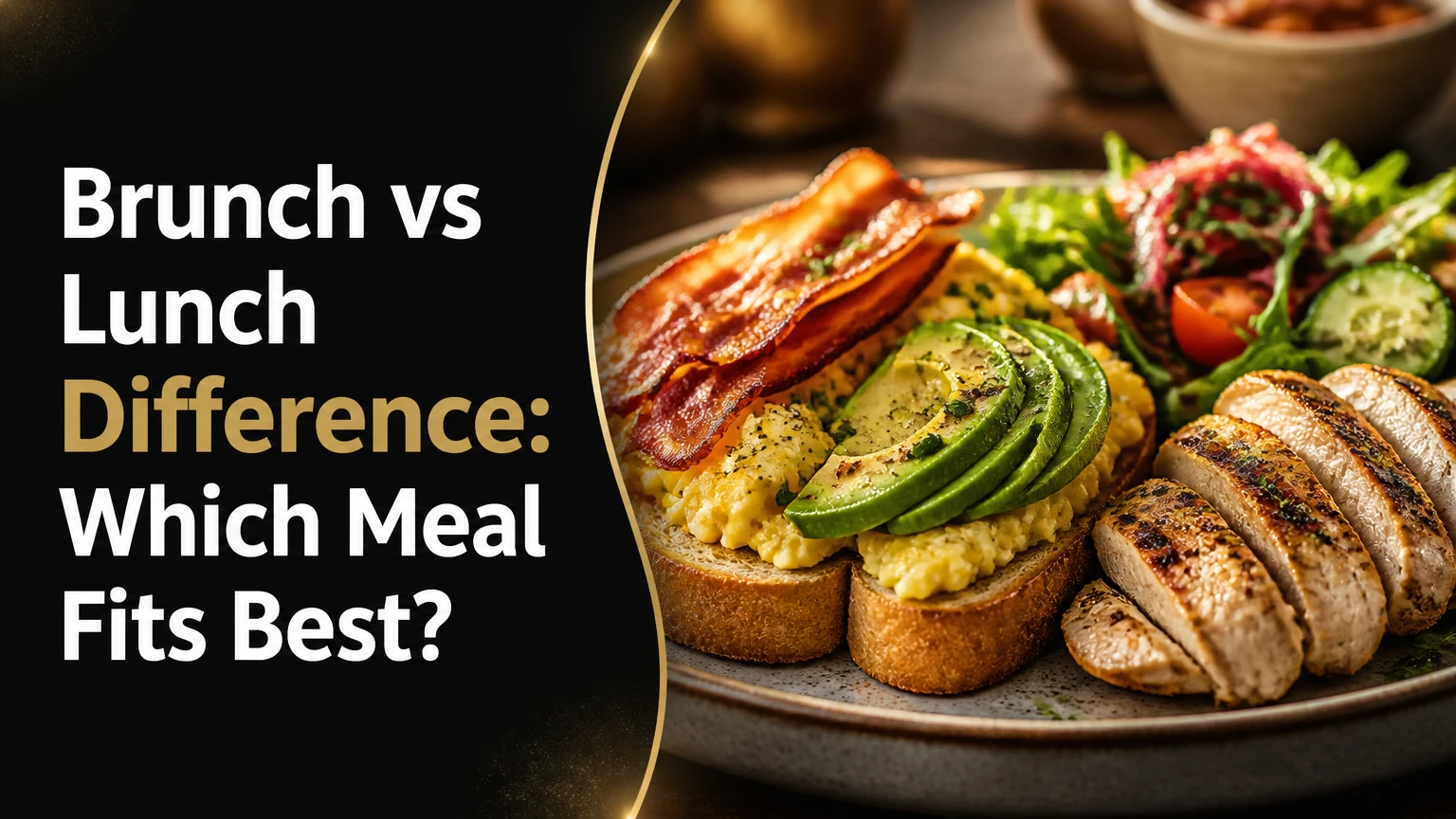
The brunch vs lunch difference is mainly timing, purpose, menu, and pace. Lunch is usually a shorter midday meal centered on efficient savory food, while brunch is a later-morning or early-afternoon meal combining breakfast and lunch dishes in a more social format. The boundary is flexible because restaurants set their own hours and menus.
Key Facts at a Glance
- Lunch typically begins around 11:30 a.m. or noon and lasts 30-60 minutes.
- Brunch commonly runs from 9:00 or 10:00 a.m. to 2:00 or 3:00 p.m.
- Lunch menus emphasize sandwiches, soups, salads, bowls, burgers, and daily specials.
- Brunch menus combine eggs, pancakes, pastries, toast, fried chicken, salads, and lunch entrées.
- Brunch usually costs more when it includes cocktails, buffets, reservations, or fixed-price packages.
- Lunch is usually the better choice for a defined schedule, while brunch fits leisurely social gatherings.
What Is the Brunch vs Lunch Difference?
Lunch is a midday meal positioned between breakfast and dinner, usually eaten during a workday or ordinary daily routine. Brunch combines the words breakfast and lunch and traditionally occupies the period between breakfast and lunch, although many restaurants extend brunch into early afternoon.
The difference is functional as well as chronological. Lunch generally solves a practical eating need during a predictable break. Brunch often functions as an outing, gathering, celebration, or weekend ritual. A restaurant may offer eggs at lunch or burgers at brunch, so the meal’s name describes the service period and experience rather than a legally fixed menu.
The word brunch has a documented history. British writer Guy Beringer proposed the term in an 1895 Hunter’s Weekly essay, describing brunch as “cheerful, sociable and inciting” and “talk-compelling.” That early description explains why modern brunch remains associated with conversation and leisure, although contemporary brunch can also be a quick weekday meal.
Is Brunch Just a Late Lunch?
Brunch is not simply late lunch because brunch usually includes breakfast-style foods, morning beverages, and a different social rhythm. A 1:30 p.m. meal of soup and a sandwich is normally lunch, whereas eggs Benedict, pancakes, pastries, and a mimosa at the same time may be labeled brunch.
The label depends on the restaurant’s advertised service. Some cafés use “brunch” for any meal served until 3:00 p.m.; other restaurants reserve the term for weekend menus. The overlap is real, but brunch adds a breakfast component and a leisure-oriented expectation.
When Is Each Meal Served?
Lunch most often runs from 11:30 a.m. or noon until 2:00 or 3:00 p.m. Brunch commonly begins earlier, between 9:00 and 10:00 a.m., and ends between 2:00 and 3:00 p.m. Restaurant schedules vary by city, cuisine, labor model, and day of the week.
| Service attribute | Lunch | Brunch |
|---|---|---|
| Common start time | 11:30 a.m.-12:00 p.m. | 9:00-10:00 a.m. |
| Common end time | 2:00-3:00 p.m. | 2:00-3:00 p.m. |
| Typical duration | 30-60 minutes | 90 minutes-3 hours |
| Most common days | Monday-Sunday | Saturday-Sunday |
| Reservation lead time | Same day to 3 days | 2 days to 3 weeks |
| Typical table turnover | 45-75 minutes | 90-180 minutes |
Brunch is strongly associated with Saturday and Sunday in the United States, Canada, the United Kingdom, and Australia, but the pattern is not universal. Hotels, cafés, diners, and restaurants in tourist districts may offer brunch every day. “All-day breakfast” can also provide many brunch foods without using the brunch label.
Can Brunch Be Served on a Weekday?
Yes, brunch can be served on a weekday when a restaurant advertises weekday brunch or operates a late-morning combined menu. The word brunch does not require a Saturday or Sunday, although weekend service remains the most common pattern.
Check the restaurant’s service page rather than relying on a search-result category. A venue may offer brunch from 10:00 a.m. to 2:00 p.m. on Tuesday, while another may use “weekday brunch” to describe only a few breakfast plates added to the lunch menu.
How Do the Menus Differ?
Lunch menus usually prioritize savory, portable, and quickly plated dishes. Brunch menus combine sweet breakfast foods, egg-based dishes, pastries, and selected lunch foods, creating a wider range of flavors but often requiring more cooking time.
| Menu category | Typical lunch examples | Typical brunch examples | Practical distinction |
|---|---|---|---|
| Bread-based meals | Turkey sandwich, panini, wrap | Brioche French toast, avocado toast | Brunch uses sweeter or richer bread |
| Egg dishes | Quiche, egg salad sandwich | Omelet, shakshuka, eggs Benedict | Brunch gives eggs a central role |
| Meat dishes | Burger, roast-beef sandwich | Chicken and waffles, steak and eggs | Brunch pairs lunch proteins with breakfast sides |
| Light meals | Caesar salad, grain bowl, soup | Fruit, yogurt, pastry, breakfast bowl | Brunch often includes smaller morning options |
| Sweet dishes | Cookie, brownie, seasonal dessert | Pancakes, waffles, French toast | Sweet items are a core brunch category |
| Beverage pairing | Water, soda, iced tea, coffee | Specialty coffee, juice, mimosa, Bloody Mary | Brunch has a broader morning-drink identity |
Lunch food is usually designed around a single meal format. A sandwich arrives with fries or salad, and a bowl arrives as a complete portion. Brunch menus are more likely to mix savory and sweet ordering, such as eggs for one guest, pancakes for another, and pastries for the table.
Brunch also creates more kitchen complexity. Eggs may require individual cooking, hollandaise must be held carefully, pancakes need a dedicated griddle, and fried chicken can have a longer preparation time than a pre-portioned lunch bowl. Those demands help explain why brunch service may have longer waits.
What Foods Are Typical at Lunch?
Typical lunch foods include sandwiches, wraps, salads, soups, burgers, grain bowls, pasta, tacos, and daily specials. Lunch portions tend to emphasize protein, vegetables, starch, or bread in a format that can be eaten within an hour.
Business-oriented restaurants often add steaks, seafood, or plated entrées to the lunch menu. Fast-casual restaurants rely on assembly-line items because bowls, salads, and sandwiches can be prepared consistently during a concentrated midday rush.
What Foods Are Typical at Brunch?
Typical brunch foods include eggs Benedict, omelets, pancakes, waffles, French toast, avocado toast, shakshuka, pastries, yogurt, chicken and waffles, breakfast sandwiches, and salads. Brunch menus can also include burgers, fried chicken, steak, or seafood.
The most recognizable brunch plates cross meal categories. Chicken and waffles combine a fried lunch-style protein with a sweet breakfast-style base; shakshuka uses eggs in a spiced tomato dish that can function as breakfast, lunch, or dinner.
Which Costs More, Brunch or Lunch?
Brunch usually costs more per diner than ordinary lunch because brunch frequently includes larger portions, premium breakfast ingredients, cocktails, buffets, fixed-price packages, and longer table occupancy. Typical United States restaurant pricing is approximately $12-$25 for lunch and $20-$45 for à la carte brunch before tax and tip.
| Dining format | Typical food price per person | Typical drink cost | Common total before tip |
|---|---|---|---|
| Fast-casual lunch | $10-$18 | $0-$4 | $10-$22 |
| Full-service lunch | $16-$30 | $3-$8 | $19-$38 |
| À la carte brunch | $18-$40 | $4-$14 | $22-$54 |
| Bottomless brunch | $35-$70 | Included or package-based | $35-$70 |
| Hotel buffet brunch | $45-$100+ | $0-$20 | $45-$120+ |
These are typical planning ranges, not universal prices. New York, London, Sydney, resort destinations, and hotel dining rooms can exceed them, while diners and neighborhood cafés may charge less.
Lunch can be cheaper even when the food is similar. Restaurants may offer weekday lunch specials, smaller portions, prix fixe menus, or lower-priced beverage programs. Brunch becomes especially expensive when a group adds multiple cocktails, automatic service charges, reservation deposits, or a mandatory package.
Is Bottomless Brunch Always the Better Value?
Bottomless brunch is better value only when a guest wants the included drinks and can legally and safely consume them within the service limit. A fixed-price package may cost more than an à la carte meal for guests who drink little, arrive late, or prefer nonalcoholic beverages.
Restaurants commonly impose a 90-minute or 120-minute alcohol window, require all guests in a party to purchase the package, and add tax and gratuity afterward. A $45 package can exceed $65 after a 20 percent tip and local tax, depending on the venue.
A practical rule is to compare the package with the à la carte price before ordering. Never treat unlimited alcohol as a reason to drink quickly; arrange transportation and follow the restaurant’s service rules.
Why Does Brunch Usually Take Longer?
Brunch takes longer because restaurants combine labor-intensive breakfast cooking with lunch service while guests often remain at tables for conversation and drinks. Eggs cooked to order, pancakes, sauces, fried items, reservations, and slower table turnover can extend the meal to 90 minutes or more.
Lunch restaurants often optimize for a concentrated rush. Staff prepare ingredients in advance, use streamlined menus, and seat guests who expect to leave within an hour. Brunch service has a different operating model, particularly when a restaurant accepts large weekend reservations.
The longer duration is not automatically a service failure. It becomes a problem when a guest has a timed event, a child who needs a predictable meal, a work appointment, or a long journey afterward.
How Long Should You Allow for Each Meal?
Allow 45-75 minutes for a standard seated lunch and 90 minutes-3 hours for a full brunch. Add 15-30 minutes for a weekend wait, 10-20 minutes for a large party, and additional time when a fixed-price alcohol package has a specific end time.
| Situation | Lunch planning time | Brunch planning time | Recommended buffer |
|---|---|---|---|
| Solo weekday meal | 30-45 minutes | 45-75 minutes | 10 minutes |
| Two-person restaurant meal | 45-60 minutes | 90-120 minutes | 15 minutes |
| Party of six | 60-90 minutes | 120-180 minutes | 30 minutes |
| Pre-theater or event meal | 45-60 minutes | 90 minutes minimum | 30-45 minutes |
| Bottomless package | 75-120 minutes | 90-150 minutes | Confirm cutoff |
What Are the Main Types of Lunch and Brunch?
Lunch types differ mainly by purpose and service speed, while brunch types differ by format, price structure, and social occasion. A desk lunch prioritizes convenience; a power lunch prioritizes conversation and business; an à la carte brunch prioritizes menu choice; and a buffet brunch prioritizes variety.
| Meal format | Typical setting | Typical duration | Best use |
|---|---|---|---|
| Desk lunch | Office, home, takeaway | 20-40 minutes | Workday convenience |
| Fast-casual lunch | Counter-service restaurant | 30-50 minutes | Predictable weekday meal |
| Power lunch | Full-service business restaurant | 60-90 minutes | Client meeting or negotiation |
| Family lunch | Diner, café, casual restaurant | 45-75 minutes | Children and mixed preferences |
| À la carte brunch | Café or restaurant | 90-150 minutes | Friends, couples, celebrations |
| Bottomless brunch | Licensed restaurant | 90-120 minutes | Group social event |
| Hotel buffet brunch | Hotel dining room | 120-180 minutes | Holiday or special occasion |
| All-day breakfast | Diner or café | 30-90 minutes | Flexible meal timing |
A buffet brunch may offer omelet stations, pastries, fruit, carved meat, seafood, and desserts, but the higher price reflects staffing, food variety, and venue overhead. An à la carte brunch usually gives better cost control because each guest pays for selected dishes.
Which Meal Is Better for Your Situation?
Lunch is better for work, a fixed appointment, a modest budget, or a meal that should finish within an hour. Brunch is better for weekend socializing, celebrations, late risers, and groups that value conversation over speed.
For a Business Meeting
Choose lunch for most business meetings because midday scheduling is easier and the meal can fit into a 45-90-minute calendar block. A quiet full-service restaurant with reservations is more appropriate than a crowded weekend brunch room with loud music and shared drink packages.
A power lunch can support negotiation because the meal has a conventional time boundary. Brunch can work for informal networking, but it is a weak choice for confidential discussions or meetings involving people who do not drink alcohol.
For a Weekend Celebration
Choose brunch when guests want a relaxed gathering with flexible breakfast and lunch choices. À la carte brunch usually works better than bottomless brunch for mixed-age groups, sober guests, pregnant guests, or anyone who wants to control the final bill.
Reserve early for parties of six or more. Ask about deposits, seating limits, automatic gratuity, and whether the table must purchase a single package.
For Families With Young Children
Choose early lunch, usually between 11:30 a.m. and 12:30 p.m., when predictability and speed matter more than cocktails or extended conversation. Brunch can work at a diner with children’s portions, but peak weekend waits often conflict with young children’s meal schedules.
Family-friendly brunch is easier when the restaurant accepts reservations, provides high chairs, offers plain foods, and can serve a child’s meal within 15 minutes. A crowded 1:00 p.m. bottomless-brunch venue is rarely a practical family choice.
For a Limited Budget
Choose weekday lunch specials, fast-casual lunch, or an à la carte café brunch without alcohol. Compare the full bill, not the advertised entrée, because tax, tip, beverages, package fees, and service charges can add 25-40 percent.
A budget diner can also order a breakfast plate during regular lunch hours if the restaurant offers all-day breakfast. That option often delivers brunch-style food without weekend pricing or reservation pressure.
For a Sober or Alcohol-Free Group
Choose à la carte brunch or lunch rather than bottomless brunch. Ask for coffee, tea, juice, sparkling water, or a zero-proof cocktail, and confirm that the venue does not require every guest to buy an alcoholic package.
Brunch does not require alcohol. The social identity of brunch comes from timing, food variety, and company, so a restaurant should accommodate nonalcoholic preferences without treating them as an exception.
How Can You Order More Strategically?
Order lunch when speed, price, or predictable portions are the priority; order brunch when the group values variety and time together. At brunch, balance one sweet item with a savory dish containing protein and a side of fruit or vegetables.
Use these practical rules:
- Check the cutoff time. Confirm when the kitchen stops serving brunch or lunch, especially for arrivals after 2:00 p.m.
- Ask about the full price. Include drinks, tax, gratuity, deposits, and package fees.
- Confirm the seating limit. Bottomless packages may last 90 minutes, while the table itself may have a two-hour limit.
- Match food to the schedule. Choose lunch before a meeting, flight, class, or performance.
- Balance the table. Share one sweet dish, then order savory options with eggs, beans, fish, chicken, or another protein.
- Check substitutions. Brunch kitchens may not substitute lunch sides or serve lunch dishes before the advertised lunch period.
An expert rule of thumb is to treat the meal label as a scheduling signal, not a guarantee of ingredients. The posted hours determine what you can order; the menu determines whether the experience feels like brunch or lunch.
Common Mistakes and Edge Cases
The most common mistake is assuming that every restaurant uses brunch and lunch consistently. A café may call its 11:00 a.m. weekend menu brunch, while a hotel may serve a brunch buffet until 4:00 p.m.; the venue’s posted menu is more reliable than a general definition.
Another mistake is arriving late to a bottomless reservation. A party that arrives 20 minutes into a 90-minute package may lose part of the included service window, and some venues start the clock at the reservation time.
Ordering only sweet brunch foods can also produce an unsatisfying meal. Pancakes, French toast, pastries, and sugary drinks provide a high carbohydrate load but may lack enough protein or fiber for sustained fullness. Sharing one sweet plate and choosing a savory entrée is a more reliable approach.
Lunch has its own failure modes. A business lunch at a noisy fast-casual venue can undermine the meeting, while a formal power lunch can waste time and money when guests need a quick meal. Choose the service format before choosing the cuisine.
Brunch is not automatically healthier or less healthy than lunch. Eggs, fruit, beans, vegetables, and whole-grain toast can create a balanced brunch; a lunch of fried food and a sugary drink can be more energy-dense. Meal composition matters more than the label.
The Bottom Line
The brunch vs lunch difference comes down to timing, purpose, menu design, price, and pace. Lunch usually means a shorter, savory midday meal that fits a routine or work schedule. Brunch usually means a later-morning or early-afternoon meal that combines breakfast and lunch foods in a slower social setting.
Choose lunch for business, families, limited budgets, and fixed schedules. Choose brunch for weekend gatherings, celebrations, late starts, and groups that want sweet and savory choices. Check the restaurant’s actual hours, menu, reservation rules, and total price before deciding.
Frequently Asked Questions
Is brunch before or after lunch?
Brunch is normally eaten after the usual breakfast period and before, during, or instead of lunch. Most brunch services begin between 9:00 and 10:00 a.m. and end between 2:00 and 3:00 p.m., so a guest may eat brunch at the same time another person would eat lunch.
Can you order lunch food at brunch?
You can order lunch food at brunch when the restaurant includes burgers, salads, fried chicken, sandwiches, or other midday dishes on its brunch menu. Some kitchens restrict lunch items until noon, while others run a combined menu, so check the printed or online menu before ordering.
Why is brunch more expensive than lunch?
Brunch often costs more because it uses labor-intensive eggs and pastries, offers larger or richer dishes, runs during high-demand weekend periods, and includes cocktails or fixed-price packages. Brunch becomes substantially more expensive when guests add bottomless drinks, automatic gratuity, tax, reservation deposits, or buffet pricing.
Is brunch a meal or a time?
Brunch is both a meal category and a service period. As a meal category, brunch combines breakfast and lunch foods; as a service period, it usually occupies late morning and early afternoon. Restaurants can therefore serve brunch on weekdays, extend it to 3:00 p.m., or offer it every day.
What is the difference between brunch and breakfast?
Breakfast usually occurs earlier and centers on morning foods such as cereal, toast, eggs, fruit, and coffee. Brunch begins later, often includes lunch-style dishes and alcoholic or specialty beverages, and commonly lasts longer. Brunch can replace breakfast and lunch, while breakfast normally replaces only the first meal.
Is lunch healthier than brunch?
Neither meal is inherently healthier. A balanced brunch with eggs, vegetables, fruit, and whole-grain toast may be more nutritious than a fried lunch, while a lean lunch with vegetables may be lighter than pancakes, pastries, and sugary cocktails. Portion size, ingredients, protein, fiber, and drinks determine the nutritional result.