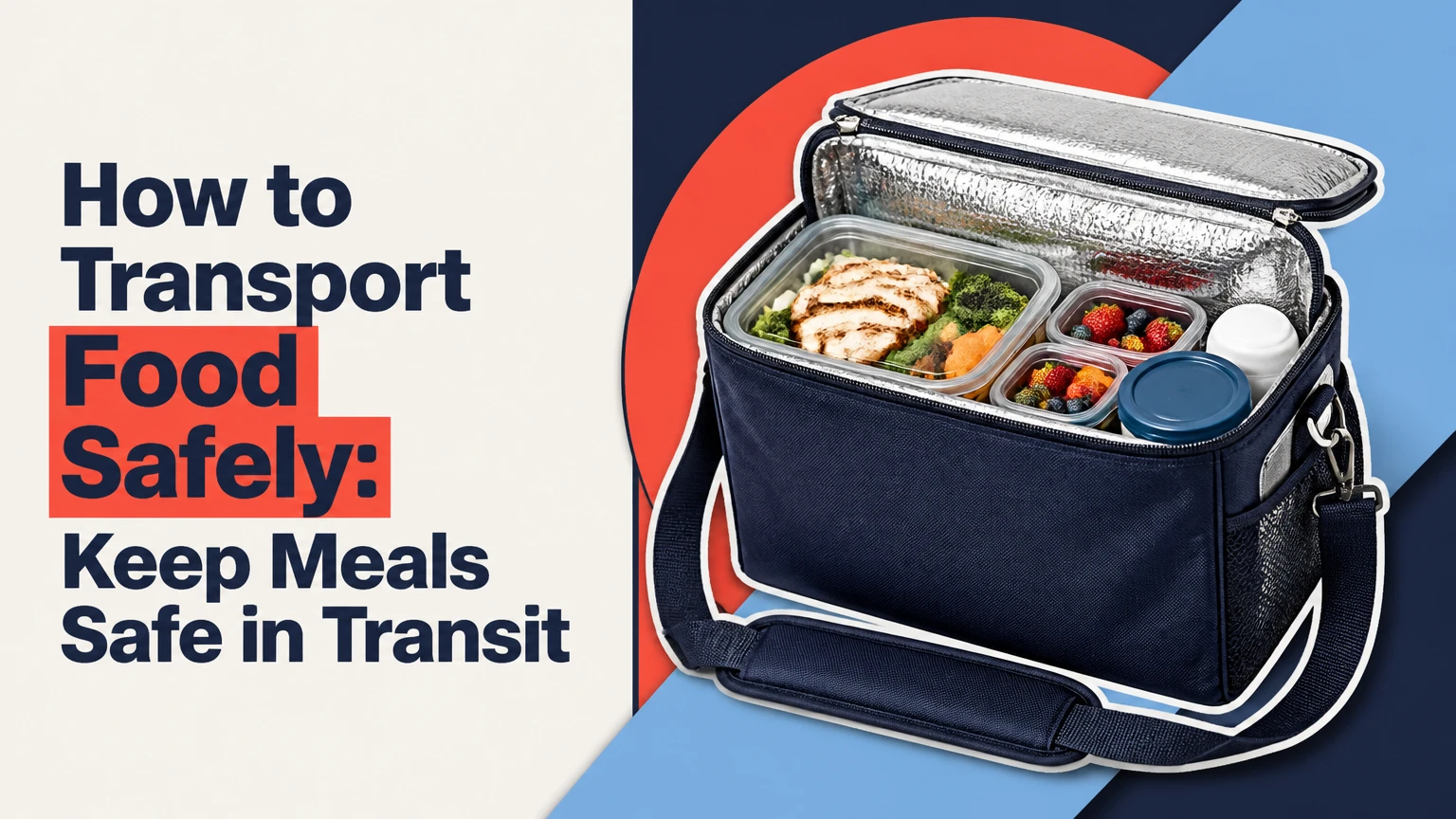
To transport food safely, keep cold food at 40°F (4°C) or below, hot food at 140°F (60°C) or above, and frozen food at 0°F (-18°C) or below. Use clean, leak-proof containers inside insulated carriers, minimize transit time, measure temperatures with a food thermometer, and discard perishable food that exceeds safe time limits.
Key Facts:
The USDA Food Safety and Inspection Service identifies 40°F to 140°F as the food safety danger zone.
Refrigerated food should travel at 40°F or below; the FDA Food Code generally uses 41°F or below for regulated food-service storage.
Hot food should remain at 140°F or above during transport.
Perishable food should not remain between 40°F and 140°F for more than 2 hours, or 1 hour when ambient temperatures exceed 90°F.
Frozen food should remain at 0°F (-18°C) or below, or still contain ice crystals and remain refrigerator-cold if briefly transported.
A clean probe thermometer verifies safety; container insulation alone does not prove a safe temperature.
What temperatures keep food safe during transport?
Cold food must stay at 40°F or below, hot food at 140°F or above, and frozen food at 0°F or below. These thresholds limit the time bacteria can multiply during a car trip, catering run, grocery transfer, or commercial delivery.
The USDA uses 40°F to 140°F for consumer food-safety guidance. The FDA Food Code, which many jurisdictions adopt for restaurants and caterers, generally specifies 41°F or below for cold holding. Following the stricter 40°F household target creates a useful margin, but local health departments may impose different requirements.
| Food condition | Transport target | Typical examples | Verification method |
|---|---|---|---|
| Refrigerated | 40°F or below | Meat, dairy, cooked rice, cut produce | Probe thermometer between packages |
| Regulated cold holding | 41°F or below | Restaurant salads, sauces, prepared meals | Calibrated food thermometer |
| Hot holding | 140°F or above | Soup, curry, cooked meat, casseroles | Measure center of food |
| Frozen | 0°F or below | Ice cream, frozen meat, frozen meals | Product thermometer or freezer probe |
| Brief frozen transfer | Ice crystals remain | Frozen groceries during short trips | Touch, appearance, and temperature check |
Temperature is only one control. A food carrier that starts at 45°F cannot make food safe, and a hot container that begins at 125°F cannot reliably reach the required holding temperature without reheating.
How long can transported food remain safe?
Perishable food has a two-hour limit at room temperature and a one-hour limit when the surrounding temperature is above 90°F. The four-hour concept is a cumulative control used in some food-service guidance: food exposed between 41°F and 135°F or 140°F may be served immediately before four hours, but it must not be returned to refrigeration.
The USDA states, “Never leave food out of refrigeration over 2 hours,” in its consumer food-safety guidance. Count time from the moment food leaves temperature control, including preparation delays, loading, driving, waiting, and delivery handoff.
| Exposure condition | Maximum practical action | Example |
|---|---|---|
| Below 90°F, perishable food | Refrigerate within 2 hours | A 35-minute drive plus 20-minute setup |
| Above 90°F | Refrigerate within 1 hour | Food in a parked vehicle during summer |
| Cumulative 2-4 hours | Serve immediately, do not re-chill | Buffet tray delayed before service |
| More than 4 hours | Discard | Warm chicken delivered after a long delay |
| Cold food at 40°F or below | Time control remains favorable | Proper cooler with sufficient ice |
| Hot food at 140°F or above | Time control remains favorable | Preheated insulated carrier |
Local rules may use a four-hour discard rule, a two-hour cooling rule, or stricter requirements for commercial operations. A caterer should follow the jurisdiction where the food is prepared and served, not rely on a general internet summary.
Before You Start: time, tools, and prerequisites
A household transfer usually takes 10-20 minutes to pack and costs $10-$60 if basic containers and a cooler already exist. Catering loads commonly require 30-90 minutes, two people for large orders, multiple carriers, labels, and temperature records.
Prepare these materials:
- Probe food thermometer, preferably with an accuracy of ±2°F
- Insulated cooler or delivery bag with a tight closure
- Two to four frozen gel packs per small cooler, or enough ice to surround the food
- Leak-proof, food-safe containers with lids
- Clean towels or paper liners for condensation and spills
- Labels showing product name, packing time, allergens, and destination
- Separate raw-food carrier if uncooked meat, poultry, seafood, or eggs are included
- Sanitizer approved for food-contact surfaces, used according to its label
- Reusable crate or seat-belt restraint to prevent tipping inside a vehicle
Check that the thermometer reads 32°F in an ice-water slurry. If it does not, calibrate it when the model allows calibration, or replace it.
Step 1: Stabilize the food before packing
Cool cooked food promptly in shallow containers, or keep it fully hot until loading. Do not place a deep pot of soup directly into a cooler because its center may remain hot while the container surface feels cold.
For home transport, divide hot food into containers no deeper than 2-3 inches when rapid cooling is required. Refrigerate uncovered or loosely covered until steam stops, then seal the containers. For commercial cooling, the FDA Food Code cooling benchmark is 135°F to 70°F within 2 hours and 70°F to 41°F within an additional 4 hours.
For hot transport, load food at 165°F or higher when possible, then verify that the center remains at least 140°F. Reheating food only to 140°F is not a reliable recovery method after prolonged warm exposure; food-service reheating generally requires 165°F for 15 seconds, followed by hot holding.
You’ll know stabilization worked when cold food measures 40°F or below, hot food measures 140°F or above, and frozen food remains hard with no liquid pooling.
Common mistake: sealing a large volume of hot food tightly before cooling. The trapped heat extends the cooling period and can increase bacterial growth.
Step 2: Seal, label, and separate every food category
Use rigid, leak-proof containers for soups, sauces, dairy products, cooked grains, and cut produce. Wrap raw meat and seafood in a second bag or tray, then place them below ready-to-eat food so a leak cannot contaminate a meal.
Labels should identify the food, packing time, destination, allergens, and whether the contents are raw, chilled, frozen, or ready to eat. A label prevents a delivery worker from opening several containers to identify an order and reduces allergen mix-ups.
Separate these zones:
- Raw poultry, meat, seafood, and eggs
- Ready-to-eat cooked meals
- Desserts and baked goods
- Ice, drinks, and non-food products
- Allergen-containing meals, when an allergen-free order is promised
Use a dedicated carrier for raw animal products whenever possible. A plastic grocery bag does not provide the same leak protection, insulation, or separation as a sealed food container inside a clean carrier.
You’ll know sealing worked when the container survives a gentle inversion test without leakage and the lid does not flex away from the rim.
Common mistake: transporting hot food in a sealed, non-vented container with crisp fried items. Steam softens the crust. Use a vented food-service container where food quality requires it, while preserving temperature control.
Step 3: Pack cold and frozen food with thermal control
Pre-chill the cooler or delivery bag for 15-30 minutes when practical, and freeze gel packs for at least 12 hours. Put cold food in the center, place ice packs above and beside the load, and fill large air gaps with additional packs or clean, sealed ice.
A useful household starting point is one pound of ice or frozen gel per 3-4 pounds of refrigerated food for a trip of up to 4 hours, provided the cooler stays closed and the starting food is already cold. Warm weather, repeated opening, direct sunlight, and a thin bag require more cooling capacity.
Do not place loose ice directly against unpackaged food. Meltwater can spread pathogens, damage labels, and contaminate ready-to-eat items. Drainable coolers are useful for sealed raw products, but a non-draining cooler can retain cold air better when its contents remain dry.
Pack frozen goods last, use a separate frozen carrier when possible, and keep the carrier in the passenger compartment rather than a hot trunk. Frozen food may be refrozen if it still contains ice crystals or remains 40°F or below, although quality can decline.
You’ll know packing worked when the carrier is cold throughout, food is surrounded by cooling material, and the thermometer reads 40°F or below after the longest expected route segment.
Common mistake: putting a small amount of ice on top of a half-empty cooler. Air pockets warm quickly. Thermal contact matters more than the visible amount of ice.
Step 4: Transport hot food in a preheated carrier
Preheat an insulated hot box with hot water for 5-10 minutes, empty it, and load food immediately. Use a carrier designed for hot holding, not a standard picnic cooler, because some coolers soften, warp, or lose insulation when exposed to very hot containers.
Keep lids closed, minimize empty air space, and place a clean towel above the container only when it does not contact food or block the lid. Do not stack very hot pans directly on delicate foods, and keep cold salads, desserts, and drinks in a separate cold carrier.
For long catering routes, use electric heated cabinets or active hot boxes with thermostatic control. Passive insulation has a finite hold time, while an active unit can maintain temperature only if the power source, thermostat, and vehicle connection work correctly.
You’ll know hot packing worked when the food center measures at least 140°F at loading and remains at or above that temperature at delivery.
Common mistake: opening the carrier repeatedly to check food. Measure quickly at loading and handoff, then keep the carrier closed between checks.
Step 5: Plan the route and document the handoff
Schedule the shortest practical route, load the final destination first or last according to the delivery sequence, and avoid leaving carriers in a parked vehicle. A shaded passenger compartment is safer than a sun-heated trunk, but neither replaces insulation and temperature measurement.
For commercial delivery, record product temperature at packing, departure, arrival, and any delay exceeding the operating limit. A basic log should include the time, product, temperature, carrier identification, driver, destination, and corrective action.
| Operation | Recommended monitoring | Typical route limit | Documentation |
|---|---|---|---|
| Household meal transfer | Check at packing and arrival | 1-2 hours | Optional note or phone record |
| Small catering order | Check each carrier at loading and handoff | 2-4 hours with control | Paper or digital temperature log |
| Restaurant delivery | Check representative orders and carrier | 30-90 minutes | Dispatch and delivery timestamps |
| Refrigerated fleet | Continuous probe or data logger | Set by product and validation | Electronic temperature history |
| Frozen shipment | Product or air probe monitoring | Validated by packaging | Shipment logger and exception report |
Do not use a vehicle air-conditioner display as a food temperature reading. Air temperature changes faster than the food center, and an apparently cool cabin can hide a warm container.
You’ll know routing worked when the destination handoff occurs within the planned window and the food still meets its cold, hot, or frozen target.
Common mistake: accepting an additional delivery after loading a temperature-sensitive order. Route changes can consume the entire safety margin.
Which transport equipment is appropriate?
A hard cooler is the best low-cost option for short household and catering trips, while active refrigerated vehicles are appropriate for validated commercial routes. Insulated delivery bags are portable and inexpensive, but they lose temperature faster when overloaded, opened often, or exposed to heat.
| Equipment | Typical purchase cost | Practical hold time | Best use | Main limitation |
|---|---|---|---|---|
| Insulated delivery bag | $20-$80 | 1-2 hours | Single hot or cold meal | Limited thermal mass |
| 20-50 quart hard cooler | $30-$180 | 4-12 hours | Household groceries and meals | Bulky, no active control |
| Caterer insulated food carrier | $100-$450 | 2-6 hours | Hotel pans and event service | Requires correct pan fit |
| Electric hot box | $350-$2,000 | 4-12 hours with power | Catering and restaurant routes | Power failure risk |
| Portable powered refrigerator | $250-$1,200 | Indefinite with power | Road trips and sensitive foods | Battery capacity limits |
| Refrigerated van conversion | $10,000-$25,000 or more | Continuous with system running | Fleet delivery | Maintenance and compliance costs |
Typical hold times vary by insulation thickness, ambient temperature, product mass, starting temperature, opening frequency, and ice or power capacity. Treat manufacturer claims as performance estimates, not a substitute for validation with the actual menu and route.
An insulated bag is not good for a four-hour summer catering route carrying several hot pans. A powered refrigerator is not automatically suitable for hot food, because many units cool but do not safely hot-hold.
How should food types be packed?
Food type determines container choice, separation, and thermal priority. High-moisture, high-protein, ready-to-eat foods require the strongest temperature control because they support bacterial growth and may receive no further kill step.
| Food category | Container and placement | Temperature target | Practical note |
|---|---|---|---|
| Raw chicken or meat | Double-bagged, bottom of separate cooler | 40°F or below | Prevent drips onto ready-to-eat food |
| Cooked rice or pasta | Shallow sealed container | 40°F or below when cold | Cool quickly because starch foods support growth |
| Soup or stew | Leak-proof container, upright | 140°F or above hot | Use a hot carrier or chill rapidly |
| Cut fruit and salads | Sealed shallow container | 40°F or below | Keep away from raw products |
| Cream desserts | Rigid container with gel packs | 40°F or below | Protect from crushing and melting |
| Bread and dry baked goods | Clean breathable box | Ambient, dry location | Avoid refrigeration when quality suffers |
| Ice cream | Frozen carrier with dense gel packs | 0°F or below preferred | Keep carrier closed throughout route |
Use separate compartments for foods with conflicting needs. Fried food needs ventilation for texture, while meat requires a sealed environment for spill control, so a single universal container often protects safety or quality but not both.
Common mistakes and how to fix them
A cooler is packed with warm food
Risk: Warm food raises the temperature of nearby items and may remain in the danger zone for hours.
Fix: Chill food before packing, use shallow containers, and measure the center rather than the surface. If the food has exceeded its time limit, discard it instead of trying to cool it later.
Raw juices leak onto cooked food
Risk: Pathogens from raw poultry, meat, or seafood can contaminate ready-to-eat meals.
Fix: Discard exposed ready-to-eat food, clean and sanitize the carrier, and transport raw products below or apart from cooked products. Wiping a leak with a dry towel is not sanitation.
Food sits in a hot parked car
Risk: Vehicle interiors can exceed 100°F, rapidly consuming the one-hour warm-weather limit.
Fix: Keep the engine running only where lawful and safe, use a validated active carrier, or move food directly into temperature-controlled storage. Never leave children, pets, or food-dependent medication in an unattended running vehicle.
A delivery is delayed
Risk: Time and temperature exposure continue during traffic, missed handoffs, and customer unavailability.
Fix: Record the delay, keep the carrier closed, contact the recipient, and reject the order when the time or temperature limit is exceeded. A discount does not restore food safety.
The thermometer gives an unreliable reading
Risk: A low-battery, dirty, or poorly placed probe can produce false confidence.
Fix: Clean and sanitize the probe between foods, measure the thickest portion, avoid touching the container wall, and verify calibration in ice water. Replace damaged probes.
What changes for homes, caterers, and delivery fleets?
Households should use one clean cooler for cold food, a separate bag for raw meat, and a direct route from store or kitchen to refrigerator. Put groceries away immediately and do not use the trunk for chilled food during warm weather.
Small caterers need written packing times, carrier identification, allergen labels, probe checks, and a contingency plan for power loss or vehicle breakdown. Load food in batches when possible, because opening every carrier at once can remove the safety margin from the first batch.
Commercial fleets need validated packaging, preventive maintenance, calibrated sensors, cleaning records, driver training, and jurisdiction-specific procedures. Refrigerated vehicles should be pre-cooled, inspected for door-seal damage, and checked for adequate airflow around the load.
A fleet data logger is useful, but it cannot detect every product failure. A probe near the door may remain cold while food in a dense center warms, so validation should compare air readings with product temperatures on representative routes.
What should you do if food arrives too warm?
If refrigerated food arrives above 40°F, measure several packages, identify the exposure time, and determine whether the product remained within the permitted time window. If hot food arrives below 140°F, apply the same time-based assessment, not a visual inspection.
Discard perishable food when the duration above safe limits is unknown, when food has exceeded two hours in ordinary conditions, or when it has exceeded one hour above 90°F. Commercial operators should isolate the affected order, record the incident, notify the responsible manager, and follow the company’s disposition procedure.
Do not taste questionable food. Pathogenic bacteria may produce no unusual smell, color, or texture, and reheating may not eliminate toxins already produced by some organisms.
How much does safe food transport cost?
A basic household setup costs approximately $30-$180 for a hard cooler, $10-$30 for gel packs, and $10-$40 for a probe thermometer. A small catering setup commonly costs $250-$1,500 for carriers, pans, thermometers, labels, and spare cooling capacity.
Commercial costs rise sharply because equipment must support route duration, cleaning, monitoring, vehicle integration, and regulatory documentation. A refrigerated van conversion may cost $10,000-$25,000 or more before maintenance, fuel, insurance, and temperature-monitoring software.
The least expensive safe system is not always the cheapest purchase. Adding a second carrier may prevent cross-contamination and reduce opening frequency, producing more reliable control than buying a larger single cooler.
FAQ
Can I transport food safely on public transportation?
Yes, for short journeys when food begins at the correct temperature and travels in a closed insulated carrier. Keep raw products separate, avoid placing the carrier on dirty floors, and move food into refrigeration or hot holding immediately after arrival. Public-transit delays make a thermometer and time record especially useful.
Should I use aluminum foil to keep food hot?
Aluminum foil reduces heat loss but does not provide enough insulation by itself for prolonged transport. Wrap the sealed container in foil only as a secondary layer, then place it inside a preheated insulated carrier. Check the food center at loading and delivery because foil does not confirm a safe holding temperature.
Can I transport frozen food after it starts thawing?
Frozen food can usually be refrozen when it still has ice crystals or remains 40°F or below, although texture may deteriorate. Discard food that is fully thawed and has remained above 40°F for longer than the applicable time limit. Keep frozen products in a dedicated carrier with dense frozen packs.
How do I transport food safely without ice?
Use a validated powered refrigerator or hot-holding unit when ice is unavailable. Passive insulation alone cannot create cold or heat, so it only slows temperature change. For a short trip, pre-chilled food in a well-insulated carrier may remain compliant, but verify the temperature rather than assuming the carrier worked.
Are cardboard boxes safe for food delivery?
Cardboard can transport dry, packaged, or boxed foods when it remains clean and dry, but it is a poor primary barrier for leaking, wet, raw, or temperature-sensitive food. Use food-safe sealed containers inside insulated carriers, then use cardboard as an outer packaging layer where appropriate.
What is the safest way to transport food in summer?
Pre-chill food, use a hard insulated cooler with frozen packs, keep the carrier out of direct sun, minimize stops, and target a one-hour maximum for uncontrolled warm exposure above 90°F. Measure the food at arrival. Summer conditions reduce the margin for mistakes, especially in parked vehicles.
The Bottom Line
How to transport food safely depends on controlling temperature, time, contamination, and route conditions together. Keep cold food at 40°F or below, hot food at 140°F or above, frozen food at 0°F or below, and perishable food within the two-hour limit, using clean sealed containers, separate raw-food zones, insulated carriers, and a thermometer to verify the result.