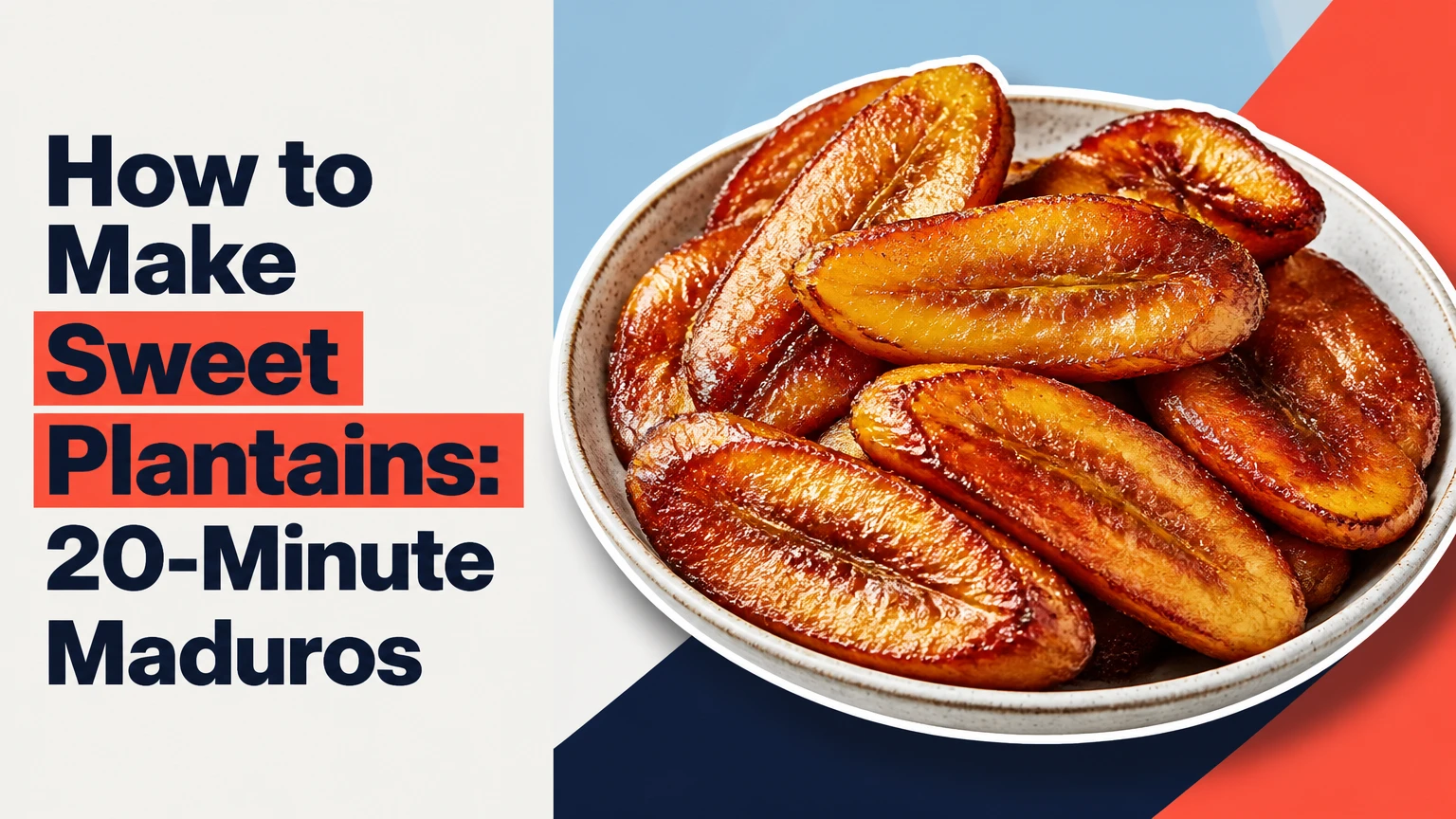
To make sweet plantains, slice deeply ripe yellow plantains with heavy black spots, then fry them in 340-355°F oil for 5-7 minutes until caramelized outside and custardy inside. Drain, rest for 2 minutes, and add a small pinch of salt. The full process takes about 20 minutes, including peeling and heating the pan.
Key Facts at a Glance
- One medium plantain produces approximately 10-12 diagonal slices and serves 2-3 people as a side dish.
- The best peel is yellow with extensive black spotting or mostly black without mold, leaking liquid, or an unpleasant odor.
- Half-inch slices cooked in 340-355°F oil develop browned edges without burning the center.
- Shallow frying takes about 5-7 minutes per batch, while baking takes 20-25 minutes.
- Ripe plantains contain more simple sugars and less firm starch than green plantains, producing a softer, sweeter result.
- Cooked maduros keep for up to 4 days in the refrigerator and reheat best in a skillet or toaster oven.
What Are Sweet Plantains?
Sweet plantains are ripe cooking bananas prepared until their natural sugars brown and their flesh becomes soft. In Spanish-speaking Caribbean and Latin American cuisines, the fried preparation is commonly called maduros, while green plantains are used for savory preparations such as tostones or patacones.
Plantains and dessert bananas belong to the same Musa family, but plantains are typically larger, firmer, and starchier during early ripening. A green plantain tastes bland and potato-like when cooked. A heavily spotted plantain develops a honeyed flavor with a texture closer to soft custard.
The classic target is a contrast between browned, slightly crisp edges and a tender center. Sweet plantains are not meant to become shatteringly crisp like potato chips. Overcooking removes their moisture and turns the caramelized surface bitter.
Why Ripeness Determines Sweetness
Ripening converts part of a plantain’s starch into sugars and weakens pectin in the cell walls. That combination creates the characteristic sweetness and soft texture of maduros, so cooking temperature cannot fully compensate for an underripe fruit.
A yellow peel with a few small spots can work, but the center often remains firm. A peel covered in black freckles gives a better balance of structure and sweetness. Nearly black fruit produces the softest result and requires gentler handling because the flesh breaks more easily.
Harold McGee’s On Food and Cooking describes ripening as a process in which fruit “softens and sweetens” as its internal chemistry changes. That principle matters here: heat caramelizes the surface, but ripeness supplies most of the sweetness.
How Ripe Should a Plantain Be?
Choose a plantain with yellow skin covered by roughly 60-90% black spots for the most dependable maduros. A nearly black peel is also usable when the fruit feels soft but remains intact, while a completely green or mostly yellow plantain is better suited to savory cooking.
| Peel appearance | Flesh condition | Expected flavor | Best use |
|---|---|---|---|
| Green, firm | Dense and starchy | Mild, potato-like | Tostones, chips, boiling |
| Yellow, few spots | Firm with moderate starch | Mildly sweet | Grilling, roasting, mixed dishes |
| Yellow, many black spots | Soft and sugar-rich | Sweet and caramelized | Fried maduros |
| Mostly black, intact | Very soft and highly sweet | Deep, honeyed flavor | Gentle frying, baking |
| Black with mold or liquid | Degraded or contaminated | Sour or fermented | Discard |
Black skin alone does not mean a plantain is spoiled. Discard it if the flesh smells sour, the peel has fuzzy mold, the fruit leaks liquid, or the interior contains widespread gray, pink, or green discoloration. A few dark bruises are usually harmless; a fermented odor is not.
How to Ripen Yellow Plantains
Keep yellow plantains at room temperature for 2-5 days, checking the peel daily until black spots spread across the surface. A paper bag can speed ripening by retaining ethylene, but refrigeration slows the process and may darken the peel without softening the flesh.
Do not place an underripe plantain in the refrigerator expecting it to sweeten normally. If the fruit is already cut, wrap the exposed flesh tightly and use it within 24 hours, although whole fruit ripens more evenly.
Before You Start
The following quantities make a practical batch for four side servings. Use a wide skillet so the slices can remain in one layer.
| Item | Quantity for 4 servings | Useful specification |
|---|---|---|
| Ripe plantains | 2 medium | About 8-10 inches each |
| Neutral cooking oil | 1/3-1/2 cup | Canola, vegetable, corn, or avocado |
| Fine salt | 1/8 teaspoon | Add after frying |
| Frying pan | 1 | 10-12-inch heavy skillet |
| Paper towels | 2-3 sheets | For draining surface oil |
| Cooking thermometer | 1, optional | Target 340-355°F |
Typical preparation: 5-7 minutes
Typical cooking: 6-10 minutes, depending on batch size
Total time: 15-20 minutes
Difficulty: Easy
Typical cost: $2-$5 for four servings in a United States supermarket, excluding pantry oil
Use a knife, cutting board, tongs or a slotted spatula, and a plate lined with paper towels. A thermometer improves consistency, but visual cues work when the oil shimmers and a test slice begins bubbling immediately without smoking.
How to Make Sweet Plantains
Step 1: Inspect and Wash the Plantains
Select ripe, intact plantains and rinse the peels under cool running water before cutting. Washing the exterior prevents surface dirt from transferring to the knife and flesh, even though the peel will be removed.
You will know this step worked when the fruit has no leaking liquid, fuzzy mold, or fermented smell. A common mistake is choosing fruit by peel color alone while ignoring odor and texture.
Step 2: Cut Off the Ends and Score the Peel
Place each plantain on a cutting board, slice off both tips, and make one shallow lengthwise cut through the peel. Keep the knife in the skin rather than cutting deeply into the flesh, because deep cuts release juice and make the pieces harder to handle.
If the peel is black and soft, make two shorter scoring cuts instead of forcing one long cut. The flesh should remain whole after the peel opens.
Step 3: Peel and Slice on a Bias
Pull away the peel with your thumbs, then cut each plantain diagonally into slices about 1/2 inch thick. Diagonal slices expose more surface area than straight rounds, which creates broader caramelized faces and longer browned edges.
For very soft fruit, support the plantain with your fingertips and use a sharp knife with one clean motion. You will know the slices are suitable when they hold their shape without cracking. Slices thinner than 1/4 inch burn quickly; pieces thicker than 3/4 inch may stay firm inside.
Step 4: Heat the Oil to 340-355°F
Pour 1/3-1/2 cup oil into a 10-12-inch skillet, creating a depth of approximately 1/4-1/2 inch. Heat over medium to medium-low until the oil reaches 340-355°F, or until a test slice produces steady bubbles without aggressive splattering.
The oil should shimmer but never smoke. If the oil smokes, remove the pan from heat for 60 seconds and lower the burner. High heat browns the sugar before the flesh warms through, producing a bitter surface and hard center.
Step 5: Fry the First Side
Arrange the slices in a single layer with at least 1/2 inch between pieces when possible. Fry the first side for 2-4 minutes, depending on thickness and ripeness, until the underside is deep golden brown with darkened edges.
You will know the first side is ready when the slice releases easily from the pan and the exposed edge looks soft rather than white. The common mistake is overcrowding the skillet, which lowers the oil temperature and causes the plantains to absorb oil instead of browning.
Step 6: Turn and Finish Cooking
Turn each slice with tongs or a thin spatula and fry the second side for 2-3 minutes. The finished flesh should feel tender when pressed lightly, while the surface should show brown patches rather than a pale yellow color.
Very ripe plantains may need only 90 seconds per side. Less ripe fruit may need 3-4 minutes per side over lower heat. If the surface darkens before the center softens, reduce the heat and cover the skillet for 1-2 minutes.
Step 7: Drain, Rest, and Season
Transfer the cooked plantains to paper towels and let them rest for 2 minutes. Sprinkle with approximately 1/8 teaspoon fine salt for a four-serving batch, adjusting the amount if the main dish is already salty.
The resting period allows trapped steam to soften the center and lets excess surface oil drain. Serve maduros warm, because refrigeration firms the starches and reduces the fresh caramel aroma.
Which Cooking Method Should You Choose?
Shallow frying is the best method for classic maduros because direct oil contact produces the strongest browned crust and softest center. Baking suits large batches and low-oil cooking, while air frying saves oil but creates a slightly drier surface; boiling produces tenderness without caramelization.
| Method | Temperature and time | Oil amount | Texture | Batch capacity |
|---|---|---|---|---|
| Shallow fry | 340-355°F, 5-7 minutes | 1/3-1/2 cup per 2 plantains | Browned edges, custardy center | 2-3 plantains per 12-inch pan |
| Bake | 400°F, 20-25 minutes | 1 tablespoon per 2 plantains | Soft center, drier edges | 4-6 plantains per sheet |
| Air fry | 375°F, 10-12 minutes | 1-2 teaspoons spray or oil | Light crust, soft center | 2-3 plantains per basket |
| Boil | Simmer, 15-20 minutes | None | Soft, moist, non-caramelized | 3-4 plantains per pot |
When Is Baking Better Than Frying?
Baking is better when you need four or more plantains, want less added fat, or prefer hands-off cooking. Toss 2 sliced plantains with 1 tablespoon oil, arrange them on parchment, and bake at 400°F for 10-12 minutes per side.
Baking does not reproduce the same fried crust. The dry oven air removes more moisture from exposed edges, so use thicker 1/2-3/4-inch slices and remove them as soon as the surfaces turn deep golden.
How Do You Air Fry Sweet Plantains?
Air fry lightly oiled 1/2-inch slices at 375°F for 6 minutes, turn them, and cook for another 4-6 minutes. Leave space between slices so circulating air can brown the surfaces instead of steaming them.
Air fryer baskets vary substantially in heating intensity. Check the plantains at 8 minutes during the first batch, especially when using very black fruit. A quick spray of oil improves browning, but excess oil can make the soft slices difficult to turn.
When Does Boiling Make Sense?
Boiling makes sense when tenderness matters more than caramelization, particularly as a side dish with stews, beans, or grilled fish. Peel the plantains, cut them into 2-inch chunks, simmer them in lightly salted water for 15-20 minutes, and drain when a fork enters easily.
Boiled ripe plantains are softer and less sweet-tasting because their surfaces do not reach caramelization temperatures. They are useful for low-oil meals but are not a substitute for fried maduros when browned edges are the goal.
How Much Oil and How Many Plantains Do You Need?
Plan on one medium plantain for every two modest side servings, or one plantain per person when maduros are the main starch. A 10-12-inch skillet usually handles two sliced plantains in one layer using 1/3-1/2 cup oil.
| Diners | Plantains | Oil for shallow frying | Finished slices |
|---|---|---|---|
| 2 | 1 medium | 1/4 cup | 10-12 |
| 4 | 2 medium | 1/3-1/2 cup | 20-24 |
| 6 | 3 medium | 1/2-2/3 cup | 30-36 |
| 8 | 4 medium | 2/3-3/4 cup, two batches | 40-48 |
The oil is not intended to cover the plantains completely. A shallow layer allows the slices to contact hot metal and oil at the same time, creating a more controlled crust than deep frying.
Use a neutral oil with a high smoke point. Canola, vegetable, corn, and avocado oil work well; extra-virgin olive oil can add a strong flavor and may smoke sooner over sustained medium-high heat.
What Should You Serve With Maduros?
Maduros pair best with salty, acidic, or spicy foods that balance their concentrated sweetness. Serve them beside black beans and rice, roast pork, grilled chicken, stewed beef, eggs, fried cheese, or a cabbage slaw dressed with lime.
Common combinations include:
- Caribbean plate: maduros, black beans, white rice, roast pork, and lime.
- Latin American breakfast: fried eggs, avocado, queso fresco, and hot sauce.
- West African-inspired meal: ripe fried plantain with beans, pepper sauce, or grilled fish.
- Simple vegetarian plate: maduros, lentils, sautéed greens, and pickled onions.
Add salt after cooking rather than before frying. Salt draws moisture toward the surface and can increase splattering, while post-cooking seasoning stays on the caramelized exterior.
Common Mistakes and How to Fix Them
| Problem | Likely cause | Immediate fix | Prevention |
|---|---|---|---|
| Bitter black surface | Oil above 355°F | Remove pan from heat for 60 seconds | Use medium-low heat |
| Greasy, pale slices | Low oil temperature or crowding | Fry a smaller batch | Keep one layer with gaps |
| Tough white center | Plantain is underripe | Lower heat and cover 1-2 minutes | Wait for heavy black spotting |
| Slices break apart | Fruit is extremely soft or overcooked | Turn once with a wide spatula | Cut thicker and handle gently |
| Uneven browning | Different slice thicknesses | Remove dark slices first | Cut consistent 1/2-inch pieces |
| Excessive splatter | Wet surface or crowded pan | Lower heat and move pieces carefully | Dry slices before frying |
Why Are the Plantains Tough Inside?
Tough centers usually indicate insufficient ripeness, excessive slice thickness, or heat that browned the outside too quickly. A yellow plantain can soften somewhat during cooking, but it will not develop the deep sweetness of a black-spotted fruit.
For recovery, lower the heat, add 1 tablespoon water to the skillet, cover it for 1-2 minutes, and then uncover to evaporate moisture. The result may become tender, but the flavor remains less sweet than properly ripened maduros.
Why Do Sweet Plantains Become Soggy?
Soggy plantains usually result from low oil temperature, crowded slices, or a wet surface. When the oil falls below roughly 325°F, moisture escapes slowly and the plantain absorbs more oil before its exterior browns.
Fry in smaller batches and allow the oil to return to 340-355°F between batches. Drain on paper towels immediately, but do not stack the slices because trapped steam softens the browned surfaces.
Can You Store and Reheat Maduros?
Store cooled maduros in an airtight container for up to 4 days in a refrigerator at 40°F or below. Reheat them in a skillet over medium-low heat for 2-3 minutes per side, in a 375°F oven for 6-8 minutes, or in an air fryer for 3-5 minutes.
| Storage method | Maximum typical time | Reheating method | Texture result |
|---|---|---|---|
| Refrigerator, airtight | 4 days | Skillet, 2-3 minutes per side | Best surface recovery |
| Refrigerator, uncovered | 1 day | Toaster oven, 6-8 minutes | Drier edges |
| Freezer, wrapped | 1 month | Oven, 12-15 minutes at 375°F | Soft center, limited crust |
| Room temperature | 2 hours | Not recommended | Food-safety risk |
Freeze individual slices on a lined tray before transferring them to a sealed bag. Thawing creates moisture, so an oven or air fryer restores texture better than a microwave. Microwave reheating takes 30-60 seconds but produces soft, steamy maduros.
Three Useful Variations
Low-Oil Skillet Maduros
Brush 2 sliced plantains with 2 teaspoons oil and cook them in a well-seasoned nonstick skillet over medium-low heat for 3-4 minutes per side. Cover for the final minute if the centers are firm.
This method reduces added oil substantially, but the crust will be thinner and the slices may stick in an unseasoned pan. Use a flexible spatula and wait until the first side browns before turning.
Cinnamon-Lime Maduros
Finish fried or baked plantains with a pinch of cinnamon and 1 teaspoon lime zest per two plantains. Add the lime after cooking so its acidity remains bright rather than turning bitter in hot oil.
This variation works with breakfast foods and desserts, but cinnamon can overpower delicate plantain flavor. Start with less than 1/8 teaspoon ground cinnamon.
Coconut-Oil Plantains
Use refined coconut oil for a subtle coconut aroma, or virgin coconut oil for a stronger tropical flavor. Keep the pan at 340-350°F and avoid overheating because coconut oil can smoke as food residue accumulates.
Coconut oil changes the flavor more than canola or vegetable oil. Choose it when the plantains accompany beans, rice, seafood, or a dish that already suits coconut.
Frequently Asked Questions
Are plantains bananas?
Plantains are banana relatives in the Musa genus, but they are generally firmer and starchier than dessert bananas, especially when green. Ripe plantains can be eaten after cooking and become sweet as starch converts to sugars. Dessert bananas are usually softer and sweeter without cooking.
Can you make sweet plantains with yellow plantains?
You can cook yellow plantains, but the result will be firmer, less sweet, and less custardy than maduros made from heavily spotted fruit. For better flavor, leave yellow plantains at room temperature for 2-5 days until black spots cover most of the peel.
Should you soak plantains before frying?
Do not soak ripe plantains before frying. Soaking adds surface water, increases splattering, and can prevent the sugar-rich exterior from browning efficiently. Cut and fry the slices directly, wiping away visible moisture if the flesh feels wet.
Can you use butter instead of oil?
Butter alone can burn before the plantains finish cooking because its milk solids brown quickly. Use neutral oil for the main frying, then add a small amount of butter during the final minute if you want a richer flavor without exposing butter to prolonged high heat.
Why are my sweet plantains not sweet?
Insufficient ripeness is the most common reason sweet plantains lack sweetness. Plantains with mostly yellow peels still contain substantial starch, so cooking them longer may soften the flesh without creating the deep flavor associated with maduros. Choose fruit with extensive black spotting.
Are completely black plantains safe to eat?
Completely black plantains can be safe when the flesh smells fresh, the peel has no fuzzy mold, and the interior is soft but not slimy. Split the peel and inspect before cooking. Discard fruit with fermentation odors, leaking liquid, or mold that reaches the flesh.
The Bottom Line
The most reliable way to make sweet plantains is to use yellow fruit with heavy black spots, cut it into 1/2-inch diagonal slices, and shallow-fry the pieces at 340-355°F for 5-7 minutes. Drain and rest the maduros for 2 minutes, then serve them with salty beans, rice, meat, eggs, or vegetables. Fresh ripeness determines the result more than any seasoning or appliance.