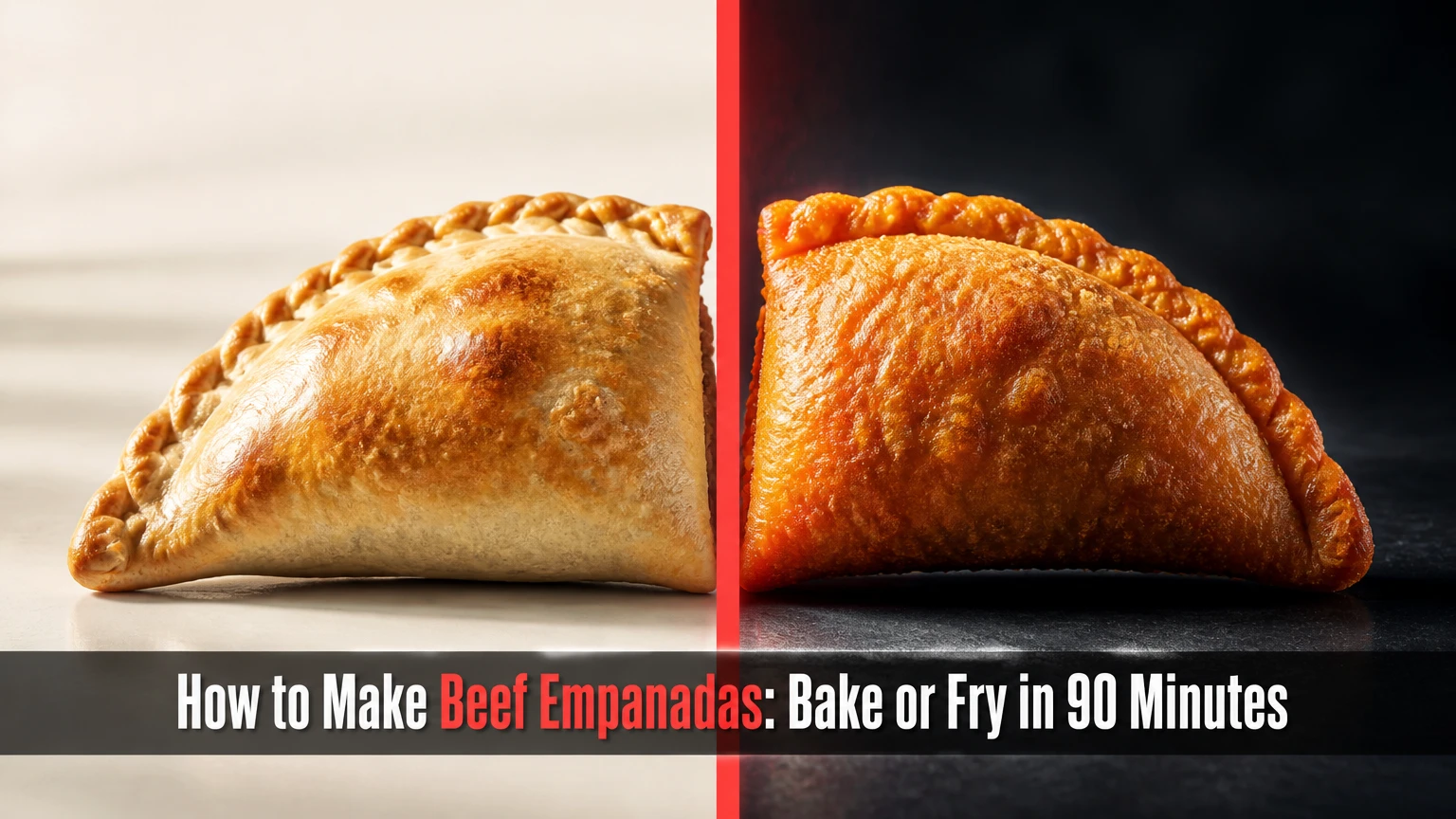
Beef empanadas are filled turnovers made from wheat-flour pastry and seasoned beef picadillo. This Argentine-style version makes 12 empanadas in about 90 minutes of active and cooking time, plus chilling, by combining a tender dough, fully cooked cold filling, careful sealing, and either a 425°F bake or 350°F fry.
Key Facts
This recipe yields 12 beef empanadas using 1 pound of beef and 12 dough rounds measuring 4 1/2 inches.
Cold, relatively dry filling prevents steam pressure from splitting the pastry during cooking.
Bake empanadas at 425°F for 15-20 minutes, or fry them at 350°F for 3-4 minutes.
Ground beef must reach 160°F, the USDA’s safe minimum internal temperature for ground meat.
A 2-3 mm pastry sheet provides enough structure for filling while remaining tender after baking.
Raw assembled empanadas can be frozen and baked from frozen at 400°F for approximately 25-30 minutes.
What You Need Before You Start
Prepare the dough and filling separately, then cool both before assembly. The recipe requires approximately 45 minutes of hands-on preparation, at least 60 minutes for dough resting, and 30-60 minutes for filling cooling if spread in a shallow container; overnight chilling produces the easiest filling to handle.
Ingredients for the dough
| Ingredient | Quantity | Function |
|---|---|---|
| All-purpose flour | 500 g, about 4 cups | Forms the pastry structure |
| Unsalted butter or lard | 100 g, 7 tablespoons melted | Adds tenderness and flavor |
| Warm water | 200 ml, about 3/4 cup | Hydrates the flour |
| Fine salt | 10 g, 2 teaspoons | Seasons and strengthens dough |
Ingredients for the beef filling
| Ingredient | Quantity | Preparation |
|---|---|---|
| 80/20 ground beef | 500 g, 1 pound | Brown lightly and break into small pieces |
| Yellow onions | 500 g, about 3 large | Finely chop |
| Olive oil or beef lard | 3 tablespoons | Cook the onions and beef |
| Sweet paprika | 2 tablespoons | Add after the beef loses its raw color |
| Ground cumin | 1 tablespoon | Add with the paprika |
| Dried oregano | 1 teaspoon | Add with the other spices |
| Scallions | 2 | Thinly slice after cooking |
| Hard-boiled eggs | 2 | Chop and add during assembly |
| Green olives | 12 | Pit and chop |
| Salt and red pepper flakes | To taste | Season in stages |
You also need one egg mixed with 1 tablespoon of water for baking, parchment paper, a rolling pin, a 4 1/2-inch round cutter, a large skillet, and an instant-read thermometer. For frying, use 1 1/2-2 quarts of canola, sunflower, or another neutral oil in a deep, heavy pot.
Typical cost: Homemade ingredients cost approximately $10-$18 for 12 empanadas, or $0.85-$1.50 each, depending on beef, butter, and olive prices. Store-bought wrappers can reduce labor but may raise the per-piece cost.
How Does the Filling Stay Juicy Without Making the Dough Soggy?
Beef empanada filling stays juicy when the onions are softened slowly, the beef is not overcooked, and excess liquid is evaporated before chilling. The filling should be cold and cohesive rather than hot and runny, because cold fat firms the mixture and reduces pastry softening during assembly.
Empanadas cook through enclosed steam. Heat sets the flour-and-fat shell while moisture from the onions and beef turns to steam inside the sealed turnover. That steam keeps the center moist, but too much free liquid creates pressure, leaks, and a damp underside.
A useful practitioner rule is to cook the filling until a spoon dragged across the skillet leaves a path for about 1 second. If liquid immediately flows into the gap, continue cooking. If the beef looks dry before the onions are tender, lower the heat and add 1-2 tablespoons of water, then cook until the water disappears.
The 1:1 beef-to-onion ratio used in many Argentine-style fillings gives strong flavor and moisture. It is not mandatory. Using 350 g of onions with 500 g of beef produces a meatier, drier filling that is easier to seal.
Step 1: Mix and Knead the Dough
Dissolve 10 g of salt in 200 ml of warm water, then combine the water with 500 g of flour and 100 g of melted butter or lard. Knead for 5-7 minutes, rest the dough for at least 60 minutes, and stop when the surface becomes smooth and elastic.
- Place the flour in a bowl and make a well in the center.
- Add the melted fat and salted water.
- Stir with a fork or wooden spoon until a shaggy dough forms.
- Transfer the dough to a lightly floured counter.
- Knead until no dry flour remains and the dough feels supple.
- Shape it into a ball, wrap it tightly, and refrigerate it for 60-120 minutes.
Success checkpoint: A pressed fingertip should leave a shallow indentation that slowly springs back. The dough should not crack around the edges when folded.
Common mistake: Adding extra flour during kneading creates a tough crust. Oil your hands lightly or rest the dough for 5 minutes if it feels sticky instead of dusting heavily with flour.
Can you use store-bought empanada wrappers?
Yes. Refrigerated or thawed frozen wrappers are the fastest option, especially for beginners or large batches. Choose wheat-flour discs around 4 1/2 inches wide for this filling, keep them covered with a damp towel, and assemble only a few at a time so the exposed wrappers do not dry out.
Store-bought wrappers vary in thickness and diameter. Thin discs usually bake more delicately but tear more easily, while thicker discs tolerate a generous filling and fork crimp. Do not stack frozen wrappers while they are still rigid, because cracking at the fold creates invisible leaks.
Step 2: Soften the Onions
Cook 500 g of finely chopped onions in 3 tablespoons of oil or lard over medium-low heat for 12-15 minutes with a pinch of salt. The onions should become translucent and soft before the beef enters the skillet.
Slow onion cooking is a flavor and texture step, not a cosmetic preference. Onions that remain crisp release water inside the sealed pastry, while deeply browned onions can make the filling sweeter and darker than the classic Argentine profile.
Use a skillet at least 10 inches wide. Overcrowding in a narrow pan traps steam and prolongs cooking. Stir every 2-3 minutes, scraping the base before the onions begin to color.
Success checkpoint: The onions should bend easily around a spoon and show no firm white center.
Common mistake: Browning the onions on high heat makes the mixture uneven. If the edges darken before the centers soften, reduce the heat and add 1 tablespoon of water.
Step 3: Cook and Season the Beef
Increase the skillet heat to medium-high, add 500 g of ground beef, and cook until the meat loses its pink color, then season with paprika, cumin, oregano, salt, and pepper flakes. Verify the thickest portion reaches 160°F, the USDA safe minimum for ground beef.
Break the beef into pieces no larger than 1/2 inch. Large clumps create uneven seasoning and make the filling difficult to portion. The beef will continue cooking inside the empanada, but it still must reach the food-safe temperature before chilling.
Add 2 tablespoons of sweet paprika, 1 tablespoon of cumin, and 1 teaspoon of oregano after the raw beef color disappears. Cook the spices for 30-45 seconds, then remove the pan from the heat. Add the sliced scallions after cooking so they retain a fresher flavor.
If using hand-cut steak, choose skirt, flank, or sirloin and cut it into approximately 5 mm cubes. Sauté the pieces in batches, because crowded steak releases water and steams instead of browning.
Success checkpoint: The filling should smell aromatic, contain no raw beef, and leave only a thin sheen of fat rather than a pool of liquid.
Common mistake: Overcooking ground beef until it resembles dry crumbs produces a mealy center. Remove the pan promptly after the meat reaches temperature and the liquid has reduced.
Step 4: Cool the Picadillo Completely
Spread the cooked beef mixture on a shallow tray and refrigerate it uncovered for 30-60 minutes, or cover it after initial cooling and chill it for at least 4 hours. Stir in chopped egg and olives only when the filling is cold and firm enough to portion.
Rapid cooling improves both food safety and pastry handling. A shallow layer cools much faster than a deep bowl, and refrigeration limits the time cooked meat spends in the bacterial growth range. Do not leave the filling at room temperature for more than 2 hours, or 1 hour when the room exceeds 90°F.
Fold in two chopped hard-boiled eggs and 12 chopped green olives after chilling, or reserve them for direct placement during assembly. The second method creates more even distribution when some diners prefer less olive or egg.
Success checkpoint: A tablespoon of filling should hold its shape for several seconds. Visible liquid should not run across the tray.
Common mistake: Assembling with warm filling melts the butter or lard in the dough and weakens the seam. Chill the filling longer, or place the tray over an ice pack for 10-15 minutes while stirring.
Step 5: Roll and Cut the Dough
Roll the rested dough to 2-3 mm thick, then cut twelve rounds approximately 4 1/2 inches in diameter. Keep the cut discs covered between sheets of parchment or under a clean towel so their edges remain flexible.
Divide the dough into two portions before rolling. Roll from the center outward, rotating the dough frequently, and use minimal flour. Excess flour dries the surface and prevents the folded edge from bonding.
If the dough springs back, pause for 10 minutes. Gluten needs additional relaxation. If the dough tears, let it warm for 5 minutes and patch small holes with a scrap pressed firmly into place.
A 4 1/2-inch disc accepts about 2 tablespoons of filling without excessive stretching. Cocktail empanadas use 3-inch discs and approximately 2 teaspoons of filling, with baking time reduced by 3-5 minutes.
Success checkpoint: Hold a disc by one edge. It should bend into a half-moon without cracking, yet remain thick enough that the counter is not visible through it.
Common mistake: Overfilling causes the seam to stretch and split. Reduce the quantity before trying to seal more forcefully.
Step 6: Fill and Seal Each Empanada
Place about 2 tablespoons of cold beef filling slightly below the center of each disc, fold the dough into a half-moon, press out trapped air, and seal with a repulgue or fork crimp. A properly sealed empanada has a dry, continuous edge with no filling touching the rim.
- Place one wrapper in your palm or on the counter.
- Add the beef mixture, chopped egg, and olive if they were held separately.
- Moisten only the upper inner rim with water.
- Fold the lower half over the filling.
- Press from the filling outward to expel air.
- Pinch the edge closed, then fold small sections inward to create a rope-like repulgue.
- Alternatively, press the edge with the tines of a fork.
Use water sparingly. A wet rim becomes slippery and weak, whereas a lightly moistened surface bonds the two layers. Keep finished empanadas on parchment and refrigerate them while the remaining pieces are assembled.
Success checkpoint: Lift the empanada by its sealed edge. It should not open or sag, and the filling should remain at least 1/4 inch from the seam.
Common mistake: Trapped air expands during cooking. Press outward from the filling, and make a tiny vent hole in the top of baked empanadas if the filling remains unusually moist.
Step 7: Bake or Fry the Empanadas
Bake beef empanadas at 425°F for 15-20 minutes after brushing them with egg wash, or fry them in 350°F oil for 3-4 minutes. Bake until the crust is deep golden, and fry in small batches so the oil temperature recovers quickly.
Which cooking method fits your batch?
| Method | Setting | Cooking time | Best result |
|---|---|---|---|
| Conventional oven | 425°F | 15-20 minutes | Golden, moderately crisp crust |
| Convection oven | 400°F | 13-17 minutes | Faster, darker browning |
| Deep fryer or pot | 350°F oil | 3-4 minutes | Blistered, crisp shell |
| Air fryer | 375°F | 10-14 minutes | Low-oil individual portions |
For baking, place the empanadas 1 inch apart on parchment. Brush only the exposed dough with one beaten egg mixed with 1 tablespoon of water. Rotate the tray at the halfway point if the oven has uneven hot spots.
For frying, use a thermometer rather than visual judgment. Add 2-3 empanadas at once, fry until the crust is evenly golden, and drain them on a rack or paper towels. If the oil falls below 325°F, pause before adding another batch.
Success checkpoint: A baked shell feels firm and sounds hollow when tapped lightly. A fried shell has an even golden surface without dark seams or raw pale patches.
Common mistake: Frying at low temperature makes the pastry greasy and can rupture weak seams. Allow the oil to return to 350°F between batches.
What Are the Main Beef Empanada Styles?
Argentine wheat-flour empanadas are the closest match for this recipe, while Colombian and Venezuelan versions use corn-based dough and Filipino empanadas often include vegetables and a slightly sweet pastry. The wrapper, filling moisture, and cooking method must match the regional style.
| Style | Wrapper | Typical filling | Cooking method |
|---|---|---|---|
| Argentine | Wheat flour, 4-5 inch disc | Beef, onion, cumin, paprika, olive, egg | Bake or fry |
| Colombian | Precooked yellow cornmeal | Beef, potato, tomato, hogao | Deep-fry at about 350°F |
| Venezuelan | Cornmeal, sometimes lightly sweetened | Shredded beef, peppers, onion, garlic | Deep-fry at about 350°F |
| Filipino | Butter-based wheat pastry | Beef, potato, carrot, peas, soy sauce | Bake at 375-400°F |
Cornmeal wrappers are not interchangeable with the wheat dough above. Corn dough needs different hydration and usually benefits from frying, while wheat pastry develops a more layered texture when baked with egg wash.
How Do Ground Beef and Hand-Cut Steak Compare?
Ground beef is faster and easier to portion, while hand-cut steak gives a more distinct, meaty bite. Use 80/20 ground beef for a dependable first batch, and choose skirt or flank steak when texture and traditional presentation matter more than speed.
| Beef choice | Preparation time | Texture | Moisture control | Best use |
|---|---|---|---|---|
| 80/20 ground beef | 10-12 minutes | Fine, cohesive | Easy to reduce | Beginner batches |
| 90/10 ground beef | 8-10 minutes | Leaner, firmer | Needs careful cooking | Lower-fat filling |
| Skirt steak | 15-20 minutes | Distinct, fibrous | Cut small and cook quickly | Steak-style Argentine filling |
| Flank steak | 15-20 minutes | Firm, lean | Benefits from onion moisture | Hand-cut premium filling |
Lean beef is not automatically better. Fat carries spice and onion flavor, but excessive rendered fat must be drained or chilled before assembly. If the cooled filling forms a thick oil layer, remove part of it before stuffing.
How Should You Store, Freeze, and Reheat Empanadas?
Refrigerate cooked beef empanadas for up to 3-4 days in a sealed container, freeze raw assembled pieces for up to 2 months, and reheat cooked empanadas in a 375°F oven for 10-15 minutes. Oven reheating restores crispness more effectively than microwaving.
Freezing raw empanadas
Arrange sealed, unbaked empanadas on a parchment-lined tray without touching. Freeze them for 2-3 hours, transfer them to a freezer bag, and label the date. Bake directly from frozen at 400°F for 25-30 minutes, adding egg wash immediately before baking.
Do not thaw frozen empanadas on the counter. Thawing creates condensation on the dough and increases the chance of leaks. Frozen pieces may need 5 additional minutes if they are tightly filled or larger than 4 1/2 inches.
Reheating cooked empanadas
Use a 375°F oven or toaster oven for 10-15 minutes. An air fryer at 375°F usually takes 6-9 minutes, while a microwave takes 45-90 seconds but leaves the crust soft.
Expert insight: Reheating on a wire rack is more effective than reheating directly on a baking sheet because hot air reaches the underside and prevents trapped steam from softening the base.
What Causes Beef Empanadas to Burst or Leak?
Beef empanadas burst when trapped air, hot filling, excess liquid, or a weak seam generates more internal pressure than the pastry can hold. The reliable correction is cold filling, restrained portions, outward sealing pressure, and a stable oven or oil temperature.
| Failure | Likely cause | Correction |
|---|---|---|
| Seam opens | Wet rim or trapped air | Dry the rim, press outward, crimp twice |
| Soggy bottom | Hot filling or excess liquid | Chill filling and reduce skillet liquid |
| Tough crust | Over-kneading or excess flour | Knead 5-7 minutes and rest 60 minutes |
| Greasy fried shell | Oil below 325°F | Fry smaller batches at 350°F |
| Burned edges | Dough too thin or oven too hot | Roll to 2-3 mm and verify temperature |
| Dry filling | Beef cooked too long | Remove from heat at 160°F and cool promptly |
Can you repair empanadas that have already opened?
For uncooked pieces, scrape away filling from the seam, wipe the rim dry, add a narrow strip of dough if necessary, and reseal with fork pressure. For cooked pieces, place them upright on a rack and serve them once safe, because patching a baked shell will not restore its structure.
Do not pour filling liquid back into the skillet after draining. The liquid contains flavor, but it also becomes steam inside the pastry. Reduce it separately until syrupy, cool it, and add only a teaspoon if the filling tastes dry.
How Can You Adapt the Recipe for Different Situations?
Adjust the wrapper size, filling quantity, and cooking time rather than changing every ingredient. Smaller cocktail empanadas need less filling and shorter cooking, while a large party batch benefits from prepared components and staged refrigeration.
- For a weeknight batch: Use refrigerated wrappers, ground beef, and a shallow tray for 12-minute cooling. The active work can drop to about 35 minutes.
- For a party: Double every ingredient, cook the filling in two skillets, and assemble in batches of six. Keep finished pieces refrigerated before cooking.
- For a less spicy filling: Omit red pepper flakes and add 1/2 teaspoon of black pepper. Keep cumin and paprika because they define the savory profile.
- For a dairy-free dough: Use beef lard, vegetable shortening, or olive oil instead of butter. Lard produces a crisper, more savory shell.
- For an egg-free finish: Brush the pastry with milk, cream, or oil. The surface will brown less deeply than an egg-washed crust.
- For a vegetarian variation: Replace beef with cooked lentils and mushrooms, but reduce the onion liquid carefully because plant fillings can release substantial moisture.
How many empanadas should you serve?
Serve two large 4 1/2-inch empanadas per person as a main course, or one per person alongside salad, rice, or soup. A 12-piece batch feeds six light diners or three hungry adults.
| Serving situation | Empanadas per person | Batch requirement |
|---|---|---|
| Appetizer with other food | 1 | 12 pieces for 12 guests |
| Light lunch with salad | 2 | 12 pieces for 6 guests |
| Main meal for hungry adults | 3-4 | 12 pieces for 3-4 guests |
| Cocktail size | 3-4 | 24 pieces for 6-8 guests |
Frequently Asked Questions
Can I make beef empanadas without hard-boiled eggs?
Yes. Omit the eggs without changing the dough or beef quantity. The filling will taste more meat-forward and slightly less rich, so add 1-2 tablespoons of finely chopped roasted red pepper or an additional scallion if you want more contrast without increasing moisture substantially.
Should beef empanadas be baked covered or uncovered?
Bake beef empanadas uncovered. Covering them traps surface steam and prevents the pastry from browning and crisping. If the edges darken too quickly, place a loose strip of foil around the perimeter during the final 5 minutes, leaving the centers exposed.
Why do my empanadas taste bland?
Bland empanadas usually contain under-salted onions or seasoning added only after the beef is cooked. Salt the onions lightly, season the beef while it cooks, and taste the cooled filling before assembly. Olives add salt, so adjust the final seasoning after adding them.
Can I prepare the filling the day before?
Yes. Refrigerated cooked filling keeps for 3-4 days in a sealed container when cooled promptly. Chilling overnight improves handling because the rendered fat firms, allowing cleaner portions and more reliable seams during assembly.
What sauce goes with beef empanadas?
Serve Argentine-style beef empanadas with chimichurri, salsa criolla, or a simple tomato and onion relish. Use about 1 tablespoon of sauce per empanada so the crisp pastry remains intact rather than becoming saturated.
The Bottom Line
To make beef empanadas successfully, prepare a seasoned onion-and-beef picadillo, cool it completely, roll the dough to 2-3 mm, fill each 4 1/2-inch round with about 2 tablespoons, and seal the edge without trapped air. Bake at 425°F for 15-20 minutes or fry at 350°F for 3-4 minutes. Cold, reduced filling is the factor that most reliably prevents leaks, while the exact cooking method determines whether the crust is moderately crisp or deeply blistered. Make beef empanadas ahead by freezing them raw, then bake them directly from frozen at 400°F for approximately 25-30 minutes.