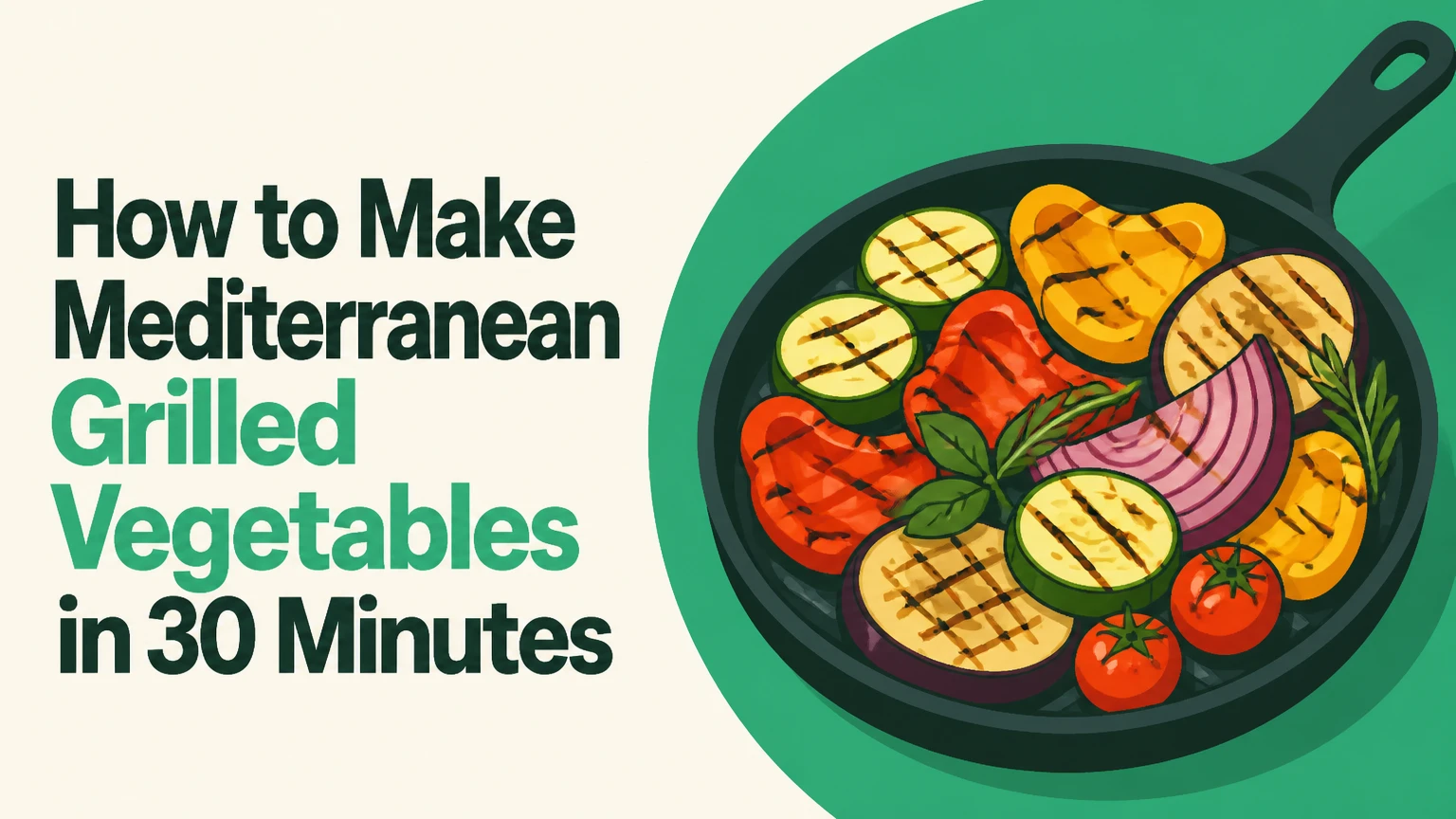
Mediterranean grilled vegetables are made by coating thick-cut zucchini, eggplant, peppers, onions, or similar produce with olive oil, salt, pepper, garlic, and dried herbs, then grilling over high direct heat until tender and charred. The most reliable method takes 30-45 minutes and depends on dry vegetables, adequate spacing, and cooking dense pieces before quick-cooking ones.
Key Facts at a Glance
- Use about 2 tablespoons of extra-virgin olive oil per 1 pound of prepared vegetables.
- Preheat a grill or grill pan to 400-450°F, or 200-230°C.
- Cut zucchini into 1 cm planks, eggplant into 1.5 cm slices, and onions into 1.5 cm wedges.
- Grill vegetables in a single layer with roughly 1 inch of space between pieces.
- Add lemon juice, fresh herbs, feta, or balsamic vinegar after grilling.
- A family-sized platter typically costs $7-$15 and takes 30-45 minutes.
How to Make Mediterranean Grilled Vegetables
Mediterranean grilled vegetables need five stages: wash and dry the produce, cut it evenly, season it, grill it in cooking-time order, and finish it with acid and fresh herbs. For four servings, prepare about 2 pounds of vegetables, use 4 tablespoons of olive oil, and cook in batches if the grill surface cannot hold the pieces without crowding.
Before You Start
| Item | Typical specification | Why it matters |
|---|---|---|
| Prepared vegetables | 2 lb, about 900 g | Produces 4 side-dish servings |
| Olive oil | 4 tbsp | Coats the surface and carries seasoning |
| Grill temperature | 400-450°F | Produces browning before vegetables soften excessively |
| Preparation time | 15-20 minutes | Includes washing, drying, cutting, and seasoning |
| Cooking time | 12-20 minutes | Varies by vegetable density |
| Total cost | $7-$15 | Typical U.S. grocery range for seasonal produce |
You need a grill or cast-iron grill pan, long tongs, a large bowl, a sharp knife, a cutting board, a clean platter, and paper towels. Wash produce under running water and dry it thoroughly. The U.S. Department of Agriculture advises washing fruits and vegetables under running water even when the peel will not be eaten, because cutting can transfer surface contamination inward.
Step 1: Prepare and Dry the Vegetables
Wash the vegetables, remove damaged areas, and dry every surface with a clean towel. Remove the woody ends from asparagus, the seeds and white ribs from peppers, and the stem from eggplant. Leave the root end attached to onion wedges so the layers stay together during grilling.
Cut vegetables into pieces thick enough to retain moisture. Slice zucchini and summer squash lengthwise into 1 cm planks, eggplant into 1.5 cm rounds or planks, bell peppers into wide quarters, and red onions into 1.5 cm wedges.
You will know this step worked when pieces have similar thickness and no visible water beads remain. Wet surfaces steam before they brown. A common mistake is cutting everything into small cubes, which makes softer vegetables overcook before onions and eggplant become tender.
Step 2: Season With Olive Oil and Dried Herbs
Toss the prepared vegetables with 2 tablespoons of extra-virgin olive oil per pound, 1 teaspoon of kosher salt per pound, black pepper, and dried Mediterranean herbs. Oregano is the most versatile choice; thyme, rosemary, Aleppo pepper, smoked paprika, and dried mint also work.
For 2 pounds of vegetables, use 4 tablespoons olive oil, 2 teaspoons kosher salt, 1 teaspoon dried oregano, 1/2 teaspoon black pepper, and 1/2 teaspoon garlic powder. If using fresh garlic, add it after grilling rather than before. Small garlic pieces scorch quickly on a hot grate and develop bitter flavors.
Salt changes more than seasoning. Samin Nosrat explains in Salt, Fat, Acid, Heat (2017), “Salt enhances flavor.” For vegetables, early salting can also draw out surface water, so grill soon after seasoning rather than letting salted slices sit for 30 minutes.
You will know the coating is correct when vegetables look lightly glossy, not wet or pooled with oil. Excess oil drips into flames and can create soot. Another common mistake is using a sugary bottled marinade before grilling, because sugar burns before thick vegetables finish cooking.
Step 3: Heat and Clean the Grill
Preheat a gas grill, charcoal grill, or cast-iron grill pan to 400-450°F. Clean the hot grates with a grill brush suited to the grate material, then lightly oil the cooking surface with a folded paper towel held by tongs.
A clean, hot grate improves release and creates defined browning. For charcoal, arrange the coals in two zones: a hot direct side for color and a cooler indirect side for finishing. For gas, set burners to medium-high and reserve an unlit area if the grill allows it.
The surface is ready when a vegetable piece sizzles immediately on contact. A common mistake is relying on the grill’s lid thermometer alone, because it measures surrounding air rather than the grate. A preheated cast-iron pan may smoke heavily indoors, so use strong ventilation and reduce the heat slightly if oil smokes continuously.
Step 4: Grill Dense Vegetables First
Place onion wedges, eggplant, and pepper quarters on the hottest part of the grill. Keep at least 1 inch between pieces, and position vegetables perpendicular to the bars when their size permits.
Cook the first side undisturbed for 4-6 minutes. Turn once, then cook another 3-6 minutes. Move pieces to indirect heat if the exterior darkens before the center softens.
You will know dense vegetables are ready when a knife enters the thickest section with slight resistance, the edges are browned, and the surface has distinct grill marks. Onions should feel flexible rather than rigid. The common mistake is turning too early; vegetables release more cleanly after a browned crust forms.
Step 5: Add Zucchini, Squash, and Asparagus
Add zucchini, yellow squash, and asparagus after the dense vegetables have begun cooking. These vegetables contain more accessible moisture and need less time, so adding them at the beginning often produces limp squash and undercooked onions.
Grill zucchini and squash for 3-4 minutes per side. Turn asparagus every 1-2 minutes for a total of 4-6 minutes, using tongs to expose multiple sides to the grate. Keep the lid closed between turns on an outdoor grill to maintain heat.
You will know zucchini is done when the center is tender but still holds its shape and the cut face has browned patches. Asparagus should bend slightly without collapsing. The common mistake is repeatedly moving small vegetables, which prevents a dry sear and causes uneven cooking.
Step 6: Check Doneness and Finish Off the Heat
Transfer cooked vegetables to a wide platter rather than piling them into a deep bowl. Immediately add 1-2 tablespoons of lemon juice per pound of vegetables, then taste for salt and pepper.
Finish with chopped parsley, basil, mint, or oregano. Add crumbled feta for a Greek-style platter, toasted almonds for crunch, or a drizzle of balsamic vinegar for an Italian-style variation. Add fresh garlic only after the vegetables leave the heat.
You will know the finish is balanced when the vegetables taste sweet, smoky, salty, and slightly acidic rather than oily. Residual heat softens the herbs and distributes the lemon without cooking away all of its aroma. The common mistake is adding lemon before grilling, which can make delicate vegetables wet and interfere with browning.
Which Vegetables Work Best?
The best vegetables for Mediterranean grilling have firm flesh, enough surface area for direct heat, and a cooking time between 4 and 12 minutes. Zucchini, eggplant, bell peppers, red onions, asparagus, mushrooms, cherry tomatoes, and fennel all work, but they require different cuts and sequencing.
| Vegetable | Cut and thickness | Typical total time | Doneness test |
|---|---|---|---|
| Eggplant | 1.5 cm rounds or planks | 8-10 min | Knife enters the center easily |
| Zucchini | 1 cm lengthwise planks | 6-8 min | Tender center with browned faces |
| Bell pepper | Seeded quarters | 8-10 min | Skin blisters, flesh softens |
| Red onion | 1.5 cm wedges | 10-12 min | Layers are flexible and browned |
| Asparagus | Whole trimmed stalks | 4-6 min | Slight bend, crisp-tender center |
| Mushrooms | Whole small caps or 2 cm halves | 6-9 min | Juices release, edges brown |
| Cherry tomatoes | Whole on skewers or basket | 4-6 min | Skins blister without collapse |
| Fennel | 1.5 cm lengthwise slices | 8-12 min | Core softens while edges char |
Eggplant absorbs oil rapidly, so toss it thoroughly and grill soon after coating. Bell pepper can tolerate longer cooking and may be moved to indirect heat to soften its interior. Cherry tomatoes need a basket, skewers, or a perforated grill tray because their skins split easily.
How Long Should Each Vegetable Cook?
Most Mediterranean grilled vegetables finish in 4-12 minutes over 400-450°F heat. Vegetable thickness, starting temperature, wind, grill material, and crowding affect the result more than the clock, so use the timing table as a sequence rather than a rigid guarantee.
A mixed platter cooks most evenly in this order: onions and eggplant first, peppers next, zucchini and squash after 3-4 minutes, then asparagus and tomatoes during the final 4-6 minutes.
| Vegetable group | Start time | Turn pattern | Total time |
|---|---|---|---|
| Onion wedges | Minute 0 | Turn at 5-6 min | 10-12 min |
| Eggplant planks | Minute 0 | Turn at 4-5 min | 8-10 min |
| Bell pepper quarters | Minute 0 | Turn at 5 min | 8-10 min |
| Zucchini planks | Minute 3-4 | Turn at 3-4 min | 6-8 min |
| Asparagus | Final 4-6 min | Turn every 1-2 min | 4-6 min |
| Cherry tomatoes | Final 4-6 min | Toss once or twice | 4-6 min |
The practical checkpoint is texture, not a target internal temperature. Vegetables are safe to eat when tender and heated through, but no universal vegetable temperature produces ideal grilled texture.
How Should You Season Mediterranean Grilled Vegetables?
Season Mediterranean grilled vegetables with olive oil, kosher salt, black pepper, dried oregano, and garlic powder before cooking, then add lemon juice and fresh herbs after grilling. The two-stage approach protects delicate aromatics from burning while giving the finished platter a fresher, sharper flavor.
For 1 pound of vegetables, combine 2 tablespoons olive oil, 1 teaspoon kosher salt, 1/2 teaspoon dried oregano, 1/4 teaspoon garlic powder, and black pepper. Use 1 tablespoon lemon juice after grilling, adjusting to taste.
Three Finishing Formulas
- Greek-style: lemon juice, parsley, mint, feta, and a pinch of dried oregano.
- Italian-style: balsamic vinegar, basil, grated Parmesan, and toasted pine nuts.
- Spanish-style: sherry vinegar, smoked paprika, parsley, and toasted almonds.
Balsamic vinegar contains more sugar than lemon juice, so use it after cooking. Fresh rosemary can tolerate brief heat better than basil, but even sturdy herbs become dull or bitter when trapped against a hot grate for a long cooking period.
Which Grilling Method Should You Choose?
Direct grates deliver the strongest smoke and clearest grill marks, a grill basket handles small pieces safely, and a cast-iron grill pan provides the most consistent indoor browning. Choose the method according to piece size, desired smoke, ventilation, and batch volume.
| Method | Best temperature | Best pieces | Main limitation |
|---|---|---|---|
| Outdoor grates | 400-450°F | Planks, quarters, wedges | Small pieces can fall through |
| Grill basket | 400-450°F | Tomatoes, mushrooms, diced squash | Crowding causes steaming |
| Cast-iron grill pan | Medium-high | Planks and slices | Indoor smoke and limited capacity |
| Perforated tray | 400-450°F | Small mixed vegetables | Weaker direct contact marks |
A grill basket should be preheated for several minutes and filled loosely. A cold basket drops the cooking surface temperature, while an overcrowded basket traps steam. Cast iron needs a thin oil film and batches; placing 2 pounds of vegetables into one small pan usually lowers browning quality.
For charcoal cooking, direct heat creates the best char, while indirect heat finishes thick onions and eggplant. For gas cooking, closing the lid between turns retains heat and shortens cooking time.
What Causes Soggy Grilled Vegetables?
Soggy grilled vegetables result from excess surface water, overcrowding, low heat, thin cuts, or a wet marinade. The correction is to dry the produce, increase the cooking temperature, leave about 1 inch of space, and grill in batches.
| Failure | Likely cause | Immediate fix |
|---|---|---|
| Mushy zucchini | Thin slices or crowding | Use 1 cm planks and a hotter grate |
| Burned outside, hard center | Heat too high for thick cuts | Move to indirect heat |
| Pale vegetables | Cold grate or excess moisture | Preheat longer and dry produce |
| Bitter black flecks | Fresh garlic, herbs, or sugar | Scrape lightly and finish with fresh ingredients |
| Eggplant remains tough | Thick pieces or short cooking | Lower heat and cook 2-4 minutes longer |
| Onion falls apart | Wedges cut too thin | Keep root end intact and use 1.5 cm wedges |
Do not solve sogginess by adding more oil. Oil improves heat transfer, but it cannot compensate for a wet, crowded cooking surface. If vegetables are already soft, spread them on a platter, add acid and herbs, and serve them warm rather than returning them to a crowded grill.
Can You Make Them Without Oil?
Oil-free Mediterranean grilled vegetables are possible, but they brown less readily and stick more easily. Use a well-seasoned cast-iron surface or perforated tray, dry the vegetables thoroughly, and brush them with lemon juice only after cooking.
For an oil-free batch, use 1 pound of dry vegetables, 1 teaspoon kosher salt, 1/2 teaspoon oregano, and black pepper. Preheat the surface completely, place vegetables without touching, and turn them only after browned marks appear.
Mushrooms, peppers, onions, and eggplant can tolerate this method better than thin zucchini. A small amount of water released from the produce will eventually help soften the vegetables, but it will not recreate the richness or surface lubrication of olive oil.
For lower sodium, reduce salt before grilling and use lemon zest, garlic powder, smoked paprika, mint, and vinegar after cooking. For a vegan platter, omit feta and use toasted nuts, white beans, or a tahini-lemon sauce.
Can You Make Mediterranean Grilled Vegetables Ahead?
Mediterranean grilled vegetables can be made 2-24 hours ahead and served at room temperature or reheated briefly. Cooling the vegetables on a wide platter preserves their texture better than sealing them hot in a deep container.
For make-ahead service, grill the vegetables 1-2 minutes less than the final target, cool them within 2 hours, cover, and refrigerate at 40°F or below. The USDA recommends refrigerating perishable leftovers within 2 hours, or within 1 hour when ambient temperature exceeds 90°F.
Serve refrigerated vegetables at room temperature after about 30 minutes, or reheat them in a 400°F oven for 5-8 minutes. Avoid microwaving a full platter because trapped steam softens the charred surfaces. Add fresh herbs and lemon after reheating, not before storage.
How Should You Serve Them?
Serve Mediterranean grilled vegetables as a warm side dish, room-temperature mezze, sandwich filling, or topping for grains. A 2-pound batch provides approximately four generous side servings or six smaller portions alongside meat, fish, beans, or bread.
| Serving use | Additions | Typical portion |
|---|---|---|
| Mezze platter | Hummus, feta, olives, pita | 1 cup vegetables |
| Fish side | Lemon, parsley, yogurt sauce | 3/4 cup vegetables |
| Grain bowl | Farro, chickpeas, tahini | 1 cup vegetables |
| Sandwich filling | Pita, greens, garlic yogurt | 3/4-1 cup vegetables |
| Pasta topping | Basil, Parmesan, olive oil | 1 cup vegetables |
Mediterranean grilled vegetables pair especially well with grilled chicken, salmon, lamb, white beans, couscous, farro, and crusty bread. Keep the finishing acid moderate when serving with already-seasoned foods such as feta, olives, or anchovies.
Common Questions
Do you need to salt eggplant before grilling?
You usually do not need to salt modern eggplant before grilling. Salted eggplant can lose some surface moisture, but the step adds 20-30 minutes and is unnecessary when slices are fresh, dry, and at least 1.5 cm thick. Salt immediately before oiling, then grill without delay.
Should you peel eggplant for the grill?
Keep the eggplant skin on for grilling because the skin helps the slices retain their shape. Peel only very large, mature eggplant with unusually tough skin. The exposed flesh will absorb more oil and may become fragile during turning.
Can frozen vegetables be grilled?
Frozen vegetables are poor candidates for direct grilling because ice melts into surface water and prevents browning. Thaw them completely, dry them carefully, and use a grill basket for sturdy options such as frozen peppers or onions. Fresh vegetables produce better char and firmer texture.
Why do vegetables stick to the grill?
Vegetables stick when the grate is dirty, the surface is underheated, the pieces are moved before browning, or the coating is too dry. Clean and preheat the grate, apply a thin oil film, and wait until browned edges form before turning with a wide spatula or tongs.
Can you use balsamic vinegar before grilling?
Use balsamic vinegar after grilling rather than before it. Balsamic vinegar contains sugars that darken quickly over direct heat, so an early coating can burn while the vegetables remain firm. A post-grill drizzle adds acidity without producing bitter, blackened residue.
What is the simplest vegetable combination?
Use zucchini, bell pepper, red onion, and eggplant in roughly equal weights. Start the onion, eggplant, and pepper first, add zucchini after 3-4 minutes, and finish everything with lemon juice, parsley, oregano, and feta or toasted almonds.
The Bottom Line
To make Mediterranean grilled vegetables, dry and thick-cut about 2 pounds of produce, coat it with 4 tablespoons of olive oil and dried seasonings, and grill at 400-450°F in cooking-time order. Leave space between pieces, move dense vegetables to indirect heat when needed, and finish the platter with lemon, fresh herbs, and optional feta. Proper moisture control matters more than elaborate marinade ingredients.