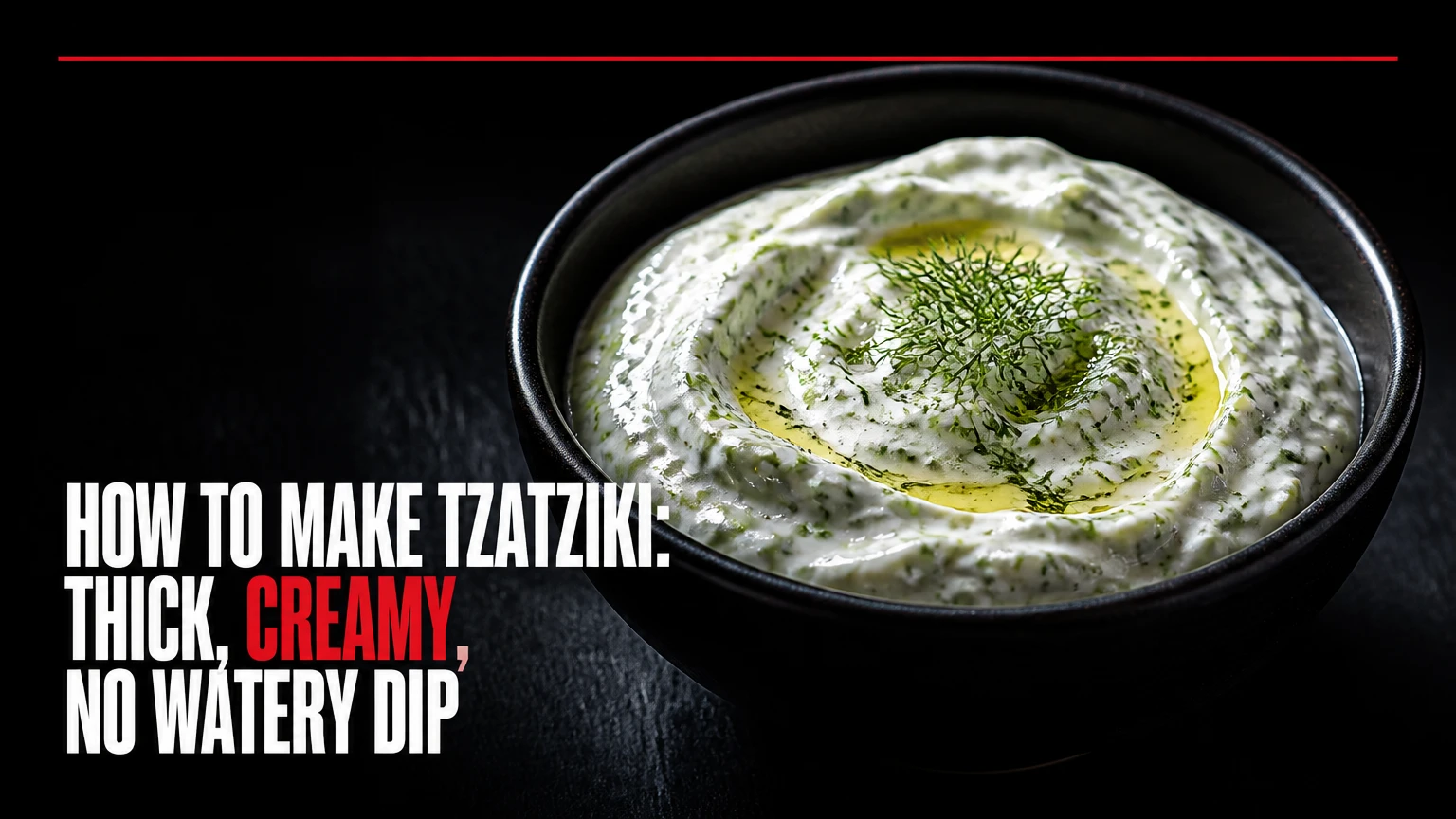
Tzatziki is made by folding thoroughly drained grated cucumber and finely grated garlic into thick plain Greek yogurt, then balancing the mixture with olive oil, lemon juice or vinegar, herbs, and salt. The full process takes about 20 minutes of active work, but chilling for at least 1 hour gives the garlic and acid time to settle into a cohesive, creamy dip.
Key Facts at a Glance
- A batch made with 2 cups of Greek yogurt yields about 2.5-3 cups of tzatziki, or 4-6 appetizer servings.
- Salting and squeezing the cucumber is the main defense against watery tzatziki.
- Full-fat strained Greek yogurt, usually 5%-10% milk fat, produces the richest texture.
- Tzatziki needs at least 1 hour of chilling; 2 hours gives a more integrated garlic flavor.
- Homemade tzatziki keeps for about 3-5 days in an airtight container at 40°F or below.
- Typical ingredient cost is approximately $4-$7 per batch, depending on yogurt and olive oil.
What Is Tzatziki?
Tzatziki is a cold Greek yogurt sauce made with cucumber, garlic, olive oil, an acidic ingredient, salt, and fresh herbs. Greek cooks commonly pair the thick dip with pita, gyros, souvlaki, grilled lamb, chicken, roasted vegetables, and crisp bread.
Tzatziki is thicker than Turkish cacık, which is often loosened with water and eaten as a cold soup or spoonable side. Cypriot talattouri overlaps with tzatziki but commonly emphasizes dried mint and lemon. Recipes vary by household, so dill, mint, vinegar, lemon, peeling, and garlic intensity can change without making the dish unrecognizable.
The target texture is spoonable rather than pourable. A lifted spoonful should hold a soft ridge for several seconds, while the cucumber should remain detectable as fine strands instead of disappearing into a purée.
Why Does Tzatziki Turn Watery?
Tzatziki turns watery when cucumber liquid remains in the mixture or when thin yogurt contributes too much whey. Cucumbers contain roughly 95% water by weight, according to USDA FoodData Central, so grated cucumber must be salted, rested, and physically squeezed before it touches the yogurt.
Salt draws water toward the cucumber surface through osmosis, but salt alone does not remove enough liquid. The towel, cheesecloth, or sieve performs the decisive step by expressing the released water. Blending creates another risk because it ruptures cucumber cells more completely and releases liquid faster.
Olive oil improves richness and helps distribute fat-soluble garlic and herb aromas, but olive oil cannot repair a cucumber that was barely drained. Start with dry cucumber and thick yogurt. Texture is much easier to preserve than to recover.
How to Make Tzatziki
This recipe uses 2 cups of full-fat Greek yogurt and produces approximately 2.5-3 cups. Active preparation takes 15-20 minutes, followed by at least 1 hour of chilling.
Before You Start
| Item | Typical specification | Why it matters |
|---|---|---|
| Active time | 15-20 minutes | Includes grating, squeezing, chopping, and mixing |
| Chill time | 1-4 hours | One hour works; two hours improves flavor |
| Yield | 2.5-3 cups | Enough for 4-6 appetizer servings |
| Difficulty | Beginner | Moisture control is the main technical step |
| Estimated cost | $4-$7 | Depends mainly on yogurt and olive oil |
| Main tools | Box grater, fine-mesh sieve, bowl | A clean towel replaces cheesecloth |
Ingredients
| Ingredient | Amount | Practical specification |
|---|---|---|
| Full-fat Greek yogurt | 2 cups | Plain, strained, preferably 5%-10% fat |
| English cucumber | 1 large, about 10-12 oz | Or use 2-3 Persian cucumbers |
| Garlic | 2-3 cloves | Fresh, firm cloves without green sprouts |
| Extra virgin olive oil | 2 tablespoons | Use a mild or medium-fruity oil |
| Lemon juice | 1 tablespoon | Freshly squeezed |
| White wine vinegar | 1 tablespoon | Use instead of, or with, lemon |
| Fresh dill | 2 tablespoons | Finely chopped |
| Fine sea salt | 1/2 teaspoon initially | Add more only after draining |
| Black or white pepper | 1/8 teaspoon | Optional, added at the end |
Step 1: Grate and Salt the Cucumber
Grate 1 large English cucumber or 2-3 Persian cucumbers on the large holes of a box grater. Toss the shreds with 1/2 teaspoon of fine sea salt, place them in a fine-mesh sieve over a bowl, and let them drain for 10-15 minutes.
English cucumbers have thin skins and moderate seed content, so they can usually be grated without peeling. Persian cucumbers have small seeds and firm flesh, making them convenient for fast preparation. Large garden cucumbers often need peeling and seed removal because their mature seeds release extra water and can taste bitter.
Do not rinse the salted cucumber. Transfer it to cheesecloth, a clean lint-free towel, or a nut-milk bag and twist firmly until the shreds form a compact ball. Continue squeezing until liquid changes from a stream to occasional drops.
You will know it worked when: a compressed handful feels damp and pliable but does not drip when held over the sink.
Common mistake: letting the cucumber sit in salt for a long time without squeezing it. Salt starts the drainage process; pressing removes the liquid.
Step 2: Choose and Prepare the Yogurt
Measure 2 cups of plain full-fat Greek yogurt into a mixing bowl. Select yogurt labeled “Greek,” “strained,” or “whole-milk Greek yogurt,” with approximately 5%-10% fat for the most stable, rounded texture.
Greek yogurt has already had much of its whey removed, which gives tzatziki body. Regular yogurt can work, but pour it into a coffee-filter-lined sieve and refrigerate it for about 3 hours before measuring 2 cups. Do not use sweetened yogurt, vanilla yogurt, or a product with fruit.
If the yogurt has pooled liquid on top, pour off the visible whey before stirring. Mixing the whey back in makes the sauce thinner before the cucumber is added.
You will know it worked when: the yogurt sits in a mound on a spoon rather than running like cream.
Common mistake: choosing fat-free regular yogurt because it appears lighter. Fat-free yogurt can taste chalky and lacks the body needed for a thick dip, although a well-strained 0% Greek yogurt remains usable when calories matter more than richness.
Step 3: Make a Smooth Garlic Paste
Finely grate 2-3 garlic cloves with a microplane, or mince them and crush them with a pinch of salt using the flat side of a chef’s knife. Add the garlic paste to the yogurt before adding the cucumber.
A paste distributes sulfur compounds evenly, preventing sharp pockets of raw garlic. Young, firm garlic usually tastes cleaner than sprouting cloves, whose green center can taste harsh. For mild tzatziki, use 1 clove; for a strong restaurant-style profile, use 3 small cloves.
Garlic flavor changes during refrigeration. The initial mixture may taste aggressive, while the same tzatziki becomes rounder after 2 hours. Acidic yogurt contributes to that mellowing, but the effect is gradual rather than instantaneous.
You will know it worked when: no visible chunks larger than a grain of rice remain.
Common mistake: adding coarsely chopped garlic directly to the finished dip. Large pieces release uneven flavor and create a hot bite in isolated mouthfuls.
Step 4: Combine the Base and Balance the Flavor
Fold the dry cucumber and garlic paste into the yogurt, then stir in 2 tablespoons of extra virgin olive oil, 1 tablespoon of lemon juice, 1 tablespoon of white wine vinegar, 2 tablespoons of chopped dill, and 1/8 teaspoon of pepper. Taste before adding any final salt.
Using both lemon juice and vinegar creates a sharper profile, but either acid alone works. For a softer, rounded dip, use 1 tablespoon lemon juice only. For a more traditional savory bite, use 1 tablespoon vinegar only. Add the acid gradually if your yogurt is already strongly tangy.
Stir with a spoon or silicone spatula until the cucumber strands are evenly distributed. Avoid food-processing the mixture because aggressive blending breaks down the cucumber structure and makes separation more likely.
You will know it worked when: the tzatziki looks thick and evenly flecked, with no free oil pooling around the edges.
Common mistake: pouring in extra oil to improve thin tzatziki. Oil adds richness, but excess oil can make the surface greasy without increasing structural thickness.
Step 5: Chill, Taste, and Finish
Cover the bowl and refrigerate the tzatziki for at least 1 hour, preferably 2 hours. Stir once after chilling, then adjust salt, acid, garlic, or herbs before transferring the dip to a serving bowl.
Cold temperatures firm the yogurt and allow the garlic, dill, cucumber, and acid to merge. A final teaspoon of olive oil on top is optional. Fresh dill, mint, cucumber slices, or a single Kalamata olive can provide a traditional presentation, but garnishes do not change the underlying flavor.
You will know it worked when: a spoonful holds its shape, the cucumber tastes fresh rather than watery, and the garlic is noticeable without burning.
Common mistake: judging the final seasoning immediately after mixing. Cold food tastes less salty, and the garlic becomes less forceful during the resting period.
Which Cucumber and Yogurt Should You Use?
English cucumbers and Persian cucumbers are the easiest choices because their skins are thin and their seeds are relatively mild. Full-fat strained Greek yogurt gives the most reliable body, but other yogurts work when you account for their water and fat content.
| Ingredient choice | Preparation | Texture result | Best use |
|---|---|---|---|
| English cucumber | Grate whole; salt 10-15 minutes | Fine, moderately crisp strands | Standard 2-cup yogurt batch |
| Persian cucumber | Grate whole; squeeze firmly | Dense, small strands | Fast weeknight preparation |
| Large garden cucumber | Peel and remove seeds; salt 15 minutes | Softer strands, less excess water | Summer garden produce |
| Full-fat Greek yogurt | Use directly after draining surface whey | Thick, creamy, rich | Traditional dip and gyro sauce |
| 2% Greek yogurt | Use directly; add no extra liquid | Firm but less rich | Lower-fat preparation |
| Regular plain yogurt | Strain about 3 hours | Usable after whey removal | Substitute when Greek yogurt is unavailable |
| Sheep’s-milk yogurt | Use chilled and strained | Tangy, dense, pronounced | Traditional-style variation |
| Unsweetened plant yogurt | Strain 2-4 hours if thin | Variable, often less creamy | Vegan adaptation |
Should You Peel or Seed the Cucumber?
Peel a large, waxed, or bitter cucumber, and remove its soft center if the seeds are mature. Leave English or Persian cucumber skin intact when the skin is thin and clean, because the peel adds color and a firmer bite without dominating the dip.
Cucumber skin is a preference rather than a strict authenticity rule. Fully peeled cucumber creates a paler, smoother mixture; unpeeled cucumber creates green flecks and slightly more texture. Seed removal matters more than peeling when the cucumber is large and watery.
How Can You Adapt Tzatziki for Different Diets and Regions?
Tzatziki can be adjusted by changing the herb, yogurt, acid, or dilution while preserving its cucumber-garlic identity. The most important substitution rule is to match the original yogurt’s thickness before adding cucumber.
| Variation | Main changes | Texture and flavor | Limitation |
|---|---|---|---|
| Greek-style tzatziki | Thick yogurt, dill, olive oil, lemon or vinegar | Dense, tangy, spoonable | Richer and more calorie-dense |
| Turkish cacık | Loosen yogurt with cold water; emphasize mint | Thin, cooling, sometimes soup-like | Poor choice for a firm sandwich spread |
| Cypriot talattouri | Use dried mint and lemon; moderate garlic | Bright, mint-forward, dense | Dried mint tastes less fresh |
| Vegan tzatziki | Unsweetened soy, almond, or coconut yogurt | Dairy-free, variable tang | Some products need straining |
| Blended version | Pulse cucumber, garlic, yogurt, and herbs | Smooth, uniform, more sauce-like | Greater risk of liquid separation |
| Labneh version | Replace part of yogurt with labneh | Very thick, tart, spreadable | Stronger acidity and higher cost |
For vegan tzatziki, choose unsweetened soy or coconut Greek-style yogurt with at least 3 grams of protein per serving when possible. Strain a thin plant yogurt through a coffee filter for 2-4 hours, then add cucumber gradually because plant-based products vary widely in water retention.
For cacık, begin with the same drained cucumber and add cold water 1 tablespoon at a time until the mixture reaches a pourable consistency. Mint is more characteristic than dill in many cacık recipes, although household formulas differ across Turkey.
What Should You Serve With Homemade Tzatziki?
Tzatziki works best with foods that benefit from cool acidity and a creamy contrast. Spoon it over chicken souvlaki, lamb kebabs, roasted potatoes, falafel, grilled zucchini, or warm pita, and use it as a dip for carrots, peppers, and cucumbers.
The sauce also works with salmon, shrimp, grain bowls, and roasted chickpeas, although those pairings are modern rather than required for a Greek-style presentation. For sandwiches, keep the tzatziki thick and drain the cucumber aggressively. For grilled meats, a slightly looser texture makes spreading easier.
Avoid serving tzatziki beside very watery salads unless the dip will be eaten immediately. Tomato juice, dressing, and warm food can thin the sauce on the plate even when the original batch was properly made.
How Do You Fix Common Tzatziki Problems?
Most tzatziki problems come from excess water, unbalanced garlic, unsuitable yogurt, or seasoning before chilling. Correct the underlying cause rather than masking the symptom with large amounts of oil or salt.
| Problem | Likely cause | Recovery method | Prevention |
|---|---|---|---|
| Watery bottom layer | Cucumber was under-squeezed | Strain finished dip 30-60 minutes | Squeeze until no steady stream remains |
| Thin overall texture | Regular or low-body yogurt | Fold in 2-4 tablespoons labneh or thick Greek yogurt | Use strained yogurt |
| Harsh garlic | Sprouting cloves or large pieces | Chill 6-12 hours; add yogurt if needed | Make a fine paste; use 1-2 cloves |
| Bland flavor | Insufficient acid or final salt | Add 1 teaspoon acid and salt gradually | Taste after chilling |
| Greasy surface | Excess olive oil | Stir in 2-4 tablespoons yogurt | Limit oil to 2 tablespoons per 2 cups |
| Bitter taste | Mature cucumber, peel, or old garlic | Remove visible cucumber peel; dilute with yogurt | Use small cucumbers and fresh garlic |
| Watery plant-based version | Thin dairy-free yogurt | Strain the yogurt before mixing | Choose a Greek-style product |
If finished tzatziki is watery, place it in a cheesecloth-lined sieve over a bowl and refrigerate it for 30-60 minutes. Fold the recovered thick portion gently, then add 1 tablespoon labneh or sour cream if the texture still lacks body.
Do not use sugar as the primary fix for bitter garlic. A tiny amount may mask bitterness, but extra yogurt, fresh garlic replacement, and additional resting time address the flavor more cleanly.
How Long Does Tzatziki Last?
Homemade tzatziki typically lasts 3-5 days in a sealed container kept at 40°F or below. The FDA advises keeping a refrigerator at 40°F or below, and tzatziki should be discarded if it develops an off odor, mold, unusual bubbling, or prolonged room-temperature exposure.
Use a clean spoon each time and store the dip promptly after serving. Cucumber continues releasing some water during storage, so stir the mixture before serving and drain any surface liquid if the flavor remains sound.
Freezing is usually a poor choice. Ice crystals damage the yogurt structure, and thawed cucumber becomes soft and releases additional liquid. Make a smaller batch instead.
| Storage situation | Maximum practical window | Expected result |
|---|---|---|
| Sealed container, refrigerator at 40°F or below | 3-5 days | Flavor remains acceptable; some liquid may separate |
| Open serving bowl, refrigerated promptly | 2-3 days | More exposure to air and utensils |
| Room temperature during a meal | About 2 hours | Refrigerate promptly afterward |
| Hot outdoor conditions above 90°F | About 1 hour | Discard rather than re-chill |
| Frozen and thawed | Not recommended | Watery, grainy texture likely |
How Much Tzatziki Should You Make?
A standard batch provides about 2.5-3 cups, which equals approximately 1/2 cup per person for a dip serving 4-6 people. For a meal where tzatziki is a sauce alongside several dishes, plan on 1/4 cup per person.
| Diners | Yogurt | Cucumber | Garlic | Oil | Acid |
|---|---|---|---|---|---|
| 2 people | 1 cup | 1/2 English cucumber | 1 clove | 1 tablespoon | 1/2 tablespoon |
| 4-6 people | 2 cups | 1 large English cucumber | 2-3 cloves | 2 tablespoons | 1 tablespoon |
| 8-10 people | 4 cups | 2 large English cucumbers | 4-6 cloves | 1/4 cup | 2 tablespoons |
| 12-15 people | 6 cups | 3 large English cucumbers | 6-9 cloves | 6 tablespoons | 3 tablespoons |
Scale the cucumber drainage step separately for large batches. A crowded sieve drains poorly, so squeeze the cucumber in two or more portions rather than pressing one oversized mass.
How Much Does Homemade Tzatziki Cost?
A typical 2-cup yogurt batch costs approximately $4-$7 in United States grocery stores, with Greek yogurt and extra virgin olive oil accounting for most of the expense. The same quantity of refrigerated store-bought tzatziki often costs about $3.50-$6 for an 8-12-ounce tub, so homemade preparation becomes more economical when a larger batch replaces multiple tubs.
Homemade tzatziki offers control over garlic, salt, herbs, acidity, and thickness. Store-bought dip saves preparation time but may contain stabilizers, added oils, or a thinner cucumber profile. Price varies substantially by brand, region, and whether premium olive oil or sheep’s-milk yogurt is used.
Expert Rules for Better Results
- Drain before seasoning the yogurt: cucumber water dilutes salt and acid, so seasoning the final mixture gives a more accurate result.
- Use a smaller cucumber instead of more squeezing force: mature cucumber centers contain more water and seeds, which makes the finished dip less stable even after pressing.
- Rest garlic-forward tzatziki overnight only when the garlic is balanced: 6-12 hours can soften a harsh batch, but extended storage cannot correct rancid oil or spoiled dairy.
- Add yogurt to fix thinness, not flour or starch: starch changes the fresh, cultured character and creates a paste-like mouthfeel when chilled.
- Keep the cucumber grated for a dip: blending is useful for a pourable sauce, but grated cucumber gives better drainage control and a more recognizable texture.
Frequently Asked Questions
Can I Make Tzatziki Without Dill?
Yes, tzatziki works without dill. Use fresh mint, dried mint, parsley, or no herb at all, then adjust the acid and salt after chilling. Dill gives the familiar Greek restaurant profile, while mint produces a cooler, more Turkish or Cypriot direction. Start with 1 tablespoon chopped mint for every 2 cups of yogurt.
Is Tzatziki Healthy?
Tzatziki can fit a balanced diet because Greek yogurt supplies protein, cucumber adds volume, and olive oil contributes unsaturated fat. Nutrition depends on the yogurt, oil quantity, salt, and serving size. A tablespoon of oil adds about 120 calories to the entire batch, not to each serving.
Can I Use Sour Cream Instead of Greek Yogurt?
Sour cream can replace part of the Greek yogurt, but it creates a richer, less tangy sauce with a softer structure. Use up to 1/2 cup sour cream for every 2 cups of yogurt, and keep the cucumber especially dry. Sour cream alone usually lacks the cultured firmness of strained Greek yogurt.
Why Is My Tzatziki Bitter?
Bitter tzatziki usually comes from a mature cucumber, thick bitter peel, sprouting garlic, or excessive olive oil. Remove cucumber seeds and peel when necessary, replace harsh garlic with a smaller fresh clove, and dilute the mixture with more yogurt. Do not rely on sugar to conceal a strong bitter source.
Can I Make Tzatziki Ahead of Time?
Yes, making tzatziki 2-12 hours ahead usually improves the garlic and herb flavor. Store it covered in the refrigerator, then stir and taste before serving. If you prepare it more than 24 hours ahead, expect some cucumber liquid to separate and drain or stir it back according to the desired thickness.
What Is the Difference Between Tzatziki and Cacık?
Tzatziki is generally a thick Greek dip or sauce, while cacık is often thinner because yogurt is loosened with water and mint is emphasized. The two share yogurt, cucumber, garlic, salt, and herbs, but serving style and consistency distinguish them more reliably than a single fixed ingredient list.
The Bottom Line
To make tzatziki successfully, use thick strained yogurt, grate a small or English cucumber, salt it for 10-15 minutes, and squeeze until no steady liquid remains. Add fine garlic paste, olive oil, acid, herbs, and final seasoning, then chill for at least 1 hour. Homemade tzatziki is ready when it holds a spoonable ridge, tastes cool and tangy, and shows no watery pool around the edges.