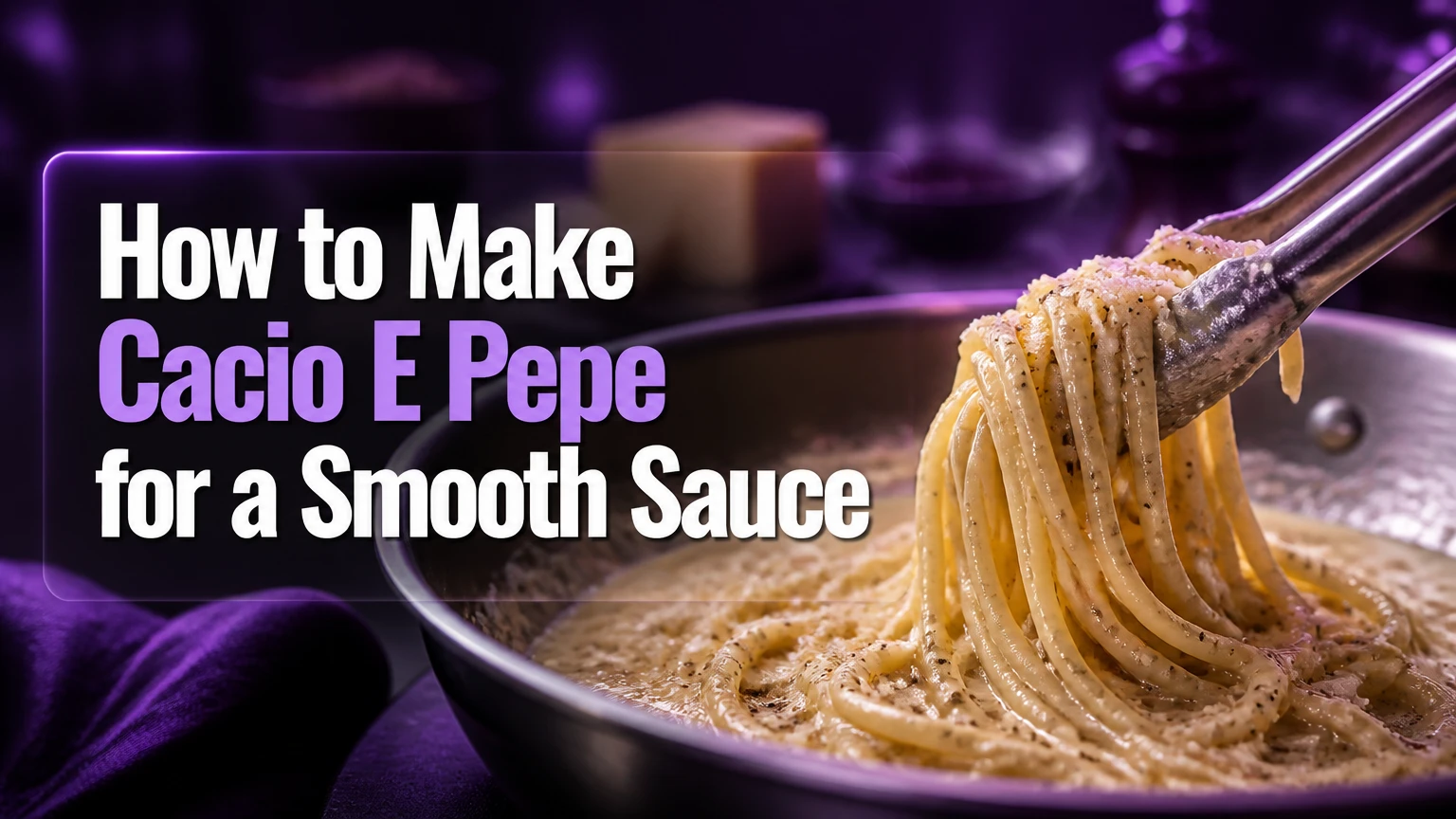
Cacio e pepe is made by tossing hot pasta with toasted black pepper, finely grated Pecorino Romano, and concentrated pasta water. For two servings, cook 200 g pasta, make a cool cheese paste, then emulsify everything off the heat in about 15 minutes. The decisive factor is temperature control.
Key Facts at a Glance
Cacio e pepe traditionally uses pasta, Pecorino Romano, black pepper, and salted water.
A typical two-person batch needs 200 g pasta and 70-90 g finely grated Pecorino Romano.
The cheese should be added off the heat, preferably when the pan is below about 65°C.
Low-water pasta cooking produces more concentrated starch for a tighter sauce.
Whole peppercorns toasted for 60-90 seconds provide more aroma than pre-ground pepper.
The finished sauce should coat the pasta in a thin, glossy layer rather than pool on the plate.
What Is Cacio e Pepe?
Cacio e pepe is a Roman pasta dish whose name means “cheese and pepper,” using Pecorino Romano and black pepper as its defining flavors. The dish contains no cream, garlic, onion, or tomato in its classic form, and its creamy texture comes from an emulsion of cheese fat, pasta water, and loosened starch.
“Cacio” is a central Italian word for cheese, while “pepe” means pepper. Roman versions generally use Pecorino Romano, a hard sheep’s-milk cheese with a salty, sharp flavor. Tonnarelli is especially associated with the dish, although dried spaghetti and bucatini work well.
The simplicity creates a narrow cooking window. Cheese can become stringy when exposed to excessive heat, while insufficient starch or agitation leaves a thin, greasy mixture. The reliable method therefore separates the hot pasta-cooking stage from the cooler cheese-emulsifying stage.
Why Does the Sauce Turn Creamy?
Cacio e pepe becomes creamy when pasta starch stabilizes water and melted cheese fat around dispersed cheese particles. Heat gelatinizes starch during cooking, while tossing spreads that starch across the pasta and helps bind the aqueous and fatty components into a glossy coating.
Pasta water contains dissolved starch released from the noodles. Using 1.5-2 liters for 200 g pasta, rather than a very large stockpot, typically creates a more concentrated liquid, although fresh pasta can release starch quickly and may need more water to prevent sticking.
Pecorino Romano contains casein proteins and milk fat. Above roughly 65°C, often cited as about 150°F in practical kitchen guidance, the proteins can tighten before the water and starch stabilize them. The exact threshold varies with cheese age, particle size, and moisture, so temperature is a useful guide rather than a laboratory cutoff.
Food writer and food scientist Harold McGee describes emulsions as mixtures in which one liquid is dispersed through another, a useful framework for understanding why pasta water matters. Cacio e pepe applies that principle through starch and vigorous movement instead of cream.
Which Ingredients Matter Most?
The best traditional combination is bronze-cut pasta, Pecorino Romano DOP, and freshly cracked black pepper. Ingredient quality affects flavor, but technique affects texture more strongly: excellent cheese still clumps if it is added to a smoking-hot pan.
Ingredient Quantities for Two Servings
| Ingredient | Quantity | Practical specification |
|---|---|---|
| Dried pasta | 200 g | Spaghetti, tonnarelli, bucatini, or rigatoni |
| Pecorino Romano | 80 g | Finely grated from a cold block |
| Whole black peppercorns | 8-12 g | About 1-2 tablespoons, cracked coarsely |
| Cooking water | 1.5-2 liters | Reserve at least 300 ml before draining |
| Kosher salt | 8-12 g | Reduce for salty Pecorino Romano |
| Optional Parmesan | 20-40 g | Replace part of Pecorino for a milder sauce |
Pecorino Romano varies noticeably in saltiness. Taste the finished sauce before adding any extra salt, and begin with less salt in the pot than you would use for plain pasta. A typical target is water that tastes seasoned but not aggressively briny.
Finely grated cheese creates smaller particles that hydrate quickly and distribute evenly. A Microplane produces a light, powdery grate; the smallest holes on a box grater also work, but thick shreds need more heat and are more likely to form strings.
What Pasta Shape Should You Use?
Tonnarelli is the closest traditional choice, but dried spaghetti is the most dependable supermarket option. Choose a shape with enough surface texture to carry the emulsion, and adjust the final tossing time according to thickness and cooking speed.
| Pasta shape | Typical cooking time | Sauce behavior | Best use |
|---|---|---|---|
| Dried spaghetti | 9-11 minutes | Smooth strands hold a light coating | Most accessible classic version |
| Tonnarelli | 6-9 minutes fresh | Thick, porous strands carry more sauce | Traditional Roman-style serving |
| Bucatini | 9-11 minutes | Hollow center adds chew and sauce weight | Larger appetite or robust pepper |
| Rigatoni | 11-13 minutes | Ridges and tubes trap cheese sauce | Easier fork handling |
| Gluten-free spaghetti | 8-12 minutes | Water can become thick and foamy | Gluten-free adaptation |
Bronze-die extruded dried pasta often has a rougher surface than highly polished pasta. That texture can help sauce adhesion, but the label alone cannot guarantee a successful emulsion. Reserve water from the actual pot because starch release differs by brand, shape, and cooking time.
Before You Start
A two-serving batch takes about 5 minutes to prepare and 10-12 minutes to cook. The practical difficulty is moderate, the typical ingredient cost is $5-$12, and the required equipment is a wide skillet, pasta pot, tongs, a fine grater, and a bowl for mixing the cheese.
| Requirement | Typical amount or time | Why it matters |
|---|---|---|
| Yield | 2 servings | 100 g dry pasta per person |
| Total time | 15-17 minutes | Includes grating and cooking |
| Active preparation | 5 minutes | Grate cheese and crack pepper |
| Skillet size | 10-12 inches | Gives pasta room to toss |
| Cheese grater | Microplane or fine box grater | Produces fast-hydrating particles |
| Reserved water | 300-400 ml | Allows controlled thinning |
| Typical cost | $2.50-$6 per serving | Depends on imported cheese and pasta |
Grate the cheese before the pasta enters the water. Crack the pepper before heating the skillet. Cacio e pepe moves quickly after the noodles are ready, and preparation prevents the pan from sitting hot while you search for tools.
How to Make Cacio e Pepe
Step 1: Cook the Pasta in Concentrated Water
Bring 1.5-2 liters of water to a boil in a pasta pot, add 8-12 g salt, and cook 200 g pasta until it is about 2 minutes short of al dente. Stir during the first minute, then reserve at least 300 ml cooking water before draining.
Use tongs to transfer the pasta later rather than pouring away the water. The noodles should remain firm in the center because they finish cooking with the pepper and starch mixture.
You’ll know it worked when: the pasta bends easily but still offers a firm bite.
Common mistake: cooking the noodles fully before the sauce stage, which produces soft pasta after additional tossing.
Step 2: Bloom the Cracked Pepper
Crack 1-2 tablespoons of whole black peppercorns into uneven pieces, then toast them in a dry 10-12-inch skillet over medium heat for 60-90 seconds. Add 60 ml, or ¼ cup, of hot pasta water when the pepper smells floral and spicy.
Toasting drives aromatic compounds into the dry pan, and the added water extracts those compounds into a peppery base. Tellicherry and Malabar peppercorns provide bold aromatics, but ordinary supermarket pepper works when cracked immediately before cooking.
You’ll know it worked when: the pepper smells fragrant and the water lightly bubbles around the specks.
Common mistake: waiting for dark, smoking pepper; burnt pepper tastes bitter and cannot be corrected with cheese.
Step 3: Build the Pepper Base
Reduce the skillet heat to low and let the pepper water simmer gently while the pasta finishes. The liquid should become lightly cloudy and aromatic, not evaporate completely.
This short simmer gives the pepper time to hydrate. If the skillet looks dry before the pasta is ready, add 1-2 tablespoons reserved water rather than increasing the heat.
You’ll know it worked when: a shallow layer of peppered liquid covers the skillet without large bubbles.
Common mistake: using high heat to reduce the water, which creates a hot, concentrated pan just before cheese is introduced.
Step 4: Make the Cheese Paste
Place 70-80 g of the grated Pecorino Romano in a bowl and whisk in 60-90 ml warm pasta water gradually until the mixture becomes a smooth, thick paste. Use water that is hot but no longer visibly boiling, ideally around 60-70°C.
The cheese paste tempers the Pecorino gradually and reduces direct contact between dry cheese and a hot metal surface. Leave 10-20 g cheese aside for finishing, and add water one tablespoon at a time because a loose paste is harder to recover.
You’ll know it worked when: the paste resembles thick yogurt and contains no dry pockets or visible shreds.
Common mistake: adding all the water at once, which can create a thin suspension that never coats the pasta properly.
Step 5: Finish the Pasta in the Pepper Water
Transfer the undercooked pasta into the skillet with tongs, add 60-120 ml pasta water, and toss over medium-low heat for 60-90 seconds. Move the strands continuously so the pasta releases starch and absorbs the pepper base.
The liquid should cling to the noodles before the cheese paste enters. Add another tablespoon of water if the pan becomes dry, but avoid flooding the skillet.
You’ll know it worked when: the pasta looks lightly glossy and the bottom of the skillet contains a small amount of cloudy liquid.
Common mistake: draining the pasta thoroughly and leaving no liquid for starch transfer.
Step 6: Emulsify the Cheese Off the Heat
Remove the skillet from the burner and wait about 30 seconds, then add the cheese paste while tossing continuously. Add reserved water in 1-tablespoon increments until the Pecorino forms a smooth, glossy coating.
Residual heat continues cooking the pasta, so the skillet should feel hot but not aggressively steaming. On an electric or induction cooktop, move the pan to a cool burner because lowering the setting does not remove stored heat from the metal.
You’ll know it worked when: sauce gathers around the pasta instead of separating into oily streaks and water.
Common mistake: adding cheese over direct high heat, which tightens the proteins and creates clumps or strings.
Step 7: Adjust and Plate Immediately
Taste one strand, then correct the texture with small splashes of pasta water. Plate the cacio e pepe immediately and finish with the remaining Pecorino Romano and a pinch of cracked pepper.
A finished sauce should look fluid while hot but cling to the pasta within seconds. If the mixture is too loose, vigorous tossing and a brief 15-second rest often thicken it more effectively than adding a large amount of cheese.
You’ll know it worked when: the plate has a uniform sheen, with no puddle of water at the bottom.
Common mistake: holding the pasta in the skillet for several minutes, which allows the sauce to tighten into a paste.
What Are the Best Cheese and Pepper Options?
Pecorino Romano DOP gives the most traditional result, while a Pecorino and Parmigiano-Reggiano blend offers a milder flavor and a slightly more forgiving texture. Butter can stabilize a beginner’s sauce, but it changes the dish from the classic water-and-cheese emulsion.
| Choice | Amount for 200 g pasta | Flavor and texture | Best situation |
|---|---|---|---|
| 100% Pecorino Romano | 70-90 g | Salty, sharp, traditional | Roman-style preparation |
| 75% Pecorino, 25% Parmesan | 70-90 g total | Balanced and moderately salty | First attempt |
| 50% Pecorino, 50% Parmesan | 70-90 g total | Mild, sweet, less intense | Children or sensitive palates |
| Pecorino plus butter | 70-80 g cheese, 15 g butter | More stable and rich | Beginner training method |
| Pre-shredded cheese | Package-dependent | Poor hydration from anti-caking agents | Avoid for the main method |
Pre-shredded Pecorino and Parmesan often contain cellulose or potato starch to prevent sticking. Those additives can interfere with hydration, although the larger problem is usually the coarse shred and inconsistent melting. Grate a block immediately before cooking for the most predictable paste.
Black pepper should be treated as an aromatic ingredient, not a table condiment. Freshly cracked pepper gives both fine particles for heat and larger fragments for fragrance, while pre-ground pepper tends to taste dusty after prolonged storage.
Which Method Is Most Reliable for Different Cooks?
The cheese-paste method is the most reliable traditional approach because it separates hydration from the pan’s residual heat. A direct bowl toss can work for experienced cooks, while a small amount of butter gives beginners a wider margin for error.
| Cook or situation | Recommended method | Added ingredient | Expected result |
|---|---|---|---|
| Beginner | Cheese paste plus low heat | 15 g unsalted butter optional | Most stable, less traditional |
| Traditionalist | Cheese paste, water only | None | Sharpest Roman profile |
| Experienced cook | Direct off-heat toss | None | Fast, elegant, higher risk |
| Fresh tonnarelli user | Reduced water addition | None | Thick, highly coated strands |
| Gluten-free cook | Separate pasta water test | None | Variable starch, careful thinning |
Fresh egg tonnarelli cooks quickly and releases starch differently from dried pasta. Start with 30-60 ml water in the skillet, then add more only as needed. Gluten-free pasta water can become unusually thick or foamy, so reserve it in a cup and dilute gradually.
Common Mistakes and How to Fix Them
Why Did the Pecorino Become Clumpy?
Clumpy Pecorino usually results from excessive heat, coarse grating, or insufficient water and agitation. Remove the pan from heat immediately, add 1 tablespoon warm pasta water, and toss forcefully; partially seized cheese may loosen, but fully rubbery curds rarely return to a smooth texture.
If the sauce remains stringy, do not keep heating it. A teaspoon of butter can help salvage the flavor and add lubrication, but it will not reverse severely tightened proteins.
Why Is the Sauce Watery?
A watery sauce contains too much pasta water relative to cheese and starch, or the pasta did not release enough starch into the skillet. Toss off heat for 20-30 seconds, then add 5-10 g finely grated cheese only if the liquid remains excessive.
Avoid boiling the mixture to evaporate water. High heat can reduce liquid while simultaneously causing the Pecorino to split, producing a thick but greasy sauce.
Why Is the Sauce Dry or Pastelike?
A dry sauce needs more water, not automatically more cheese. Add warm pasta water 1 tablespoon at a time while tossing until the coating becomes glossy.
Dryness commonly appears when the pasta absorbs the available liquid during the final minute. A wide skillet also evaporates water quickly, so cooks using a 12-inch pan may need 30-60 ml more water than cooks using a smaller pan.
Why Does the Dish Taste Too Salty?
Excess salt usually comes from heavily salted cooking water combined with aged Pecorino Romano. Use 8 g salt for 1.5 liters of water on the first attempt, and do not season the sauce until tasting it.
If the finished dish is already salty, add unsalted cooked pasta or a small amount of warm water and toss. Sugar, cream, and large quantities of butter mask salt but move the dish away from its intended flavor.
Why Is the Pepper Weak?
Weak pepper flavor comes from old pre-ground pepper or skipping the blooming stage. Crack whole peppercorns immediately before cooking and toast them for 60-90 seconds before adding water.
Pepper burns quickly in an empty pan. Once the aroma turns acrid or smoke appears, discard the pepper and restart the base because cheese cannot hide that bitterness.
Situational Variations
How Can a Beginner Make It More Forgiving?
A beginner can replace 20-30 g of Pecorino Romano with Parmigiano-Reggiano and add 15 g unsalted butter to the pepper-water base. The butter improves lubrication and stabilizes the emulsion, while the Parmesan reduces the aggressive salt and sheep’s-milk flavor.
Use the cheese-paste method rather than adding dry cheese directly to the noodles. The result is less traditional but remains recognizably cacio e pepe and gives useful practice with heat control.
Can You Make It for Four or More People?
For four servings, use 400 g pasta, 140-180 g cheese, 16-24 g peppercorns, and 3-4 liters water. A 12-inch skillet is usually too crowded for a large batch, so emulsify in two pans or use a wide sauté pan with at least 30 cm of cooking surface.
Large batches lose heat more slowly and require more tossing. Keep 500-600 ml pasta water available, but add it incrementally rather than following a fixed volume.
Can You Make It Gluten-Free?
Gluten-free cacio e pepe works with rice, corn, or quinoa-based spaghetti, but the sauce may be less stable because different pasta formulas release different starches. Cook the noodles according to the package, reserve extra water, and begin the skillet with only 30 ml.
Choose a gluten-free pasta that remains firm after cooking. Overcooked noodles release excess solids and can make the sauce gummy rather than creamy.
How Much Time and Money Does It Take?
A typical two-serving batch costs $5-$12 and takes 15-17 minutes, with imported Pecorino Romano accounting for much of the price variation. Domestic pasta and a supermarket cheese block can approach $2.50 per serving, while imported DOP cheese and fresh tonnarelli raise the cost.
| Shopping level | Pasta cost | Cheese cost | Total for two |
|---|---|---|---|
| Budget supermarket | $1-$2 | $3-$5 | $5-$8 |
| Imported Pecorino | $2-$3 | $6-$9 | $9-$14 |
| Fresh tonnarelli | $4-$7 | $6-$9 | $12-$18 |
| Restaurant-style pantry | $2-$4 | $8-$12 | $12-$20 |
These are typical retail ranges, not fixed prices. Cheese packaging, local availability, and imported-food markups can change the final total substantially.
FAQ
Can I Grate the Cheese in Advance?
You can grate Pecorino Romano several hours ahead and refrigerate it in an airtight container, but freshly grated cheese hydrates more evenly. Do not leave fine cheese uncovered because it dries quickly and absorbs refrigerator odors. Bring it close to room temperature before making the paste.
Can I Use Parmesan Instead of Pecorino?
Parmesan can replace some or all of the Pecorino, but the flavor becomes sweeter and less salty. Use a 50:50 blend for a mild version, then adjust the cooking-water salt after tasting. Parmigiano-Reggiano generally forms a workable sauce when finely grated and added off heat.
Can I Make Cacio e Pepe Without a Microplane?
A fine box grater, rotary grater, or food processor can replace a Microplane. The goal is a powdery, even grate rather than a specific tool. If using a food processor, pulse briefly to avoid warming the cheese and forming oily clumps before cooking.
Can I Reheat Leftover Cacio e Pepe?
Reheating cacio e pepe is possible but changes the texture because the cheese firms as it cools. Add 1-2 tablespoons water to a skillet, warm the pasta over low heat, and toss continuously for 2-3 minutes. Avoid a microwave blast, which often separates the sauce.
Should I Add Cream to Cacio e Pepe?
Traditional cacio e pepe does not need cream because concentrated pasta water supplies the liquid and starch for the emulsion. Cream can make the dish more stable, but it adds dairy sweetness and masks the sharp Pecorino flavor. Use butter instead if you need a beginner-friendly stabilizer.
What Is the Correct Final Texture?
Correct cacio e pepe has a thin, glossy sauce that coats every strand without pooling beneath the pasta. The sauce should remain fluid while being tossed, then thicken slightly on the plate. A stringy, rubbery, oily, or watery texture indicates a heat, water, or grating problem.
The Bottom Line
How to make cacio e pepe successfully comes down to finely grated Pecorino Romano, concentrated pasta water, freshly bloomed black pepper, and off-heat emulsification. Cook 200 g pasta for two servings, prepare a smooth cheese paste, toss the noodles in the pepper base, then add the paste below aggressive heat. Serve immediately for the smoothest result.