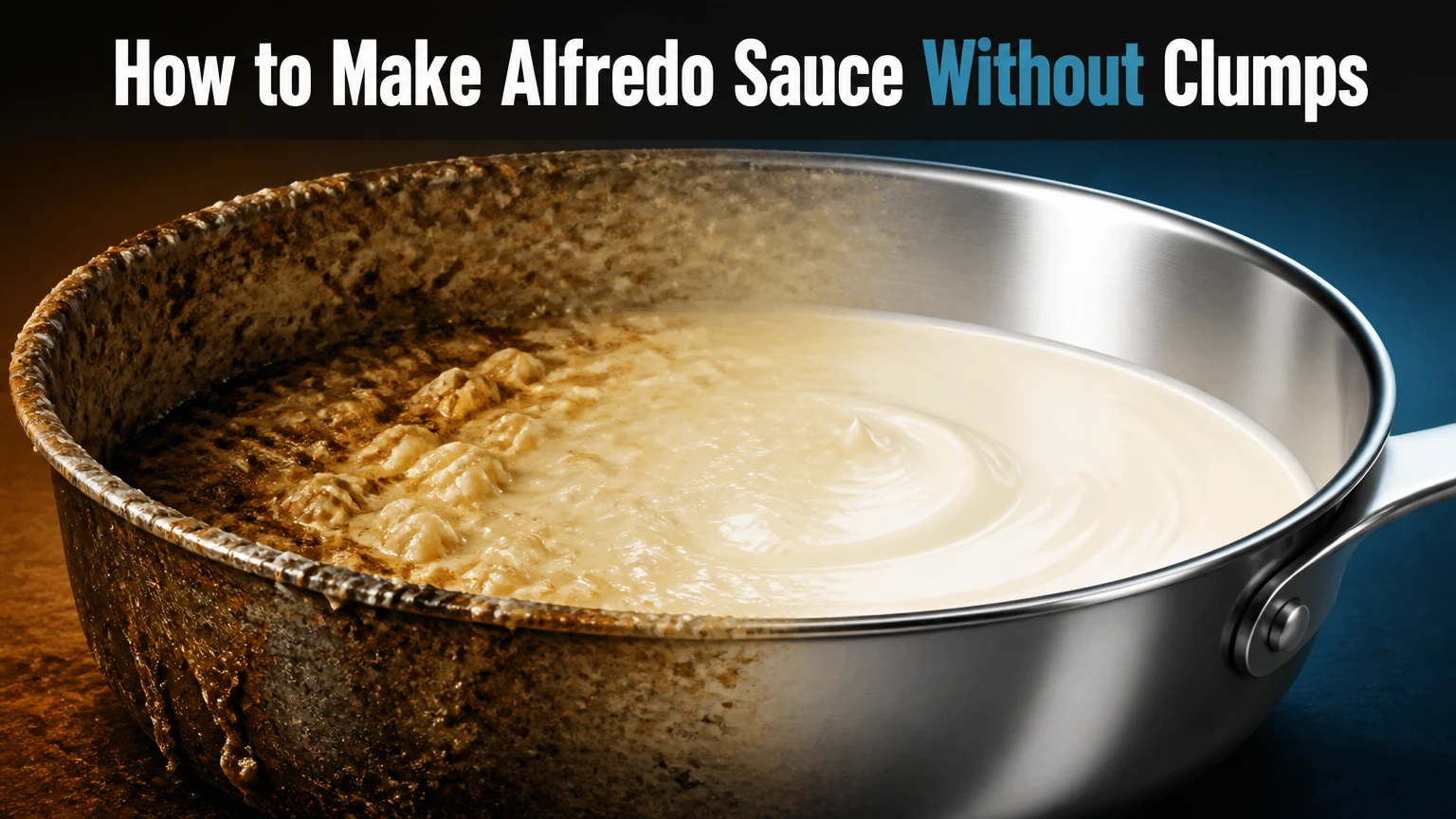
To make Alfredo sauce, toss hot fettuccine with melted unsalted butter, finely grated Parmigiano-Reggiano, and reserved starchy pasta water until the ingredients form a glossy emulsion. For a richer American-style sauce, simmer heavy cream with butter, then whisk in Parmesan off the heat. The key control is gentle heat.
Key Facts at a Glance
- Homemade Alfredo sauce takes about 20 minutes from starting the pasta to serving.
- One batch using 12 ounces of pasta serves 3 to 4 people.
- Finely grated Parmigiano-Reggiano melts more smoothly than pre-shredded or shaker-can Parmesan.
- Traditional Alfredo contains butter, cheese, and pasta water, not heavy cream.
- Cheese should be added away from boiling heat because excessive heat causes clumping and oil separation.
- A typical four-serving batch costs $5-$14, depending on the cheese and cream selected.
What Is Alfredo Sauce?
Alfredo sauce is a warm emulsion of dairy fat, cheese, and water that coats pasta. The original Roman preparation, commonly called fettuccine al burro, uses butter, Parmigiano-Reggiano, and pasta water; the cream-heavy version popular in the United States adds heavy cream and often garlic or nutmeg.
The sauce has no flour-based roux in its traditional form. Pasta water supplies dissolved starch, while cheese proteins help disperse butter into the water phase. The result should cling to noodles as a thin, shiny coating rather than sit as a thick pool beneath them.
Alfredo sauce is best served immediately. As the pan cools, butter firms and cheese proteins tighten, so even a successful sauce becomes thicker within several minutes.
How Does Alfredo Sauce Become Creamy?
Alfredo sauce becomes creamy when heat, fat, cheese protein, and starchy water remain in balance. Whisking or tossing breaks butter into small droplets, and the starch-rich liquid helps keep those droplets dispersed rather than allowing them to collect on the surface.
Parmigiano-Reggiano is not a liquid cheese designed for high-heat melting. Its casein proteins can tighten when overheated, producing grainy clumps while the butter separates. Gentle heat and gradual hydration protect the emulsion.
A useful practitioner rule is to keep the cheese mixture below a simmer. The pan can remain warm enough to melt the cheese, but visible bubbling indicates that the sauce is approaching a failure point. This is why the traditional method finishes off the heat.
Ingredient Functions and Amounts
| Ingredient | Amount for 4 servings | Function | Best choice |
|---|---|---|---|
| Fettuccine | 12 ounces | Provides pasta surface and starch | Bronze-die or standard dried pasta |
| Unsalted butter | 4 tablespoons, 56 g | Supplies dairy fat | European-style butter, 82% fat |
| Parmigiano-Reggiano | 5 ounces, 140 g | Adds salt, protein, and umami | Freshly grated, aged 24 months |
| Pasta water | 1/2-1 cup | Hydrates and stabilizes sauce | Water reserved before draining |
| Heavy cream | 1 cup, 240 ml | Adds liquid fat and stability | 35-40% milk fat |
| Garlic | 1 small clove | Adds savory aroma | Finely grated, optional |
| Nutmeg | 1/8 teaspoon | Adds warm dairy spice | Freshly grated, optional |
How to Make Alfredo Sauce
This method makes a glossy traditional Alfredo for four people in about 20 minutes. Cook the pasta until one minute short of al dente, reserve at least one cup of cooking water, then finish the noodles in butter with cheese and water away from direct heat.
Before You Start
| Preparation factor | Recommended specification |
|---|---|
| Total time | 20 minutes |
| Active cooking time | 10-12 minutes |
| Difficulty | Moderate for traditional, easy for cream-based |
| Yield | About 3 cups sauce with pasta |
| Pasta | 12 ounces fettuccine |
| Pan | 12-inch skillet or wide sauté pan |
| Grater | Microplane or fine box-grater side |
| Reserved water | At least 1 cup |
| Typical cost | $5-$14 for four servings |
Grate the cheese before heating the pan. Fine shreds melt faster because more surface area contacts the warm pasta and water. Coarse cubes often remain intact long enough for the exterior to overheat.
Step 1: Boil the Pasta
Bring 4 quarts of water to a full boil, then add about 1 tablespoon of kosher salt and cook 12 ounces of fettuccine according to the package timing. Stir during the first minute to prevent strands from adhering.
Stop cooking the pasta about one minute before the package’s al dente direction. Before draining, scoop out 1 cup of the cloudy cooking water.
You will know it worked when: the noodles bend easily but still have a firm center.
Common mistake: using too little water and expecting highly concentrated starch. A small pot can work, but stir frequently and reserve water before dilution or draining.
Step 2: Melt the Butter
Place 4 tablespoons of unsalted butter in a wide skillet over low heat. Melt it until liquid, but do not let it brown for a classic Alfredo flavor.
Add the drained pasta directly to the skillet and toss for 30 seconds. The residual pasta heat warms the butter and creates the first coating before cheese enters the pan.
You will know it worked when: every strand looks lightly lubricated and no butter remains in a separate puddle.
Common mistake: using high heat to speed melting. Browned butter is delicious, but its toasted flavor changes the sauce and increases the risk of a broken emulsion.
Step 3: Add Cheese and Pasta Water
Turn off the burner. Add about 1/2 cup of hot pasta water and toss the noodles with the butter. Sprinkle in 140 g of finely grated Parmigiano-Reggiano in four additions, tossing continuously after each addition.
Add another tablespoon or two of pasta water whenever the cheese resists melting. The finished sauce may require 3/4 cup of water, although the exact quantity depends on pasta starch and cheese age.
You will know it worked when: the sauce looks glossy, flows slowly from a spoon, and coats the noodles without visible oil.
Common mistake: adding all the cheese at once. A large cold mass lowers the pan temperature unevenly and encourages lumps.
Step 4: Adjust the Emulsion
Toss for 60-90 seconds, then inspect the skillet. Add hot pasta water one tablespoon at a time if the noodles look dry, or continue tossing briefly if the sauce seems loose.
Taste before adding salt. Parmigiano-Reggiano supplies substantial sodium, and salted pasta water contributes more. Finish with freshly cracked black pepper if desired.
You will know it worked when: the sauce forms a continuous film around the pasta and leaves only a faint streak on the skillet.
Common mistake: reducing the sauce after cheese is added. Evaporation concentrates salt and removes the water needed to keep butter dispersed.
Step 5: Serve Immediately
Transfer the pasta to warmed bowls and serve within five minutes. A small amount of grated cheese and black pepper can finish each portion, but heavy extra cheese may make the coating pasty.
Traditional Alfredo has its best texture between roughly 140°F and 150°F, a practical serving range rather than a strict culinary requirement. Temperatures above about 160°F increase the chance of protein tightening; temperatures below 120°F allow the butter and cheese to firm.
How Do You Make Creamy Alfredo With Heavy Cream?
For stable American-style Alfredo, simmer 1 cup of heavy cream with 4 tablespoons of butter for 4-5 minutes, then remove the pan from heat and whisk in 1 cup of finely grated Parmesan. The cream method is thicker, more forgiving, and easier to reheat than butter-only Alfredo.
Warm the cream and butter in a saucepan over medium-low heat until the mixture reduces slightly. Do not boil aggressively. Add one grated garlic clove and 1/8 teaspoon of nutmeg during the final minute if those flavors suit the dish.
Remove the saucepan from the burner and add cheese by the handful. Whisk until each addition disappears before adding the next. Loosen the sauce with 2-4 tablespoons of hot pasta water or milk, then season after tasting.
The cream method is not a lower-fat version of traditional Alfredo. One cup of heavy cream adds substantial dairy fat, but the extra water and milk proteins make the sauce more resistant to separation during serving.
Which Alfredo Style Should You Make?
Traditional butter-and-cheese Alfredo is the better choice for a quick plated meal with concentrated Parmesan flavor. Cream-based Alfredo is the better choice when the sauce must remain smooth for 15-30 minutes, coat added ingredients, or tolerate gentle reheating.
| Decision factor | Traditional Roman style | Cream-based American style |
|---|---|---|
| Main liquid | 1/2-1 cup pasta water | 1 cup heavy cream |
| Cheese amount | 140 g per 12 oz pasta | 100-115 g per 12 oz pasta |
| Active finish | 2-3 minutes | 5-7 minutes |
| Texture | Thin, glossy coating | Thick, spoonable sauce |
| Reheating quality | Low | Moderate |
| Best use | Immediate plated pasta | Chicken, vegetables, buffet service |
| Typical cost for 4 | $5-$10 | $7-$14 |
| Main failure risk | Separation | Over-reduction or graininess |
Traditional Alfredo is also more dependent on timing. Cream-based sauce gives beginners a wider working window, but it can taste heavy if the cream overwhelms the cheese.
Is Authentic Alfredo Made With Cream?
Authentic Roman Alfredo is generally made without cream. Alfredo di Lelio’s early restaurant preparation is associated with fettuccine, butter, and Parmesan, while heavy cream became common in American restaurant versions because it creates a stable, rich sauce.
The word “authentic” requires context. Roman cooks may use different butter or cheese quantities, and restaurant recipes evolve. Calling a cream-based preparation American-style is more precise than calling it inauthentic in every setting.
Which Ingredients Produce the Smoothest Sauce?
Freshly grated, finely textured Parmigiano-Reggiano produces the smoothest Alfredo sauce, especially when combined with unsalted butter and freshly reserved pasta water. Cheese labeled Parmigiano-Reggiano comes from a protected production area in Italy, while domestic Parmesan varies widely in moisture, aging, and texture.
Avoid pre-shredded cheese when possible. Anti-caking powders such as cellulose can interfere with hydration and leave a sandy texture. A wedge grated immediately before cooking also gives you control over the fineness.
| Cheese choice | Melting behavior | Flavor | Typical price per pound | Recommendation |
|---|---|---|---|---|
| Parmigiano-Reggiano, 24 months | Fine and savory | Nutty, salty | $18-$28 | Best traditional choice |
| Parmigiano-Reggiano, 12-18 months | Softer, faster melting | Mild, milky | $14-$22 | Good budget compromise |
| Domestic Parmesan wedge | Variable | Mild to sharp | $9-$18 | Check freshness and grate finely |
| Pre-shredded Parmesan | Often uneven | Mild, sometimes dusty | $8-$16 | Use only when convenience matters |
| Shelf-stable shaker cheese | Poor melting | Salty, dry | $5-$10 | Not suitable for smooth sauce |
| Pecorino Romano | Melts well in small amounts | Sharper and saltier | $14-$24 | Blend up to 25% with Parmesan |
Do not replace all Parmesan with Pecorino Romano unless you want a saltier, more assertive sauce. A blend of 75% Parmesan and 25% Pecorino usually preserves balance.
Why Does Alfredo Sauce Break?
Alfredo sauce breaks when butterfat separates from the water and cheese solids, usually because the mixture becomes too hot, too dry, or too concentrated. The visible symptoms are a greasy sheen, oily pools, or cheese clumps that no longer coat the pasta.
Remove the pan from heat immediately. Add 1 tablespoon of hot pasta water and toss or whisk vigorously for 15-20 seconds; repeat once or twice until the surface looks uniform.
If the sauce is grainy, high heat probably tightened the cheese proteins. A high-speed blender can temporarily smooth a small batch, but it may produce a thinner texture and cannot reverse scorched dairy flavors.
Common Mistakes and How to Fix Them
| Problem | Likely cause | Immediate fix | Prevention |
|---|---|---|---|
| Greasy sauce | Excess heat or insufficient water | Add hot pasta water and toss | Finish cheese off heat |
| Gritty sauce | Coarse or overheated cheese | Add water and whisk gently | Grate cheese finely |
| Sauce too thick | Too much cheese or evaporation | Add water, 1 tablespoon at a time | Reserve 1 cup water |
| Sauce too thin | Excess liquid | Toss with hot pasta for 30-60 seconds | Add water gradually |
| Sauce too salty | Salty cheese and cooking water | Add unsalted pasta or cream | Taste before salting |
| Bland sauce | Weak cheese or under-seasoned pasta | Add black pepper and cheese | Salt pasta water properly |
| Garlic tastes harsh | Raw garlic added late | Simmer garlic in cream or butter | Use one small clove |
One counterintuitive point matters: adding more cheese does not always thicken Alfredo successfully. Cheese can absorb water, but too much cheese also raises the solids concentration and makes the emulsion seize.
How Should You Reheat Alfredo Sauce?
Reheat cream-based Alfredo over low heat with 1-2 tablespoons of milk, cream, or water per serving. Traditional butter-and-cheese Alfredo reheats poorly, so warm it gently in a skillet and add liquid before the sauce becomes hot enough to split.
For refrigerated leftovers, transfer the pasta to a covered skillet over low heat. Add 1 tablespoon of liquid for each cup of pasta, stir every 30 seconds, and stop when the center reaches about 165°F for food-safety purposes.
Microwave reheating works in 15-20-second bursts at medium power. Stir between bursts and add liquid early, not after the sauce has already become oily.
Reheated Alfredo is not identical to freshly emulsified sauce. The pasta continues absorbing moisture in the refrigerator, and the cheese network firms as it cools.
What Variations Work?
Chicken, shrimp, broccoli, mushrooms, and peas work well with Alfredo when they are cooked separately and added after the sauce reaches the correct consistency. Cooking wet ingredients directly in the sauce can dilute it or release water at the wrong time.
For chicken Alfredo, use 12 ounces of thinly sliced chicken breast, season it separately, and cook it before starting the sauce. For shrimp Alfredo, cook 12 ounces of peeled shrimp for about 2 minutes per side, then return the shrimp at the end so it does not become rubbery.
A lighter sauce can use evaporated milk, but the result is less rich and may need a teaspoon of cornstarch dispersed in cold liquid. Do not add dry cornstarch directly to hot sauce because it forms lumps.
Dairy-Free and Vegan Alternatives
Dairy-free Alfredo requires a different emulsion because butter and casein are absent. Blend 1 cup soaked cashews with 1 cup unsweetened oat milk, 1 tablespoon nutritional yeast, 1 teaspoon lemon juice, and 1/2 teaspoon salt, then warm the mixture gently.
The cashew version is creamy but does not replicate aged Parmesan exactly. Nutritional yeast supplies savory flavor, while lemon juice supplies the acidic contrast that cheese normally contributes.
For gluten-free Alfredo, use certified gluten-free pasta and check packaged stock, seasoning blends, and plant-based cheese labels. The butter, cream, and cheese themselves are naturally gluten-free, but flavored additions can introduce wheat ingredients.
How Much Sauce Does This Make?
A traditional batch using 12 ounces of pasta produces approximately four moderate servings and costs $5-$10 with supermarket ingredients. A cream-based batch costs approximately $7-$14 because heavy cream and high-quality Parmesan raise the ingredient total.
| Batch size | Pasta | Butter | Cheese | Cream option | Servings |
|---|---|---|---|---|---|
| Small | 6 oz | 2 tbsp | 70 g | 1/2 cup | 2 |
| Standard | 12 oz | 4 tbsp | 140 g | 1 cup | 3-4 |
| Large | 16 oz | 5 1/3 tbsp | 185 g | 1 1/3 cups | 5-6 |
| Dinner party | 24 oz | 8 tbsp | 280 g | 2 cups | 8 |
The standard batch is easier to emulsify than a very large batch because a home skillet loses less control over temperature and tossing. For more than six servings, finish the pasta in two pans or use the cream method.
Expert Rules for Better Alfredo
- Warm the serving bowls. Cold ceramic can reduce sauce temperature quickly enough to firm butter before the meal reaches the table.
- Grate cheese before boiling pasta. The finishing stage lasts only two or three minutes, so preparation delays matter more than most cooks expect.
- Use a wide pan. A 12-inch skillet exposes more pasta to the butter and water, reducing clumps compared with a narrow saucepan.
- Treat pasta water as an ingredient. Reserve more than you expect to need because starch concentration varies by pasta shape, pot size, and water volume.
- Season last. Aged cheese, salted water, and butter can already provide enough sodium for the finished sauce.
Homemade Alfredo sauce is not ideal for long holding, slow cookers, or vigorous boiling. The sauce depends on a narrow balance of moisture and temperature, so service immediately after emulsification produces the best texture.
FAQ
Can I Make Alfredo Sauce Without Pasta Water?
Yes, but pasta water gives traditional Alfredo its most reliable body and emulsion. Use hot plain water with a small pinch of cornstarch only as an emergency substitute, or use warm milk for a cream-based sauce. Plain water lacks the dissolved starch that helps butter and cheese remain evenly dispersed.
Can I Use Milk Instead of Heavy Cream?
You can use whole milk, but Alfredo sauce made with milk will be thinner and less stable than cream-based Alfredo. Simmer 1 cup of whole milk with 1 teaspoon of cornstarch mixed into cold milk before heating, then add cheese off the heat. Skim milk produces a weaker, more easily separated sauce.
Why Is My Alfredo Sauce Not Thickening?
Alfredo sauce may remain thin because it contains too much pasta water, has not coated enough hot pasta, or uses low-fat liquid. Toss the sauce with the pasta for 30-60 seconds before adding more cheese. If using cream, simmer the cream and butter for several minutes before incorporating Parmesan.
Can I Make Alfredo Sauce in a Blender?
A blender can make a smooth emergency sauce, but it is not the best primary method. High-speed blending may incorporate air and create a thinner texture, while hot liquids can expand dangerously under a sealed blender lid. Vent the lid, use small batches, and blend only after the mixture has cooled slightly.
How Long Does Homemade Alfredo Last?
Refrigerated Alfredo pasta is best eaten within three to four days when stored promptly in a covered container. The United States Department of Agriculture recommends refrigerating perishable leftovers within two hours, or within one hour when ambient temperatures exceed 90°F. Reheat leftovers thoroughly with added liquid.
Can I Freeze Alfredo Sauce?
You can freeze cream-based Alfredo, but thawing may produce a slightly separated texture. Traditional butter-and-cheese Alfredo freezes less successfully because the emulsion has little stabilizing liquid. Thaw overnight in the refrigerator, warm gently, and whisk in milk or cream one tablespoon at a time.
The Bottom Line
To make Alfredo sauce successfully, cook 12 ounces of fettuccine, reserve at least 1 cup of starchy water, melt 4 tablespoons of butter, and add 140 g of finely grated Parmigiano-Reggiano away from direct heat. Toss until glossy, adjust with water, and serve immediately. For easier reheating and a thicker result, use the cream-based method.