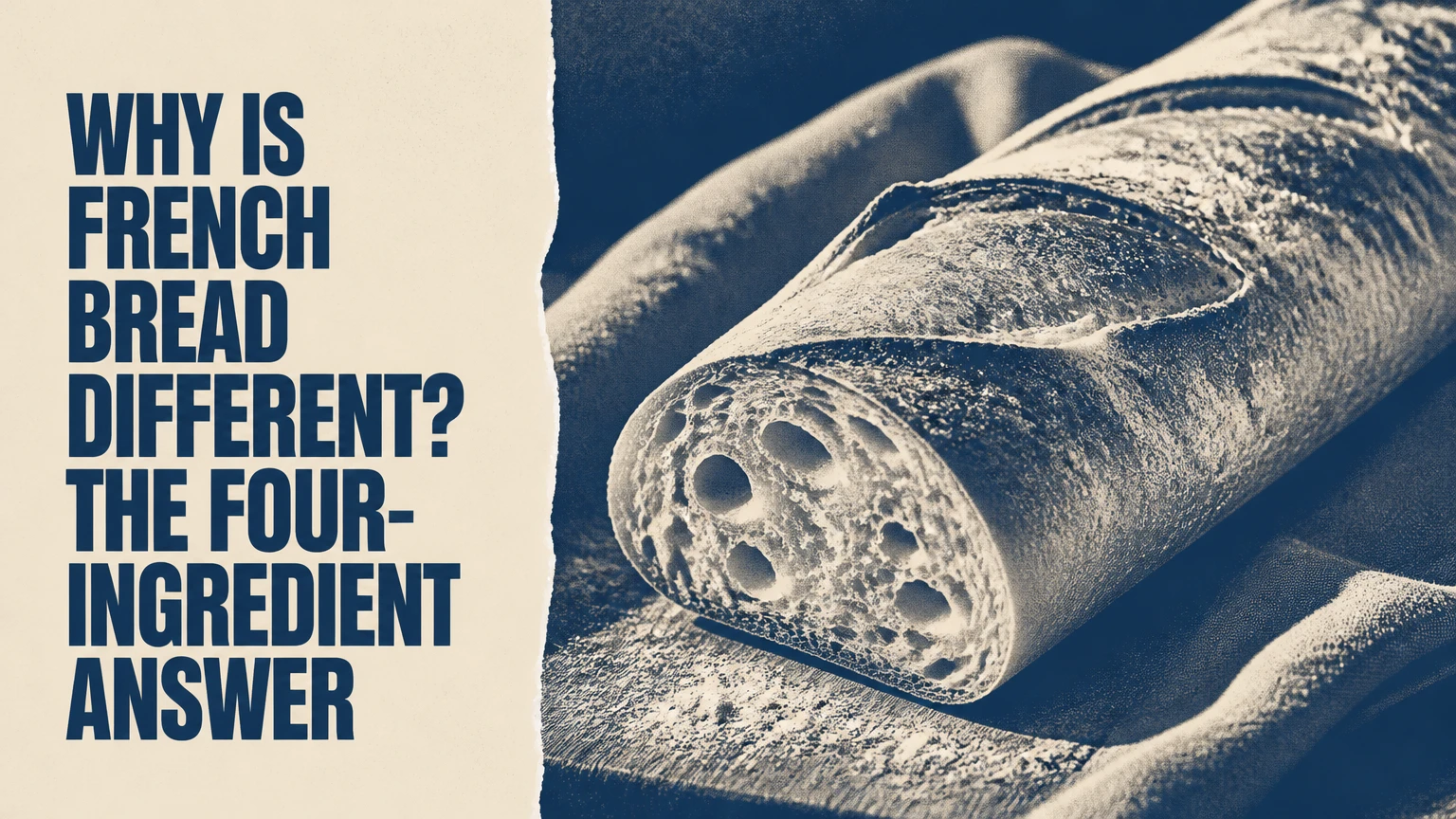
French bread differs because traditional French bread uses a lean formula built around flour, water, salt, and yeast or sourdough, without added fat, sugar, or chemical preservatives. Long fermentation, high hydration, gentle dough handling, shaping, scoring, and steam baking create its thin crisp crust, chewy crumb, irregular holes, and pronounced wheat flavor.
Key Facts at a Glance
- Traditional French bread under France’s 1993 Décret Pain is made from wheat flour, water, salt, and a permitted leavening culture.
- A typical baguette dough contains 65-70% water, 2% salt, and approximately 0.1-1% commercial yeast, depending on fermentation time.
- Steam keeps the dough surface flexible during early baking, allowing oven spring before the crust hardens.
- Traditional baguettes contain no added oil, butter, sugar, or chemical preservatives, so their eating quality declines within hours.
- Baguette de tradition is legally restricted, while “French bread” used internationally can describe many formulas that do not meet French legal standards.
- French bread tastes distinctive because fermentation produces acids, alcohols, and aromatic compounds that enriched, fast-risen bread often has in smaller amounts.
Why Is French Bread Different?
French bread is different because its defining character comes from restraint rather than enrichment. A conventional French baguette has no butter or oil to tenderize the crumb, no sugar to sweeten and accelerate browning, and no preservatives to extend softness. Flour proteins and starches therefore provide most of the structure.
French bread also uses a production method designed to preserve gas and develop flavor. A moderately high-hydration dough ferments for several hours, receives folds instead of aggressive punching, and bakes with strong initial heat and steam. The result is a thin, brittle crust around a moist, elastic interior.
The term requires care. France regulates certain names and production methods, but not every loaf called “French bread” worldwide follows the same formula. A supermarket loaf with French styling may contain oil, milk powder, sugar, dough conditioners, or preservatives.
What Makes French Bread Legally Distinct?
Traditional French bread is legally distinct because French Decree No. 93-1074 of 13 September 1993 restricts the ingredients and handling of pain traditionnel français. The dough may contain wheat flour, water, salt, and yeast or a sourdough starter, while chemical additives, freezing during production, and certain treatment methods are excluded.
The decree applies to named traditional products, not every bread baked or sold in France. A baker can sell enriched breads, whole-grain breads, brioche, or specialty loaves under different names and formulas. The legal category therefore explains why baguette de tradition has a more controlled definition than the loose English phrase “French bread.”
Traditional Baguette Versus Ordinary Baguette
A baguette de tradition française must follow the traditional ingredient and production rules, while an ordinary baguette may use authorized additives and a faster process. Both can be long, thin loaves, so shape alone proves nothing.
| Feature | Baguette de tradition | Ordinary baguette | Enriched French-style loaf |
|---|---|---|---|
| Core ingredients | Flour, water, salt, yeast or levain | May include authorized additives | May include fat, sugar, milk |
| Typical weight | 250 g or 1 kg legal formats | Commonly 250 g | 300-500 g typical |
| Added fat | 0% | Formula-dependent | 2-8% typical |
| Fermentation | Often 6-24 hours | Commonly 2-6 hours | Often 2-5 hours |
| Crust | Thin, crisp, blistered | Crisp to moderately soft | Softer, darker, tender |
| Flavor | Fermented wheat, mild acidity | Mild wheat flavor | Sweeter, richer profile |
The decree also regulates the use of the word “tradition.” A bakery sign that says “baguette tradition” carries more information in France than an overseas label that merely says “French baguette.”
How Do Ingredients and Baking Create the Texture?
French bread texture comes from the interaction of water, gluten, fermentation, heat, and steam. Flour supplies gluten-forming proteins and starch; water hydrates both; salt tightens the gluten network and moderates fermentation; yeast or levain creates carbon dioxide and flavor compounds.
During baking, the dough expands rapidly as gases warm and water turns to vapor. Steam delays surface drying, so the loaf can stretch before the crust sets. Surface starch absorbs water and gelatinizes, producing a smooth film; once the surface dries and exceeds roughly 140°C, Maillard browning creates roasted aromas and color.
Caramelization also occurs at high temperatures, but Maillard reactions contribute more directly to the savory, toasted flavor of a lean bread crust. Calling every browned crust “caramelized” is an oversimplification.
Why Does the Crust Become So Crisp?
A baguette crust becomes crisp because steam first keeps the surface extensible, then the oven’s dry heat removes surface moisture. A thin, low-moisture shell forms around the loaf, and its brittle structure fractures when bitten.
A home baker typically needs a baking surface heated to 230-250°C and strong steam during the first 8-12 minutes. Without steam, the skin dries too early, restricting expansion and producing a dull, thick, pale crust.
Why Is the Crumb Chewy and Uneven?
The crumb is chewy because a lean dough leaves gluten and gelatinized starch relatively unsoftened by fat. High hydration, usually 65-75% for baguette-style dough, also makes the dough extensible enough to form irregular gas cells when the baker handles it gently.
Large holes are not automatically proof of quality. A loaf with enormous voids but a gummy base may have weak fermentation control, poor shaping, or insufficient baking. Professional bakers judge the crumb by elasticity, moisture, cell distribution, aroma, and whether the loaf supports its intended use.
How Is Traditional French Bread Made?
Traditional French bread commonly takes 6-12 hours by a direct method or 18-30 hours when a pre-ferment and cold retardation are included. The decisive factors are dough temperature, fermentation maturity, gentle handling, and a fully heated oven.
Typical Baguette Formula
| Ingredient or variable | Baker’s percentage | Example for 1,000 g flour | Function |
|---|---|---|---|
| White wheat flour | 100% | 1,000 g | Gluten and starch structure |
| Water | 65-70% | 650-700 g | Hydration and dough extensibility |
| Salt | 1.8-2.2% | 18-22 g | Flavor and gluten control |
| Instant yeast | 0.1-1% | 1-10 g | Leavening speed |
| Liquid levain | 15-25% | 150-250 g | Acidity and fermentation flavor |
| Dough temperature | 23-25°C | 23-25°C | Fermentation control |
The levain percentage depends on the starter’s hydration and flour content, so it cannot be compared directly with yeast by weight. A liquid levain at 100% hydration contains equal weights of flour and water.
Stage-by-Stage Production
- Autolyse flour and water for 20-60 minutes. The rest hydrates flour and begins enzymatic activity before salt and yeast enter. You will know it worked when the dough feels smoother with less mixing. Adding salt during autolyse creates a different process, often called a saltolyse.
- Mix in salt and leavening. Knead for roughly 5-12 minutes by machine or use folds by hand until the dough gains strength. Stop before the dough becomes excessively warm, because high dough temperature can accelerate fermentation and weaken handling.
- Bulk ferment for 2-4 hours at approximately 23-25°C. Complete two or three folds during the first 90 minutes. A ready dough should expand noticeably, show bubbles at the edges, and feel elastic rather than soupy.
- Divide and pre-shape the dough. Use a bench knife to divide pieces accurately, commonly 250-350 g for baguette-sized loaves. Cover the pieces and rest them for 15-30 minutes so gluten contracts less during final shaping.
- Shape and proof on a floured couche. Roll each piece into a controlled cylinder without pressing out all the gas. Proof for 45-120 minutes at room temperature, or retard covered dough for 8-24 hours at approximately 4°C.
- Score with a lame immediately before baking. Make overlapping cuts at a shallow angle along the loaf rather than short vertical slashes. Proper scoring opens into a raised lip, often called an ear, instead of tearing at random.
- Bake at 230-250°C with steam. Steam for the first 8-12 minutes, then vent the oven so the crust dries and colors. A typical baguette bakes for 20-25 minutes, and the interior should reach approximately 96-99°C.
A common practitioner rule is to judge fermentation by the dough, not the clock. Ken Forkish expresses the principle in Flour Water Salt Yeast as, “The dough is the boss.” Room temperature, flour strength, starter activity, and inoculation can shift timing substantially.
Which French Bread Types Are Actually Different?
French bread types differ mainly by shape, flour composition, leavening, hydration, and intended use. Baguette is long and thin, pain de campagne is usually a country loaf with mixed flours, and pain au levain depends on sourdough rather than commercial yeast as its primary leavener.
| Bread type | Typical form or weight | Flour and leavening | Texture and flavor | Best use |
|---|---|---|---|---|
| Baguette | 250 g, 55-65 cm long | White wheat flour, yeast or levain | Thin crust, open chewy crumb | Jambon-beurre, table bread |
| Baguette de tradition | 250 g or 1 kg | Restricted traditional formula | Deep fermentation, creamy crumb | Butter, cheese, direct eating |
| Ficelle | 100-150 g, narrow cylinder | Baguette-style wheat dough | High crust ratio, fast drying | Appetizers, crostini |
| Pain de campagne | 500-1,000 g boule or bâtard | Wheat with rye or whole-wheat flour | Moist, aromatic, substantial | Soups, stews, tartines |
| Pain au levain | 500-1,000 g typical | Wild starter, often mixed flour | Tangy, thick crust, resilient crumb | Strong toppings, long meals |
| Boule | 500-1,000 g round loaf | White or mixed flour | Moist center, durable crust | Slicing, soup service |
Pain de campagne is not one fixed recipe. French regulations allow several flour compositions and naming conventions, so a country loaf from one bakery may be mostly white flour while another includes rye, whole wheat, or sourdough.
Why Does French Bread Go Stale So Quickly?
French bread goes stale quickly because it contains little fat, sugar, and emulsifier, while its thin crust loses moisture rapidly. Staling is not simply drying: starch molecules reassociate after baking, a process called retrogradation, which makes the crumb firmer.
A traditional baguette often tastes best within 4-6 hours of baking. It may remain edible for 24 hours, but the crust softens and the crumb loses its fresh elasticity. A larger boule can retain acceptable texture for 1-3 days because its lower surface-area-to-volume ratio slows moisture migration.
| Storage method | Typical useful period | Result | Best action |
|---|---|---|---|
| Uncovered at room temperature | 4-8 hours | Crisp crust, fresh crumb | Eat the same day |
| Paper bag at room temperature | 8-24 hours | Crust softens gradually | Reheat before serving |
| Plastic bag at room temperature | 1-2 days | Softer crust, slower moisture loss | Use for toast |
| Refrigerator | 1-3 days | Faster crumb staling | Avoid unless necessary |
| Freezer, sealed at -18°C | 1-3 months | Quality largely retained | Freeze within hours |
| Oven refresh at 200°C | 5-10 minutes | Crust becomes crisp again | Use for day-old bread |
Do not store a baguette in the refrigerator merely to extend freshness. Refrigerator temperatures accelerate starch retrogradation, even though they slow mold growth.
Is French Bread Healthier Than Sandwich Bread?
French bread is not automatically healthier than sandwich bread. Traditional baguette usually has a short ingredient list and no added sugar or fat, but it remains a refined wheat bread with comparable carbohydrate and calorie density to many white sandwich loaves.
Health depends on portion size, flour extraction, fiber, sodium, and the rest of the meal. A whole-grain pain de campagne may provide more fiber than a white baguette, while a heavily salted loaf can contribute substantial sodium. A fortified sandwich bread may offer nutrients absent from a small refined baguette.
French bread may suit someone avoiding added oils or sugars, but it is not suitable for people with celiac disease because standard wheat baguettes contain gluten. People managing blood glucose should evaluate the total carbohydrate serving rather than assume sourdough or crust changes the outcome enough to remove that concern.
How Does French Bread Compare With Other Styles?
French bread prioritizes crust, fermentation aroma, and a resilient crumb, while American sandwich bread prioritizes softness and shelf life. Italian ciabatta usually uses more water and often olive oil, creating a flatter loaf with larger holes and a different crust-to-crumb balance.
| Attribute | French baguette | American sandwich bread | Italian ciabatta | French brioche |
|---|---|---|---|---|
| Typical hydration | 65-70% | 60-68% | 75-85% | 50-60% |
| Added fat | 0% | 2-8% | 1-5% olive oil | 30-70% butter |
| Added sugar | 0% traditional | 3-10% | 0-3% | 8-15% |
| Crust | Thin and crisp | Soft and thin | Crisp, often floury | Soft and tender |
| Crumb | Elastic, irregular | Fine and uniform | Large, irregular cells | Rich, shreddable |
| Peak freshness | 4-6 hours | 3-7 days | 8-24 hours | 2-4 days |
| Main use | Table bread, sandwiches | Toast, packed lunches | Panini, dipping | Breakfast, dessert |
Ciabatta can outperform baguette for oil-heavy fillings because its open crumb absorbs olive oil and sauces. Baguette is usually easier to hold and slice cleanly, especially when its crumb is moderately open rather than extremely holey.
What Should You Look for When Buying It?
Buy baguette de tradition when you want a legally restricted ingredient profile and a longer fermentation character, but choose pain de campagne when you need a loaf that remains useful beyond one meal. The best loaf should match the eating time, filling, and desired crust rather than carry the most prestigious name.
Look for a browned but not burned crust, irregular scoring, and a loaf that feels light for its volume. The bottom may show a rougher deck-baked texture, although that feature alone does not prove stone baking. A creamy or pale ivory crumb is common in slowly fermented wheat dough, but crumb color varies with flour, oxidation, and extraction.
Which Loaf Fits Each Eating Situation?
| Situation | Recommended loaf | Typical portion or size | Reason |
|---|---|---|---|
| Same-day breakfast | Baguette | 250 g | High crust and fresh aroma |
| Jambon-beurre | Baguette de tradition | 250 g | Firm crumb supports butter and ham |
| Soup for several people | Boule or pain de campagne | 500-1,000 g | Larger loaf retains moisture |
| Acidic or smoky toppings | Pain au levain | 500-1,000 g | Acidity balances strong flavors |
| Crostini or appetizers | Ficelle | 100-150 g | High crust ratio and easy slicing |
| Multi-day household use | Country loaf | 750-1,000 g | Slower moisture loss than baguette |
Typical bakery prices in France are approximately €1.00-€1.40 for a standard baguette and often €1.20-€2.00 for a baguette de tradition, with regional and bakery differences. International artisan bakeries commonly charge about $3.50-$6.00 for a comparable loaf because labor, flour, rent, and steam deck equipment cost more.
How Can a Home Baker Reproduce the Crust?
A home baker can reproduce much of French bread’s crust with a preheated Dutch oven, baking steel, or covered roasting vessel. The vessel traps the dough’s own evaporating water, creating the steam that a deck oven injects commercially.
Use a Dutch oven preheated at 240-250°C for at least 30-45 minutes. Load the shaped dough onto parchment, cover for 15-20 minutes, then uncover and finish for 10-20 minutes until the crust is deeply browned. A baguette requires more length than most Dutch ovens provide, so a steel with a preheated metal pan for boiling water is more practical.
Never pour water directly onto a glass oven door or exposed heating element. Use a heavy metal tray, boiling water, or a manufacturer-approved steam method. Vent the oven after the first 10 minutes because persistent humidity prevents the crust from drying and coloring.
What Common Problems Change the Result?
Most French bread failures come from fermentation errors, weak steam, inaccurate dough temperature, or excessive handling. Changing hydration alone rarely repairs a loaf if the dough is under-fermented or the oven loses heat during loading.
| Symptom | Likely cause | Corrective action | Check next time |
|---|---|---|---|
| Pale, soft crust | Weak steam or oven below 230°C | Preheat longer and steam strongly | Crust colors after venting |
| Dense crumb | Under-fermentation or low hydration | Extend bulk rise and use 65-70% water | Dough shows bubbles and expansion |
| Huge holes with collapsed base | Weak gluten or overproofing | Add folds and shorten final proof | Loaf holds its shape after scoring |
| Loaf bursts beside score | Shallow scoring or underproofing | Cut deeper at a lower angle | Ear opens along the slash |
| Flat loaf after scoring | Overproofing | Reduce proof time or yeast | Dough springs back slowly |
| Gummy center | Underbaking or cutting hot | Bake to 96-99°C and cool fully | Crumb cuts cleanly after 45 minutes |
A counterintuitive practitioner insight is that a wetter dough does not guarantee a more open crumb. Water increases extensibility, but the dough still needs sufficient gluten strength and fermentation gas; otherwise, high hydration produces a flat, sticky loaf.
Another useful rule is to cool bread before judging its crumb. Cutting a baguette immediately releases steam and compresses gelatinized starch, making a properly baked loaf appear gummy.
French humidity also changes the result. On a rainy day, flour may absorb water differently and crusts soften faster after baking, so experienced bakers adjust dough water by a small amount and prioritize oven venting rather than following a fixed formula blindly.
FAQ
Does French bread contain less gluten than regular bread?
Traditional French bread does not inherently contain less gluten than other wheat bread. Its gluten network may feel more elastic because the dough is lean, fermented longer, and handled differently, but wheat flour still supplies gluten proteins. Sourdough fermentation can modify some proteins, yet ordinary sourdough is not safe for celiac disease.
Why are French baguettes so thin?
French baguettes are thin because their elongated shape creates a high crust-to-crumb ratio and supports rapid same-day eating. The familiar baguette commonly weighs about 250 grams, while its long form allows strong oven spring and easy sharing. Thin loaves lose moisture faster than boules, which explains their short peak freshness.
Can French bread be made with whole wheat flour?
French bread can include whole-wheat flour, but a whole-wheat pain de campagne differs from a classic white baguette. Bran absorbs more water and can interrupt gluten development, so whole-grain formulas often require higher hydration, longer soaking, or gentler mixing. The crumb becomes denser and the flavor more nutty.
Why does French bread taste better with butter?
Butter adds fat, aroma, salt, and a creamy contrast to a lean loaf’s chewy crumb and toasted crust. French bread itself does not need butter for structure, but the combination balances the baguette’s low-fat formula. Unsalted butter also lets the baker taste fermentation and wheat more clearly than strongly flavored spreads.
Is a baguette the same as French bread?
A baguette is one type of French bread, defined primarily by its long, narrow shape and customary weight. French bread is a wider category that includes baguette, ficelle, boule, pain de campagne, and other regional loaves. A product labeled baguette outside France may not meet the French rules for baguette de tradition.
Should French bread be refrigerated?
French bread should generally not be refrigerated because cold temperatures accelerate crumb staling through starch retrogradation. Keep a baguette in paper for same-day use, freeze it in an airtight package for longer storage, and refresh a thawed or day-old loaf in a 200°C oven for 5-10 minutes.
The Bottom Line
Why is French bread different? Traditional French bread combines a legally restricted lean ingredient formula with fermentation, gentle handling, high heat, and steam. The method produces a crisp crust, chewy irregular crumb, and concentrated wheat flavor, but it also creates a short shelf life. Choose baguette for immediate eating, pain de campagne for meals over several days, and baguette de tradition when ingredient restrictions and fermentation character matter most.