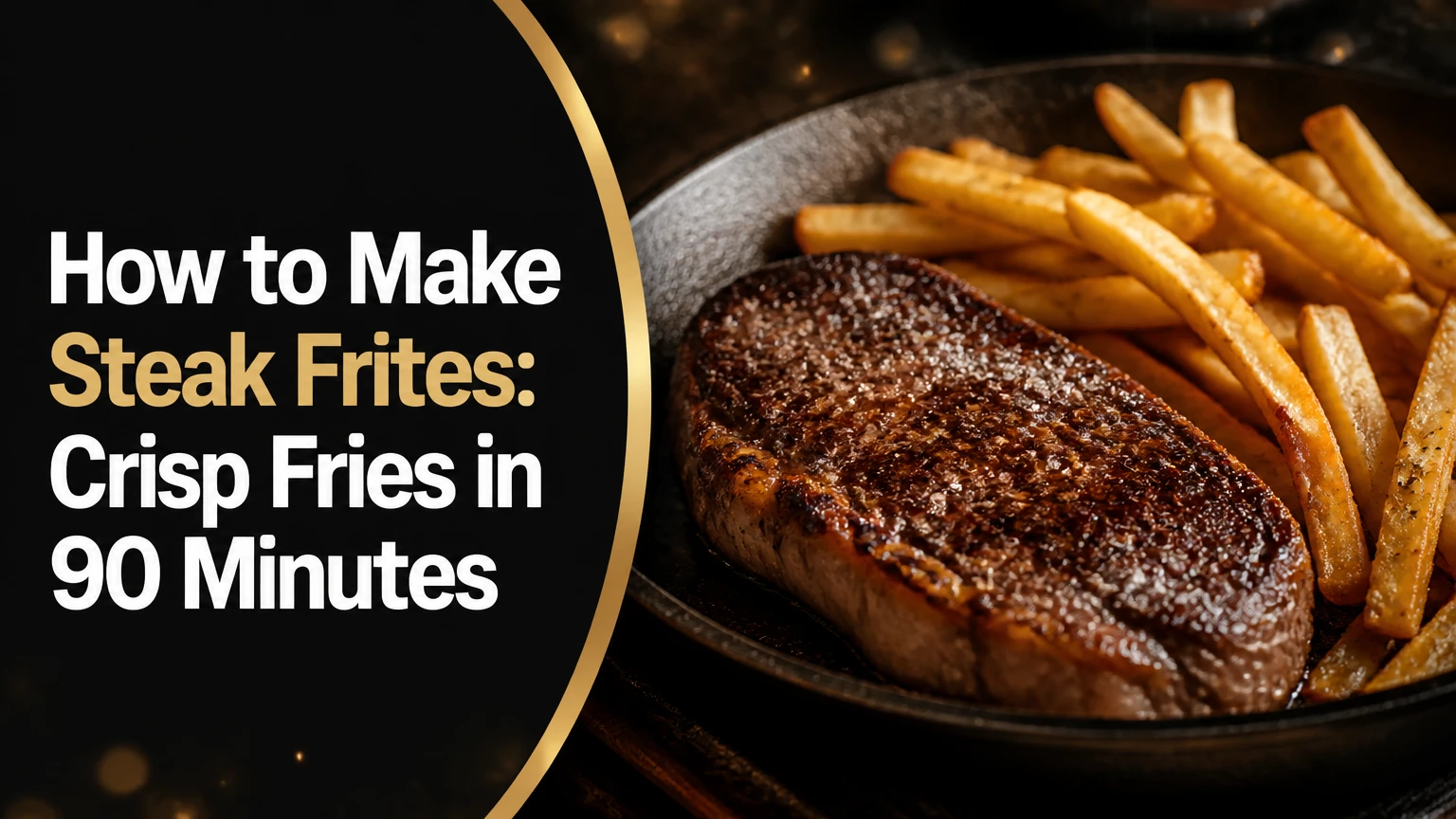
Steak frites combines a deeply browned pan-seared steak with twice-fried potato batons that are crisp outside and fluffy inside. For two servings, use 1.5-inch steaks, 1 pound of russet potatoes, and a thermometer; fry the potatoes at 325°F and 375°F, cook the beef to 125-130°F before resting, and serve immediately.
Key Facts at a Glance
- Steak frites takes about 90 minutes, including a 30-minute potato soak and resting time.
- Russet potatoes cut into 8 mm batons produce the driest, fluffiest interior and crispest shell.
- Double-fry potatoes at 325°F for 5-7 minutes, then at 375°F for 2-4 minutes.
- A 1.5-inch ribeye, strip steak, hanger steak, or flat iron is easier to crust without overcooking.
- Pull medium-rare steak at 125-130°F; carryover heat usually raises the final temperature by about 5°F.
- Salt fries immediately after draining, and rest steak on a rack or warm plate for 5-10 minutes.
What Makes Steak Frites Work?
Steak frites works because the dish pairs two different forms of browning with contrasting textures. Steak frites needs a dry, hot meat surface for Maillard browning, while frites need a moist, gelatinized potato center and a dehydrated, crisp exterior. Temperature control determines whether both components succeed.
The steak develops savory roasted flavors when amino acids and reducing sugars react on its surface. The potatoes require a separate sequence: the first fry softens the interior and cooks the starch, while the second fry removes surface moisture and hardens the crust.
Auguste Escoffier is widely credited with the phrase, “Good cooking is the foundation of true happiness.” Steak frites illustrates that principle through technique rather than elaborate ingredients. A modest steak and potatoes can taste restaurant-quality when the cook controls moisture, heat, timing, and salt.
A home kitchen has one practical disadvantage: fries and steak compete for attention. The most reliable order is to complete the first fry, prepare the steak, finish the sauce, then perform the second fry while the steak rests. That sequence protects the crust and puts hot food on the plate together.
Which Steak Cut Should You Buy?
For most home cooks, a 1.25-1.5-inch strip steak or ribeye is the most dependable choice because both cuts brown well and remain juicy during a short sear. Hanger steak offers the most traditional bistro character, while flank and skirt steak require careful slicing against the grain.
| Cut | Typical thickness | Typical price per pound | Best doneness | Main limitation |
|---|---|---|---|---|
| Hanger, onglet | 1-1.5 inches | $14-$24 | Rare to medium-rare | Center membrane needs trimming |
| Ribeye, entrecôte | 1.25-2 inches | $18-$35 | Medium-rare to medium | High fat can flare or smoke |
| Striploin, faux-filet | 1.25-1.5 inches | $12-$24 | Medium-rare to medium | Less marbling than ribeye |
| Flat iron | 1-1.25 inches | $10-$18 | Rare to medium-rare | Must remove connective seam if present |
| Flank, bavette | 0.75-1 inch | $11-$19 | Rare to medium-rare | Fibers become chewy when overcooked |
| Skirt steak | 0.5-0.75 inch | $12-$22 | Rare to medium-rare | Thin shape leaves little margin for error |
Cut and Trim Rules
Choose steaks with even thickness, visible marbling, and a surface that is not wet inside the package. Thickness matters more than weight because a thick steak gives the surface time to brown before the center passes medium-rare.
Trim only hard exterior silver skin and excessive fat. Leave a fat cap approximately 3-5 mm thick on strip steak, then score the fat every 1 inch so the steak does not curl. Hanger steak has a tough central membrane; ask a butcher to remove it or separate the two lobes yourself with a thin boning knife.
Flank, skirt, and bavette steaks are not poor choices, but they are poor choices for thick steakhouse-style portions. Cook them quickly over high heat, rest them, and slice across their long fibers into pieces no thicker than 5 mm.
Which Potatoes and Frying Fat Work Best?
High-starch, low-moisture russet potatoes produce the lightest centers and crispiest shells for steak frites. Yukon Gold potatoes offer a more buttery flavor and golden color, but their higher moisture and waxier texture generally produce less shattering crunch.
| Potato or fry | Cut or package specification | Texture after cooking | Typical cost for 2 servings | Best use |
|---|---|---|---|---|
| Russet Burbank | 8 mm batons, peeled | Fluffy center, crisp shell | $1.50-$3 | Traditional double-fried frites |
| Yukon Gold | 8-10 mm batons, peeled or skin-on | Creamy center, moderate crunch | $2-$4 | Buttery flavor and smaller batches |
| Kennebec | 8 mm batons, peeled | Balanced starch and moisture | $2-$4 | Fresh-cut fries when available |
| Frozen shoestring fries | 6-8 mm, packaged | Consistent, less potato flavor | $3-$7 | Weeknight convenience |
| Frozen steak fries | 12-15 mm, packaged | Thick, soft center | $3-$7 | Air fryer or oven preparation |
Beef tallow gives fries a pronounced roasted beef flavor and a crisp finish. Peanut oil is neutral, handles high heat well, and is a strong choice for repeated frying. Canola oil costs less and works effectively, although it contributes less flavor.
Use 2-3 quarts of oil in a 5-6-quart Dutch oven, filling the vessel no more than one-third full. A thermometer clipped to the pot is safer and more accurate than judging oil temperature by appearance.
Before You Start
| Requirement | Specification for 2 servings |
|---|---|
| Total time | 80-100 minutes |
| Active cooking time | 35-45 minutes |
| Difficulty | Moderate |
| Steak | 2 steaks, 10-14 ounces each, 1.25-1.5 inches thick |
| Potatoes | 1 pound russets, about 2 medium potatoes |
| Frying oil | 2-3 quarts peanut, canola, or tallow |
| Cooking pan | 10-12-inch cast-iron or carbon-steel skillet |
| Frying vessel | 5-6-quart Dutch oven or heavy pot |
| Thermometer | Instant-read probe or leave-in probe |
| Drying equipment | Clean towels, sheet pan, wire rack |
| Optional sauce | 1 shallot, 1/4 cup wine, 1/2 cup stock, 1 tablespoon butter |
Set out the wire rack before frying. A rack prevents condensation from softening the potatoes, unlike a flat plate lined with paper towels. Keep a lid nearby for the pot, but never cover hot oil unless removing the vessel from heat.
How Do You Make Steak Frites?
Steak frites requires four coordinated stages: soak and dry the potatoes, blanch them in moderate oil, cook and rest the steak, then crisp the potatoes in hotter oil. The complete method takes 80-100 minutes, and the most important success factor is controlling surface moisture before both frying and searing.
Step 1: Cut and Soak the Potatoes
Peel 1 pound of russet potatoes and cut them into uniform 8 mm batons, approximately 1/3 inch thick. Place the cut potatoes in a large bowl of cold water for at least 30 minutes, changing the water once if it becomes cloudy.
Uniform pieces finish together. A mixture of thin and thick batons creates burnt tips alongside undercooked centers.
You will know this step worked when the water contains visible starch and the potato surfaces feel cleaner rather than sticky. Do not soak overnight unless the potatoes remain fully submerged and refrigerated, because prolonged soaking can dilute flavor and make handling more difficult.
Step 2: Dry the Potatoes Completely
Drain the potatoes and spread them on clean kitchen towels. Pat them dry, then leave them uncovered for 5-10 minutes while you heat the oil.
Water on potatoes causes violent splattering and lowers the oil temperature. The potatoes do not need to be bone-dry internally, but their exterior must have no visible droplets.
You will know the potatoes are ready when a towel pressed against them remains almost dry. The common mistake is transferring damp potatoes directly into hot fat, which creates a safety hazard and produces pale, greasy fries.
Step 3: Blanch the Frites at 325°F
Heat 2-3 quarts of peanut oil, canola oil, or beef tallow to 325°F. Fry the potatoes in batches of approximately 8 ounces for 5-7 minutes, keeping the oil between 300°F and 325°F after each batch enters.
The first fry should soften the potato without producing meaningful browning. Stir gently after the first minute so pieces do not adhere to the pot or each other.
Remove the batons when they bend easily and show a pale yellow surface. Drain them on a wire rack for at least 20 minutes. For better scheduling, cool the blanched potatoes for up to 2 hours at room temperature, or refrigerate them uncovered for up to 24 hours.
The common mistake is crowding the pot. If the oil needs more than 3-4 minutes to return near 325°F, the batch is too large.
Step 4: Season the Steaks and Heat the Skillet
Pat two steaks dry and season all sides with approximately 3/4 teaspoon of kosher salt per pound of meat. Add black pepper now only if you prefer a mild toasted flavor; pepper can burn in a very hot pan, so many cooks add it after searing.
Leave the steaks uncovered at room temperature for 30-45 minutes. This period does not fully warm the center, but it allows the salt to dissolve and reduces the surface chill.
Heat a 10-12-inch cast-iron or carbon-steel skillet over high heat for 4-6 minutes. Add 1 tablespoon of a neutral high-heat oil when the pan is hot enough that the oil shimmers immediately.
You will know the pan is ready when a drop of water evaporates instantly and the oil moves freely. A pan that is merely warm produces gray meat and a weak crust.
Step 5: Sear and Render the Steak
Place the steak in the skillet away from your body. Press gently for 10 seconds to ensure full contact, then cook for 60-90 seconds before turning. Continue flipping every 30-60 seconds rather than leaving the steak untouched for several minutes.
Frequent flipping can produce an even crust while reducing the wide gray band associated with a one-sided sear. For a ribeye, hold the fat edge against the pan for 30-60 seconds to render it before laying the steak flat.
Cook until the internal temperature reaches approximately 115-120°F for rare or 125-130°F for medium-rare. Insert the probe horizontally into the thickest center, avoiding bone and large pockets of fat.
The steak should have a dark brown crust, not a blackened surface. If the pan smokes heavily before the crust develops, lower the heat slightly and ventilate the kitchen.
Step 6: Baste with Butter, Garlic, and Herbs
Lower the heat to medium and add 2 tablespoons of unsalted butter, 2 crushed garlic cloves, and 2 sprigs of thyme. Add the butter after the initial crust forms, because milk solids burn quickly in a pan hot enough for searing.
Tilt the skillet and spoon the foaming butter over the steak for 60-90 seconds. The butter should smell nutty and herbal rather than acrid. Remove the steak if the butter darkens rapidly.
You will know the baste worked when the crust looks glossy and the butter has become light brown. Garlic and herbs flavor the fat, but they cannot rescue a steak whose surface was wet or whose pan was too cool.
Step 7: Rest and Finish the Steak
Transfer the steak to a wire rack or warm plate and rest it for 5-10 minutes. Tent loosely with foil only if the room is cold, because tight foil traps steam and softens the crust.
During resting, carryover cooking commonly raises the internal temperature by about 5°F, although the increase varies with steak thickness, pan heat, and starting temperature. Slice hanger, flank, skirt, and bavette against the grain; slice ribeye and strip steak across the width into 1/2-inch pieces if serving family-style.
The steak is ready when its juices no longer immediately pool on the cutting board and the surface remains warm. Cutting at once wastes some liquid and makes the first slices appear drier than the center.
Step 8: Crisp the Potatoes at 375°F
Raise the oil to 375°F and fry the blanched potatoes in batches for 2-4 minutes. Keep the oil between 350°F and 375°F after adding each batch, and stir during the final minute for even color.
Remove the frites when they are rigid, golden brown, and audibly crisp when shaken in the basket. Drain on a wire rack for 30-60 seconds, then season immediately with fine salt.
Use approximately 1/2 teaspoon of fine sea salt per pound of finished fries, adjusting for taste and the steak’s seasoning. Parsley, minced chives, or a small amount of garlic powder can be added, but wet ingredients such as lemon juice destroy crispness.
The common mistake is starting the second fry before the oil recovers. Pale fries that soften within minutes usually need a hotter final fry, smaller batches, or longer rack drainage.
What Is the Best Cooking Order?
The best cooking order is first-fry potatoes, prepare and sear the steak, make any pan sauce, then second-fry the potatoes during the steak’s rest. This sequence keeps the meat warm and the frites crisp without forcing either component to wait.
| Minute | Action | Target condition |
|---|---|---|
| 0 | Cut and soak potatoes | Cold water, 30 minutes |
| 30 | Dry potatoes and heat oil | Potato surfaces visibly dry |
| 40 | First-fry potatoes | 325°F oil, pale and limp |
| 55 | Heat skillet and season steak | Pan fully hot, beef dry |
| 65 | Sear and baste steak | Pull at 125-130°F for medium-rare |
| 70 | Rest steak and make sauce | Rest 5-10 minutes |
| 72 | Second-fry potatoes | 375°F oil, golden and rigid |
| 76 | Salt and plate | Serve immediately |
For a 1.5-inch steak, the first fry can be completed well ahead of the sear. For thinner bavette or skirt steak, begin the second fry before cooking the beef because those cuts may require only 3-5 minutes total.
Which Sauce Goes With Steak Frites?
The most traditional low-effort options are pan jus, maître d’hôtel butter, peppercorn sauce, and Béarnaise. Choose pan jus for a clean beef flavor, herb butter for speed, peppercorn sauce for richness, and Béarnaise when serving a thick ribeye or entertaining.
| Sauce | Time | Ingredients for 2 | Flavor profile | Best steak |
|---|---|---|---|---|
| Pan jus | 5 minutes | Shallot, 1/4 cup wine, 1/2 cup stock, butter | Savory and light | Hanger or strip |
| Maître d’hôtel butter | 5 minutes | 2 tablespoons butter, parsley, lemon | Fresh and rich | Flank or flat iron |
| Peppercorn | 10 minutes | 1 tablespoon peppercorns, cream, stock | Spicy and creamy | Strip steak |
| Béarnaise | 20-25 minutes | Egg yolks, vinegar, tarragon, butter | Tangy and buttery | Ribeye |
| Cognac cream | 8 minutes | Cognac, stock, cream, mustard | Deep and rounded | Ribeye or hanger |
Make a Fast Pan Sauce
Pour excess fat from the skillet, leaving the browned fond behind. Add 1 minced shallot and cook for 30-60 seconds, then deglaze with 1/4 cup dry red wine, white wine, or cognac.
Scrape the pan and reduce the liquid by half. Add 1/2 cup beef stock, reduce until lightly syrupy, then whisk in 1 tablespoon cold butter away from high heat. The sauce should coat a spoon but remain pourable.
For an alcohol-free version, use 1/3 cup beef stock plus 1 teaspoon sherry vinegar. The vinegar supplies acidity without making the sauce taste like vinegar when reduced properly.
Can You Use Frozen Fries or an Air Fryer?
Frozen fries are a legitimate weeknight alternative, but they do not reproduce the potato flavor and fluffy texture of fresh double-fried russets. Cook frozen fries in a single layer at the package’s highest recommended oven or air-fryer temperature, usually 400-450°F, and season immediately.
Air fryers work best with frozen shoestring or thin-cut fries because their pre-cooked surfaces brown efficiently in circulating dry heat. Fresh potatoes can work, but the limited basket area encourages crowding, which traps steam and causes limp results.
For a practical weeknight version, cook 1 pound of frozen fries in two air-fryer batches, holding the first batch on a rack in a 200°F oven for no more than 15 minutes. Sear flat iron or strip steak in a skillet while the final fries cook.
Frozen fries are not ideal for a traditionalist seeking tallow-fried flavor. They are good for speed, portion consistency, and kitchens without a large pot of hot oil.
Should You Pan-Sear or Grill the Steak?
Pan-searing is the better method for steak frites when you want a butter baste or pan sauce, while grilling is better for cooking several steaks without filling the kitchen with smoke. Both methods work when the steak surface is dry and the internal temperature is measured.
| Method | Preheat | Typical cook time | Best advantage | Main drawback |
|---|---|---|---|---|
| Cast-iron sear | 4-6 minutes | 6-10 minutes | Fond and butter basting | Indoor smoke |
| Carbon-steel sear | 3-5 minutes | 5-9 minutes | Fast heat response | Less heat retention |
| Gas grill | 10-15 minutes | 5-8 minutes | Easy batch cooking | Less pan sauce |
| Charcoal grill | 25-35 minutes | 5-8 minutes | Smoke flavor | Longer setup |
| Reverse sear | Oven at 250°F | 35-55 minutes | Even interior | Requires oven and rack |
Reverse searing suits steaks 1.75 inches or thicker. Heat the steak on a rack in a 250°F oven until it reaches 105-115°F, then sear it in a very hot skillet for 45-60 seconds per side. This method reduces the gray band but takes longer than direct pan cooking.
How Do You Make Steak Frites for Four or More?
For four diners, use two 1.25-1.5-inch steaks per skillet batch and 2 pounds of potatoes. Complete the first fry up to 2 hours early, hold the blanched potatoes uncovered, and finish the steaks in batches so the pan does not lose excessive heat.
Do not double the steak count in one 10-inch skillet. Two steaks can fit if they remain separated by at least 1 inch; four steaks create steam, cool the metal, and prevent browning.
A reliable group-service plan is:
- First-fry all potatoes and hold them on racks.
- Sear steaks in batches, moving cooked steaks to a 200°F oven for no longer than 10 minutes.
- Make the sauce from the combined fond.
- Second-fry potatoes in several small batches.
- Slice and plate the steaks only after the final fries leave the oil.
For more than six people, grill the steaks and use two pots or an electric countertop fryer for the potatoes. A single Dutch oven becomes a bottleneck because oil temperature recovery controls the entire schedule.
How Much Does Homemade Steak Frites Cost?
Homemade steak frites typically costs $12-$30 per serving, depending mainly on steak cut and grade. Choice strip steak with russets may cost about $12-$16 per person, while prime ribeye with Béarnaise can reach $25-$30 per person before wine.
| Version | Steak cost per serving | Potato and oil cost | Sauce and garnish | Typical total |
|---|---|---|---|---|
| Weeknight flat iron | $7-$11 | $2-$3 | $1-$2 | $10-$16 |
| Choice strip steak | $9-$15 | $2-$3 | $1-$3 | $12-$21 |
| Hanger with tallow | $10-$17 | $2-$4 | $2-$4 | $14-$25 |
| Prime ribeye and Béarnaise | $18-$25 | $2-$4 | $3-$6 | $23-$35 |
Oil cost depends on whether the oil is filtered and reused. Strain cooled peanut or canola oil through a fine sieve, refrigerate it in a sealed container, and discard it if it smells stale, foams excessively, or has dark sediment.
Common Mistakes and How to Fix Them
Soggy or Greasy Fries
Soggy frites usually result from wet potatoes, crowded batches, or a second fry below 350°F. Spread fries on a wire rack, let the oil recover to 375°F, and refry them for 60-90 seconds.
Gray Steak With No Crust
A gray steak indicates excess surface moisture or insufficient pan heat. Pat the beef dry again before cooking, preheat the skillet longer, and avoid adding butter until after the first crust has formed.
Burnt Butter and Bitter Garlic
Burnt butter occurs when butter enters a pan still set to maximum heat. Add butter after the initial sear and lower the heat to medium; remove the pan briefly if the milk solids turn dark brown within seconds.
Tough Hanger or Bavette
Toughness in hanger, flank, or skirt steak usually comes from overcooking or slicing with the grain. Pull these cuts near 120-125°F, rest them, and identify the long muscle fibers before cutting across them.
Fries and Steak Finish at Different Times
This timing failure occurs when the steak is started before the potatoes are staged. Complete the first fry early, hold the blanched potatoes on a rack, and use the steak’s resting period for the final fry.
Oil Smokes or Splashes Aggressively
Oil smoke signals excessive heat, contaminated fat, or water contact. Turn off the burner, move the pot from heat if safe, and never pour water onto an oil fire; use a lid or an appropriate Class B fire extinguisher.
Variations and Honest Limitations
Traditional Bistro Version
Use hanger steak, russet potatoes, and beef tallow. Finish with parsley-lemon maître d’hôtel butter or a simple pan jus rather than a heavy cream sauce.
This version gives the strongest beef-forward flavor, but hanger steak has less tolerance for medium cooking and requires more trimming than strip steak.
Fast Weeknight Version
Use flat iron steak and frozen thin-cut fries. Air-fry the potatoes at 400-450°F according to the package, then sear the steak in a hot skillet for approximately 3-5 minutes per side, depending on thickness.
This version reduces preparation to about 35-45 minutes. Frozen fries are convenient, but their interior is usually less fluffy than fresh double-fried potatoes.
Entertainer’s Version
Use thick ribeye, reverse-sear it at 250°F, and prepare Béarnaise while the steak rests. Blanch potatoes earlier in the day and refrigerate them uncovered before the final fry.
Reverse searing gives the most uniform pink center, but it is not the fastest method and offers less opportunity to build a pan sauce from the steak fond.
Frequently Asked Questions
Can I make steak frites without a deep fryer?
Yes. A heavy Dutch oven or deep saucepan works well if it holds 2-3 quarts of oil and leaves at least two-thirds of its volume empty. Use a clip-on thermometer, fry small batches, and keep a lid nearby. Never fill a shallow skillet with enough oil for deep frying because splashing and overflow become more likely.
Should I salt steak before or after cooking?
Salt steak 30-45 minutes before cooking when possible. Early salting allows salt to dissolve into surface moisture and improves seasoning beneath the exterior. If the timing is shorter than 10 minutes, salt immediately before searing and pat the surface dry again so the meat browns rather than steams.
What internal temperature is safe for steak?
The USDA recommends 145°F with a 3-minute rest for whole cuts of beef, which produces medium to medium-well meat. Many diners choose medium-rare steak at a lower temperature, but that choice carries greater food-safety risk, especially for vulnerable people. Use pasteurized, properly refrigerated beef and a clean thermometer.
Can I prepare the potatoes ahead of time?
Yes. Complete the first fry, cool the potatoes on a wire rack, and refrigerate them uncovered for up to 24 hours. The dry surface helps the second fry brown efficiently. Do not seal warm blanched potatoes in a container, because trapped steam softens them and creates condensation.
Why are my fries crisp at first but soft later?
Fries soften when steam condenses inside a bowl or when the second fry does not remove enough surface moisture. Drain frites on a rack rather than paper towels, avoid covering them, salt them immediately, and serve within 5-10 minutes of the final fry.
What is the simplest sauce for steak frites?
Herb butter is the simplest sauce. Mix 2 tablespoons softened unsalted butter with 1 tablespoon chopped parsley, 1/2 teaspoon lemon juice, a pinch of salt, and black pepper, then place it on the rested steak. The butter melts gradually without requiring a separate reduction or emulsification.
The Bottom Line
Steak frites succeeds when the potatoes are dry and double-fried, the steak is thick enough to develop a crust before overcooking, and both components are served immediately. Use russets, fry at 325°F and 375°F, pull a 1.5-inch steak at 125-130°F for medium-rare, rest it for 5-10 minutes, and finish the frites during that rest. With that sequence, making steak frites at home becomes a controlled process rather than a timing gamble.