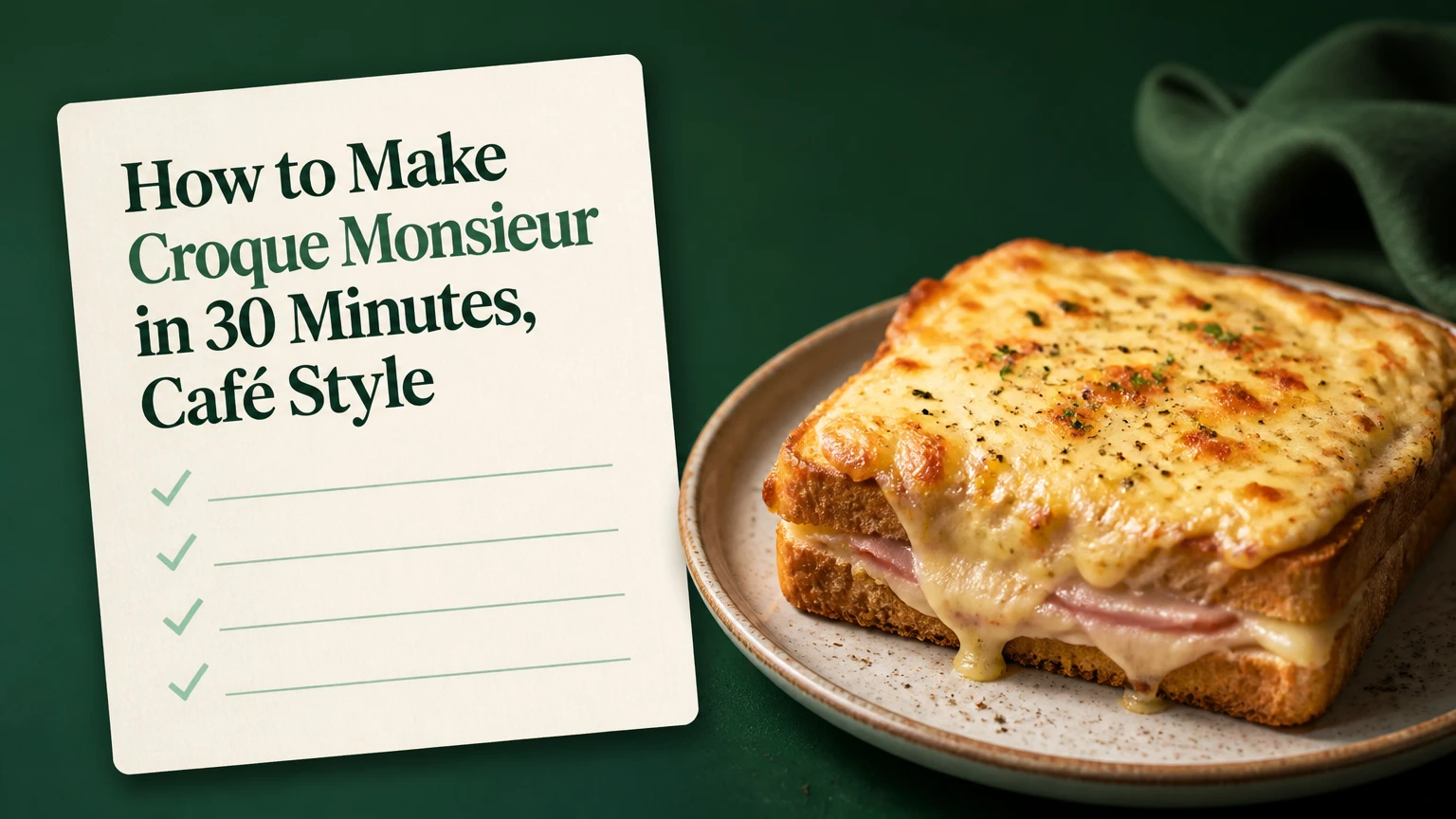
To make Croque Monsieur, layer ham and grated Gruyère between sturdy toasted bread, coat the top with Mornay sauce, bake at 400°F (200°C), then broil until browned and bubbling. The complete method makes two sandwiches in about 30 minutes, and pre-toasting the bread is the main safeguard against a soggy bottom.
Key Facts at a Glance
- Croque Monsieur is a hot French ham-and-cheese sandwich finished with béchamel or cheese-enriched Mornay sauce.
- Two sandwiches require 4 thick bread slices, 4 ham slices, about 150 g cheese, 1 cup milk, 1 tablespoon flour, and 3 tablespoons butter.
- A 400°F (200°C) oven melts the interior in roughly 8 minutes before a 2-3 minute broil browns the topping.
- Pain de mie, brioche, and dense sourdough hold sauce better than thin sandwich bread.
- Gruyère gives the most traditional nutty flavor, while Emmental melts more mildly and Comté tastes more pronounced.
- Typical ingredient cost is $3.50-$6.00 per sandwich, depending mainly on the ham and imported cheese.
What Is a Croque Monsieur?
Croque Monsieur is a French café sandwich made from cooked ham, melting cheese, bread, and a white sauce, then baked or grilled until crisp and browned. The name is commonly translated as “crunching mister,” and the sandwich is generally associated with Paris cafés in the early twentieth century, including a documented 1910 appearance on a Paris menu.
A classic version uses pain de mie, a square, close-crumbed French sandwich bread, although brioche and firm sourdough work at home. The sandwich may be closed, with sauce spread over the top, or prepared open-faced. A Croque Madame adds an egg, usually fried, to the finished Croque Monsieur.
The dish has two contrasting textures. The bread should remain crisp at the edges, the ham should stay supple, and the cheese should flow without separating into an oily puddle. Mornay sauce unites those components by adding moisture and a seasoned dairy layer that browns under direct heat.
Which Ingredients Produce the Best Texture?
The best Croque Monsieur uses thick, dry bread, finely grated melting cheese, thinly folded ham, and a sauce thick enough to coat a spoon. Ingredient choices matter because the sandwich receives moisture from both the cheese and the Mornay topping during baking.
| Ingredient | Amount for 2 | Best choice | Useful substitute |
|---|---|---|---|
| Bread | 4 slices, 1.5-2 cm thick | Pain de mie | Brioche or dense sourdough |
| Cooked ham | 4 slices, 120-160 g total | Jambon de Paris | Low-moisture deli ham |
| Melting cheese | 150 g, about 1.5 cups grated | Gruyère | Emmental or Comté |
| Whole milk | 240 ml, 1 cup | Full-fat milk | Evaporated milk, diluted 1:1 |
| Butter | 42 g, 3 tablespoons | Unsalted butter | Salted butter, with less added salt |
| Flour | 8-9 g, 1 tablespoon | All-purpose flour | Gluten-free flour blend |
| Dijon mustard | 1 teaspoon | Smooth Dijon | Omit for a milder sandwich |
| Seasoning | To taste | Nutmeg, pepper, salt | White pepper and paprika |
Use cheese grated from a block rather than pre-shredded cheese when possible. Block cheese usually melts more evenly because it contains less anti-caking powder and produces a smoother sauce. Gruyère is the strongest all-purpose choice, while Emmental is milder and often less expensive.
Pat wet ham dry before assembly. Excess surface water steams the bread and dilutes the sauce, especially when the sandwich contains several folded slices. Fold each slice once or twice instead of bunching it into a thick ribbon, which creates a loose center that slides during cutting.
Why Use Mornay Sauce?
Mornay sauce is béchamel enriched with grated cheese, and it gives Croque Monsieur a more savory, cohesive topping than plain white sauce. The flour-thickened milk holds the melted cheese in a stable suspension, provided the cheese is added after the pan leaves direct heat.
For two sandwiches, use 1 tablespoon butter, 1 tablespoon flour, and 1 cup warm whole milk. That ratio produces a medium-thick sauce, enough to cover the tops without running completely onto the baking sheet. Stir in 25-35 g grated Gruyère after removing the saucepan from the burner.
A sauce that is too thin penetrates the bread before the crust sets. A sauce that is too thick forms a heavy paste that browns before the sandwich heats through. The correct consistency resembles thick cream or warm custard and leaves a clear line when a spoon is dragged across the pan.
Before You Start
Croque Monsieur takes 15-20 minutes to prepare and 10-12 minutes to bake and broil, for a typical total of 25-35 minutes. The method is beginner-friendly, but the cook must manage two heat transitions: gentle heat for the sauce and intense top heat for browning.
| Requirement | Practical specification |
|---|---|
| Yield | 2 sandwiches |
| Total time | 25-35 minutes |
| Preparation | 15-20 minutes |
| Baking and broiling | 10-12 minutes |
| Oven | 400°F (200°C), then high broil |
| Equipment | Saucepan, whisk, baking sheet, parchment, grater |
| Typical cost | $7-$12 total, or $3.50-$6 per sandwich |
| Difficulty | Moderate, with one stovetop sauce |
Set the oven rack in the upper-middle position, not directly beneath the broiler. Prepare a parchment-lined baking sheet and keep a heatproof spatula nearby. Broilers vary widely, so the final browning stage requires visual attention rather than a fixed timer.
How to Make Croque Monsieur Without Soggy Bread
A reliable Croque Monsieur follows five actions: toast the bread, make the Mornay sauce, assemble the ham and cheese, bake until the center melts, and broil until the top browns. Pre-toasting creates a dry, fat-coated surface that delays sauce absorption while the sandwich heats.
Step 1: Toast the Bread
Heat the oven to 400°F (200°C), then lightly toast all 4 bread slices until the surfaces feel dry and show pale golden edges. You can toast them in a toaster, under the oven grill, or in a skillet with a small amount of butter.
For a skillet, melt 1 tablespoon butter over medium heat and toast the bread for about 60-90 seconds per side. Do not brown it deeply at this stage, because the assembled sandwich will receive another 8 minutes of oven heat and up to 3 minutes under the broiler.
You will know the bread is ready when the center still bends slightly but the surface no longer feels soft or damp. The common mistake is using fresh, thin bread directly from the package. That bread absorbs the sauce quickly and often tears when the sandwich is cut.
Step 2: Make the Mornay Sauce
Melt 1 tablespoon butter in a small saucepan over medium heat. Whisk in 1 tablespoon flour and cook for 60-90 seconds, keeping the roux pale. Slowly add 1 cup warm milk while whisking continuously, then simmer for 4-5 minutes until the sauce coats the back of a spoon.
Remove the saucepan from direct heat before adding 25-35 g grated cheese, a pinch of nutmeg, black pepper, and salt. Stir until smooth, then add 1 teaspoon Dijon mustard if you want a sharper café-style flavor.
You will know the sauce is ready when it falls from the whisk in a thick ribbon and no floury taste remains. The common mistake is boiling the sauce aggressively after adding cheese. High heat can force out cheese fat, leaving a gritty, greasy topping.
Step 3: Assemble the Sandwiches
Spread a thin layer of Dijon mustard on the inside of 2 toasted slices. Add approximately 25 g grated cheese to each sandwich, arrange 2 ham slices across the cheese, and finish with another 15-20 g cheese before closing with the remaining bread.
Keep the filling below the edges by about 1 cm. That margin prevents cheese from escaping before the bread is sealed. Place the sandwiches on the prepared baking sheet, then spoon Mornay sauce over each top surface, allowing only a small amount to reach the sides.
You will know the assembly is balanced when the sandwich sits level and the top sauce forms a continuous layer about 3-4 mm thick. The common mistake is piling ham in the center, which creates a domed sandwich that tips over and heats unevenly.
Step 4: Add the Cheese Topping
Scatter the remaining grated cheese over the Mornay layer. Use about 25-35 g per sandwich, concentrating it in the middle while leaving a narrow uncovered border around the bread.
The cheese topping should touch the sauce across most of the surface. Bare sauce can dry into a leathery patch, while a very thick mound remains pale underneath and releases oil during broiling.
You will know the topping is proportionate when the sauce is visible between strands of cheese rather than completely buried. The common mistake is using large cheese chunks, which melt slowly and brown unevenly. Fine, even shreds provide better coverage.
Step 5: Bake, Broil, and Rest
Bake the sandwiches at 400°F (200°C) for 8 minutes, then switch to high broil for 2-3 minutes until the cheese bubbles and develops brown spots. Rest the sandwiches for 2 minutes before cutting so the molten filling settles.
The center should be fully hot and the internal cheese should stretch when the sandwich is pulled apart. The United States Department of Agriculture Food Safety and Inspection Service recommends reheating leftovers to 165°F (74°C); that benchmark is useful when reheating a chilled assembled sandwich, although a freshly made Croque Monsieur does not contain raw meat.
You will know the finish is correct when the top has several dark-gold spots but no black edges, and the bottom remains firm enough to lift with a spatula. The common mistake is walking away during broiling. Two broilers set to the same nominal temperature can brown the cheese at noticeably different speeds.
Why Does the Sandwich Need Two Heat Stages?
The two-stage process works because baking heats the filling gradually, while broiling supplies concentrated radiant heat for surface browning. Baking alone can melt the interior but leave the cheese topping blond; broiling alone can burn the surface before the ham and center cheese become hot.
Pre-toasted bread also changes the moisture balance. A dry, lightly browned crumb absorbs some sauce without collapsing, while a soft crumb accepts liquid immediately and turns dense. The bread should therefore be firm before the Mornay reaches it.
The cheese choice affects both melt and browning. Gruyère and Comté provide strong flavor and good melt, while Emmental produces longer stretches with a gentler taste. Very aged, dry cheeses add flavor but can melt less smoothly when used alone, so combine them with a younger melting cheese.
Which Cooking Method Should You Use?
The oven and broiler provide the most reliable Croque Monsieur because they heat the sandwich through while browning the sauced top. A skillet is faster for a dry-topped sandwich, and an air fryer is practical for one portion, but both require tighter control of sauce and surface drying.
| Method | Temperature and time | Strength | Limitation | Best use |
|---|---|---|---|---|
| Oven and broiler | 400°F for 8 minutes, broil 2-3 minutes | Even center and browned top | Requires preheating | Two café-style sandwiches |
| Skillet | Medium heat, 3-5 minutes per side | Crispest bread base | Top sauce is difficult to contain | Closed sandwich without heavy sauce |
| Panini press | Medium-high, 4-6 minutes | Fast, compressed texture | Mornay can leak into plates | Quick ham-and-cheese version |
| Air fryer | 375°F, 6-8 minutes | Fast circulation and crisp edges | Fan can move loose cheese | One sandwich |
| Toaster oven | 400°F, 8-12 minutes | Smaller energy footprint | Uneven broiler distance | One or two servings |
For an air fryer, chill the assembled sandwich for 10 minutes if the sauce is loose, then cook it on a small piece of parchment at 375°F for 6-8 minutes. Add the final cheese carefully and check after 5 minutes because compact air-fryer cavities brown the topping quickly.
A panini press is not the best choice for the classic open Mornay finish. Pressure forces sauce through the bread and can burn dairy onto the plates, but the appliance works well if you toast the closed sandwich first and spoon a small amount of sauce over it afterward.
Common Mistakes and How to Fix Them
| Problem | Likely cause | Immediate fix | Prevention |
|---|---|---|---|
| Soggy bottom | Untoasted or thin bread | Move sandwich to a rack and bake 2-3 minutes | Use 1.5-2 cm bread and pre-toast |
| Greasy sauce | Cheese added over high heat | Whisk in 1-2 tablespoons warm milk | Remove sauce from heat first |
| Gritty sauce | Boiling after cheese addition | Strain while warm and add milk gradually | Use low residual heat |
| Burned top | Broiler too close or unattended | Lower rack and cover edges with foil | Watch the final 2 minutes |
| Sliding filling | Wet or bunched ham | Press gently and rest 3 minutes | Pat ham dry and fold it flat |
| Pale topping | No direct top heat | Broil for 30-second intervals | Finish under a preheated broiler |
A soggy sandwich is rarely rescued by longer broiling, because the top will burn while the bottom remains wet. The better recovery is to transfer the sandwich to a wire rack over a baking sheet and bake briefly at 375-400°F, allowing steam to escape underneath.
Broken Mornay sauce can sometimes be restored with 1 tablespoon warm milk whisked in off heat. If the sauce smells scorched, discard the bottom portion rather than scraping browned roux into the mixture, because that bitterness remains noticeable under the cheese.
Variations for Different Situations
How Do You Make Croque Madame?
Make Croque Madame by following the Croque Monsieur method and adding one fried or poached egg per sandwich immediately before serving. A sunny-side-up egg supplies a runny yolk, while a firm fried egg is easier to transport and cut.
Cook the egg separately so its moisture does not enter the sandwich during baking. Season it with salt and pepper, then place it on the browned cheese surface. The egg makes the dish richer and less tidy, so serve it on a plate with a knife and fork.
Can You Make a Vegetarian Version?
Replace the ham with 120-150 g roasted mushrooms, wilted spinach, or thinly sliced roasted zucchini, but remove excess moisture before assembly. Vegetarian fillings need a dry, concentrated texture because vegetables release more water than cooked ham during heating.
Mushrooms work particularly well when sautéed until their pan liquid evaporates. Use Gruyère with a small amount of Comté, and retain the Dijon mustard to provide the savory contrast normally supplied by cured ham.
Can You Prepare It Gluten-Free?
Use certified gluten-free bread and replace wheat flour with a gluten-free all-purpose blend or 2 teaspoons cornstarch mixed with cold milk. Check the ham, mustard, and cheese labels if cross-contact matters, because the sandwich itself can be gluten-free while packaged ingredients are not.
Cornstarch produces a glossier sauce but thickens quickly. Remove the milk mixture from heat as soon as it coats the spoon, then stir in the cheese gradually.
Time, Yield, and Cost
A two-sandwich batch typically costs $7-$12 in United States supermarket pricing, with imported Gruyère and specialty ham accounting for most of the variation. These are typical retail ranges rather than fixed prices, since regional grocery costs and package sizes differ.
| Version | Total time | Typical total cost | Cost per sandwich | Main trade-off |
|---|---|---|---|---|
| Supermarket classic | 25-30 minutes | $7-$9 | $3.50-$4.50 | Mild Swiss-style cheese |
| Imported café style | 30-35 minutes | $10-$12 | $5-$6 | Better flavor, higher price |
| Vegetarian | 25-30 minutes | $6-$9 | $3-$4.50 | Vegetable moisture control |
| Croque Madame | 30-35 minutes | $9-$14 | $4.50-$7 | One egg added per serving |
For four sandwiches, double every ingredient and use two baking sheets or bake in batches. Do not crowd the pan, since trapped steam softens the lower bread and makes browning less even.
Croque Monsieur is best served immediately. If necessary, refrigerate assembled unbaked sandwiches for up to 12 hours, cover them tightly, and add 3-5 minutes to the baking time. Do not leave the sauce-covered bread at room temperature for extended periods.
Frequently Asked Questions
What Is the Difference Between Béchamel and Mornay Sauce?
Béchamel is a white sauce made from butter, flour, and milk, while Mornay sauce is béchamel with cheese added. Croque Monsieur can use either, but Mornay provides a more integrated cheese flavor and helps create a continuous browned topping.
Can I Use Swiss Cheese Instead of Gruyère?
Yes, Swiss cheese can replace Gruyère at a one-to-one weight ratio. Standard Swiss cheese is usually milder and may melt more softly, while Gruyère contributes a nuttier, saltier flavor. Emmental is the closest traditional substitute when Gruyère is unavailable.
Should the Ham Go Above or Below the Cheese?
Place cheese on both sides of the ham when possible. The lower cheese layer bonds the filling to the bread, while the upper layer melts around the ham and reduces direct moisture transfer into the crumb.
Why Is My Croque Monsieur Watery?
Watery Croque Monsieur usually results from wet ham, under-thickened sauce, fresh un-toasted bread, or vegetables that were not cooked dry. Pat the ham, reduce the sauce until it coats a spoon, and toast the bread before assembly.
Can I Freeze Croque Monsieur?
Freezing is possible, but texture is inferior because thawing adds moisture to the bread and sauce. For better results, freeze the bread, ham, and grated cheese separately, make fresh Mornay, and assemble the sandwich shortly before baking.
What Should I Serve With Croque Monsieur?
Serve one sandwich with a bitter green salad, cornichons, or lightly dressed frisée to offset the rich cheese and sauce. A full sandwich contains substantial dairy, bread, and ham, so a sharp salad is more balanced than fries or another heavy side.
The Bottom Line
How to make Croque Monsieur successfully comes down to three controls: use sturdy pre-toasted bread, keep the Mornay sauce medium-thick, and broil only until the cheese develops brown spots. Bake at 400°F for about 8 minutes, broil for 2-3 minutes, rest for 2 minutes, and serve immediately for the crispest result.