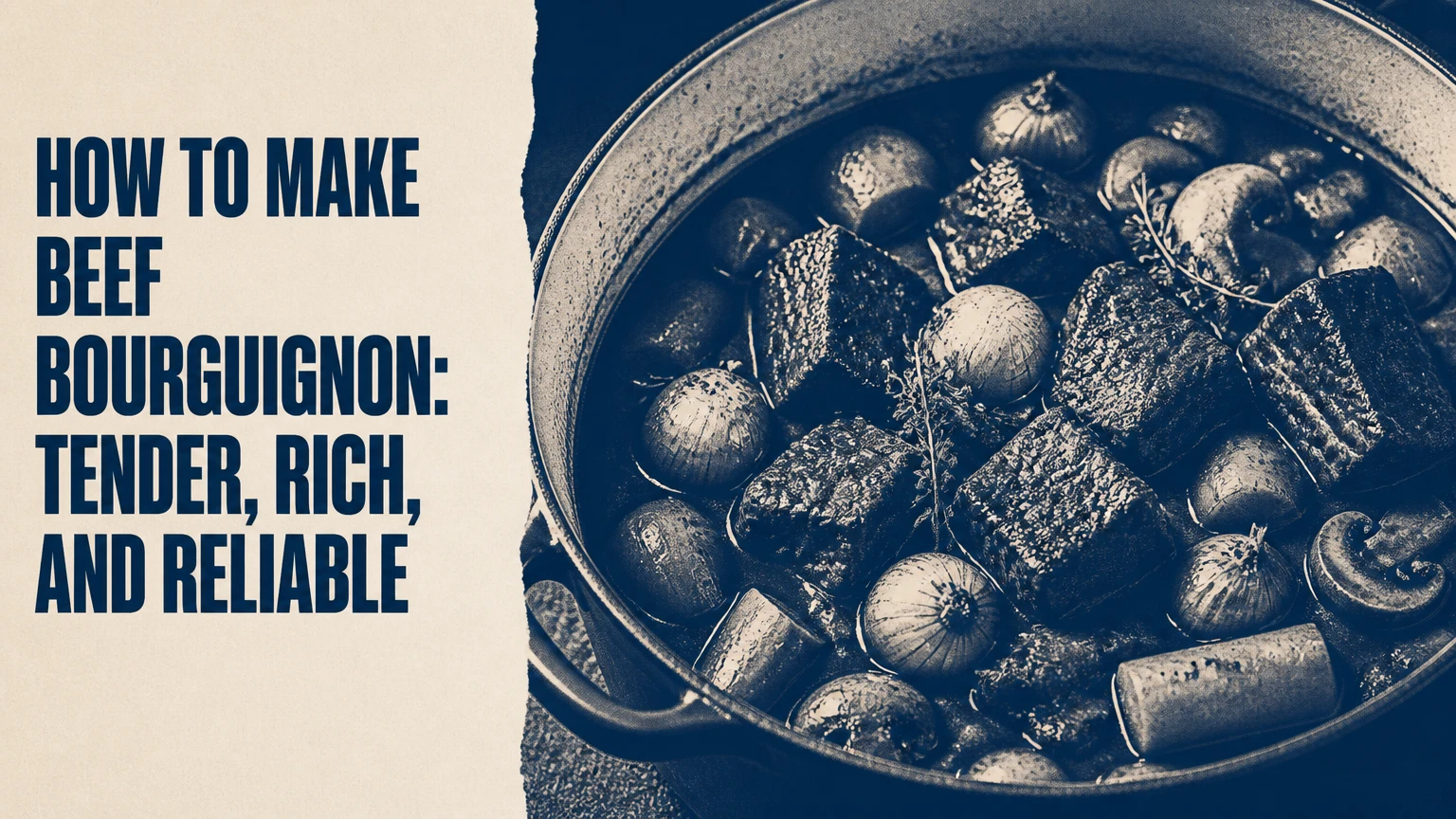
Beef bourguignon is made by browning beef chuck and bacon, softening aromatics, deglazing with dry red wine, then slowly braising the mixture with stock, herbs, and vegetables. The most reliable version takes about 3 hours in a 325°F oven, and the beef is ready when a fork slides through it with little resistance.
Key Facts at a Glance
Beef bourguignon uses collagen-rich chuck, which becomes tender during a 2.5-3.5-hour low-temperature braise.
A 3-pound beef chuck roast yields approximately 4-6 servings.
The oven should be set to 325°F (160°C), while the liquid should remain at a gentle simmer rather than a rolling boil.
Dry red Burgundy, Pinot Noir, Côtes du Rhône, and Merlot all work when the wine is pleasant enough to drink.
Mushrooms and pearl onions are best cooked separately and added near the end, so they retain shape and browned flavor.
Typical ingredient cost is $25-$40 for four to six portions, excluding premium beef and wine.
What Makes Beef Bourguignon Different?
Beef bourguignon is a Burgundy-style French beef stew built around red wine, beef stock, browned beef, lardons, carrots, onions, garlic, and a bouquet garni. Unlike a quick pan sauce, the dish depends on prolonged, moist heat that converts connective tissue into gelatin and concentrates the braising liquid.
The traditional French name is bœuf bourguignon. Regional and household versions vary: some use pearl onions, some use ordinary onions, and some omit flour for a lighter sauce. The defining combination is not one rigid ingredient list. It is browned beef, red wine, aromatic vegetables, and a slow braise.
The recipe below uses a Dutch oven because it provides direct searing, even heat, and controlled evaporation in one vessel. The method also explains how to adapt the dish for a slow cooker or pressure cooker without pretending those methods produce identical results.
Why Does the Braising Method Work?
Braising works because low, moist heat gradually dissolves collagen without aggressively squeezing water from the muscle fibers. Beef chuck commonly becomes fork-tender after its internal temperature reaches roughly 190-205°F (88-96°C), but tenderness matters more than a single thermometer reading.
Searing creates browned flavor through Maillard reactions at the meat’s dry surface. Drying the beef and leaving space between pieces therefore matters more than adding extra seasoning. A crowded pot fills with steam, the surface temperature falls, and the beef turns gray instead of developing a deep crust.
Wine contributes acidity, aroma, and fruit character, while stock supplies water and savory compounds. Alcohol itself mostly evaporates during the uncovered reduction and braise, although the exact amount depends on time, temperature, and pot shape. The wine should not be expected to tenderize the center of a large beef cube.
A practical rule is simple: use high heat only for browning, then use low heat for tenderness. The liquid should show an occasional lazy bubble, not constant turbulence.
Before You Start
Time: 45-60 minutes preparation and browning, followed by 2.5-3.5 hours braising.
Difficulty: Intermediate, because browning and sauce reduction require attention.
Yield: 4-6 servings.
Typical cost: $25-$40 with chuck and a $10-$15 bottle of wine.
Equipment: 5.5- to 7-quart Dutch oven, tongs, paper towels, wooden spoon, chef’s knife, cutting board, skillet, and optional fine-mesh strainer.
Ingredients and Useful Substitutions
| Ingredient | Quantity | Function and substitution |
|---|---|---|
| Boneless beef chuck | 3 lb (1.35 kg) | Main collagen-rich cut; use 3.5 lb bone-in short ribs |
| Thick bacon or slab pork belly | 5 oz (150 g) | Lardons and rendered fat; use pancetta for a less smoky result |
| Dry red wine | 750 ml | Burgundy, Pinot Noir, Côtes du Rhône, or Merlot |
| Beef stock | 2 cups (475 ml) | Braising liquid; use unsalted stock for seasoning control |
| Yellow onion | 1 large, about 10 oz | Aromatic base; use 10-12 pearl onions in the base if preferred |
| Carrots | 2 medium, about 8 oz | Sweetness and structure; cut into 1-inch pieces |
| Garlic | 4 cloves | Aromatic depth; finely chop or crush |
| Tomato paste | 1 tablespoon | Savory depth and color |
| All-purpose flour | 2 tablespoons | Lightly thickens the sauce; use rice flour for gluten-free cooking |
| Pearl onions | 20-24 | Traditional garnish; frozen peeled onions reduce preparation time |
| Cremini mushrooms | 8 oz (225 g) | Separate browned garnish; white mushrooms also work |
| Thyme, parsley stems, bay leaves | 3 thyme sprigs, 4 stems, 2 leaves | Bouquet garni |
| Kosher salt and black pepper | About 2 teaspoons salt initially | Season in stages, then adjust after reduction |
| Butter | 2 tablespoons | Pearl onions and mushrooms |
Which Beef Cut Should You Buy?
Chuck roast is the best general-purpose choice because it combines accessible pricing, marbling, and abundant connective tissue. Beef short ribs produce a richer, more gelatinous sauce, while beef shank contributes marrow and collagen but requires more trimming and often contains bones.
Lean sirloin, eye of round, and top round are poor choices for a three-hour braise. Those cuts can become dry and stringy because they contain less connective tissue and intramuscular fat.
| Cut | Typical price | Braise time | Result |
|---|---|---|---|
| Boneless chuck | $6-$12 per lb | 2.5-3.5 hours | Balanced, tender, practical |
| Bone-in short ribs | $9-$18 per lb | 3-4 hours | Rich, gelatinous, more expensive |
| Beef shank | $7-$14 per lb | 3-4 hours | Marrow-rich, deeply savory |
| Top round | $6-$10 per lb | 2.5-3 hours | Lean, more likely to dry out |
Which Red Wine Works Best?
A dry Pinot Noir is the closest widely available substitute for red Burgundy, but a Côtes du Rhône or medium-bodied Merlot can produce a fuller stew. Avoid sweet red wine, heavily oaked high-alcohol wines, and salted cooking wine because each can distort the sauce.
Use a bottle priced in the range you would willingly drink. Cooking cannot remove excessive bitterness, residual sweetness, or unpleasant oxidation. Reserve approximately ½ cup if you want a matching glass with dinner.
How to Make Beef Bourguignon
Step 1: Cut, Dry, and Season the Beef
Cut 3 pounds of chuck into 2-inch cubes, trimming only thick seams of hard exterior fat. Pat every surface dry with paper towels, then season with approximately 2 teaspoons kosher salt and 1 teaspoon black pepper.
Dry meat browns; wet meat steams. For better seasoning, salt the cubes 4-24 hours ahead and refrigerate them uncovered on a rack, then pat them dry again before searing.
You’ll know it worked when: the beef surface feels dry and the seasoning adheres evenly.
Common mistake: cutting pieces smaller than 2 inches, which increases the chance of dry edges during the long braise.
Step 2: Render the Bacon and Brown the Beef
Place the lardons in a cold Dutch oven over medium heat. Cook for 8-10 minutes until the fat renders and the bacon turns golden, then transfer the lardons to a bowl.
Increase the heat to medium-high. Add the beef in two or three batches, leaving at least ½ inch between pieces. Brown each broad side for 2-3 minutes, adding a teaspoon of neutral oil only if the pot looks dry.
You’ll know it worked when: the beef has a dark brown crust and the pot bottom contains mahogany-colored fond.
Common mistake: turning the beef repeatedly. Leave each side undisturbed until it releases naturally.
Step 3: Cook the Aromatics and Tomato Paste
Reduce the heat to medium and add the diced onion and carrots to the rendered fat. Cook for 5-7 minutes, scraping lightly, until the onion softens and the carrot edges begin to brown.
Add the garlic and tomato paste. Stir for 60-90 seconds, until the garlic smells fragrant and the tomato paste darkens from bright red to brick red. Return the beef and half of the bacon to the pot.
You’ll know it worked when: the vegetables are softened but not collapsed, and the tomato paste leaves a darker coating on the pot.
Common mistake: adding garlic at the beginning, which can burn while the onions soften.
Step 4: Add Flour, Wine, and Stock
Sprinkle 2 tablespoons flour over the beef and vegetables. Stir for 2 minutes to coat the ingredients and cook out the raw flour flavor.
Pour in the 750 ml bottle of wine gradually while scraping the pot with a wooden spoon. Add 2 cups beef stock, 1 tablespoon tomato paste if it was not already added, and the bouquet garni. The liquid should reach roughly three-quarters of the way up the beef, not completely submerge it.
Bring the pot to a simmer for 3-5 minutes. Taste the liquid for salt before covering, remembering that later reduction will intensify seasoning.
You’ll know it worked when: the fond has dissolved and the liquid looks lightly thickened rather than watery.
Common mistake: adding cold liquid all at once to a smoking-hot pot, which can loosen fond unevenly and create splatter.
Step 5: Braise at 325°F
Cover the Dutch oven tightly and place it in a preheated 325°F (160°C) oven. Braise for 2½ hours, then test one cube with a fork. Continue for 20-60 minutes if the beef still resists.
A bare simmer is the target. If the liquid boils hard, lower the oven to 300°F (150°C), check the pot, and add ¼ cup stock only if the liquid has fallen below one-third of the meat’s height.
You’ll know it worked when: a fork enters the beef with little pressure and the cube begins to separate without shredding into dry fibers.
Common mistake: using the clock alone. Beef chuck varies by animal, cube size, pot, and oven, so tenderness is the final test.
Step 6: Cook the Pearl Onions and Mushrooms Separately
While the beef braises, heat 1 tablespoon butter in a skillet over medium heat. Add the pearl onions and ½ cup stock, cover, and cook for 8-10 minutes. Remove the lid and cook until the liquid evaporates and the onions become glossy.
Wipe out the skillet, add the remaining tablespoon butter, and cook the mushrooms over medium-high heat for 6-10 minutes. Keep cooking until their released water evaporates and the cut surfaces brown.
You’ll know it worked when: pearl onions hold their shape and mushrooms have browned edges rather than a wet, gray appearance.
Common mistake: salting mushrooms immediately. Salt them after browning begins, because early salt draws out water before the pan develops heat.
Step 7: Finish and Balance the Sauce
Remove the beef, carrots, and any loose herbs from the Dutch oven. Discard the bouquet garni. If the sauce is thin, simmer it uncovered for 5-15 minutes, or strain it first for a smoother restaurant-style finish.
Return the beef, carrots, pearl onions, mushrooms, and remaining bacon to the sauce. Simmer gently for 5 minutes, then taste for salt, pepper, and acidity. A teaspoon of red wine vinegar can sharpen a heavy sauce, while a small knob of cold butter can soften its edges.
You’ll know it worked when: the sauce coats a spoon, the beef remains moist, and the vegetables retain recognizable shape.
Common mistake: boiling the finished stew to thicken it, which can break apart tender beef and toughen the exterior.
Which Cooking Method Should You Use?
The Dutch oven produces the deepest flavor because the beef and aromatics brown in the same vessel and the sauce reduces naturally. A slow cooker offers convenience but needs separate browning and stovetop reduction, while a pressure cooker shortens the schedule but gives less evaporation and softer vegetables.
| Method | Total time | Equipment | Best adjustment |
|---|---|---|---|
| Dutch oven | 3.5-4.5 hours | 5.5-7-quart covered pot | Braise at 325°F (160°C) |
| Slow cooker | 7-9 hours | 6-quart slow cooker plus skillet | Reduce wine before transferring |
| Pressure cooker | 75-95 minutes | 6- to 8-quart electric cooker | Add carrots and mushrooms later |
| Stovetop | 3-4 hours | Heavy covered pot | Maintain a barely visible simmer |
How Do You Adapt the Recipe for a Slow Cooker?
Brown the bacon, beef, onions, and tomato paste in a skillet first. Simmer the wine for 5-8 minutes to reduce its raw alcoholic aroma, then transfer the beef, aromatics, wine, stock, and herbs to a 6-quart slow cooker.
Cook on LOW for 7-8 hours or until the beef is fork-tender. Add carrots during the final 3 hours if you want firmer pieces. Cook mushrooms and pearl onions separately, then transfer the finished stew to a saucepan and reduce the sauce for 10-20 minutes.
How Do You Adapt It for an Instant Pot?
Use the Sauté function to render bacon and brown the beef in batches. Deglaze with wine, add stock and herbs, then pressure-cook the beef for 35 minutes with a 15-minute natural release.
Add carrots after the first pressure cycle and cook for 3 minutes at high pressure, followed by a quick release. Brown mushrooms separately. Remove the beef before reducing the sauce on Sauté, because pressure cooking does not evaporate enough liquid for a naturally concentrated finish.
Common Mistakes and How to Fix Them
| Problem | Likely cause | Immediate fix | Prevention |
|---|---|---|---|
| Gray beef | Crowded Dutch oven | Remove pieces and brown in batches | Leave ½ inch between cubes |
| Tough beef after 3 hours | Braise too cool or undercooked | Continue 20-45 minutes | Test with a fork, not a timer |
| Dry, stringy beef | Lean cut or hard boil | Stop boiling and add ¼ cup stock | Use chuck and maintain a lazy simmer |
| Thin sauce | Excess liquid or weak stock | Reduce uncovered 5-15 minutes | Keep liquid at three-quarters meat height |
| Bitter sauce | Burned fond or over-reduced wine | Add stock, butter, or ½ teaspoon sugar | Scrape browned fond, not black deposits |
| Mushy vegetables | Added at the beginning | Replace with separately cooked garnish | Add mushrooms and onions near service |
A beurre manié can repair a persistently thin sauce. Knead 1 tablespoon softened butter with 1 tablespoon flour, whisk small pieces into the simmering liquid, and cook for 3-5 minutes. Add it cautiously because a reduction usually thickens further as it cools.
A thermometer helps, but it cannot replace texture testing. Beef bourguignon is finished when collagen has converted sufficiently for the fibers to separate, not when the center reaches a steak-style medium temperature.
Make-Ahead, Storage, and Reheating
Beef bourguignon is often better the next day because cooling allows fat to solidify on the surface and the sauce to settle. Refrigerate the stew within 2 hours of cooking in shallow containers, keep it at 40°F (4°C) or below, and use it within 3-4 days according to USDA guidance for cooked leftovers.
For the best make-ahead result, braise the beef and sauce one day ahead, refrigerate overnight, and cook the mushrooms and pearl onions fresh before serving. Remove hardened surface fat if desired, then reheat gently over medium-low heat until the center reaches 165°F (74°C).
Freeze the cooled stew for up to 2-3 months for best quality. Potatoes, if added, become grainy after freezing, so serve the bourguignon with fresh mashed potatoes, noodles, rice, or crusty bread instead.
Variations for Common Situations
How Can You Make It Gluten-Free?
Replace the flour with 1 tablespoon rice flour, or omit flour and reduce the finished sauce uncovered. Beef stock, bacon, and wine must also be checked for gluten-containing additives, especially flavored stocks and processed bacon.
How Can You Make It Without Alcohol?
Use 2 cups additional unsalted beef stock plus 2 tablespoons red wine vinegar or pomegranate juice. Add the acidic ingredient gradually near the end rather than treating the substitute as a one-to-one replacement for a full bottle of wine.
The result will not taste like classic Burgundy-style bourguignon because wine supplies distinctive volatile aromas and fruit compounds. It can still be a balanced beef braise.
How Should You Scale the Recipe?
For eight to ten servings, use two pots or a very large 9-quart Dutch oven. Do not double the beef in a standard 5.5-quart pot, because crowding prevents browning and raises the liquid level enough to weaken the sauce.
| Servings | Beef | Wine | Stock | Dutch oven |
|---|---|---|---|---|
| 2-3 | 1.5 lb | 375 ml | 1 cup | 4-quart |
| 4-6 | 3 lb | 750 ml | 2 cups | 5.5-7-quart |
| 8-10 | 5-6 lb | 1.25-1.5 L | 4 cups | Two 5.5-quart pots |
| 12-14 | 7.5-8 lb | 1.9-2 L | 5-5.5 cups | Two large pots |
What Should You Serve With Beef Bourguignon?
The best side absorbs sauce without competing with the wine and gelatin-rich beef. Mashed potatoes provide the most direct pairing, while buttered egg noodles, pommes purée, steamed rice, and crusty baguette offer different levels of richness.
Serve approximately 1 cup finished stew per person, with ¾ cup mashed potatoes or noodles alongside. A bitter green salad dressed with mustard vinaigrette cuts the richness more effectively than another creamy side.
A practical dinner-party schedule is to braise the stew the day before, prepare the garnish on the serving day, and reheat the sauce slowly for 25-35 minutes. Avoid holding the completed dish at a hard simmer, which can break the beef into shreds.
FAQ
Can I Use Frozen Pearl Onions?
Yes. Frozen peeled pearl onions save 15-25 minutes of peeling and usually retain their shape well. Add them directly to the skillet with ½ cup stock and butter, cover for 8-10 minutes, then uncover and cook until glossy. Thawing is unnecessary, but frozen onions may need 2-3 additional minutes.
Should I Marinate the Beef Overnight?
An overnight wine marinade is optional, not required. Marinating can flavor the surface and contribute aroma, but it does not replace drying and browning. If you marinate, drain the beef, pat it thoroughly dry, and simmer the strained marinade before using it in the braise.
Can I Leave Out the Bacon?
Yes, but bacon contributes both rendered fat and smoky, salty depth. Replace it with 1½ tablespoons olive oil for browning, then add ½ teaspoon smoked paprika only if a subtle smoky note is wanted. The dish remains recognizable, although it will taste less traditional.
Why Is My Beef Bourguignon Watery the Next Day?
Refrigerated sauce can appear loose before reheating because gelatin firms when cold and releases as it warms. Reheat the stew uncovered for 5-10 minutes, then judge the consistency. If it remains thin, remove the solids and reduce the sauce separately to prevent overcooking the beef.
Can I Use a Different Type of Mushroom?
Yes. Cremini mushrooms are the practical standard, while shiitake, oyster, or button mushrooms each change the texture and aroma. Remove tough shiitake stems, cook delicate oyster mushrooms briefly, and always brown mushrooms separately so their water does not dilute the braising sauce.
How Do I Know When the Beef Is Done?
Beef bourguignon is done when a fork or thin skewer enters a cube with minimal resistance and the meat begins to separate. A typical internal range is 190-205°F (88-96°C), but chuck can remain tough below that range or become dry after excessive boiling above it.
The Bottom Line
To make beef bourguignon successfully, use 2-inch cubes of chuck, dry and brown them in uncrowded batches, reduce a drinkable dry red wine, and braise at 325°F (160°C) until a fork slides through the meat. Cook mushrooms and pearl onions separately, reduce the sauce only after tenderness is secured, and make the stew a day ahead when possible. This method produces the dependable flavor, texture, and sauce concentration that define how to make beef bourguignon well.