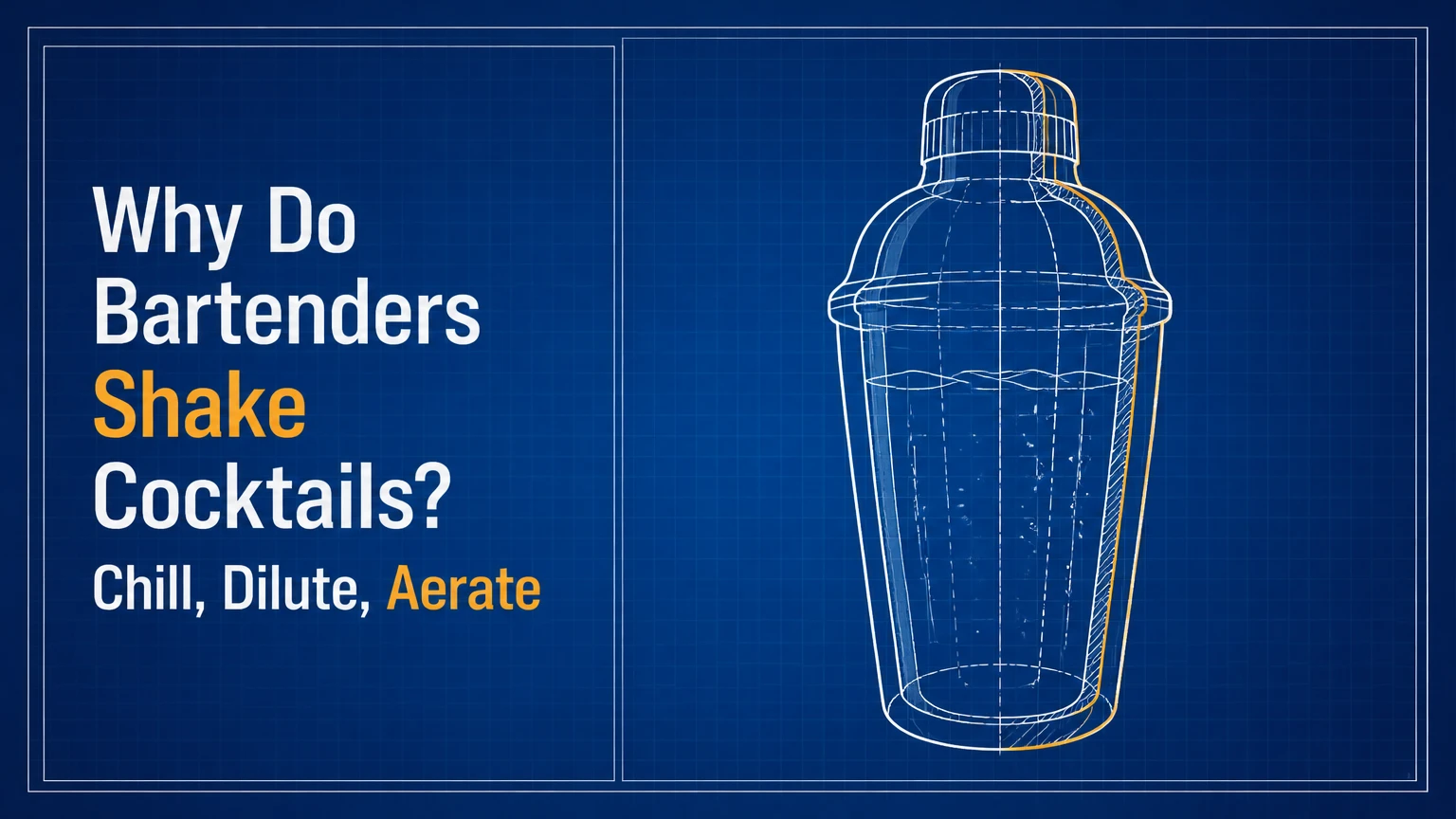
Bartenders shake cocktails to chill, dilute, aerate, emulsify, and rapidly combine ingredients. The method works especially well for drinks containing citrus juice, syrups, eggs, cream, or coffee because vigorous movement changes both flavor and texture, while stirring is usually better for clear, spirit-forward cocktails that need controlled dilution without foam.
Key Facts at a Glance
- Cocktail shaking typically takes 10-15 seconds with a full load of fresh ice.
- Shaking commonly adds about 15-25% water by volume to a sour-style cocktail, although ice shape, temperature, and technique change the result.
- A shaken cocktail becomes colder because melting ice absorbs heat through the latent heat of fusion.
- Citrus juice, dairy, egg white, aquafaba, and thick syrups need more mechanical force than clear spirits.
- Shaking introduces air and can create a foam cap, lighter body, or temporarily cloudy appearance.
- Carbonated liquids should be added after shaking because a sealed shaker cannot safely contain expanding gas pressure.
Why Do Bartenders Shake Cocktails?
Bartenders shake cocktails because one short process performs several jobs at once: rapid heat transfer, controlled water addition, ingredient integration, and air incorporation. A Daiquiri illustrates the point clearly. Rum, lime juice, and simple syrup separate in flavor density and viscosity, but shaking turns them into a cold, balanced drink with a rounded texture.
Stirring can chill and dilute the same ingredients, but it moves liquid in a smoother pattern and introduces less air. Shaking therefore changes the sensory result, not merely the speed of preparation. A shaken Margarita usually tastes brighter and feels more expansive than a stirred version made with the same tequila, lime, and orange liqueur.
The choice is functional rather than theatrical. Bartenders select a shake when the recipe benefits from force, foam, opacity, or fast integration.
How Does Shaking Chill a Cocktail?
Shaking chills a cocktail when warm liquid repeatedly contacts ice, causing some ice to melt and absorb heat. NIST lists the enthalpy of fusion for water at approximately 6.01 kilojoules per mole, or about 334 kilojoules per kilogram, so melting ice removes substantial thermal energy from the drink.
The final temperature is not automatically -5°C to -8°C. That range can occur in some alcoholic mixtures under favorable conditions, but the actual drink temperature depends on alcohol concentration, ice temperature, shaker material, contact time, and the amount of liquid. A typical short shake produces a cocktail near or below 0°C, while the serving glass and straining time quickly raise the temperature.
A metal shaker transfers heat efficiently. Glass changes temperature more slowly, which is one reason many professional bartenders prefer stainless steel tins. The ice must melt slightly for cooling and dilution to occur; unmelted ice is not evidence that no dilution happened.
What Role Does Ice Play?
Ice is both a coolant and a measured source of water. Bartenders normally fill the shaker with enough solid ice to keep the liquid moving through repeated contact rather than leaving the drink in a small, warm pool.
Fresh cubes produce more predictable results than crushed or partially melted ice. Crushed ice has greater surface area, so it chills quickly but can add water rapidly and clog a strainer. Wet ice contributes uncontrolled dilution before the shake begins.
| Ice condition | Typical result after 10-15 seconds | Best use |
|---|---|---|
| Fresh 25-35 mm cubes | 15-25% dilution | Daiquiri, Whiskey Sour, Margarita |
| Large 40-50 mm cubes | 10-18% dilution | Strong stirred-style experiments |
| Wet bar ice | 20-35% dilution | Avoid for precise service |
| Crushed ice | 25-40% dilution | Swizzles and flash shakes |
These are practitioner ranges, not universal laboratory values. A full shaker, vigorous motion, and colder ice generally produce more repeatable chilling than a half-filled shaker with warm, wet cubes.
How Much Water Does Shaking Add?
A typical shaken sour gains approximately 15-25% of its liquid volume as melted ice water during a 10-15 second shake. A 90 milliliter cocktail may therefore receive roughly 14-23 milliliters of water, although the real amount varies with ice temperature, cube size, shaker load, and shaking duration.
Dilution is a flavor adjustment. Water lowers the perceived alcohol intensity, spreads sugar through the liquid, reduces sharp acid impact, and helps volatile aromas leave the surface. A 60 milliliter pour of 40% ABV spirit contains 24 milliliters of pure alcohol before dilution; adding 20 milliliters of water lowers the drink’s approximate strength considerably.
Longer shaking does not always improve a cocktail. Once the drink is cold, continued movement often adds more water than texture or temperature benefit. Professional bars usually standardize the ice load and shake time because consistency matters more than the exact movement style.
How Can You Estimate Dilution at Home?
Weigh the shaker before and after shaking, without the ice, to estimate melted water. One gram of added mass is approximately one milliliter of water, so a 20 gram increase indicates about 20 milliliters of dilution.
A simple test uses a Daiquiri:
- Weigh the empty shaker.
- Add 60 milliliters rum, 30 milliliters lime juice, and 15 milliliters syrup.
- Add fresh ice and shake for 12 seconds.
- Strain the drink and weigh the shaker again.
- Treat the mass increase as melted water, allowing for liquid left behind.
The test is approximate because some liquid remains on ice and inside the tin. It still teaches more than counting shakes, since “hard shaking” has no universal force standard.
Why Does Shaking Change Texture?
Shaking changes texture by forcing air into the liquid and breaking ingredients into smaller droplets. Egg proteins, dairy fat, coffee oils, and citrus pulp respond differently to that energy, producing foam, creaminess, opacity, or a more integrated mouthfeel.
Aeration is temporary in some drinks. A shaken Martini may appear cloudy because tiny air bubbles scatter light, then become clearer as the bubbles disappear. A Whiskey Sour with egg white retains a more stable foam because proteins form films around air bubbles.
Emulsification matters when ingredients resist blending. Cream liqueur, egg yolk, syrups, and citrus contain components with different densities or chemical behavior. Shaking disperses them throughout the drink, while gentle stirring can leave streaks, floating pulp, or a thin layer of syrup.
Espresso Martinis provide a visible example. Coffee crema, sugar, and spirit need force to form a persistent surface foam. The foam depends on coffee composition and freshness, so shaking alone cannot guarantee an equally dense cap every time.
Which Ingredients Require Shaking?
Cocktails containing citrus, fruit juice, egg, cream, coffee, thick syrups, or cloudy mixers generally benefit from shaking. Clear spirits and fortified wines usually do not require that extra force unless the recipe deliberately seeks aeration or rapid integration.
| Ingredient profile | Why shaking helps | Representative cocktails | Typical method |
|---|---|---|---|
| Citrus juice and syrup | Disperses acid and sugar | Daiquiri, Gimlet, Margarita | 10-15 second shake |
| Egg white or aquafaba | Builds protein or plant-protein foam | Whiskey Sour, Clover Club | Dry or reverse dry shake |
| Cream or milk | Integrates fat and liquid | Brandy Alexander, White Russian variation | 10-15 second shake |
| Coffee or espresso | Creates surface foam and blends sugar | Espresso Martini | Hard shake, double strain if needed |
| Carbonated soda | Shaking creates dangerous pressure | Tom Collins, Mojito | Shake base, top afterward |
| Spirit and vermouth | Requires dilution but little aeration | Martini, Manhattan | Stir for 20-30 seconds |
Fruit pulp and juice also benefit from straining decisions. A Hawthorne strainer retains large ice pieces, while a fine mesh strainer removes pulp, herbs, and small ice shards. Double straining produces a cleaner drink but can reduce some desirable texture.
How Long Should You Shake a Cocktail?
Shake a cocktail vigorously for about 10-15 seconds when using a full shaker of cold cubes and a single serving. Smaller drinks, colder ice, or a nearly frozen tin may need closer to 8-10 seconds, while egg-white drinks often use two separate 10-second phases.
| Drink or technique | Ice stage | Typical time | Serving result |
|---|---|---|---|
| Daiquiri | Ice shake | 10-12 seconds | Cold, bright, moderately diluted |
| Margarita | Ice shake | 10-15 seconds | Integrated citrus and tequila |
| Whiskey Sour with egg | Dry then ice | 10 seconds each | Dense foam and cold liquid |
| Reverse dry shake | Ice, strain, then dry | 10 seconds each | Stable foam with fine bubbles |
| Espresso Martini | Ice shake | 12-15 seconds | Cold drink with coffee foam |
The sound provides a practical checkpoint. Ice should travel from one end of the shaker to the other with a sharp, continuous rattle. A gentle rocking motion usually produces less cooling and less aeration, while excessively prolonged shaking can make a drink watery.
Hold a Boston shaker horizontally or at a slight angle. The exact figure-eight pattern matters less than giving the ice room to move through the liquid rather than merely rotating around the center.
What Is the Correct Shaking Method?
The correct method is to measure liquid first, add dry ice, seal securely, shake for a defined interval, open the shaker safely, and strain immediately. A consistent sequence prevents premature dilution and makes recipe results easier to repeat.
Step 1: Measure the Liquid
Add the spirit, juice, syrup, liqueur, and other non-carbonated ingredients before adding ice. This gives the bartender time to correct a measurement without allowing ice to melt during preparation.
Step 2: Add Fresh Ice
Fill the larger tin with solid cubes, usually enough to occupy most of its volume without preventing movement. Drain standing water from the tin before adding the ice.
Step 3: Seal the Shaker
For a Boston shaker, place the smaller tin over the larger tin at a slight angle and tap the top gently to seat it. The seal comes from the fitted surfaces, liquid cooling, and pressure conditions inside the shaker, not from a simple friction-created vacuum.
Step 4: Shake Vigorously
Shake horizontally for 10-15 seconds. Keep both hands on the tins, especially when using a dry shake, because expanding air and liquid pressure can loosen the seal.
Step 5: Open the Tins
Tap the side of the larger tin near the joint, not the bottom or rim. If the shaker is stuck, rotate the smaller tin slightly instead of striking harder.
Step 6: Strain Immediately
Use a Hawthorne strainer for standard service. Add a fine mesh strainer when the recipe contains citrus pulp, herbs, egg particles, or fractured ice.
The drink is ready when the tin feels very cold, the outside may frost, and the liquid strains with a uniform color. A cold shaker alone does not prove balanced dilution.
What Is a Dry Shake and Reverse Dry Shake?
A dry shake agitates egg white or aquafaba without ice before the chilling shake, while a reverse dry shake chills the drink with ice first and then agitates the strained liquid without ice. Both techniques develop foam, but the reverse method usually produces finer, more stable bubbles.
| Method | First stage | Second stage | Foam character | Main drawback |
|---|---|---|---|---|
| Standard shake | Ingredients plus ice, 10-15 seconds | None | Moderate foam | Less dense egg foam |
| Dry shake | Ingredients without ice, 10 seconds | Add ice, shake 10 seconds | Thick and airy | Warm pressure can loosen seal |
| Reverse dry shake | Ingredients plus ice, 10 seconds | Strain, then dry shake 10 seconds | Fine and stable | Adds preparation time |
| Blender method | Ingredients plus ice | Blend 5-10 seconds | Very aerated | Warmer, louder, less traditional |
Egg white requires careful handling because raw egg presents a food-safety concern for some guests. The U.S. Food and Drug Administration recommends pasteurized eggs or egg products for recipes served raw or lightly cooked to higher-risk consumers, including pregnant people, older adults, young children, and immunocompromised guests.
Aquafaba offers a plant-based alternative, but its foam varies by brand and salt content. Start with 15-30 milliliters per drink and adjust syrup or salt only after tasting.
When Should a Bartender Stir Instead?
A bartender should stir when the cocktail contains mostly clear spirits and the intended result is transparent, dense, and silky rather than frothy or cloudy. Stirring provides chilling and dilution with less air, less agitation of citrus oils, and lower risk of foam.
| Decision factor | Shake | Stir |
|---|---|---|
| Citrus or fresh juice | Preferred | Usually unsuitable |
| Egg, cream, or aquafaba | Preferred | Poor integration |
| Clear spirit and vermouth | Adds unwanted air | Preferred |
| Desired appearance | Cloudy or opaque | Clear and polished |
| Typical technique time | 10-15 seconds | 20-30 seconds |
| Representative drink | Whiskey Sour | Manhattan |
A Martini, Manhattan, or Negroni usually tastes better stirred because the drink’s structure depends on clarity and a smooth, concentrated texture. An Old Fashioned can be built and stirred over ice because its sugar and bitters integrate adequately without aggressive aeration.
The boundary is not absolute. A bartender may shake a spirit-only drink when a guest wants a colder, more aerated result, and some recipes use a short “flash blend” for speed. The recipe’s intended texture determines the method.
Which Shaker Should a Home Bartender Use?
A home bartender should usually choose a two-piece stainless-steel Boston shaker because it seals reliably, chills efficiently, and has fewer parts to clean. A three-piece Cobbler shaker is easier for beginners who want an integrated strainer, but its cap can freeze shut during a long shake.
| Shaker type | Typical capacity | Typical price | Strength | Limitation |
|---|---|---|---|---|
| Boston, tin plus tin | 18 oz and 28 oz | $20-$45 | Fast seal and cleanup | Requires separate strainer |
| Boston, tin plus glass | 16 oz and 28 oz | $20-$50 | Visible liquid level | Glass breaks and insulates |
| Cobbler | 18-28 oz | $15-$35 | Built-in strainer | Cap can stick or clog |
| Parisian or French | 18-28 oz | $25-$50 | Compact two-piece design | Requires separate strainer |
Weighted tins from professional suppliers such as Cocktail Kingdom commonly cost more than entry-level sets, but the purchase does not automatically improve the drink. Ice quality, measurement, and timing affect the result more than a premium finish.
Glass mixing cups are useful for stirring but are less suitable for vigorous shaking. A stainless-steel tin conducts heat efficiently and tolerates drops that would damage ordinary glass.
What Goes Wrong During Shaking?
The most common shaking failures are excess water, weak foam, broken seals, clogged strainers, and unsafe pressure from carbonated ingredients. Each failure has a specific cause, so changing the shaker alone rarely fixes the drink.
- The cocktail tastes watery: Wet ice, an undersized drink, or a shake longer than 20 seconds probably added excess water. Use fresh cubes, fill the tin appropriately, and stop when the drink is cold.
- The drink tastes harsh: The cocktail may be under-diluted. Shake a fresh batch for 10-12 seconds with more vigorous ice movement rather than adding water blindly.
- The shaker freezes shut: Ice water has frozen around the joint. Tap the larger tin near the seam and warm only the outside joint with your hands.
- The foam collapses: Old egg white, insufficient dry shaking, or heavy oil from citrus peel can destabilize bubbles. Use fresh pasteurized egg, shake without ice first, and strain promptly.
- Small ice shards reach the glass: Use a fine mesh strainer or replace fractured ice with larger cubes.
- The shaker sprays liquid: The seal was incomplete, the tin was overfilled, or a carbonated ingredient was included. Reduce the fill level and add soda, tonic, or sparkling wine after straining.
Carbonated ingredients belong in the serving glass. Shaking soda, tonic water, champagne, or sparkling wine traps dissolved gas in a sealed container and can force the lid open or eject liquid at high speed.
How Do Professionals Control the Result?
Professionals control shaking by standardizing the variables that home bartenders often overlook: ice mass, ingredient temperature, liquid volume, shake time, and straining delay. The goal is repeatable dilution, not maximum violence.
A bar may use the same cube size for every sour and train staff to shake for 12 seconds. Some high-volume programs pre-dilute large-format cocktails by weighing water into the batch, then chill the mixture without introducing inconsistent ice melt. A pre-diluted Martini can be refrigerated and served from a bottle, but the batch must be kept cold and protected from oxidation.
Two practitioner rules are especially useful:
- Do not chase frost. A heavily frosted tin can indicate cold metal, but the drink may already be over-diluted.
- Judge the drink, not the noise. Ice sound, tin temperature, and final flavor together provide better feedback than a fixed count alone.
- Strain with purpose. Double straining improves smoothness, but a single Hawthorne strain may preserve the pulp and body that some drinks require.
A thermometer can help during experiments, but it is awkward during service and measures the tin or liquid at one moment. Taste and repeatable technique remain more practical for most bartenders.
What Should Beginners Practice First?
Beginners should practice a Daiquiri because its three-part structure exposes errors in sweetness, acidity, spirit strength, and dilution. Use 60 milliliters white rum, 30 milliliters fresh lime juice, and 15 milliliters simple syrup as a starting point, then adjust to taste.
Measure the ingredients into a Boston shaker, add fresh cubes, shake for 12 seconds, and strain into a chilled coupe. If the result tastes sharp, increase syrup slightly; if it tastes flat or watery, reduce dilution or use colder, drier ice.
A Margarita offers a second useful exercise because tequila, orange liqueur, lime, and salt show how alcohol, acid, sugar, and salinity interact. An egg-white Whiskey Sour should come later, since foam technique adds another variable before basic dilution control is reliable.
FAQ
Does shaking make alcohol weaker?
Shaking does not remove alcohol, but melted ice lowers the drink’s alcohol concentration by increasing total liquid volume. A cocktail containing 60 milliliters of 40% ABV spirit and 20 milliliters of melted ice has a lower final ABV than the undiluted spirit, while the total pure alcohol remains approximately 24 milliliters.
Why do bartenders shake cocktails instead of using a blender?
Bartenders shake cocktails because a shaker chills and dilutes without pulverizing ice or creating the extreme aeration produced by a blender. Blenders suit frozen drinks and some culinary-style textures, but a shaker gives better control over clarity, dilution, noise, cleanup, and serving speed.
Can I shake a cocktail without ice?
A cocktail can be shaken without ice during a dry shake, mainly to build foam from egg white or aquafaba. The liquid will not become properly chilled or diluted, so a dry shake normally needs a second ice shake unless the recipe specifically uses another chilling method.
Why does my shaken cocktail taste different from a stirred one?
A shaken cocktail usually contains more air, slightly more dilution, and more dispersed ingredients than a stirred cocktail. The difference is most noticeable in drinks with citrus, egg, cream, or coffee, while a stirred Manhattan or Martini emphasizes clarity, viscosity, and concentrated spirit flavor.
Should a cocktail be shaken until the tin is frosty?
A frosty tin is a useful visual clue but not a reliable stopping rule. Shaking for about 10-15 seconds with fresh ice usually provides a practical starting point, and the final taste should determine whether the drink needs more chilling, dilution, or a shorter shake.
The Bottom Line
Why do bartenders shake cocktails? They shake to combine ingredients forcefully while chilling, diluting, aerating, and sometimes emulsifying the drink. Use shaking for citrus, fruit, eggs, dairy, syrups, and coffee; use stirring for clear, spirit-forward cocktails where transparency and silky concentration matter more than foam. With fresh ice, a secure shaker, a 10-15 second working range, and prompt straining, the technique becomes predictable rather than performative.