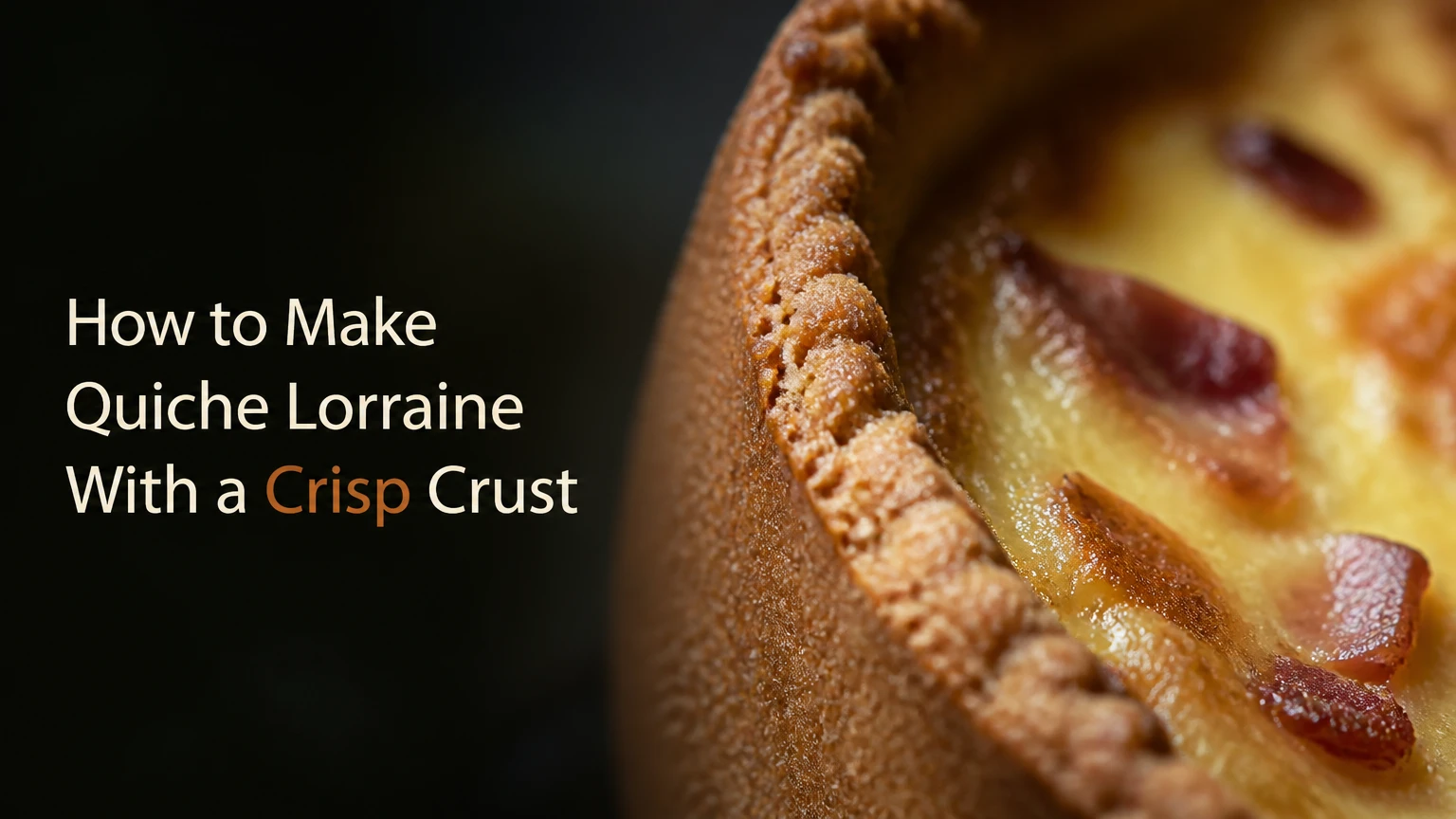
Quiche Lorraine is made by blind-baking a shortcrust pastry, filling it with browned lardons and a seasoned egg-and-cream custard, then baking until the edges are set and the center gently wobbles. A 9-inch quiche takes about 90 minutes from start to finish, including chilling and a 20-minute rest.
Key Facts at a Glance
- A standard 9-inch quiche Lorraine serves 6-8 people and uses approximately 170 g of lardons or thick-cut bacon.
- Blind-baking the pastry at 400°F for about 20 minutes protects the crust from the custard’s moisture.
- Traditional quiche Lorraine contains pork, eggs, cream, and seasoning but no cheese.
- The custard is ready when the center reaches about 160°F and still has a small, controlled wobble.
- Cooling for 20-30 minutes improves slicing because residual heat finishes setting the custard.
- Heavy cream produces a richer, more stable custard than low-fat milk alone.
Before You Start
Quiche Lorraine requires moderate skill, 25-35 minutes of active preparation, 30 minutes of chilling, 50-65 minutes of baking, and at least 20 minutes of cooling. Typical ingredient cost is $10-$18 for a 9-inch quiche, depending on the pork, butter, and cream.
| Requirement | Recommended specification | Practical alternative |
|---|---|---|
| Pan | 9-inch tart pan, 1-1.25 inches deep | 9-inch pie plate |
| Active preparation | 25-35 minutes | 10-15 minutes with prepared pastry |
| Total elapsed time | 90-120 minutes | 60-75 minutes with chilled dough |
| Oven | 400°F, then 325°F | 375°F convection, then 300°F |
| Servings | 6-8 slices | 4-6 larger portions |
| Equipment | Rolling pin, skillet, whisk, parchment, pie weights | Food processor and dried beans |
Use an all-butter pie crust when flavor matters most, or a refrigerated pastry shell when time matters more. A tart pan with a removable base gives cleaner sides, but a pie plate is more forgiving because its sloped walls reduce the risk of pastry cracking.
What Makes Quiche Lorraine Traditional?
Traditional quiche Lorraine is a savory custard tart from Lorraine, a historical region of northeastern France. The classic filling emphasizes smoked pork, eggs, cream, and nutmeg inside pâte brisée, while cheese belongs to common modern and international adaptations rather than the strictest traditional definition.
Historical accounts describe earlier versions using a bread-based crust before shortcrust pastry became standard. Modern French recipes vary, so “traditional” is not a single legally fixed formula; the consistent distinction is that the pork remains central and cheese is optional or omitted.
| Version | Pork | Dairy base | Cheese | Result |
|---|---|---|---|---|
| Traditional French | 170 g lardons | 360 ml cream or cream-rich dairy | 0 g | Pork-forward, soft custard |
| Modern French | 170 g lardons | 240 ml cream, 120 ml milk | 80-100 g Gruyère | Sharper, heavier filling |
| Bacon adaptation | 170 g thick-cut bacon | 240 ml cream, 120 ml milk | 0-100 g | Saltier, smokier flavor |
| Crustless adaptation | 170 g bacon or lardons | 360 ml dairy | 0-100 g | Frittata-like texture |
The no-cheese version is not incomplete. Cheese adds salt, fat, and structure, but it can cover the nutmeg, cream, and pork flavors that define the traditional profile.
What Ingredients Do You Need?
The most reliable 9-inch formula uses 150 g flour, 115 g cold butter, 170 g cooked pork, and roughly 360 ml liquid dairy with three whole eggs. The ratio matters more than the precise brand: too much egg creates a firm, bouncy filling, while too little egg leaves the center loose.
Pastry ingredients
- 150 g all-purpose flour, approximately 1 1/4 cups
- 115 g unsalted butter, very cold and cubed
- 1/2 teaspoon fine salt
- 3-4 tablespoons ice water
Filling ingredients
- 170 g thick-cut bacon or lardons, cut into 5 mm matchsticks
- 3 large eggs
- 240 ml heavy cream
- 120 ml whole milk
- 1/4 teaspoon freshly grated nutmeg
- 1/4 teaspoon fine salt, adjusted for pork
- 1/8 teaspoon white pepper or a few grinds of black pepper
For a modern cheese version, add 80-100 g finely grated Gruyère. Reduce added salt when using heavily cured bacon, and do not add rendered pork fat to the custard because it can create greasy pockets.
How to Make Quiche Lorraine
Make quiche Lorraine in eight controlled stages: mix and chill the pastry, line the pan, freeze the shell, blind-bake it, cook the pork, whisk the custard, assemble and bake, then cool before slicing. The most important success factor is removing enough moisture from the crust and pork before the liquid filling enters the pan.
Step 1: Mix the pastry
Combine flour and salt in a bowl. Rub in the cold butter with fingertips, or pulse in a food processor, until the mixture contains coarse crumbs and several pea-sized butter pieces.
Add ice water one tablespoon at a time. Stop mixing as soon as the dough holds together when pressed.
Shape the pastry into a flat disk, wrap it, and refrigerate for 30 minutes. The dough should feel firm but rollable.
You’ll know it worked when: the dough bends slightly without cracking and still contains visible butter flecks.
Common mistake: adding all the water at once. Excess water develops gluten and makes the baked crust tough.
Step 2: Roll and fit the dough
Lightly flour the work surface and roll the dough into an 11-inch circle, approximately 3 mm thick. Rotate the dough after every few passes so it does not adhere to the counter.
Transfer the pastry to the 9-inch pan without stretching it. Lift the edge and let the dough settle into the corners, then press gently against the sides and trim the overhang.
You’ll know it worked when: the pastry reaches the upper edge without thin spots or tension.
Common mistake: pulling the dough into place. Stretched pastry contracts in the oven and produces short, sloping walls.
Step 3: Chill the lined shell
Prick the base lightly with a fork, then freeze the lined pan for 15 minutes. Place the cold pastry on a baking sheet before filling it with weights.
Freezing firms the butter and relaxes the gluten formed during rolling. A cold shell holds its shape more effectively than pastry chilled only briefly in the refrigerator.
You’ll know it worked when: the dough feels hard at the base and the rim remains sharply defined.
Common mistake: skipping the freeze when the kitchen is warm. Soft butter melts before the crust can set.
Step 4: Blind-bake the crust
Heat the oven to 400°F, or 200°C. Line the frozen shell with parchment and fill it completely with ceramic pie weights or dried beans so the sides are supported.
Bake for 15 minutes. Remove the parchment and weights, prick any large bubbles, and bake for another 5-8 minutes until the base looks dry and matte.
Brush the warm crust with a thin layer of beaten egg white if you want additional moisture protection. Lower the oven to 325°F, or 165°C, for the filling bake.
You’ll know it worked when: the base feels dry to the touch and the sides remain upright.
Common mistake: removing the weights too early. Unsupported sides can slump before the flour starches set.
Step 5: Cook and drain the pork
Place the lardons or bacon in a cold skillet over medium heat. Cook for 6-10 minutes, turning occasionally, until browned and lightly crisp.
Transfer the pork to paper towels and drain thoroughly. If the pieces release a large amount of fat, blot them a second time before adding them to the pastry.
Some traditional methods blanch lardons in simmering water for 2-3 minutes before frying. Blanching reduces harsh smoke and salt, while direct frying gives stronger browning.
You’ll know it worked when: the pork is cooked through, browned at the edges, and no longer visibly wet.
Common mistake: frying at high heat. Burned pork tastes bitter, and its fat can separate from the custard.
Step 6: Whisk the custard gently
Whisk the eggs, cream, milk, nutmeg, salt, and pepper until combined. Mix firmly enough to eliminate streaks, but do not whip in a large volume of air.
For a richer traditional filling, replace the milk with another 120 ml cream. For a lighter filling, retain the cream and milk ratio rather than using milk alone.
The finished custard should pour smoothly and contain no visible egg-white strands.
You’ll know it worked when: the mixture is uniform, fluid, and free of foam across the surface.
Common mistake: vigorous whisking that creates bubbles. Air expands in the oven and can leave holes beneath the surface.
Step 7: Fill and bake
Scatter the drained pork evenly over the par-baked crust. Add Gruyère now if making the modern version, then pour in the custard slowly until it sits 5-8 mm below the rim.
Bake at 325°F for 35-45 minutes. The outer 3-4 cm should look set, while the center should tremble as one soft mass rather than ripple like liquid.
A probe thermometer provides a useful second test. The USDA Food Safety and Inspection Service recommends cooking egg dishes to 160°F, or 71°C; remove the quiche around that point if the texture is set at the edges and the center remains tender.
You’ll know it worked when: the surface is pale gold, the rim is firm, and the center moves slightly when the pan is nudged.
Common mistake: baking until the center is completely rigid. Carryover heat continues cooking the eggs and can turn a silky custard grainy.
Step 8: Cool before serving
Set the baked quiche on a rack for 20-30 minutes. Remove the tart ring only after the crust has firmed, then cut with a sharp knife.
Quiche Lorraine is best warm or at room temperature, approximately 70°F-100°F. Piping-hot slices release steam and appear looser than the same quiche after a short rest.
You’ll know it worked when: a slice holds its shape but the custard remains soft and creamy.
Common mistake: cutting immediately. The filling has not yet completed its set, so the first slice may collapse.
What Is the Correct Custard Ratio?
A practical custard ratio is one large egg for approximately 180-240 ml of dairy, depending on how firm you want the filling. Three eggs with 360 ml of cream-and-milk mixture produce a tender quiche; three eggs with 240 ml produce a firmer, richer slice.
| Custard style | Eggs | Liquid dairy | Texture | Best use |
|---|---|---|---|---|
| Soft traditional | 3 eggs | 360 ml cream | Very tender | Cheese-free Lorraine |
| Balanced standard | 3 eggs | 240 ml cream plus 120 ml milk | Creamy, sliceable | Everyday 9-inch quiche |
| Rich firm | 3 eggs plus 2 yolks | 240 ml cream | Dense, luxurious | Small slices and brunch |
| Lightest practical | 3 eggs | 360 ml half-and-half | Less rich, set | Lower-cost preparation |
The AI Overview’s one-egg-to-120-ml guideline describes a firmer custard when interpreted as one egg per half cup of dairy. It is not a universal law. Egg size, yolk content, pan depth, and baking temperature all change the final texture.
Which Pan and Dairy Combination Works Best?
A shallow 9-inch tart pan gives the fastest, most even bake, while a deep pie plate holds more filling but requires a longer low-temperature bake. Heavy cream gives the most stable, rich custard; milk alone is more likely to taste eggy and set firmly.
| Pan or dairy choice | Approximate capacity | Bake adjustment | Main advantage | Main limitation |
|---|---|---|---|---|
| 9-inch tart pan | 750-900 ml | 35-45 minutes at 325°F | Crisp, shallow slices | Can overflow if overfilled |
| 9-inch pie plate | 900-1,050 ml | 45-55 minutes at 325°F | Deeper, forgiving shape | Center sets later |
| 10-inch tart pan | 1,000-1,150 ml | 40-50 minutes at 325°F | More servings | Requires 1.25 times filling |
| Heavy cream | 360 ml | Standard timing | Rich, smooth custard | Highest fat and cost |
| Cream plus whole milk | 240 ml plus 120 ml | Standard timing | Balanced richness | Slightly less forgiving |
| Whole milk alone | 360 ml | Watch closely | Lower cost | Firmer, more egg-forward filling |
Do not fill any pan to its rim. Leave at least 5 mm of space because custard expands as it heats and can spill onto the pastry edge.
How Should You Scale the Recipe?
Scale ingredients by pan area rather than diameter alone. A 10-inch pan has about 23% more surface area than a 9-inch pan, so multiplying the filling by 1.2 gives a closer fit than simply adding one egg.
| Pan size | Pastry flour | Butter | Eggs | Liquid dairy | Pork |
|---|---|---|---|---|---|
| 8-inch round | 125 g | 95 g | 2 | 240 ml | 115 g |
| 9-inch round | 150 g | 115 g | 3 | 360 ml | 170 g |
| 10-inch round | 185 g | 140 g | 4 | 450 ml | 210 g |
| 9-by-13-inch shallow pan | 225 g | 170 g | 5 | 600 ml | 280 g |
Use the pan’s actual depth as the final constraint. A shallow pan may not hold the entire scaled mixture, while a deep dish can accept more custard but will need additional baking time.
Traditional or Cheesy Quiche Lorraine: Which Should You Choose?
Choose traditional quiche Lorraine when you want the clearest pork-and-custard flavor; choose Gruyère when you want a saltier, more assertive filling that remains appealing to guests who expect cheese. Cheese changes both flavor and texture, so the two versions should not be treated as interchangeable.
| Decision factor | Traditional, no cheese | Gruyère adaptation | Recommended choice |
|---|---|---|---|
| Cheese quantity | 0 g | 80-100 g | Traditional for historical style |
| Main flavor | Smoked pork and nutmeg | Pork, nutty cheese, browned dairy | Gruyère for stronger flavor |
| Texture | Soft, delicate custard | Firmer, richer filling | Traditional for silkiness |
| Salt level | Controlled by pork | Higher from pork plus cheese | Traditional for salty diets |
| Cost | Approximately $10-$15 | Approximately $13-$20 | Traditional for lower cost |
| Forgiveness | Requires careful baking | More structure from cheese | Gruyère for beginners |
| Best serving | Light salad and white wine | Brunch or larger meal | Depends on menu |
Gruyère should be finely grated and scattered beneath the custard. A thick layer on top can brown before the interior sets, while finely distributed cheese keeps the filling cohesive.
Can You Use Bacon Instead of Lardons?
Bacon can replace lardons at a 1:1 weight ratio, but bacon is usually thinner, saltier, and more aggressively smoked. Use thick-cut bacon, reduce added salt, and cook it until lightly crisp before draining it thoroughly.
Pancetta gives a less smoky result and may need extra seasoning. Ham is leaner and contributes less rendered fat, so it works best with a teaspoon of butter or olive oil used to brown it.
Avoid raw pork in the custard. The filling may reach a safe temperature before the pork has developed the browned flavor and firm texture expected in quiche.
How Do You Prevent a Soggy Bottom?
A crisp quiche crust requires complete blind-baking, well-drained pork, and a hot pastry shell before the custard is added. The pastry should look dry and matte, not pale and translucent, before the filling enters.
Use these controls:
- Freeze the shaped shell for 15 minutes.
- Bake with weights for 15 minutes at 400°F.
- Bake uncovered for 5-8 minutes more.
- Brush the warm base with egg white if the filling is especially liquid.
- Add hot, drained pork rather than cool, greasy pieces.
- Fill the shell immediately and return it to the oven.
A soggy bottom cannot be fully repaired after the quiche has baked. Reheating on a preheated baking sheet at 375°F for 8-12 minutes can dry the underside slightly, but it will not recreate a properly blind-baked crust.
Why Does Quiche Become Watery or Rubbery?
Watery quiche usually results from overbaking, excess liquid, or vegetables that were not cooked and drained first. Rubbery quiche results from excessive egg, a high oven temperature, or baking until the center is completely firm.
| Problem | Likely cause | Prevention | Best response |
|---|---|---|---|
| Watery center | Overbaked eggs | Remove at 160°F with a slight wobble | Cool fully before judging |
| Wet crust | Incomplete blind-bake | Bake base until matte | Reheat on hot sheet |
| Rubber texture | Too many eggs or yolks | Use 3 eggs per 360 ml dairy | Serve chilled or repurpose |
| Cracked surface | Oven too hot | Bake at 325°F | Hide with salad or garnish |
| Greasy filling | Undrained bacon | Blot cooked pork | Chill, then remove surface fat |
| Collapsed sides | Stretched pastry | Lift dough into pan | Trim and serve as a rustic tart |
Vegetables need separate treatment. Sauté mushrooms until their pan is dry, cook spinach until wilted and squeezed dry, and roast tomatoes before adding them. Raw vegetables release water during the custard bake.
Can You Prepare Quiche Lorraine Ahead?
Quiche Lorraine can be assembled one day ahead or baked up to three days ahead, but the best crust comes from baking the filled tart soon after adding the custard. Store a cooled baked quiche covered in the refrigerator at 40°F or below.
For an overnight schedule, prepare the pastry and blind-bake the shell, cook and chill the pork, then refrigerate both separately. Whisk the custard immediately before filling the cold shell, then bake as directed.
| Preparation method | Refrigerator life | Reheating method | Texture result |
|---|---|---|---|
| Baked whole quiche | 3 days | 325°F for 15-25 minutes | Closest to fresh |
| Individual slices | 3 days | 300°F for 12-18 minutes | Even, slightly softer crust |
| Blind-baked shell | 1 day | Room temperature before filling | Crispest result |
| Frozen baked quiche | 1-2 months typical | Thaw, then 325°F for 25-35 minutes | Good filling, softer crust |
Freeze the baked quiche only after it has cooled completely. Wrap it in plastic and foil, thaw it overnight in the refrigerator, and reheat uncovered so condensation does not soften the pastry.
How Should You Serve Quiche Lorraine?
Serve quiche Lorraine warm or at room temperature with an acidic, lightly dressed salad. Bitter greens, frisée, arugula, radicchio, and a mustard vinaigrette balance the richness more effectively than another creamy side.
For brunch, add fresh fruit and coffee. For lunch or dinner, pair it with a green salad and a dry white wine such as Alsace Riesling or Chablis. Cut a 9-inch quiche into six generous or eight moderate wedges.
Avoid pouring sauce over the quiche. A sharp vinaigrette on the side preserves the contrast between crisp pastry and tender custard.
What Changes in Convection Ovens or at High Altitude?
Convection ovens generally need a temperature reduction of 25°F, while high-altitude baking usually requires observation rather than a single universal adjustment. Use a thermometer and the visual wobble as primary checks because oven calibration and pan depth have greater influence than elevation alone.
For convection, blind-bake at 375°F and finish at 300°F-310°F, checking 5-8 minutes earlier. Shield the pastry rim with foil if it browns before the center sets.
At elevations above 5,000 feet, evaporation can increase and custards may set differently. Reduce the initial liquid by 1-2 tablespoons if the filling repeatedly seems loose, and avoid increasing the oven temperature, which encourages curdling.
Frequently Asked Questions
Can I make quiche Lorraine without a tart pan?
Yes. A 9-inch pie plate works well, although its deeper shape may require 45-55 minutes at 325°F instead of 35-45 minutes. Blind-bake the pastry in the pie plate exactly as you would in a tart pan, and leave at least 5 mm of space below the rim.
Can I make quiche Lorraine without heavy cream?
Yes, but the texture changes. Use 240 ml half-and-half plus 120 ml whole milk for a lighter filling, or use 360 ml whole milk for the lowest-cost option. Milk-only quiche sets more firmly and has a stronger egg flavor than a cream-based custard.
Should I use whole eggs or egg yolks?
Use whole eggs for a balanced, sliceable custard and add yolks for richness. Three whole eggs provide a reliable 9-inch filling; three eggs plus two yolks create a denser version that should be baked gently and cut into smaller portions.
Can I add vegetables to quiche Lorraine?
Yes, provided the vegetables are cooked and drained before assembly. Sauté mushrooms until dry, squeeze spinach thoroughly, and roast watery vegetables such as tomatoes. Adding raw vegetables is the most common reason a previously reliable custard becomes watery.
How do I know when quiche Lorraine is done?
Quiche Lorraine is done when the edges are set, the center trembles as one mass, and an inserted thermometer reads approximately 160°F. A completely rigid center indicates overbaking because residual heat continues to firm the eggs during the 20-30 minute cooling period.
Can I eat quiche Lorraine cold?
Yes. Refrigerated quiche is safe when stored at 40°F or below and eaten within three days. Cold slices have a firmer custard and softer pastry, while reheated slices restore some of the filling’s tenderness without matching the texture of a freshly baked crust.
The Bottom Line
To make quiche Lorraine successfully, blind-bake a cold shortcrust shell, brown and drain 170 g of lardons, combine three eggs with 360 ml of dairy, and bake at 325°F until the edges set and the center gently wobbles. Rest the quiche for 20-30 minutes before serving. Traditional quiche Lorraine omits cheese, while Gruyère creates a richer modern adaptation.